Best LED Lights for Kitchens: Under-Cabinet & Ceiling Picks
The best LED lights for kitchen spaces are usually not one single fixture. Most kitchens work better with a bright ceiling light for general visibility, under-cabinet lighting for counters, and dimmable task lighting for prep, cooking, cleaning, and evening use.
This guide helps you choose LED kitchen lights by zone: ceiling, cabinets, counters, sink, stove, and island. It also explains what to check before buying, including brightness, color rendering index, color temperature, dimming, installation type, and whether plug-in, rechargeable, or hardwired lighting makes more sense.
Quick Answer
For most kitchens, the best setup is layered: one main LED ceiling light or recessed lighting for room brightness, under-cabinet lights for counters, and dimmable task lighting where you prepare food. Aim for 3000K to 4000K, choose high-CRI LEDs when possible, and avoid relying on one bright fixture to light the whole room.
- For general brightness, use recessed, flush-mount, or semi-flush LED ceiling lights.
- For dark counters, add LED strip lights for kitchen cabinets or slim linear bars under the upper cabinets.
- For renters or no-wiring upgrades, rechargeable under-cabinet lights are usually the easiest option.
- For food prep, choose high-CRI LEDs so ingredients, browning, and freshness are easier to judge.
- For kitchens used at night or for dining, pick dimmable fixtures or separate control zones.
Table of Contents:
- Quick Answer
- How to Choose LED Kitchen Lights by Zone
- Best LED Kitchen Lights by Problem
- Brightness, Lumens and Layout
- Color Temperature and CRI
- Best Under-Cabinet Lighting for Counters
- Best Ceiling and Island Lighting Options
- Dimming, Smart Control and Installation
- Energy Efficiency and Long-Term Value
- Which LED Kitchen Lights Should You Choose?
- FAQ
- Key Takeaways
- Sharing This Guide
How to Choose LED Kitchen Lights by Zone
Kitchens need stronger and more precise lighting than most rooms because they are used for chopping, reading labels, cleaning, cooking, serving, and often eating or entertaining. A good kitchen lighting plan should make prep work safer without creating harsh glare, deep shadows, or an overly clinical look.
The easiest way to choose kitchen LED lights is to think by zone. Ceiling lights provide the ambient layer that makes the whole room usable. Under-cabinet lighting brightens countertops where your body often blocks overhead light. Sink and stove lighting helps with cleaning and cooking, while island pendants can add both task light and visual character.
If you are still comparing the core specs before choosing fixtures, our LED lighting buying guide covers the basics of brightness, wattage, color temperature, dimming, and fixture selection.
A practical kitchen lighting setup usually includes:
- Ambient lighting: ceiling fixtures, recessed lights, or flush-mount LEDs for general visibility.
- Task lighting: under-cabinet strips, linear bars, or focused fixtures over counters, sinks, and prep zones.
- Accent or decorative lighting: pendants, toe-kick lighting, shelf lighting, or soft evening scenes.
- Controls: dimmers, separate switches, or smart lighting scenes so the room does not feel all-or-nothing.
Food prep requires bright, focused task lighting that makes edges, textures, and color changes easy to see. Cooking areas need fixtures that can handle heat, moisture, and occasional grease. Cleaning is easier when light is spread evenly enough to reveal crumbs, streaks, and residue across the full work surface.
Before choosing products, it helps to separate the room into lighting layers: ambient light for general visibility, task light for counters and cooking, and accent light for softer evening scenes. If that distinction feels unclear, this guide to ambient, task and accent lighting explains how each layer should work before you buy strips, pendants, or ceiling fixtures.
Since many kitchens also serve as social spaces, fixed bright light is rarely the best long-term solution. Dimmable lighting makes it easier to move from a bright cooking setting to a softer evening atmosphere without changing the fixtures themselves.
Best LED Kitchen Lights by Problem
The best LED lights for kitchen use depend on the problem you are trying to solve. A dark countertop, a dim ceiling, a rental kitchen, and a large island usually need different lighting choices.
- Dark counters: choose under-cabinet LED strips or slim linear bars to place light directly on the work surface.
- Low ceiling or small kitchen: choose a flush-mount LED ceiling light or evenly spaced recessed lighting to avoid visual clutter.
- Rental kitchen: use rechargeable or plug-in under-cabinet lights when hardwiring is not realistic.
- Large island: use pendants or linear fixtures, but make sure they do not block sightlines or create glare.
- Evening cooking and dining: choose dimmable fixtures or separate control zones so the kitchen can feel bright or relaxed.
- Food prep and cooking: prioritize high CRI, even coverage, and a comfortable 3000K to 4000K color temperature.
This problem-first approach also prevents overspending. Many kitchens do not need a full remodel to feel brighter. Sometimes the biggest improvement comes from adding task lighting under the cabinets or replacing one weak ceiling fixture with a better diffused LED option.
Brightness, Lumens and Layout
One simple way to estimate kitchen brightness is to multiply the room’s square footage by about 50 lumens, then add extra light for prep surfaces and task zones. For example, a 150-square-foot kitchen may need about 7,500 lumens for general lighting, not including under-cabinet lights, pendants, or other focused sources.
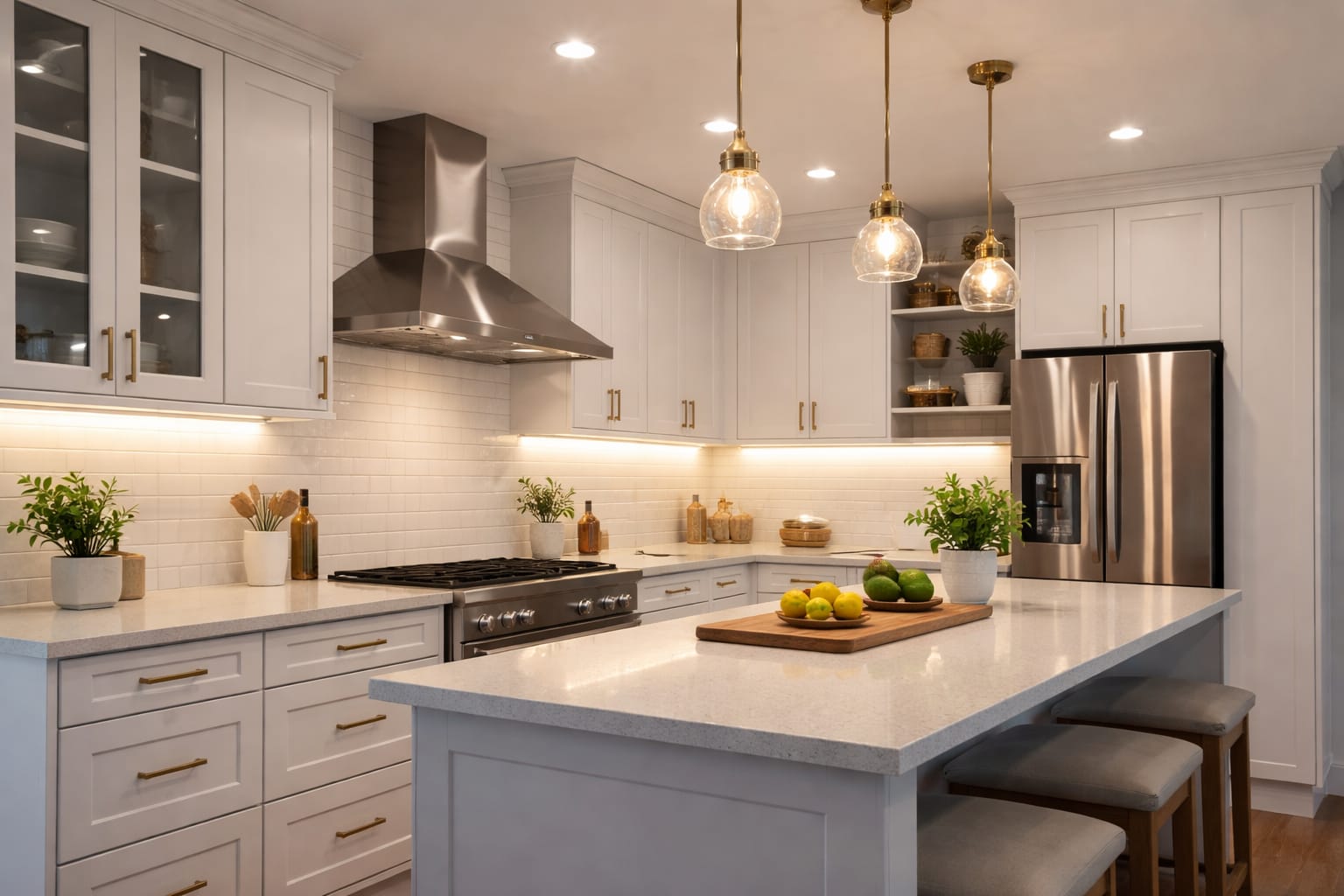
The biggest mistake is trying to get all of that light from one fixture. A layered layout usually feels and works better. Recessed lighting, under-cabinet strips, and island pendants can work together to fill shadows more evenly.
A practical layout often gives most of the brightness to ambient lighting, then adds focused task lighting over counters, sinks, and cooking areas. The exact ratio does not need to be perfect, but the goal is simple: avoid one overly bright area while corners, counters, or prep surfaces remain too dim.
When brightness is spread across multiple sources, the kitchen usually feels clearer and more comfortable. It also reduces the glare and eye fatigue that can happen when one powerful ceiling fixture has to do all the work.
Color Temperature and CRI
Color rendering index, or CRI, measures how accurately a light source displays colors compared with a natural reference. In kitchens, this matters because ingredients should look natural rather than dull, gray, or strangely tinted. For most homes, a CRI of 90 or higher is ideal for primary kitchen lighting, especially in prep zones where freshness and doneness are important.
Color temperature matters too. Many kitchens look best with LEDs between 3000K and 4000K. Warmer options feel softer and more welcoming, while cooler options can make detailed task work feel clearer. In open-plan kitchens connected to a dining or living area, 3000K often feels more comfortable because the lighting has to work for both cooking and eating. If your kitchen flows into a dining or breakfast area, our guide to the best LED lights for dining rooms can help you match pendants, dimming, and warmer light levels so the eating space does not feel washed out by the kitchen lighting.
If cooking is part of your daily routine, choose high-CRI lighting for the main work areas. CRI 90 to 95 can make subtle color differences easier to spot when trimming meat, checking produce, or judging browning.
Fixtures below CRI 80 should usually be avoided for main kitchen zones. Lower-quality light can make colors appear less natural and less vibrant. That may be acceptable in a pantry or utility area, but it is not ideal where most food preparation happens.
Best Under-Cabinet Lighting for Counters
Under-cabinet lighting is one of the most useful kitchen upgrades because it puts light directly where prep happens. Your body often blocks ceiling light when you stand at a counter, sink, or stove, so even a bright kitchen can still have shadowy work surfaces.
LED strips, puck lights, and slim linear bars can all work, but strip lights and linear bars usually provide the smoothest coverage across long prep areas. Puck lights can look attractive, but they may leave bright hotspots unless they are spaced carefully. For longer counters, diffused LED strip lights for kitchen cabinets are usually more even and less distracting than exposed points of light.
Mount fixtures near the front edge of the cabinet underside when possible. This placement reduces shadows from your hands, small appliances, and objects stored at the back of the counter. Diffused fixtures usually look cleaner than exposed light sources and are more comfortable when you are working close to the surface.
Sink areas benefit from direct, focused light that makes dishes, utensils, and small food particles easier to see. But this is also one of the kitchen zones where moisture, steam, and occasional splashes matter more than people realize. If you plan to install LED strips near a sink, dishwasher, or splash-prone counter, check the protection level before buying. Our IP rating guide for LED strips explains what those ratings mean and how to choose a strip that fits the location, not just the brightness you want.
Cooktops also need careful placement. Look for fixtures that can handle the environment around the cooking area and position them so they light the surface clearly without creating reflected glare from stainless steel pots, glossy tiles, or polished counters.
Best Ceiling and Island Lighting Options
Ceiling lighting handles the ambient layer that makes the whole kitchen feel usable. Recessed lights are a common choice because they spread light without taking up visual space. In most kitchens, wider beam angles and sensible spacing are more effective than a few intense spotlight-style fixtures that leave dark gaps.
If recessed cans are not practical, flush-mount and semi-flush fixtures can provide strong general lighting. Models with diffusers tend to be more comfortable than bare LED arrays because they soften the light source and reduce direct glare. If you need a simple overhead fixture for broad ambient lighting, a flush-mount LED kitchen ceiling light can be a practical option for lighting a wide area with one fixture.
Pendant lights can provide both useful light and visual character over islands or peninsulas. A common starting point is hanging them 30 to 36 inches above the counter, although the best height depends on sightlines, ceiling height, fixture size, and whether the island includes seating.
Several smaller pendants often light a long island more evenly than one oversized fixture. According to the ENERGY STAR guide to LED lighting basics, efficient LED lighting can deliver strong light quality and long service life, which is important in hardworking spaces like kitchens.
Dimming, Smart Control and Installation
Dimming makes kitchen lighting much more flexible. Bright light is useful during preparation, cleaning, and cooking, but that same level can feel harsh later in the day. LED-compatible dimmers let you reduce the intensity when the kitchen becomes a space for dining, gathering, or relaxing in the evening.
One of the best ways to improve a kitchen is to separate ambient, task, and accent lighting onto different switches or control zones. This lets you light only the parts of the room you need and avoids the all-or-nothing feel of single-switch kitchens.
Not every dimmer works well with every LED fixture. If the packaging does not clearly indicate compatibility, you may experience flicker, buzzing, uneven dimming, or lights that do not dim low enough.
Smart controls can add scheduling, scenes, and hands-free adjustment through voice assistants. This can be useful when your hands are full or messy, but smart features should not come before the basics: enough brightness, good color quality, and reliable control.
Installation type matters just as much as the fixture style. Hardwired under-cabinet lighting provides the cleanest finished look and allows for wall-switch control, but it usually requires electrical work. Plug-in options are easier for DIY upgrades when outlets are nearby. Rechargeable lights avoid wiring completely, making them useful for rentals or low-commitment projects, although recharging becomes part of the routine.
If you are remodeling a kitchen, plan lighting early while walls, ceilings, and cabinets are still accessible. Adding circuits or rerouting wiring after the room is finished usually costs more and limits your options. For new wiring, ceiling changes, or code-related questions, it is worth considering a qualified electrician.
Retrofit projects often involve incompatible dimmers, awkward fixture spacing, limited access to wiring, or older housings that are not ideal for modern LEDs. In many kitchens, the smartest upgrade is not the most ambitious one, but the one that solves the biggest visibility problem with the least disruption. If you are comparing upgrades across different rooms, the LED Knowledge Center is a useful next step.
Energy Efficiency and Long-Term Value
LEDs use far less electricity than incandescent or halogen lighting. That matters in kitchens because lights are often left on for long periods, especially in open-plan homes where the kitchen is part of daily living space. Over time, efficient fixtures can reduce both power use and replacement frequency.
When comparing kitchen lighting products, look beyond the purchase price. Installation complexity, light quality, lifespan, warranty coverage, dimming compatibility, and color performance all affect the real value. A slightly more expensive fixture may be the better choice if it lasts longer, dims smoothly, and gives better light where you actually work.
This does not mean buying the most expensive option. It means choosing fixtures that match the job. Good task lighting, a high CRI, and reliable dimming often make a bigger difference than paying extra for features you will rarely use.
Which LED Kitchen Lights Should You Choose?
For most kitchens, start with the biggest visibility problem first. If the whole room feels dim, improve the ceiling layer. If the room feels bright but counters are still shadowy, add under-cabinet task lighting. If the kitchen feels too harsh at night, focus on dimming and separate zones.
- For overall room brightness: choose recessed, flush-mount, or semi-flush LED ceiling lights.
- For dark counters: add under-cabinet LED strips, slim linear bars, or carefully spaced puck lights.
- For renters: choose plug-in or rechargeable under-cabinet lights before considering hardwired options.
- For food prep: use high-CRI LEDs in the 3000K to 4000K range.
- For islands: use pendants or linear fixtures that light the surface without blocking views.
- For evening use: choose dimmable fixtures or separate control zones for ceiling, task, and accent lighting.
FAQ
What Type of LED Light Is Best for a Kitchen?
The best type is usually a combination of LED ceiling lights for ambient brightness and under-cabinet lighting for counters. A single fixture can work in a small kitchen, but layered lighting usually gives better visibility and comfort.
Are Under-Cabinet Lights Worth It?
Yes, especially if your counters feel shadowy even when the ceiling light is on. Under-cabinet lighting places light directly on the work surface, making prep, cleaning, and cooking easier.
What Color Temperature Is Best for Kitchen LED Lights?
Most kitchens work well with 3000K to 4000K LEDs. Choose 3000K for a warmer, more comfortable feel, or 3500K to 4000K if you want clearer task visibility on counters and prep areas.
Do Kitchen Lights Need to Be Dimmable?
They do not have to be dimmable, but dimming is highly useful in kitchens that are also used for dining, entertaining, or evening routines. It lets the same room feel bright and practical during prep, then softer and more relaxed later in the day.
Are Rechargeable Under-Cabinet Lights Good for Kitchens?
Rechargeable under-cabinet lights can be a good choice for renters, quick upgrades, or areas where wiring is not practical. For permanent kitchens used heavily every day, plug-in or hardwired lighting is usually more convenient over time.
Key Takeaways
The best LED lights for kitchen spaces are usually part of a layered plan, not a single fixture. Strong ceiling lighting, focused under-cabinet task lighting, and good color quality matter more than simply choosing the brightest product.
In practical terms, most kitchens benefit from high-CRI LEDs, a color temperature between 3000K and 4000K, under-cabinet lighting for counters, and dimmable controls for flexibility throughout the day.
Start with the zone that causes the biggest problem: ceiling brightness, counter shadows, island lighting, or evening glare. Choosing by problem makes it easier to buy fixtures that look good, improve visibility, and keep working well after the upgrade is finished.
Sharing This Guide
Share this guide if you found it helpful. Save it for later or send it to someone planning a kitchen lighting upgrade. It is especially useful for homeowners, renters, and DIY beginners comparing practical LED options.
Share using the links below:
Interested in learning more? Browse all related articles in our category section.