IP Rating for LED Strips: IP65, IP67 or IP68?
Choosing the right IP rating for LED strips comes down to where the strip will be installed. Use IP20 only in dry indoor rooms, IP65 for kitchens, bathrooms and covered patios, IP67 where rain or temporary water pooling is possible, and IP68 only for continuous underwater use.
If you are buying a waterproof LED strip, the goal is not to choose the highest number automatically. The best choice is the rating that matches the real water exposure, connectors, power supply, and installation conditions. If you are still learning the basics of strip lighting, our complete beginner’s guide to LED strip lights covers the core concepts.
Quick Answer
For most LED strip projects, IP20 is enough for dry indoor rooms, IP65 is the best everyday waterproof choice for splashes and covered outdoor areas, IP67 is safer where rain or temporary pooling is possible, and IP68 should be reserved for continuous underwater use.
- Choose IP20 for dry living rooms, bedrooms, offices, shelves and display areas.
- Choose IP65 for kitchens, bathrooms, covered patios and areas exposed to splashes, steam or routine moisture.
- Choose IP67 for exposed outdoor areas where heavy rain, drainage issues or temporary water pooling may happen.
- Choose IP68 for pools, ponds, fountains, aquariums and other continuous underwater installations.
- Do not forget the full system: connectors, controllers, cables and power components need suitable protection too.
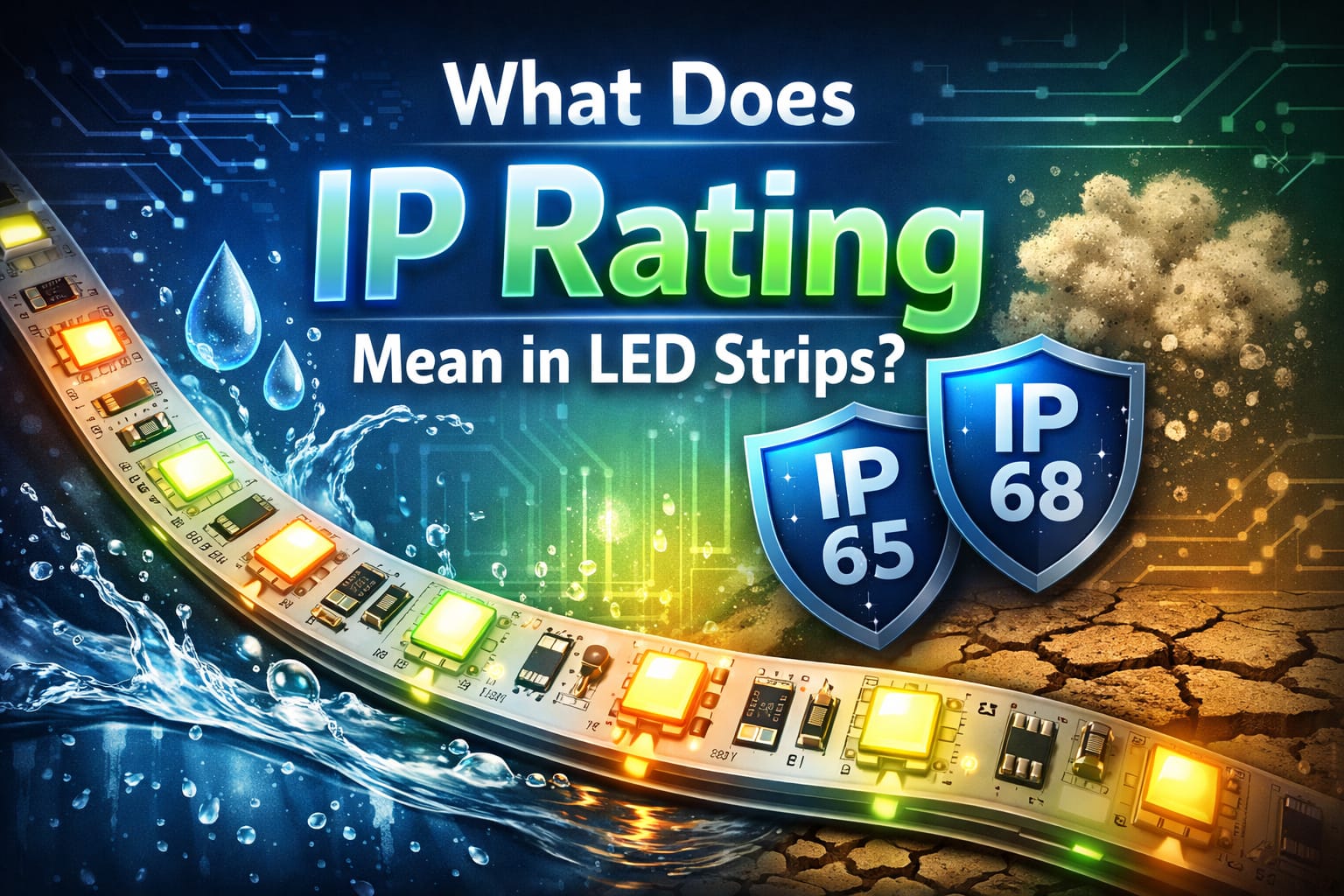
Table of Contents:
What the IP Rating Means
The IP rating for LED strips follows the international IP code system used to describe protection against solid objects and liquids. The first digit measures protection against solids such as dust and debris, while the second digit measures protection against water.
This matters because vague labels like “water-resistant” or “outdoor-friendly” do not tell you enough. A real IP rating helps you compare different strips and choose the right level of protection for a dry bedroom, humid bathroom, covered patio, garden path, fountain or pool area.
The first digit usually matters most in dusty garages, workshops, soffits and exposed outdoor locations. A higher first digit helps reduce dust buildup, which can affect light output, trap heat and shorten the strip’s lifespan. For SMD LED strip installations in challenging spaces, better sealing can make the setup more durable over time.
The second digit usually has the biggest impact on where the strip can be installed safely. IP65 protects against splashes and low-pressure water jets, IP67 protects against temporary immersion, and IP68 is intended for continuous submersion under the limits defined by the manufacturer.
According to the International Electrotechnical Commission standard IEC 60529, IP protection levels are based on defined testing procedures rather than general marketing claims. That is why checking the IP code is one of the most useful steps before buying LED strips for wet, dusty or outdoor areas.
IP20 vs IP65 vs IP67 vs IP68
The easiest way to choose the right waterproof LED strip IP rating is to compare the actual conditions around the strip. A dry shelf does not need the same protection as a bathroom mirror, an exposed deck step or a submerged fountain.
IP20: Best for dry rooms, shelves, bedrooms, offices and display lighting. Avoid it in kitchens, bathrooms, basements, patios, gardens and any area with moisture.
IP65: Best for splashes, steam, cleaning moisture, covered patios, eaves and damp indoor areas. Avoid it in temporary flooding, standing water, and underwater installations.
IP67: Best for heavy rain, low outdoor runs, deck steps, garden edging, and temporary immersion risks. Avoid it for continuous underwater use unless the product is specifically rated for it.
IP68: Best for pools, ponds, fountains, aquariums and water features requiring continuous submersion. Avoid it for simple dry indoor projects where extra sealing adds cost, bulk and heat retention.
IP20 LED Strip: Dry Indoor Use Only
IP20 is the most basic IP rating for LED strips. It provides limited protection against contact with larger objects but offers no water protection. These bare strips are best suited for clean, dry indoor areas such as living rooms, bedrooms, offices, display shelves and decorative ceiling details.
The main advantages of IP20 strips are lower cost, easier cutting and better heat dissipation. Because there is no thick waterproof coating around the strip, heat can escape more easily. That can be useful in stable indoor environments where moisture is not a realistic concern.
IP20 strips are not a safe choice for kitchens, bathrooms, basements, laundry rooms or outdoor areas. Even occasional splashes, condensation or steam can shorten their lifespan or cause immediate failure.
Open electrical components can also be a concern in homes with children or pets. In those cases, upgrading to a more protective strip is often a better choice, even when the room itself is mostly dry.
IP65 LED Strip: Best for Splashes and Covered Outdoor Use
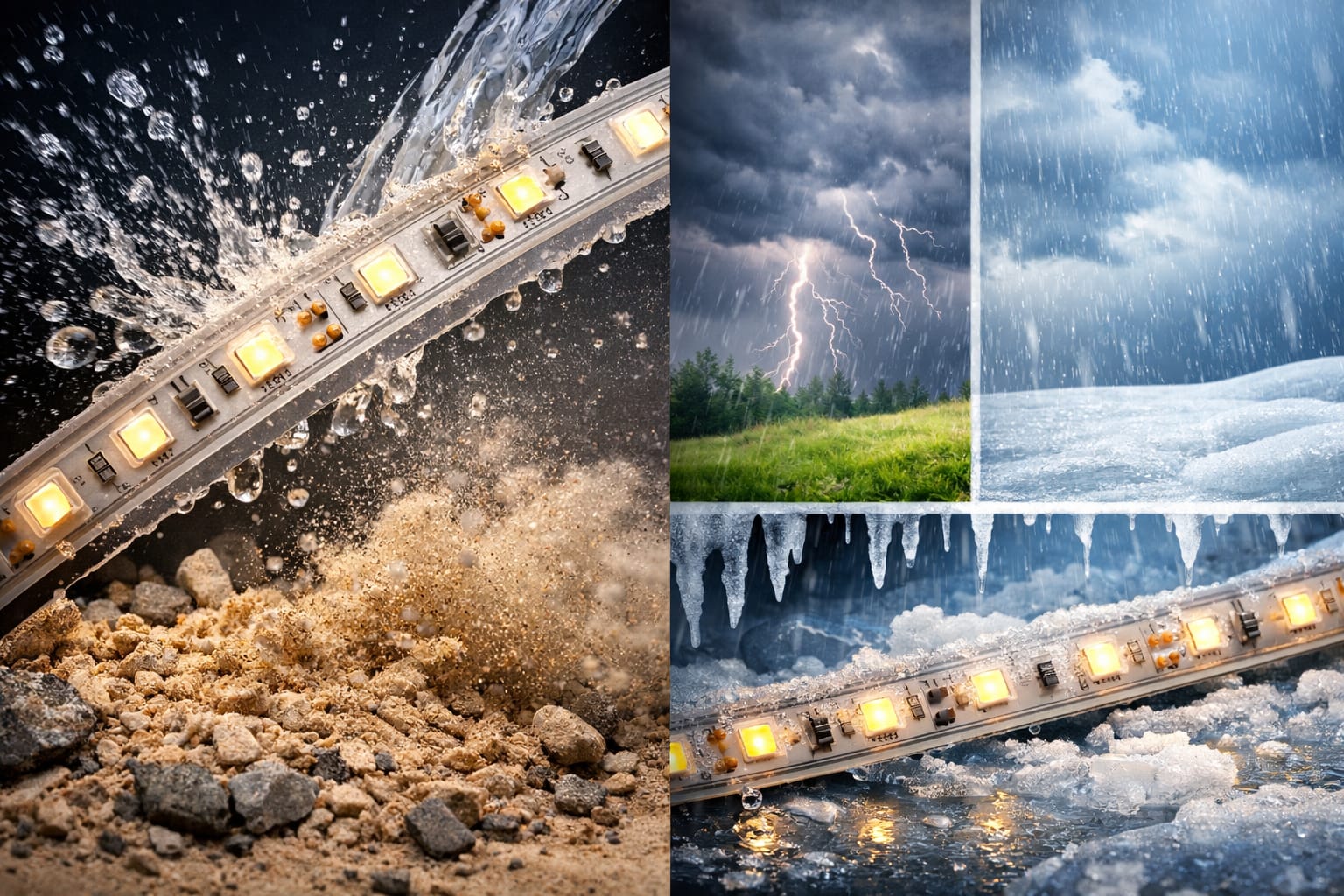
An IP65 LED strip offers full dust protection and resistance to low-pressure water jets from any direction. This makes IP65 one of the most practical choices for residential lighting because it works well where splashes, steam, dust or covered outdoor exposure are possible but full submersion is not.
IP65 is commonly used for kitchen accent lighting, bathroom details, mirror lighting, covered patios, eaves, porches and outdoor decorative lighting that may get wet during bad weather. It is also easier to handle than more heavily sealed versions, so it is often the best balance between protection, flexibility and cost.
For bathrooms, IP65 can make sense around splash-prone zones, but the full lighting plan still matters. If you are pairing strip lighting with overhead fixtures, our guide to the best LED bulbs for bathrooms can help you choose compatible lighting for the same space.
IP67 LED Strip: Best for Rain, Pooling and Temporary Immersion
IP67 means the LED strip can handle temporary immersion in water, commonly up to one meter for a limited time, depending on the product and manufacturer. This level of protection is usually achieved through full encapsulation or sealed tubing around the strip.
IP67 is useful for outdoor installations where heavy rain, standing water, drainage problems or irrigation may occasionally create conditions beyond normal splashing. It is a safer choice for garden edging, deck steps, low-mounted architectural details and exposed outdoor runs. For a broader outdoor selection guide, see our article on waterproof LED strip lights.
If you are deciding between IP65 and IP67 for an exposed outdoor project where flooding, poor drainage or irrigation could create brief standing water, IP67 is usually the safer choice.
The tradeoff is that heavier sealing can trap more heat and make the strip slightly bulkier. That does not make IP67 a bad choice, but it does mean you should follow run-length, mounting and power guidelines carefully.
IP68 LED Strip: Continuous Underwater Use Only
IP68 is the highest commonly available protection level for LED strips used in wet environments. It is designed for continuous submersion, although the exact depth, temperature and operating limits depend on the manufacturer. This is the rating to look for when the strip will remain underwater.
IP68 LED strip products are usually required for swimming pools, fountains, aquariums, ponds and water features. In these settings, the strip has to withstand constant water contact rather than occasional splashes or short-term immersion.
For color-changing lighting in fountains, ponds or other wet installations, a waterproof RGB LED strip for submerged or wet installations can be a better fit, but always check the manufacturer’s depth rating, installation limits and power requirements before using it underwater.
The strip itself is only part of the system. Every connector, cable entry, controller and power component must be protected properly. Even a high-rated IP68 strip can fail if the rest of the installation is not sealed to the same standard.
Installation and Safety Tips
Even the right IP rating for LED strips will not help much if the installation is careless. Cut points, connectors, junctions and cable entries are often the weakest parts of a waterproof lighting system, so the goal is to maintain protection across the entire setup.
When cutting a waterproof LED strip, reseal the exposed end properly. Our guide on how to correctly cut LED strip lights shows where to cut and how to avoid damaging the strip. Once the strip is cut, our guide on how to connect LED strip lights safely can help with connectors, controllers and power leads.
Mounting position also matters. Whenever possible, place the strip where water can run off naturally instead of pooling around it. Even highly protected products usually last longer when they are not exposed to unnecessary moisture, trapped heat or constant UV stress.
For damp or outdoor projects, the strip is only one part of the system. A waterproof LED power supply for outdoor or splash-prone installs helps protect the setup beyond the strip itself, especially when moisture could reach power components.
Before final mounting, test the installation while everything is still accessible. Confirm that the strip powers on correctly, inspect the seals and check that the voltage, run length and power supply match the project. Our LED strip voltage guide explains the difference between 5V, 12V and 24V setups.
Common Mistakes to Avoid
One of the biggest mistakes is assuming a space is drier than it really is. Covered outdoor areas can still get wind-driven rain, bathrooms hold lingering humidity, kitchens deal with steam and splashes, and basements may have condensation even when they look dry.
Another mistake is trusting a product page without checking the actual IP rating, manufacturer limits and installation requirements. Better suppliers usually provide clearer specifications, while very cheap listings may use vague terms that do not explain whether the strip is splash-resistant, weather-resistant or truly suitable for immersion.
It is also possible to overbuy. In a clean, climate-controlled room, an IP68 LED strip is usually unnecessary and may retain more heat than a simpler strip. It can also be harder to cut, bend and install neatly. The goal is not to buy the highest protection level available; the goal is to buy the right protection level for the job.
Maintenance and Longevity Tips
Regular checks help protect LED strips and extend their lifespan. Look for cracks in silicone coatings, loose seals, corrosion near connections, water inside channels and signs of moisture near the power supply or controller. Fixing small issues early is usually much easier than replacing an entire run later.
Cleaning matters too. Use gentle methods that will not damage the protective layer. Mild soap, water and a soft cloth are safer than aggressive cleaners or abrasive scrubbing, which can weaken coatings and seals over time.
Environmental protection is only part of the picture. Correct voltage, sensible run lengths, proper heat management and a reliable power supply all affect lifespan. Even a well-sealed waterproof LED strip can fail early if the electrical setup is overloaded or poorly ventilated.
Which IP Rating Should You Choose?
The best IP rating is the one that matches the actual exposure level of the installation. Choosing a rating that is too low can lead to early failure, replacement costs and safety concerns. Choosing a rating that is too high can add unnecessary cost, bulk and heat retention.
- Dry indoor decoration: IP20 is usually enough if there is no moisture, steam, condensation or cleaning spray.
- Kitchen or bathroom accent lighting: IP65 is usually the better baseline because splashes, steam and cleaning moisture are common.
- Covered patio or porch lighting: IP65 is often suitable if the strip is protected from direct pooling and heavy exposure.
- Exposed outdoor runs: IP67 is safer when rain, irrigation, poor drainage or temporary standing water could occur.
- Pool, pond, fountain or aquarium lighting: IP68 is the correct category, but only if the product is explicitly rated for that exact underwater use.
Before buying, look at humidity, direct water exposure, outdoor weather, nearby sinks, cleaning routines and whether water can collect around the strip. A dry decorative area today could later sit near a humidifier, aquarium or outdoor feature, so borderline installations often benefit from choosing one step above the bare minimum.
For patios, garden edges or outdoor accent lighting where dust and rain are realistic concerns, a sealed outdoor LED strip for rain and dust protection makes more sense than a bare indoor strip.
FAQ
Is IP65 Enough for Outdoor LED Strips?
IP65 can be enough for covered outdoor areas where the strip may face splashes, humidity or occasional rain, but it is not meant for standing water or immersion. For exposed areas with poor drainage or heavy rain, IP67 is usually safer.
Can IP67 LED Strips Be Submerged?
IP67 LED strips are designed for temporary immersion, not continuous underwater use. They may survive brief submersion, but pools, ponds, fountains and aquariums should use products rated for IP68 and approved by the manufacturer for that environment.
Is IP68 Always Better Than IP65?
No. IP68 offers stronger water protection, but it can add cost, thickness and heat retention. For dry rooms or simple splash-prone areas, IP20 or IP65 may be more practical than using a heavily sealed strip.
What IP Rating Is Best for Bathroom LED Strips?
IP65 is usually the practical baseline for bathroom LED strips exposed to steam, cleaning moisture or splashes. The exact choice depends on placement, distance from water sources, and local electrical requirements, so wet zones need extra care.
Key Takeaways
The IP rating tells you how well an LED strip resists dust and water. IP20 is suitable for dry indoor rooms, IP65 is suitable for splashes and covered outdoor use, IP67 is suitable for temporary immersion risks, and IP68 is suitable for continuous underwater installations.
The best way to choose an IP rating is to consider humidity, cleaning methods, weather exposure, nearby sinks, drainage and the likelihood of standing water. It is also important to protect the full system, not just the strip itself.
LED strips are safer, more reliable and less likely to fail early when the protection level matches the real environment. A little planning before buying usually saves money, labor and frustration later.
Sharing This Guide
If you found it helpful, save it for later or share it with a friend. It is especially useful for beginners, homeowners and DIY users choosing LED strips for indoor, outdoor or waterproof projects.
Share using the links below.
Interested in learning more? Browse all related articles in our category section.