The Best LED Lights for Bathrooms: Vanity, Ceiling, and Shower LEDs
The best LED lights for bathrooms do more than just brighten the room. They must be able to handle moisture safely, provide flattering light near the mirror, and be comfortable enough for everyday use, whether you are getting ready in the morning or winding down at night.
This guide breaks down the key choices for bathroom lighting, including IP ratings, color temperature, vanity lighting options, ceiling fixtures, shower-safe products, and small installation details that make a big difference over time.
Quick Answer
For most bathrooms, the best setup combines a damp- or wet-rated ceiling light, strong mirror lighting with a high CRI, and the appropriate IP rating for areas near water. In practical terms, this usually means 3000K to 4000K lighting, CRI 90+ lighting, and higher protection levels for shower zones and other areas with high moisture.
- Use damp- or wet-rated LED fixtures in the bathroom, not standard dry-room fittings.
- Choose 3000K to 4000K lighting for a clean yet comfortable bathroom.
- Prioritize CRI 90+ lighting around mirrors for grooming and applying makeup.
- Use stronger, moisture-resistant lighting near showers, bathtubs, and splash zones.
- Think in layers: vanity lighting, ceiling lighting, and optional accent lighting.

Table of Contents:
- Quick Answer
- What Matters Most in Bathroom Lighting
- IP Ratings and Wet Zones
- Best Color Temperature and CRI
- Vanity and Mirror Lighting
- Ceiling and Shower Lighting
- Ambient Lighting and Controls
- Installation and Compatibility
- Longevity, Maintenance, and Finish Durability
- Common Bathroom Lighting Mistakes
- What Should You Choose?
- Key Takeaways
- Sharing this Guide
What Matters Most in Bathroom Lighting
Bathrooms require lighting that is practical above all else and decorative secondarily. Unlike living rooms or bedrooms, bathrooms demand more from every fixture. You need enough brightness for tasks like shaving, applying makeup, and cleaning. However, you also need lights that can tolerate humidity, steam, and the occasional splash without becoming a maintenance problem later on.
For this reason, the best LED lights for bathrooms are usually part of a layered setup rather than a single fixture. Good bathroom lighting often combines mirror lighting and ceiling lighting. In larger spaces, it also incorporates some softer ambient or accent lighting. If you want a useful baseline before comparing fixture styles, our LED lighting buying guide covers the main specifications worth checking on any product page.
The most important factors to consider when buying are moisture protection, color temperature, CRI, fixture placement, and compatibility with your existing wiring or switches. Once those are right, design choices become much easier.
IP Ratings and Wet Zones
IP ratings indicate how well a fixture resists dust and water. In a bathroom, the second number is most important because it indicates liquid protection. For general splash-prone areas in many typical bathroom setups, IP44 is a reasonable starting point, while locations much closer to direct water exposure often call for IP65 or higher. The exact requirement depends on the fixture’s location, its rating, and local electrical codes.
Many people buy the wrong fixture here. A light that works perfectly in a bedroom or hallway may not hold up well in a bathroom if it is not designed for damp conditions. Good bathroom LED fixtures are built with better seals, more suitable materials, and housings designed to withstand steam and moisture over time.
For fixtures mounted very close to showers, bathtubs, or other wet areas, it is safer to opt for wet-location products instead of basic indoor fittings. Moisture-resistant lighting is about more than just surviving one splash. It’s about withstanding years of daily humidity and temperature changes.
Always check local codes and fixture ratings before installing a light near a shower or tub. A fixture that is safe for bathrooms in one part of the room may not be suitable for a direct wet zone.
Best Color Temperature and CRI
For most bathrooms, the sweet spot is 3000K to 4000K. A warmer light, around 3000K, feels more comfortable and spa-like. A cooler light, around 3500K to 4000K, gives a cleaner, brighter look that many people prefer around mirrors. Either can work well, but very warm lighting may be too dim for grooming tasks, and very cool lighting may make the room feel too clinical.
CRI matters just as much. Prioritize a CRI of 90 or higher in vanity lighting options because skin tones, makeup colors, hair color, and clothing all appear more accurate. Lower CRI fixtures can make the bathroom look dull or unflattering, even when the brightness seems fine. If color quality is important to you, this is one of the easiest ways to notice the difference between cheaper and higher-quality products.
If you want an all-in-one upgrade near the sink, this LED bathroom mirror with an anti-fog feature is a good example of a product that combines lighting and practical, daily-use features in one unit. For a broader explanation of how light color changes the mood of a room, check out our guide on color temperature and room comfort.
For general performance guidance, the U.S. Department of Energy’s LED lighting guidance is a useful reference for understanding how modern LEDs deliver efficiency and strong color quality.
Vanity and Mirror Lighting
Mirror lighting is the most important aspect of a bathroom because it is used for the most demanding tasks. Effective vanity lighting should reduce facial shadows, maintain accurate color, and make close-up tasks feel easy instead of frustrating. Side-mounted lights, lighted mirrors, and well-placed linear fixtures typically work better than a single harsh light directly overhead.
When light comes only from above, shadows form under the eyes, nose, and chin. This makes applying makeup, shaving, and general grooming more difficult than necessary. LED bathroom fixtures placed on the sides of the mirror or integrated into the mirror itself usually provide a much more even lighting result.
If you have a fixture with standard sockets and want an easy upgrade, consider these LED vanity light bulbs for bright, high-CRI performance without replacing the whole fixture. If you are choosing bulbs for the rest of the room, our guide to the best LED bulbs for bathrooms covers bathroom lighting in more detail.
If you have to choose where to spend more, spend it on the mirror. People notice poor vanity lighting much faster than they notice a basic ceiling fixture.
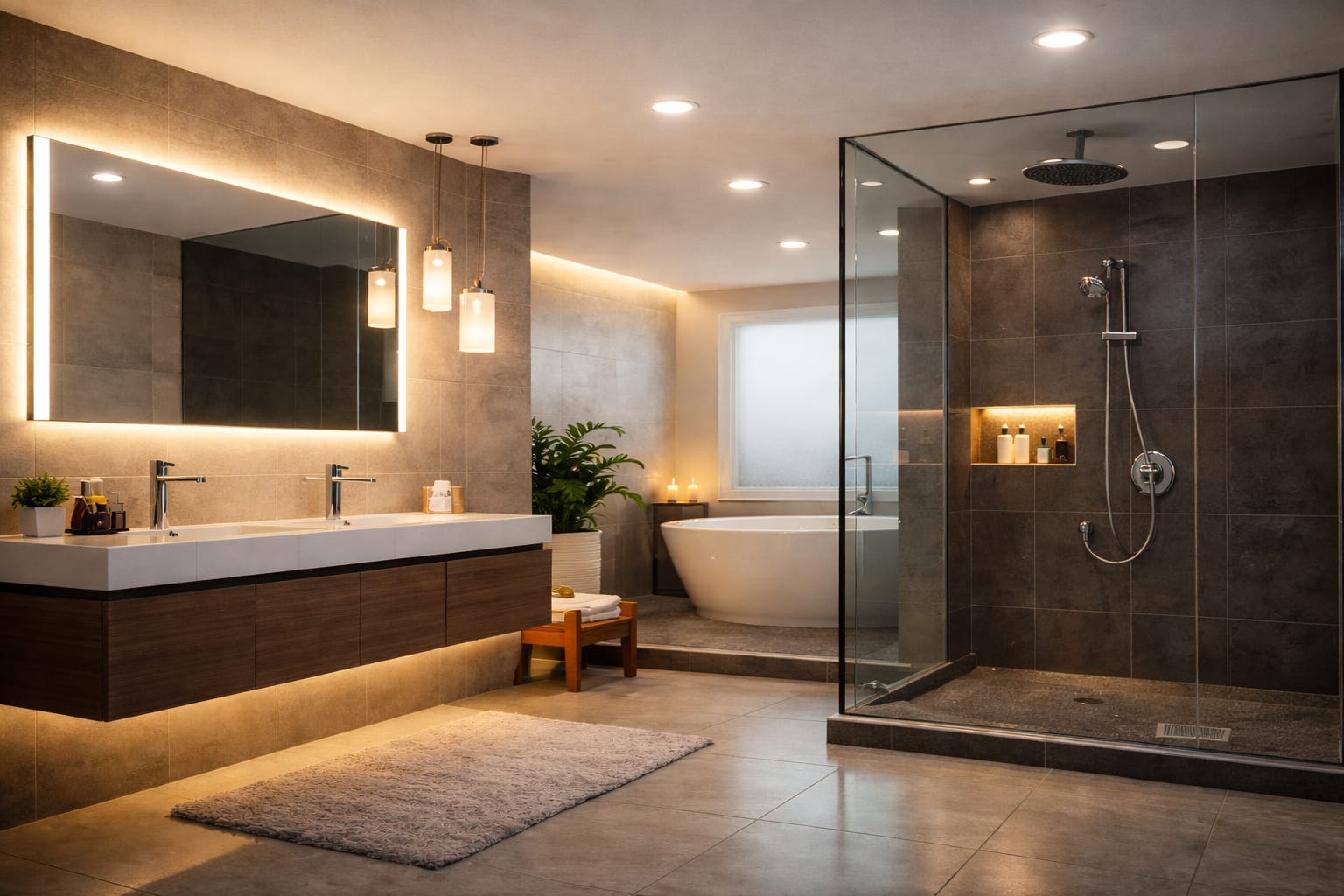
Ceiling and Shower Lighting
Ceiling lighting provides overall visibility and makes the bathroom feel clean, open, and easy to use. Recessed downlights are a popular choice because they are visually appealing and evenly distribute light without taking up space. In many bathrooms, a few well-placed recessed fixtures are more effective than one central ceiling fixture.
Shower areas are more demanding. Fixtures inside or directly above a shower need stronger protection against moisture and should be designated as wet-location products where appropriate. If you are upgrading an existing ceiling setup, these LED recessed ceiling lights are a popular damp-rated retrofit option among homeowners who want a cleaner look without a full redesign.
It is also worth considering placement, not just the rating. Even a wet-rated shower light can feel unpleasant if it creates a harsh spotlight effect. Bathrooms usually look and feel better when ceiling lights complement the mirror instead of overpowering it. The balance of brightness is just as important as the brightness itself.
Ambient Lighting and Controls
Bathrooms benefit from layered lighting more than many people realize. Mirror lighting is ideal for close-up tasks, while ceiling lighting illuminates the entire room. Softer accent or indirect lighting can create a calming atmosphere in the evening. In larger bathrooms, this layered approach makes the room feel more finished and flexible throughout the day.
Dimming the lights makes a big difference. While a bright bathroom can feel great in the morning, it can feel far too intense at night. Dimmable LED fixtures or bulbs allow you to transition from energizing task lighting to softer ambient light without replacing fixtures. If you want your bathroom to feel more comfortable at night, dimming often helps more than switching to a warmer bulb.
Motion-triggered, low-level lighting is also useful for nighttime visits, especially in larger family bathrooms. The key is to make the room adaptable instead of locking it into one brightness level all day.
Installation and Compatibility
Even the best bathroom fixture can be disappointing if it is installed in the wrong location or paired with incompatible hardware. Some products are designed for damp locations, but not for direct water spray. Others are technically dimmable, yet perform poorly with older dimmer switches. This is one of the main reasons bathroom lighting projects go wrong, even when the products themselves are decent.
This is also why retrofits require careful consideration. Screw-in bulbs are the easiest upgrade; however, integrated mirror lights often require more planning, and recessed lights need the right housing, trim, and rating. If a wet-area fixture fails right after installation, our guide to LED lights not working after installation covers several common causes.
If your bathroom project overlaps with those in other high-demand rooms, our guide to the best LED lights for kitchens is also useful, as kitchens and bathrooms share concerns about moisture, visibility, and task-focused lighting.
Longevity, Maintenance, and Finish Durability
LEDs are ideal for bathrooms because they are energy-efficient, produce less heat than older technologies, and have a long lifespan when properly rated for the environment. However, moisture can still damage fixtures over time. Gaskets, coatings, end seals, and exposed hardware are important, especially in bathrooms with daily showers and limited ventilation.
Finish durability is important, too. Even if a fixture performs well electrically, it can still look poor after a few years if the finish corrodes, discolors, or wears unevenly. In humid rooms, it is worth paying for better finishes and more corrosion-resistant materials, especially for visible fittings around mirrors or above sinks.
In most bathrooms, maintenance is simple and includes occasional cleaning, checking for loose seals, and paying attention to any early signs of moisture damage. Good, moisture-resistant lighting shouldn’t require much maintenance, but the bathroom environment is demanding enough that cutting corners tends to become apparent earlier here than in drier rooms.
For more technical background and broader LED guidance, the NeoLEDHub LED Knowledge Center is a good resource once you have narrowed down your fixture style.
Common Bathroom Lighting Mistakes
The biggest mistake is relying on one overhead light and expecting it to illuminate the entire room. This usually leaves the mirror underlit, creating shadows that make grooming difficult. Bathrooms work better when mirror lighting is prioritized instead of being an afterthought.
Another common mistake is choosing fixtures based solely on appearance. A stylish, dry-rated fixture may still be the wrong choice if it is placed near a shower or in a consistently humid area of the room. The best LED lights for bathrooms balance appearance, moisture safety, and real, everyday use.
The last mistake is ignoring color quality. Even if a bathroom is bright, it can still feel wrong if the CRI is poor or the light color is too cold. In a room where people examine their skin tone, makeup, and shaving lines up close, this matters much more than many shoppers expect.
What should you choose?
For most bathrooms, the best approach is a layered setup with a good vanity light, a damp- or wet-rated ceiling fixture, and stronger protection near the shower. Beyond that, the right choice depends on the room’s size and how you use it.
- If your priority is grooming accuracy, choose mirror lighting with a CRI of 90 or higher.
- If you want balanced, everyday lighting, choose lighting in the 3,000-4,000K range.
- If your fixture is near direct water, choose products with a higher IP rating and that are wet-rated.
- If you want a cleaner, more modern look, choose recessed ceiling lights and integrated mirror lighting.
- If comfort matters in the evening, add dimming or a softer accent layer.
Key Takeaways
The best LED lights for bathrooms combine safe moisture protection, strong mirror lighting, and a color temperature that feels clean without becoming harsh. In most homes, this means choosing rated fixtures, prioritizing vanity lighting, and using layered lighting instead of depending on one light source.
Mirror lighting is the most practical, while ceiling lighting provides general visibility, and shower lighting requires stronger protection where water is more direct. CRI, IP rating, and fixture placement usually matter more than decorative styling alone.
For the safest general recommendation, start with a CRI 90+ mirror setup, a damp-rated ceiling fixture, and higher protection near the shower. This combination will give you a bathroom that is more enjoyable to use and will hold up better over time.
Share this Guide!
Share this guide if it helped you choose the right bathroom lighting. Save it for later or share it with someone planning a renovation or fixture upgrade.
Share using the links below:
Interested in learning more? Browse all related articles in our category section.
Pingback: Best LED Lights for Hallways: Smart Choices 2026 - NeoLEDHub
Pingback: Bedroom Lighting Design: Essential Expert Guide - NeoLEDHub
Pingback: Best LED Bulbs for Bathroom Lighting - NeoLEDHub
Pingback: Best LED Lights for Kitchen: Top Picks - NeoLEDHub
Pingback: Best LED Lights for Home Offices: Essential Guide
Pingback: Best LED Lights for Dining Rooms (Top Picks) - NeoLEDHub
Pingback: Best LED Bulbs for Bathroom (Bright & Fog Free) - NeoLEDHub
Pingback: Best LED Lights for Home Offices: Essential Guide
Pingback: Best LED Lights for Dining Rooms: Warm & Dimmable Picks
Pingback: Bathroom Vanity Light Height Guide: Best Placement Tips
Pingback: Color Temperature Explained: Warm vs Cool Light by Room