The Best LED Lighting for Small Rooms: Space-Saving Fixture Tips
The best LED lighting for small rooms serves two purposes: it makes the space feel bright enough to comfortably live in, and it makes the room look bigger instead of cramped. This typically involves selecting compact fixtures, implementing a smart layered setup, and positioning lights to expand the room rather than creating harsh bright spots.
It’s easy to light a small room the wrong way. One bulky fixture, the wrong bulb color, or too much glare can make a tight space feel even tighter. This guide focuses on fixture types, placement ideas, and LED choices that work best when every inch matters.
Table of Contents:
- Why Small Rooms Need a Different Lighting Plan
- Best Fixture Types for Small Rooms
- How Bright a Small Room Should Be
- How to Layer Light Without Clutter
- Best Color Temperature for Small Spaces
- Placement Tips That Make a Room Feel Bigger
- Room-by-Room Ideas
- Smart Space-Saving Upgrades
- Common Mistakes
- Final Takeaway
- Sharing This Guide
Quick Answer: The best LED lighting for small rooms usually comes from a low-profile ceiling light, one or two focused task lights, and a warm-to-neutral LED bulb that keeps the room bright without making it feel harsh.
Why Small Rooms Need a Different Lighting Plan
A small room reacts faster to lighting mistakes than a large one. In a big room, one overly bright bulb or one bulky lamp may not dominate the whole space. In a small room, it usually does. That is why LED lighting for small rooms needs a little more precision.
The main goal is not just brightness. It’s about visual balance. You want enough light for comfort and functionality, but you also want the room to feel open, calm, and usable. The wrong fixture can make the ceiling feel lower, crowd surfaces, and create glare that makes the room feel smaller than it really is.
This is where smart layered lighting design matters more than raw output alone. If you want to start with the general framework, our LED lighting buying guide is a helpful resource for choosing specific fixtures.
The Best Fixture Types for Small Rooms
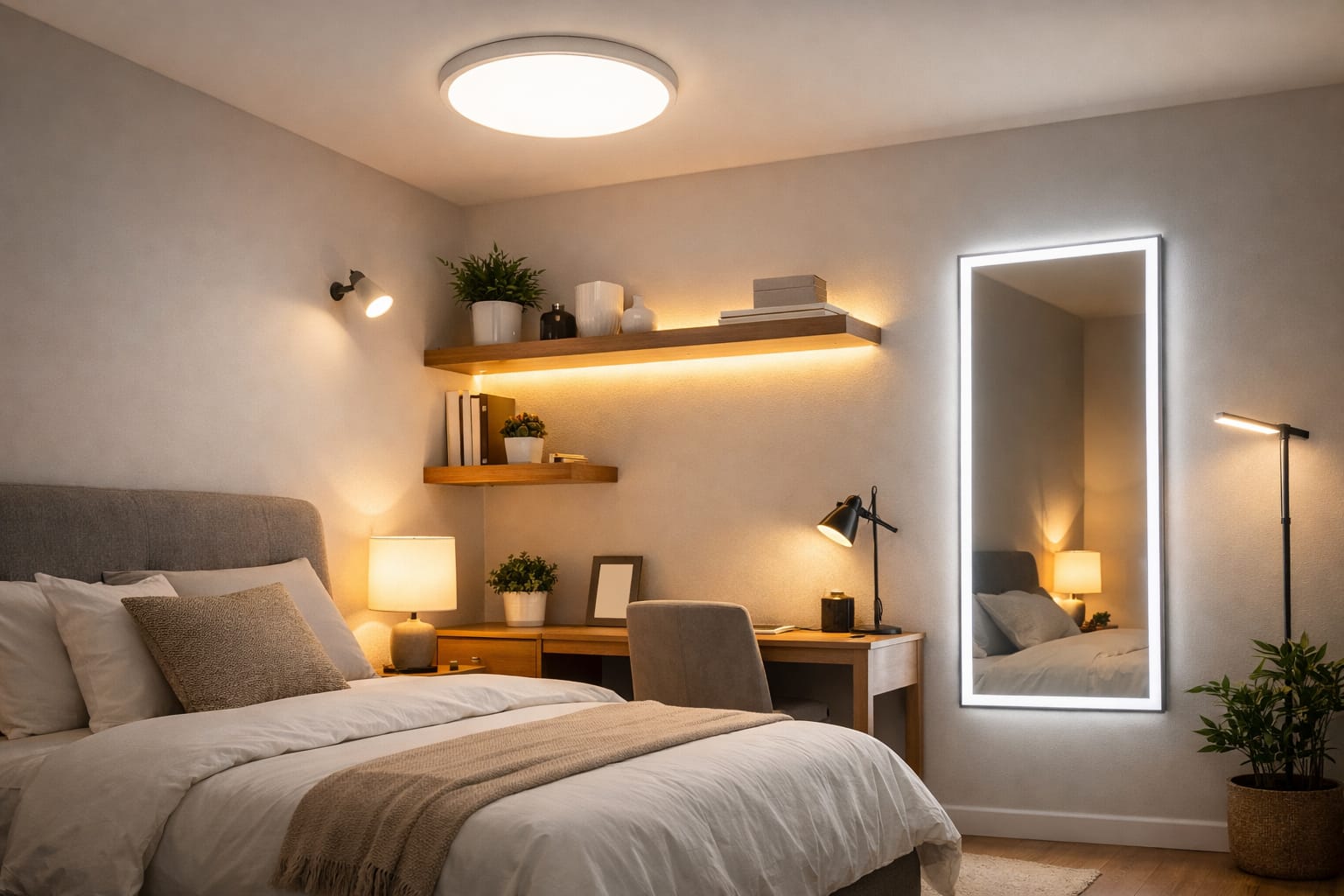
The best fixture for a small room is one that provides useful light without dominating the visual space. Flush-mount ceiling lights, ultra-slim panels, small recessed lights, wall sconces, and compact table or floor lamps are better choices than oversized chandeliers or heavy, decorative fixtures.
If the ceiling is low, low-profile fixtures are the best choice. They make the room feel cleaner and reduce the visual weight overhead. If the room needs to accommodate different moods, a dimmable flush-mount or slim smart ceiling light is often more effective than a larger decorative piece.
This slim smart ceiling light is an excellent choice for a simple ceiling upgrade that suits tight spaces. It works well when one main light needs to handle both everyday brightness and softer evening use.
Wall-mounted options are even better when surface space is limited. They free up nightstands and desks, which is often more valuable in a small room than adding another floor or table lamp.
Low-profile options work best most often
If you are not sure where to start, start with a low profile. A slim flush mount, canless recessed light, or minimal wall sconce is rarely a mistake in a compact room. These fixtures deliver light without adding bulk, making them especially useful in bedrooms, studios, small home offices, and guest rooms.
The same logic applies to tighter spaces like hallways and rooms with low ceilings. Our guides on lighting for low ceilings and lighting for narrow hallways support this point.
How Bright Should a Small Room Be?
A small room doesn’t require extreme brightness, but it does need sufficient light in the right places. As a rough guide, general ambient lighting is usually around 20 to 30 lumens per square foot and is supplemented by task lights as needed. This provides most small bedrooms, offices, and sitting rooms with a comfortable base lighting level without making them feel washed out.
The bigger issue is usually not under-lighting the entire room. It’s poor distribution. One bright ceiling bulb can technically meet the total brightness target while leaving corners dull and making the room feel flat. Good compact space lighting is about spreading brightness more intelligently, not just increasing it.
If you need stronger lighting without sacrificing efficiency, check out our guide to high-lumen LED bulbs.
Task Lighting Still Matters in Small Rooms
Even in small rooms, task lighting is important. If the space is used for activities such as reading, working, applying makeup, pursuing hobbies, or studying, ambient light alone is rarely sufficient. This is why good LED lighting for small rooms almost always includes at least one focused light source in addition to the main ceiling fixture.
A clip-on reading light, slim desk lamp, or wall-mounted swing-arm lamp often works better than brightening the whole room. This approach is more efficient, comfortable, and visually cleaner.
How to Layer Light Without Clutter
One of the fastest ways to make a small room feel better is with a strong layered lighting design. The trick is to keep the layers efficient instead of filling the room with too many fixtures. In most cases, you only need to cover three lighting areas: ambient, task, and accent.
Ambient lighting provides the room with overall visibility. Task lighting handles specific activities, such as reading or working. Accent lighting adds depth, softness, and mood. In a small room, accent lighting could be as simple as an LED strip placed behind a headboard, shelf, or desk. It doesn’t have to be a big decorative installation.
This is where ambient, task, and accent lighting become especially powerful. Rather than making one fixture do too much, each layer is used to do one job well. This usually makes the room feel more flexible and spacious.
Your article on ambient vs task vs accent lighting is the perfect supporting internal link here.
In a small room, three well-placed light sources usually outperform a larger collection of random fixtures. A main light, one task light, and one subtle accent light are often enough.
Use fewer fixtures, but use them better
In a small room, the quality and placement of light sources matter more than the number of fixtures. Three well-placed light sources are more effective than six random ones. A ceiling light, a task light, and a hidden or indirect accent light can make a room feel functional, comfortable, and bigger than it is.
Hidden LED strips are especially useful for this purpose because they provide light without adding visible bulk. This makes them one of the smartest tools for lighting compact spaces.
Best Color Temperature for Small Spaces
Color temperature affects how a small room feels almost as much as brightness. Warm white light, ranging from 2700 to 3000 Kelvin, usually feels best in bedrooms and living spaces because it makes the room feel comfortable and inviting. Neutral white works well in multipurpose rooms or home offices. A cooler light can make a room feel sharper or more open, but it may also feel sterile if it is too cool.
The best option usually depends on how the room is used. This is why tunable fixtures and smart bulbs work so well in small spaces. They allow a room to shift from work mode to evening mode without requiring a completely different setup.
High CRI matters, too. Good color rendering can make a room feel brighter and more natural without overwhelming you with overly strong light. According to the U.S. Department of Energy’s LED lighting guidance, light quality affects overall performance, not just brightness.
If work zones are part of the room, the home office lighting guide is relevant for color temperature decisions.
Placement Tips That Make a Room Feel Bigger
Placement changes perceived size. In small rooms, light that reaches the walls and ceiling usually makes the room feel larger than light aimed only downward. Wall-mounted sconces, upward-facing lamps, and indirect LED strips can all make a room feel bigger.
Mirrors also matter. They do not replace good lighting, but they can extend it. Placing a mirror opposite a window or near a lamp helps bounce light back into the room. This is one of the simplest ways to improve lighting in a small space without adding another major fixture.
Wall-mounted lights are especially useful because they free up space on desks, dressers, and bedside tables. A slim sconce or swing-arm lamp can serve as an alternative to a table lamp while saving valuable surface space. For this reason, wall lighting often outperforms table lighting in smaller rooms.
If you’re looking for a space-saving wall-mounted option for tight layouts, this slim LED wall sconce is the perfect solution. It provides light without extra bulk.
If you experience problems with harsh reflections, check out our glare reduction guide.
Room-by-Room Ideas
In a small bedroom, a flush-mount ceiling light and bedside sconces or a compact reading lamp are often sufficient. In a small home office, the ideal setup is typically an overhead light and a focused task lamp to reduce eye strain during screen or desk work. In studios or multifunction rooms, smart dimming is especially useful because the same space may need to be bright during the day and softer at night.
If the room is mostly for relaxation, warmer bulbs and softer lighting are preferable. If the room is mostly for productivity, you may prefer more neutral light and stronger task lighting. If it is a hybrid room, tunable light is often worth the upgrade.
For more room-specific ideas, the best follow-ups here are the best LED bulbs for bedrooms, a bedroom lighting design guide, and the best LED lights for home offices.
Smart Space-Saving Upgrades
Some of the best upgrades for small rooms reduce clutter while increasing flexibility. Smart bulbs, LED strips, wall sconces, lighted mirrors, and furniture-integrated lighting are all helpful because they serve multiple purposes without crowding the room.
For instance, a shelf with hidden LED strip lighting can serve as storage and provide ambient light. A backlit mirror can provide task lighting and make the room feel bigger. A single smart bulb can transform a standard ceiling fixture into a flexible lighting system by adjusting the brightness and color temperature throughout the day.
These smart LED strip lights are an ideal solution for concealed ambient light in tight spaces because they can be placed behind furniture, under shelving, or around bed frames without visually crowding the room.
This type of upgrade is useful for improving LED lighting in small rooms without adding another visible lamp.
Common Mistakes
The most common mistake is using a light fixture that is too large for the room. The second mistake is relying on one ceiling light for all the lighting needs of a space. The third mistake is choosing bulbs that are too harsh or cool for a space intended to be comfortable. All three mistakes can make a small room feel worse, even if the bulb is technically bright enough.
Another common mistake is ignoring dimming. In small spaces, flexible brightness matters more because one room often serves multiple purposes. Without dimming, it’s often necessary to compromise between lighting that is good for work and lighting that feels comfortable at night.
Mixed color temperatures can also make a small room feel disorganized. When one bulb is warm and another is cool, the room quickly loses cohesion. Matching bulbs or using a coordinated smart setup usually solves this problem quickly.
Be careful not to make a small room feel bigger by installing the brightest, coolest bulb you can find. This usually increases glare and makes the space feel tense instead of open.
In short, good LED lighting for small rooms is about restraint, consistency, and smarter placement rather than buying the brightest product available.
Final Takeaway
The best LED lighting for small rooms is simple: one low-profile main fixture, one focused task light, and one subtle accent or indirect light source. This combination provides better brightness and flexibility and makes the room feel bigger and more comfortable without looking crowded.
The smartest results come from choosing compact fixtures, using proper layered lighting design, and paying attention to color temperature, glare, and placement. When done well, even a tight room can feel brighter, calmer, and more useful without a complicated setup.
For broader support beyond this article, the LED Knowledge Center is the best overall resource.
Share This Guide!
Share this guide if you found it helpful. Save it for later or share it with a friend who is trying to make a small room feel brighter without adding visual clutter.
Share using the links below:
Interested in learning more? Browse all related articles in our category section.
Pingback: Best Energy Saving Lighting for Apartments: Smart Renter-Friendly Ideas - NeoLEDHub