Home Lighting Guide: How to Light Every Room in Your House
Good home lighting does more than illuminate a room. It shapes how a space feels, how well you can work or relax in it, and how the colors and furniture around you actually appear. Yet most people only think about lighting when a bulb burns out or a new room feels wrong. This guide changes that.
Whether you are furnishing a new home, rethinking a single room, or just trying to understand why your lighting never looks quite right, this guide covers the full picture — from room-by-room recommendations to layout, design principles, and the most common mistakes people make when lighting their homes.
Quick Answer
Effective home lighting comes down to matching the light to how each room is actually used. Different spaces need different brightness levels, color temperatures, and fixture types. A one-size-fits-all approach rarely works well anywhere in the house.
- Start with the room’s purpose, then choose brightness and color temperature to match.
- Layer ambient, task, and accent lighting rather than relying on a single overhead fixture.
- Account for ceiling height, wall color, and natural light before buying anything.
- Rooms with special conditions — no windows, low ceilings, dark walls — need a tailored approach.
- Outdoor and utility spaces have their own requirements, including weather resistance and adequate lumen output.
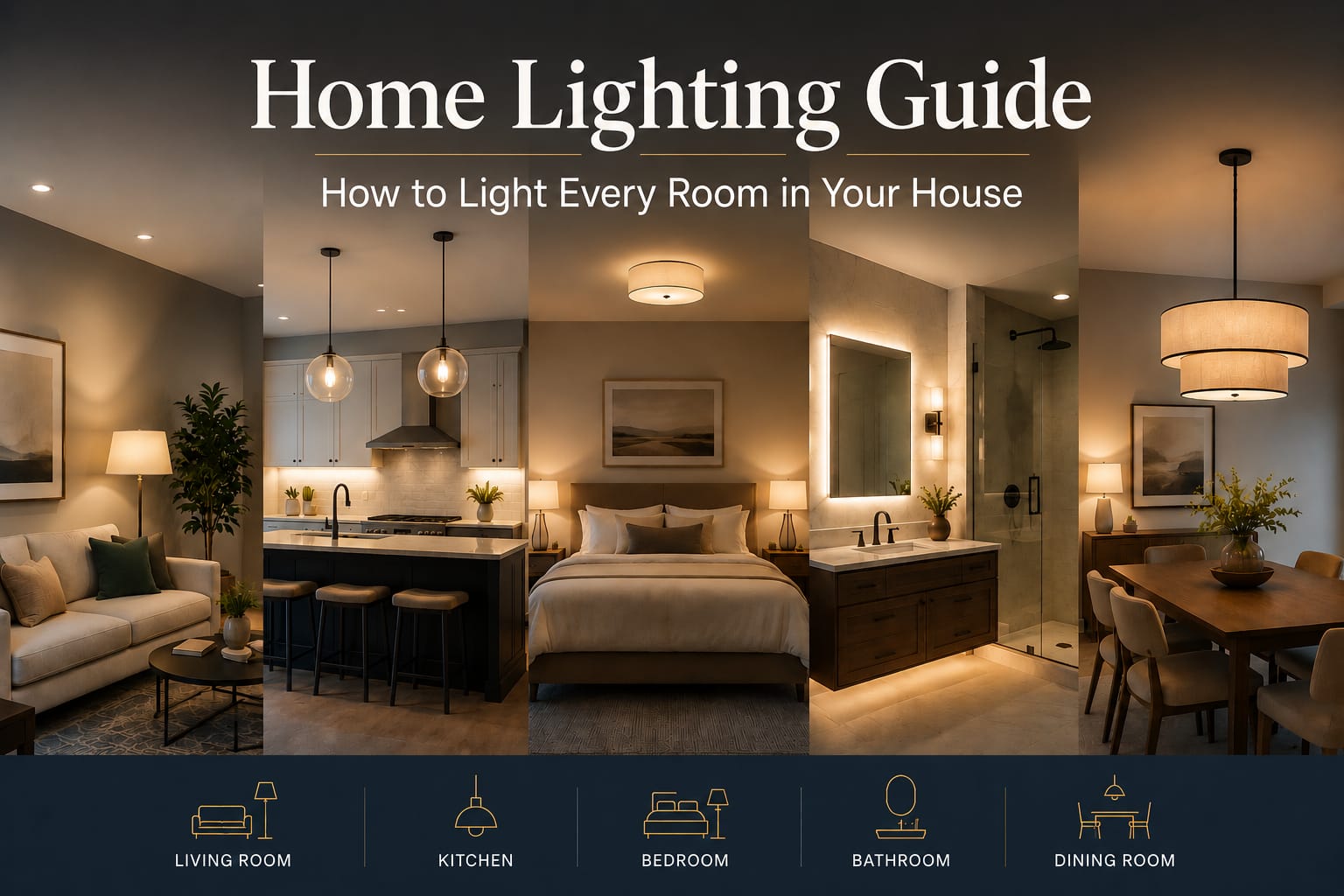
Room-by-Room Lighting Recommendations
No two rooms in a home have the same lighting needs. The bedroom calls for warm, low-stimulation light that helps you wind down. The kitchen needs clear, accurate light for safe food preparation. The bathroom requires a combination of general illumination and flattering task light at the vanity. Getting each room right means thinking about how it is used, at what time of day, and by whom.
Bedrooms
Bedrooms benefit from warm, dimmable lighting that supports relaxation and sleep. A central ceiling fixture rarely works well on its own — bedside lamps, wall sconces, and subtle accent strips give you more control over the mood. Our guide to the best LED lights for bedroom covers which bulb types and fixtures work best for different bedroom sizes and layouts. For more detail on how to design the overall look and feel, the bedroom lighting design guide walks through layering, placement, and color temperature choices in depth.
Living Rooms
The living room is one of the most demanding spaces to light well because it serves multiple functions — relaxing, entertaining, watching television, and sometimes working. Layering is especially important here. Start with a soft ambient base, add task lighting near reading chairs or sofas, and use accent lighting to highlight architectural features or artwork. The living room LED lights guide covers this layered approach in full, including how to balance light from different sources without creating glare or dark spots.
Kitchen
Kitchen lighting needs to be functional first. Task lighting over countertops and work surfaces is non-negotiable, and under-cabinet strips are one of the most effective ways to achieve it without relying entirely on overhead fixtures. Color temperature matters more in kitchens than almost anywhere else — light that is too warm makes food colors harder to judge, while light that is too cold feels clinical. The best LED lights for kitchen guide focuses on this balance and recommends products that perform well across different kitchen configurations.
Bathrooms
Bathroom lighting often frustrates people because a single overhead fixture creates shadows on the face, which is the opposite of what you need at a vanity mirror. Side lighting or strip lighting around the mirror solves this far more effectively. Vanity light height also matters more than most buyers expect — a common mistake is mounting the fixture too high. Our guide to best LED lights for bathrooms addresses these issues directly, and the bathroom vanity light height guide gives practical measurements for getting the placement right.
Dining Rooms
Dining rooms call for warm, focused light over the table with enough ambient fill to keep the rest of the room from feeling cave-like. A pendant or chandelier centered above the dining table is the natural anchor, but the light it provides often needs to be complemented by wall sconces or a dimmer to give the space flexibility. The best LED lights for dining rooms guide focuses on fixtures that flatter both food and people, with recommendations for different ceiling heights and table sizes.
Home Offices
A home office needs light that supports focus and reduces screen glare without causing eye fatigue over long periods. Cooler color temperatures, typically between 4000K and 5000K, generally support alertness better than warm tones, though the right choice depends on your work and how much natural light the room receives. The best LED lights for home offices guide identifies which products do this well, with particular attention to CRI, flicker-free operation, and how to position fixtures to minimize shadows on your workspace.
Hallways and Staircases
Hallways are often underlit as an afterthought, but they affect how a home feels from the moment you walk in. Narrow hallways in particular need careful attention to avoid a cramped, tunnel-like feel — the right fixtures can make a significant difference. Our guide on lighting for narrow hallways covers which fixture types and placement strategies work best. For staircase lighting specifically, the best LED lights for hallways and lighting design for staircases guides address both safety and style.
Garages and Basements
Utility spaces need high output, shadow-free illumination rather than atmosphere. LED shop lights and strip-mounted panels are the most practical choice for garages, while basements often benefit from a combination of overhead fixtures and perimeter lighting to compensate for the absence of windows. Both spaces are covered in our dedicated guides: best LED lights for garages and basement lighting ideas.
Lighting Design and Layout Principles
Understanding how light behaves in a room — and how to plan for it before installation — saves a lot of frustration later. Lighting design is not just about choosing fixtures; it is about how those fixtures work together, how the light distributes across surfaces, and how the space feels as a result.
Understanding the Basics
If you are new to thinking seriously about home lighting, starting with the fundamentals makes everything else easier. Direct vs. indirect lighting, how ambient and accent layers interact, and the relationship between fixture position and shadow — these concepts apply to every room and every budget. Our beginner guide to lighting design is the clearest starting point, and the direct vs. indirect lighting guide digs into one of the most important and underappreciated distinctions in home lighting.
Planning Your Layout
Where you place a fixture matters as much as which fixture you choose. Poor placement creates glare, uneven light distribution, shadows in the wrong places, and a room that feels uncomfortable without anyone being able to say exactly why. The lighting layout planning step-by-step guide provides a structured process for making these decisions, including how to calculate coverage, spacing, and fixture height. For open-plan homes — where a single large space serves multiple functions — the lighting design for open floor plans guide addresses how to zone light effectively without physical walls.
Ambient, Task, and Accent Lighting
Most well-lit rooms use three types of light working together: ambient light for general illumination, task light for specific activities, and accent light for visual interest and emphasis. Understanding the difference between these three categories — and when to use each — is explained fully in our ambient vs. task vs. accent lighting guide. This framework applies to every room in the house and is the foundation of any serious lighting plan.
Brightness, Color Temperature, and Psychology
The amount of light in a room and its color temperature both affect how people feel inside it — not just how well they can see. Warmer light tends to feel relaxed and social; cooler light supports alertness and focus. The warm light vs. cool light guide explains when to use each. For those interested in how light shapes mood and behavior more broadly, the lighting psychology guide covers the research behind light’s effects on energy, sleep, and perception. And if you are ever unsure about how many lumens a room actually needs, the how many lumens per room full guide gives room-by-room figures.
Ceiling Height and Room Size
Ceiling height changes what is possible and what works. High ceilings offer more fixture options but require more output to feel adequately lit. Low ceilings impose constraints on fixture depth and hanging height. Our guides for lighting for high ceilings and lighting for low ceilings cover these scenarios in detail. Room size is a related factor — large rooms need more coverage and sometimes different fixture types than smaller ones. The best LED lights for large rooms and LED lighting for small rooms guides address both ends of the scale.
Avoiding Common Layout Errors
Even experienced homeowners make the same layout mistakes repeatedly: placing recessed lights too close to walls, centering fixtures that would work better offset, or ignoring the effect of glare from bare bulbs. The lighting placement mistakes guide documents the most frequent errors and explains how to correct or avoid them. Using LED light diffusers is one practical way to reduce glare and create a softer, more even output from fixtures that would otherwise be too harsh for living spaces.
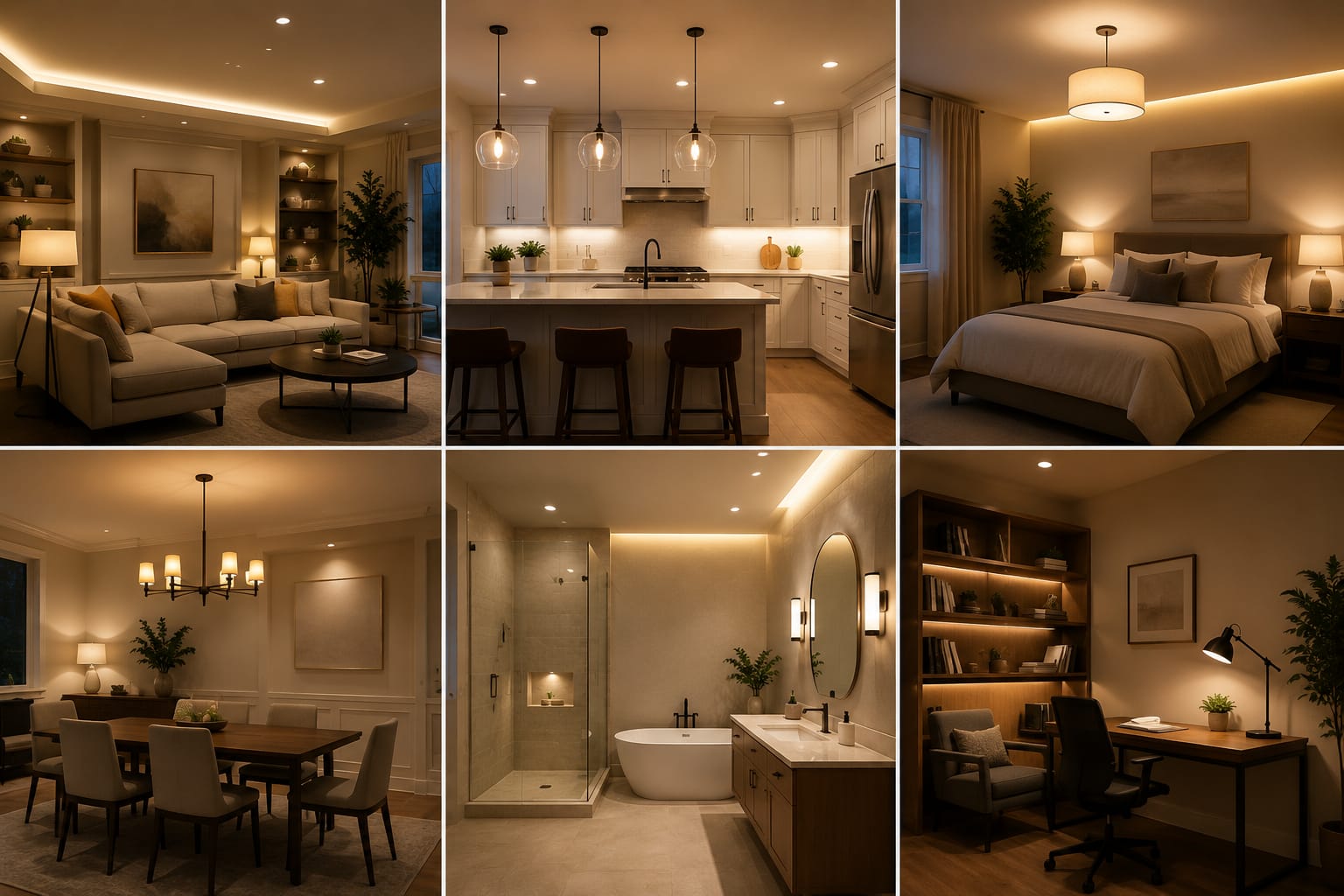
Lighting for Special Room Conditions
Some rooms present conditions that make standard lighting advice less useful. Dark walls absorb light differently than pale walls. Windowless rooms cannot rely on natural light to supplement artificial sources. Rooms with awkward proportions — very narrow, very long, or irregularly shaped — respond poorly to generic fixture placement. These situations require a more targeted approach.
Dark Walls and Challenging Color Schemes
Dark-colored walls absorb significantly more light than light-colored ones, meaning a room that seems adequately lit with white walls may feel underlit with the same fixtures after repainting. This is more common than people expect, and it catches a lot of homeowners off guard after a redecoration. Our guide on lighting rooms with dark walls explains how to compensate — whether by increasing lumen output, adding more fixture points, or using light placement strategically to draw the eye away from the absorbed light.
Windowless Rooms
Rooms with no natural light present a unique challenge because artificial lighting has to do all the work, all the time. The risk is a space that feels flat, enclosed, or fatiguing — even with technically adequate brightness. The approach involves mimicking the qualities of natural light as closely as possible: higher CRI products, appropriate color temperatures, and thoughtful placement that creates depth. The lighting for windowless rooms guide covers these strategies in full.
Glare and Visual Comfort
Glare is one of the most overlooked problems in home lighting. It causes eye fatigue, makes screens harder to read, and generally makes a room feel uncomfortable without people necessarily identifying the source of the problem. Glare often comes from exposed bulbs, incorrect fixture angles, or light bouncing off reflective surfaces. The lighting glare reduction guide explains the main sources of glare and what to do about each of them.
Outdoor and Utility Space Lighting
Outdoor and utility spaces have requirements that are entirely separate from interior rooms. Weather resistance, durability, adequate output over larger areas, and safety considerations all come into play. A product suitable for a living room will almost certainly be wrong for a patio, driveway, or garden.
Outdoor String Lights
Outdoor string lights have become one of the most popular ways to add atmosphere to patios, gardens, and outdoor entertaining areas. When chosen correctly, they create a warm, inviting atmosphere that works well for both everyday use and special occasions. Our guide to the best outdoor LED string lights covers weather ratings, bulb spacing, lumen output, and which products hold up best over time in exposed conditions.
Garages
A garage is a working space that demands a different kind of light from anywhere else in the home. High output, shadow-free coverage, and durability are the priorities. Decorative considerations come second. The best LED lights for garages guide identifies the fixtures that deliver genuine working light rather than just basic illumination, with options across different garage sizes and ceiling heights.
Common Home Lighting Mistakes to Avoid
Most home lighting problems come from a small set of recurring mistakes. Recognizing them before you buy — or before you install — saves money and avoids the frustration of redoing work that could have been right the first time.
The most common error is relying on a single overhead fixture to light a whole room. One central light source creates flat illumination with no depth, shadows in the wrong places, and a room that feels institutional rather than livable. Layering two or three light sources almost always produces a better result, even in small rooms.
Choosing the wrong color temperature for the room is another frequent mistake. Warm light in a home office makes it harder to concentrate. Cool light in a bedroom disrupts sleep and feels harsh at night. Taking five minutes to think about when and how the room is used before selecting a color temperature prevents this entirely. The warm light vs. cool light guide makes the distinction clear.
Ignoring ceiling height when choosing fixtures leads to rooms that either feel too low and cramped or too high and empty. Flush mounts are not the default answer for every low ceiling, just as pendant lights are not automatically appropriate for every high one. The height-specific guides in this series give practical guidance for both situations.
Poor placement is probably the single biggest driver of dissatisfaction with home lighting, and it is also one of the most avoidable. The lighting placement mistakes guide documents the errors that come up most often, from recessed lights positioned too close to walls to vanity fixtures mounted at the wrong height. Reviewing it before any installation is worth the time.
Finally, buying the entire set before testing one bulb or fixture is a mistake that costs money unnecessarily. Live with one or two units for a few evenings, in the actual room, under the actual conditions you will use them in. Only then commit to buying the rest.
Key Takeaways
Every room in a home has its own lighting needs, shaped by its purpose, dimensions, natural light, and the people who use it. A bedroom requires a completely different approach from a kitchen, bathroom, or home office — and even two bedrooms in the same house may need different solutions.
Layering ambient, task, and accent lighting consistently produces better results than any single-fixture solution. Placement, color temperature, and lumen output all matter — not just which product you choose.
Use the room-specific and design guides in this series to work through your home systematically. Small, informed decisions in each space add up to a home that looks and feels genuinely well lit.
Sharing This Guide
Share this guide with anyone planning a new room, rethinking their lighting, or trying to figure out why their home never quite looks the way they want it to.
Facebook | X (Twitter) | WhatsApp | LinkedIn