Best Garage Lights: LED Shop Lights, Panels & Ceiling Picks
The best garage lights are usually LED shop lights, adjustable ceiling panels, or high-bay fixtures, depending on your garage size, ceiling height, and how you use the space. For most home garages, the best LED garage lights provide bright 4000K–5000K coverage, low glare, and enough output to reduce shadows around cars, shelves, tools, and workbenches.
This guide helps you choose the right LED garage lights for parking, storage, ceiling coverage, or workshop use. You’ll see when screw-in panels make sense, when linkable LED shop lights are better, and when a high-bay fixture is worth considering for taller or larger garage spaces.
Quick Answer
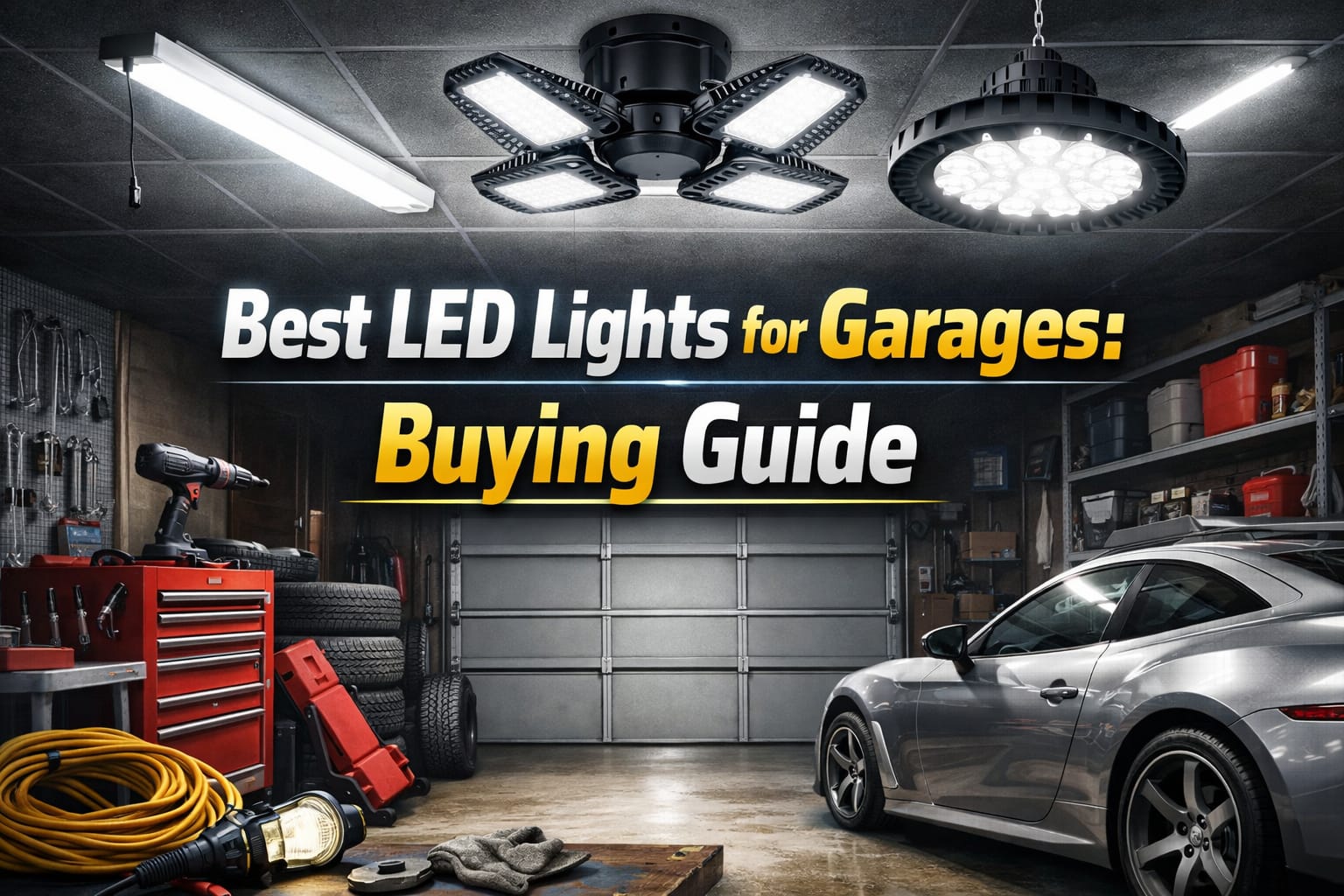
For most standard garages, linkable LED shop lights are the best choice because they spread brightness more evenly across the ceiling and reduce shadows better than one central bulb. Screw-in LED garage panels are best for quick socket upgrades, while high-bay LED fixtures make more sense for tall garages, workshops, or larger detached spaces.
- Best quick upgrade: screw-in LED garage panels.
- Best even coverage: linkable LED shop lights for garage ceilings.
- Best tall garage option: high-bay LED fixtures for workshops or large bays.
Table of Contents:
- Quick Answer
- What the Best Garage Lights Need to Do
- How Many Lumens Garage Lights Need
- Best Garage Light Types
- Choose Garage Lights by Use
- When High-Bay Garage Lights Make Sense
- How Color Temperature Changes Garage Lighting
- Garage Light Features That Matter
- Mistakes Buyers Make With Screw-In Lights
- What to Check Before Buying
- Best Fixture Types for Garage Lighting
- How to Place Lights to Reduce Shadows
- A Quick Pre-Buy Checklist
- Best Garage Lights by Garage Size
- Questions Buyers Ask Before Choosing Garage Lights
What the Best Garage Lights Need to Do
The best garage lighting is not just about looking bright when you flip the switch. The light output must spread across the room well enough to light the floor, walls, storage shelves, and the front of your car without creating deep shadow bands. That is why the best garage lights should be judged by coverage, comfort, and how well they match your real tasks, not just by a high lumen number.
A garage used solely for parking requires a different balance than one used for repairs, detailing, or woodworking. If you have compared room setups elsewhere on the site, this LED lighting buying guide will help you understand why fixture shape and placement are as important as brightness.
If the room is only bright when you stand in the middle, your garage setup is not right yet. Good garage lighting should allow you to read labels, find sockets, and clearly see tire edges when moving into corners.
How Many Lumens Do Garage Lights Need?
For most homes, the ideal amount of brightness is measured in lumens per square foot rather than by the number of fixtures. A garage used for simple storage can work with around 50 lumens per square foot, but often performs better with 80–100 lumens per square foot. When people compare the best LED garage lights, the room size is usually the missing piece of the puzzle.
The same idea applies to larger indoor spaces, which is why this guide on effectively lighting bigger rooms is useful for understanding why brightness that looks strong in the box can still feel weak once spread over a wide ceiling.
Best Garage Light Types: Panels, Shop Lights, and High-Bay Fixtures
Ceiling height, existing wiring, and the room’s shape decide far more than people expect. Screw-in panel lights are ideal for older, socket-based garages, while longer linear fixtures often provide better beam angles for broad overhead coverage. If you park near wall storage, you want the light to spread outward instead of blasting one concentrated circle directly below the fixture.
A similar design principle can be seen in residential task areas, such as in this article on choosing LED lighting for kitchens. In this context, visibility depends on how evenly the light lands on work surfaces rather than how intense it looks at the source.
Choose Garage Lights by How You Use the Space
The best garage lights differ depending on whether you use the space for parking, storage, hobbies, or mechanical work. If you mostly pull in the car and grab seasonal bins, you can keep the brightness moderate. However, if you work under the hood, sort hardware, or paint small parts, the best LED garage lights should be much closer to workshop-level output, making the room feel clean and detailed instead of gloomy and patchy.
Color also affects how usable the brightness is. Many homeowners end up in the 4000K–6500K range. 5000K is a reliable middle point because it looks neutral and crisp without the coldness of some 6500K fixtures. This balance is why many of the best lights for a garage are described as daylight fixtures without feeling unpleasant.
If your garage doubles as a workspace, hobby room, or project area, consider home office lighting recommendations, where comfort and long sessions matter almost as much as visibility.
When High-Bay Garage Lights Make Sense
Once the ceiling rises above 14 feet, regular screw-in panels and low-output bars become less effective. High-bay lights are designed to project usable light downward from a greater mounting height, making them the smarter option in this case. In tall garages, lofted workspaces, or workshop bays, the best garage lights often resemble UFO or industrial high-bay styles.
For standard garages under 10 feet, however, high-output residential fixtures are usually a better choice because they spread light more softly and are less expensive to install. Ceiling height is one of the quickest ways to determine whether your room needs residential, commercial, or somewhere-in-between LED garage lights.
How Color Temperature Changes Garage Lighting
People often focus on brightness first, but color temperature affects usability almost as much. A warm bulb can make a garage feel dull and yellow, while a very cool bulb can feel clinical or harsh. In practice, the best garage lighting usually falls within the neutral-to-cool daylight range because it makes tools, wiring, labels, and fluid leaks easier to see accurately.
For a reliable benchmark, the U.S. Department of Energy LED lighting efficiency guidance and the ENERGY STAR guide to LED lighting basics explain why LED performance should be judged by lumens and application rather than watts alone. The same principle applies in garages when comparing cool white, daylight, and neutral white fixtures.
Another useful filter is the Kelvin rating. A 4000K fixture feels calmer and softer; 5000K is often best for general garage work; and 6500K is effective when you want the space to look extra crisp. The best garage lights are the ones whose color tone matches how long you spend in the room.
Garage Light Features That Matter
A garage light may look impressive online but become irritating in real life. Glare, uneven light distribution, poorly designed diffusers, and unstable drivers can make bright lights uncomfortable to use. The best LED garage lights offer sensible optics, solid heat management, and sufficient output without creating a sharp hotspot directly below the fixture. Durability matters, too—especially in dusty or damp environments.
One overlooked detail is the IP rating. If your garage stays dry and enclosed, a basic residential fixture may suffice. However, if moisture, dust, or seasonal temperature swings are common, the best garage lights should have a more protective build to ensure stable performance over time.
Don’t buy based solely on the highest lumen claim. Low-quality drivers can create glare, visible flicker, and a harsh white cast that makes a garage feel worse, even if the number on the box sounds impressive.
What Buyers Get Wrong About Screw-In Garage Lights
Screw-in garage fixtures are popular because they seem like the easiest way to get brighter garage ceiling lights, but convenience is only one factor. Many panel-style units appear extremely bright at first glance, yet they may not adequately illuminate side walls or corners in wider rooms. Some also sit too low and create glare when the garage door is open.
This does not mean they are bad. In a standard two-car garage with central sockets, the right panel light can be one of the most effective types of garage ceiling LED lights. It simply means you should match the product to the ceiling layout instead of assuming that all adjustable panels are automatically the best garage lights for every space.
If you want a quick upgrade from an old bulb, an adjustable ceiling light that reduces eye strain can be a good option because it provides 8,000 lumens and a 6,500K tone. Its movable panels help direct light where storage racks and vehicle doors usually create shadows.
What to Look for Before Buying LED Garage Lights
Before buying, narrow your decision to the four variables that most often determine if the lights are the best fit for your garage after installation: brightness, color tone, fixture shape, and light distribution. Shortlists make it much easier to choose because you are evaluating products based on your garage rather than generic marketing language.
✅ Lumen Target
Estimate the brightness based on the floor area. A storage garage can stay around 50 lumens per square foot, while a garage used for work usually feels better with 80–100 lumens per square foot.
✅ Fixture Spread
Choose from panel, linear, or high-bay styles based on the width of the room and whether strong visibility is needed on the sides of the garage as well as in the center.
✅ Color Preference
Select a Kelvin range based on how long you typically stay in the room. Around 5000K is often the safest choice for garages and workshops.
✅ Build Quality
Look for solid heat handling, a sensible diffuser, and an appropriate enclosure if your garage is prone to dust or damp air.
The same balance between fixture type and comfort is important in smaller circulation spaces, too. This is why this article on lighting hallways effectively is a good reminder that narrow rooms benefit from thoughtful light distribution rather than maximum output.
Best Fixture Types for Garage Lighting
Most buyers choose from three categories. First, adjustable screw-in panels are ideal for straightforward upgrades when existing sockets are in optimal positions. Second, linear LED shop lights are often the best choice for garage ceilings and provide the most even full-room coverage. They are excellent when you want clean rows of light. Third, commercial-style UFO fixtures work best in larger garages, loft spaces, or workshop bays with higher ceilings.
If you have a large detached garage or workshop, a high-output fixture may be the right fit for you. With 30,000 lumens and a 5,000K output, it can provide strong, wide lighting over a large work area, which is ideal when regular panels start to feel underpowered.
For broader home lighting comparisons, look at how balanced lighting choices are implemented in spaces like this bathroom LED lighting guide, where comfort, clarity, and placement must work together.
How to Reduce Shadows With Garage Lighting
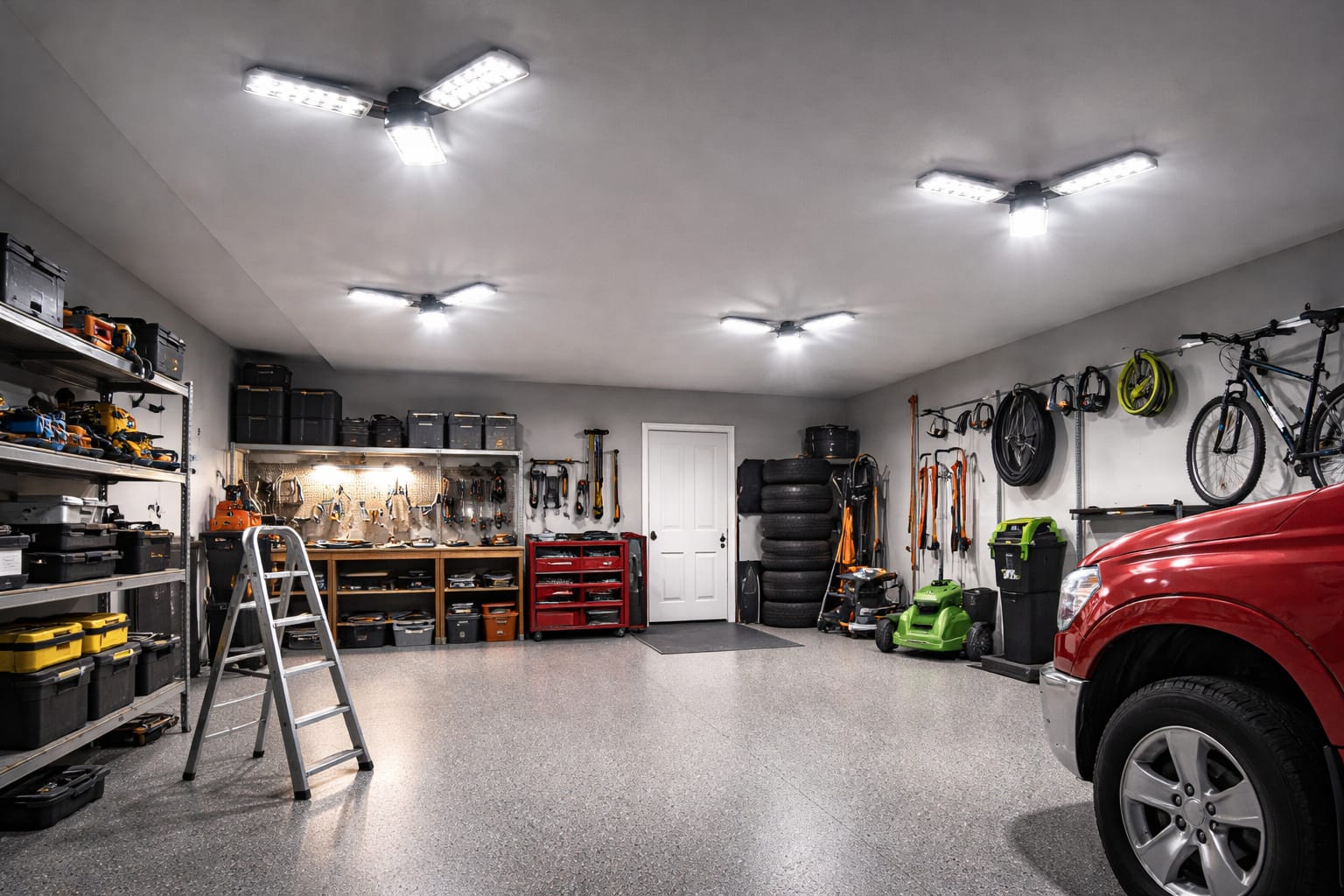
Even the best LED garage lights can be ineffective if the layout is wrong. In long garages, rows of lights often work better than a single central fixture. In wider garages, it is usually better to have lighting near each parking lane and over the workbench than to rely on one bright center point. Think in terms of lighting zones, not just fixture count.
A good rule is to aim the light where you would otherwise block it with your body: near the sides of the car, the front storage wall, and the edge of the bench. This is why linear shop lights often outperform single-source fixtures when you want to reduce shadows and increase brightness from wall to wall.
A Simple Checklist Before You Order
Before ordering, run through a quick buying check. This will prevent you from buying something that looks powerful online but does not fit your garage’s ceiling layout, work style, or comfort needs after installation.
- ✓ Measure the garage’s length, width, and ceiling height before comparing fixture types.
- ✓ Decide whether the room is mainly for parking, storage, or bench work.
- ✓ Check whether you already have sockets, hardwired boxes, or hanging mount points.
- ✓ Choose a 4000K–5000K tone unless you prefer a cooler, daylight look.
- ✓ Favor broader coverage and diffuser quality over the highest lumen claim.
If you want a quick planning shortcut before buying, this room-by-room guide on calculating lumens for indoor spaces can help you estimate whether your target for the garage is realistic given its size.
If two products appear similar, choose the one that best matches your installation needs. A slightly lower lumen fixture with better spread often feels more useful than a brighter light aimed poorly.
Best Garage Lights by Garage Size
In practical terms, the best garage lights tend to fit into a few simple purchasing categories. Smaller garages with central sockets benefit from adjustable panel units that are quick to install and aim. Mid-size garages often work best with rows of linear bars. Bigger, taller garages tend to use high-bay lighting when standard residential fixtures no longer provide enough usable light.
Many homeowners prefer a set of linkable shop lights to stabilize brightness because 4-foot fixtures in the 2500–3000 lumen range can be spaced across the ceiling to provide smoother, more even coverage than a single bright source. This is one reason why the best LED shop lights for garage projects remain so popular.
It’s also worth noting that the most effective LED garage lights are not necessarily the most industrial-looking ones. In many standard homes, several well-placed LED lights on the garage ceiling create a cleaner result than one oversized commercial fixture that overwhelms the space or causes glare at the door opening.
If you want to learn more about how fixture choice affects room performance throughout the house, the LED Knowledge Center‘s broader resource hub is useful for comparing brightness, fixture categories, and room-specific planning ideas.
Questions Buyers Ask Before Choosing Garage Lights
Below are some questions that buyers ask before choosing garage lights. At this point, the remaining confusion usually comes down to brightness targets, color choice, and whether screw-in or linear fixtures provide better real-world coverage. The answers below will help you make those final buying decisions so you can choose the best LED lights for your garage with more confidence.
How bright should garage lighting be?
Most two-car garages work well with about 8,000 to 12,000 lumens for general use. If you also repair vehicles, cut wood, or use a workbench, aim for closer to 80–100 lumens per square foot. The brightness should be even across the room, not concentrated in one hot spot.
Is 5000K good for a garage?
Yes, 5000K is a strong, all-around choice for garages because it provides clean, crisp, and accurate lighting without feeling as harsh as some 6500K fixtures. For parking and storage areas, 4000K lighting can appear softer. For detailing, tool work, and color accuracy, 5000K usually provides the best balance.
Which is better: screw-in panels or shop fixtures?
Screw-in panel lights are convenient for quickly upgrading standard sockets, but linkable shop fixtures usually provide more even coverage and fewer shadows. If your ceiling has existing sockets and you need a quick installation, screw-in units are a good option. For full-room lighting plans, fixed fixtures are usually better.
What are the best lights for a two-car garage?
For most two-car garages, linkable LED shop lights or multiple well-placed ceiling fixtures work better than one very bright central light. Aim for even coverage across both parking lanes, the front storage wall, and any workbench area so shadows do not collect around the sides of the car.
Are LED shop lights better than screw-in garage lights?
LED shop lights are usually better for even ceiling coverage, especially in wider garages or workshop areas. Screw-in garage lights are better when you want the fastest upgrade from an existing bulb socket without adding new wiring or mounted fixtures.
Key Takeaways
The best garage lights match the room’s size, ceiling height, and intended use rather than chasing the highest advertised output. The brightness should be even, the color tone should be comfortable, and the fixture style should provide clear visibility of the floor, walls, and work areas.
First, determine the square footage, then choose between screw-in panel units, linear LED shop lights, or high-bay options. As the safest option, standard garage lights in the 4000K–5000K range work well when they spread light in rows rather than from one central hotspot.
As you upgrade, consider comfort as much as brightness. Better planning now means fewer shadows, less glare, and a garage that will be easier to use for years to come. This is what makes a well-planned garage lighting setup truly worthwhile.
Sharing This Guide
If you found this guide helpful, save it or share it with someone who’s still using old bulbs.
Interested in learning more? Browse all related articles in our category section.