How LED Lighting Works: Beginner Guide to LED Basics
Most people switch to an LED bulb, notice it turns on instantly, stays cooler, and uses less power, but still have no clear idea why it behaves so differently from an old incandescent lamp. That matters because once you understand the basic working principle, it becomes much easier to choose better bulbs, avoid poor dimming performance, and judge product claims more realistically.
This beginner guide breaks the process into simple parts: the semiconductor chip, the driver, the phosphor coating, the diffuser, and the heat management around all of it. By the end, brightness, efficiency, color quality, and lifespan should feel a lot more logical whether you are replacing one bulb or planning a whole-home upgrade.
Quick Answer
LED lighting works by sending controlled electrical current through a semiconductor diode that releases energy as light instead of relying on a heated filament. A complete bulb also needs a driver to manage incoming power, a phosphor layer to help create white light, and a body that can move heat away from sensitive parts.
- The LED chip creates light through an electronic process, not by glowing hot
- The driver regulates household power so the bulb can work safely and steadily
- Phosphor helps convert the original light into usable white light
- Heat control strongly affects lifespan and reliability
- Brightness, efficiency, and color quality depend on the whole bulb design, not just wattage
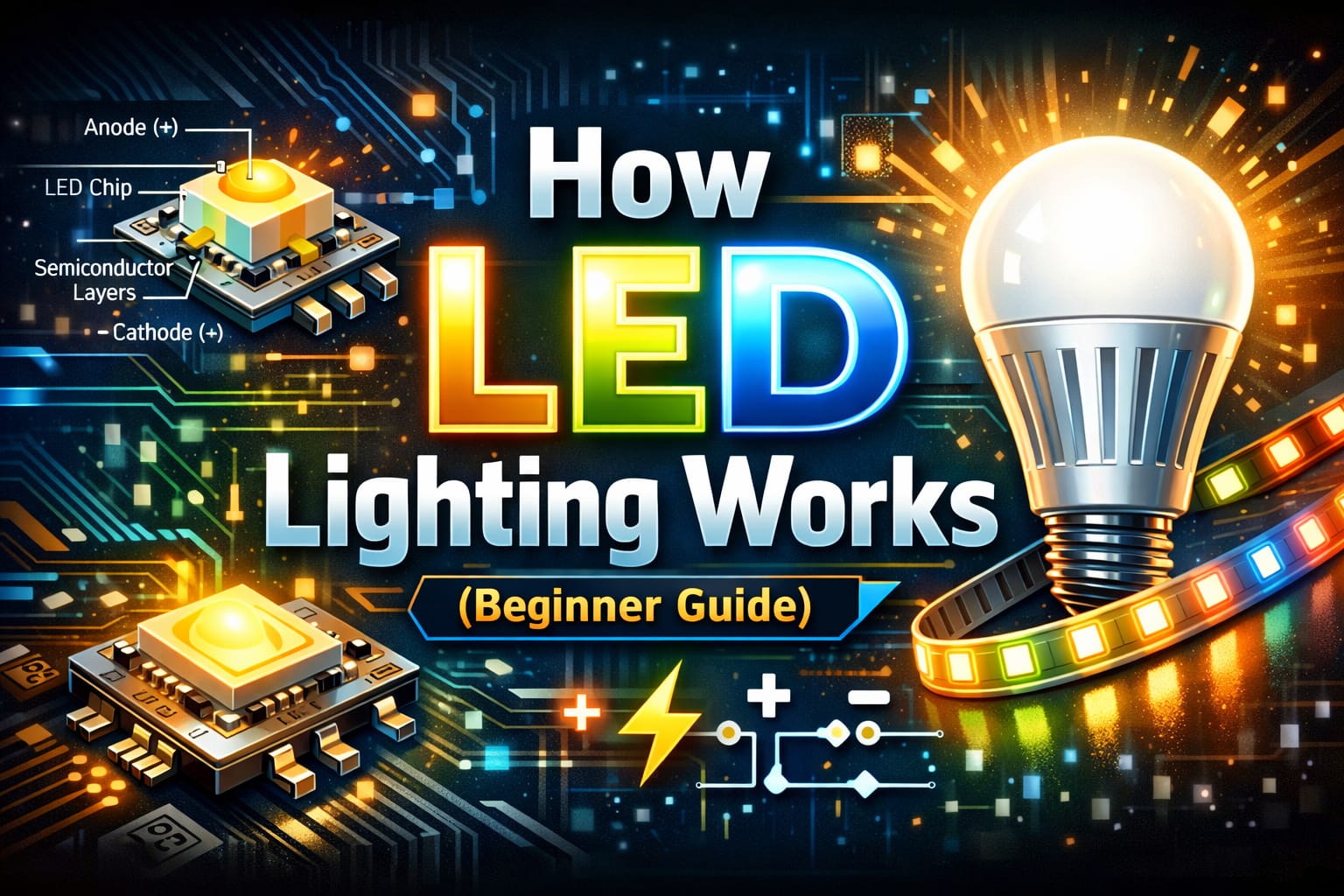
How LED Lighting Works in Simple Terms
A traditional incandescent bulb is easy to imagine because it works by heating a filament until it glows. LED lighting uses a completely different process. Instead of making a wire extremely hot, it pushes electrical current through a semiconductor component designed to release light far more efficiently. If you are still unsure what kind of product an LED bulb actually is, this guide on what modern LED bulbs are is a helpful starting point.
At the simplest level, an LED bulb takes household power, regulates it through internal electronics, sends it to a diode, and turns electrical energy into visible light with much less waste than older bulb types. That is why LEDs can deliver strong brightness while staying relatively cool and using far less energy than incandescent lamps.
This is also why the basics feel confusing at first. The most important parts are hidden inside the bulb body, so the process looks mysterious from the outside. Once you think of the bulb as a small system rather than one glowing piece, the logic becomes much easier to follow.
If a room feels harsh even with a decent bulb, the problem is not always brightness. Diffusion, color temperature, and fixture placement often affect comfort more than raw output alone.
For a warm everyday room such as a bedroom or living space, a soft warm bulb for everyday comfort can be a practical choice because it gives a softer, more familiar look in open fixtures where a sharp cool-white bulb would feel too exposed.
What Happens Inside an LED Bulb
Inside a typical LED bulb, several parts work together at once. The driver takes the incoming power from your home and converts it into the kind of current the bulb can use properly. The LED chip is the part that actually produces the original light. A diffuser spreads that light so it feels softer and more usable in the room, while the metal body or internal cooling structure helps carry heat away from the sensitive electronics.
At the center of the process is the semiconductor chip. This chip is built from materials engineered to control how electrons move through it. Unlike a metal filament, a semiconductor can be designed so current flows in a way that releases energy as light. If you want more background on how these packages vary, this guide to common LED chip types explains the differences clearly without getting too technical.
Once current reaches the chip, charge carriers move across a junction inside the diode. As they recombine, energy is released in the form of photons, which are the actual light you see. That is the real answer behind “how do LED lights work.” The bulb is not burning in a new way. It is using a controlled electronic interaction to create light much more directly than older technologies ever could.
Understanding that one point makes the rest of the bulb easier to understand too. The chip creates light, but the rest of the bulb decides how stable, comfortable, and reliable that light will actually be in daily use.
Why Phosphor, Heat, and Driver Design Matter
A common beginner assumption is that a white LED bulb simply creates white light directly from the chip. In many cases, that is not what happens. The chip often starts by producing blue or near-blue light, and a phosphor coating converts part of that output into a broader spectrum that appears white to our eyes. That conversion step is one of the biggest reasons color tone and color quality can vary so much between products. If you want to go deeper into the material side, NeoLEDHub has a full guide on how phosphor technology shapes white light.
The driver matters just as much. Household power is not something the chip can use directly without regulation. The driver smooths and manages that incoming power so the bulb can operate steadily. This is why cheap bulbs often show dimming problems, flicker, or early failure even when the chip itself is fine. Weak electronics can undermine the whole bulb long before the light source should have worn out.
Heat management is the third big factor. LEDs create less waste heat than incandescent bulbs, but they still create heat that must be moved away from the chip and the electronics. Poor thermal design can shorten lifespan, reduce brightness stability, and shift color over time. This is especially important in compact bulbs and decorative fixtures where airflow is limited. The guide to LED heat sink and cooling design explains why cooling makes such a difference in long-term performance.
A bulb installed in a fully enclosed fixture may run much hotter than expected. Always check enclosed-fixture compatibility before assuming the rated lifespan will apply in your setup.
So while the chip is the heart of the bulb, phosphor, driver quality, and cooling determine whether that bulb will actually feel good, last well, and perform consistently once it is installed at home.
How Brightness, Efficiency, and Color Really Work
Brightness is not determined by wattage alone. Two bulbs can use similar power and still feel very different because output depends on the whole system: the chip, the driver, the diffuser, the optics, and the way heat is managed. That is why shopping only by “watt replacement” claims often leads to disappointment. In real products, the useful measure is usually lumens, not watts, and even then beam spread still changes how bright the room feels.
Efficiency also needs a broader definition than “low wattage.” A bulb is efficient when it gives strong useful light for the power it uses, directs that light where it matters, and keeps doing so over time. NeoLEDHub’s guide to lumens per watt and real-world efficiency is useful if box claims feel vague or inconsistent. The U.S. Department of Energy and the ENERGY STAR LED basics guide make the same point from a consumer angle: performance is about output, longevity, and actual use, not a single marketing number.
Color works the same way. Two bulbs with the same Kelvin rating can still look a little different in practice. That is where binning becomes important. Manufacturers sort chips by output and color characteristics so finished bulbs stay closer to a target appearance. If you care about matching several bulbs across one room, the guide to LED binning and color consistency explains why better products usually look more uniform once installed together.

Once you see brightness, efficiency, and color as design outcomes rather than single specs, product comparisons start making a lot more sense. That is usually the point where LED shopping stops feeling random.
Common Myths and What to Check Before You Buy
One of the biggest myths is that every LED bulb behaves the same on a dimmer. Another is that a brighter bulb automatically creates harsher light. A third is that any bulb with an impressive lifespan claim will perform the same in every fixture. These assumptions usually fall apart because people are comparing packaging promises rather than system design, compatibility, and actual installation conditions.
If dimming has been unreliable in your home, check compatibility first. The issue may be the driver, the dimmer, or the fixture rather than LED technology itself.
When you shop, focus on the questions that actually affect performance: how many lumens the bulb produces, which color temperature fits the room, whether the CRI is strong enough for color accuracy, whether the bulb is dimmer-compatible, and whether it is safe for enclosed fixtures if that applies. NeoLEDHub’s broader LED lighting buying guide expands those points if you want a more product-focused follow-up.
- ✓ Check lumen output before relying on watt replacement wording
- ✓ Match color temperature to the room instead of trend words on the box
- ✓ Confirm enclosed-fixture and dimmer compatibility before installing
- ✓ Prefer higher CRI where appearance and color accuracy matter
- ✓ Think about beam spread and fixture design, not only bulb shape
If you need better dimming behavior in older rooms, a smooth dimming bulb for older switches can be a practical choice because it is built to reduce visible flicker where standard bulbs often feel unstable. For kitchens, worktops, or other detailed tasks, a high output bulb for detailed tasks may make more sense because the added brightness and stronger CRI are more useful there than in relaxed evening spaces.
Once you understand how the bulb actually works, shopping becomes much less about guessing and much more about matching the product to the room, the fixture, and the way you use the space.
Where Smart Features Fit
Smart features do not change the core physics of the bulb. Scheduling, app control, voice commands, scenes, and remote dimming all sit on top of the same chip, driver, phosphor, and thermal design described above. In other words, the light source still works the same way even when the user experience becomes more advanced.
That is worth remembering because smart packaging often makes ordinary control features sound like a different technology entirely. A connected bulb with poor color quality, weak cooling, or bad compatibility is still a weak bulb. The smart layer can improve convenience, but it cannot rescue bad fundamentals underneath.
If you want to go further into connected lighting after learning the basics here, the NeoLEDHub Knowledge Center is the best place to continue into more advanced guides and related topics.
Key Takeaways
The easiest way to understand how LED lighting works is to see the bulb as a coordinated system. The driver manages power, the chip produces light through a semiconductor process, phosphor helps create usable white light, and the body moves heat away so performance stays stable.
In practical terms, that means better buying decisions. Once you know why lumens, CRI, color temperature, compatibility, and cooling all matter, product comparisons become much easier and a lot less frustrating.
As homes keep moving toward more efficient and more personalized setups, people who understand the basics of LED lighting will make better decisions on comfort, performance, and long-term value.
If you found this guide helpful, save it or share it with someone who still wants a simple explanation before buying new bulbs.
Facebook | X (Twitter) | WhatsApp | LinkedIn