SMD vs COB vs Flip-Chip LED Chips: Which Type Is Best?
Choosing between SMD, COB and flip-chip LED chips affects how smooth the light looks, how well the fixture handles heat, how much you pay, and where the product performs best. In simple terms, SMD is usually the flexible and affordable choice, COB is better for smooth high-density light, and flip-chip is the premium option for efficiency and thermal performance.
This guide compares the main LED chip types by brightness, heat, cost, lifespan and best use, so you can choose the right option for LED strips, bulbs, downlights, spotlights or higher-output lighting projects.
Quick Answer
For most home LED products, SMD is the best budget-friendly and flexible chip type. Choose COB if you want smoother, dot-free light from strips, spotlights or downlights. Choose flip-chip when efficiency, heat transfer and long operating hours matter enough to justify a higher price.
- SMD LED chips are best for affordable bulbs, RGB strips, smart lighting and flexible layouts.
- COB LED chips are best when you want a cleaner light line with fewer visible hotspots.
- Flip-chip LEDs are best for premium fixtures where heat control, efficiency and reliability matter most.
- No LED chip type is automatically best in every product; the driver, diffuser, heatsink and fixture design still matter.
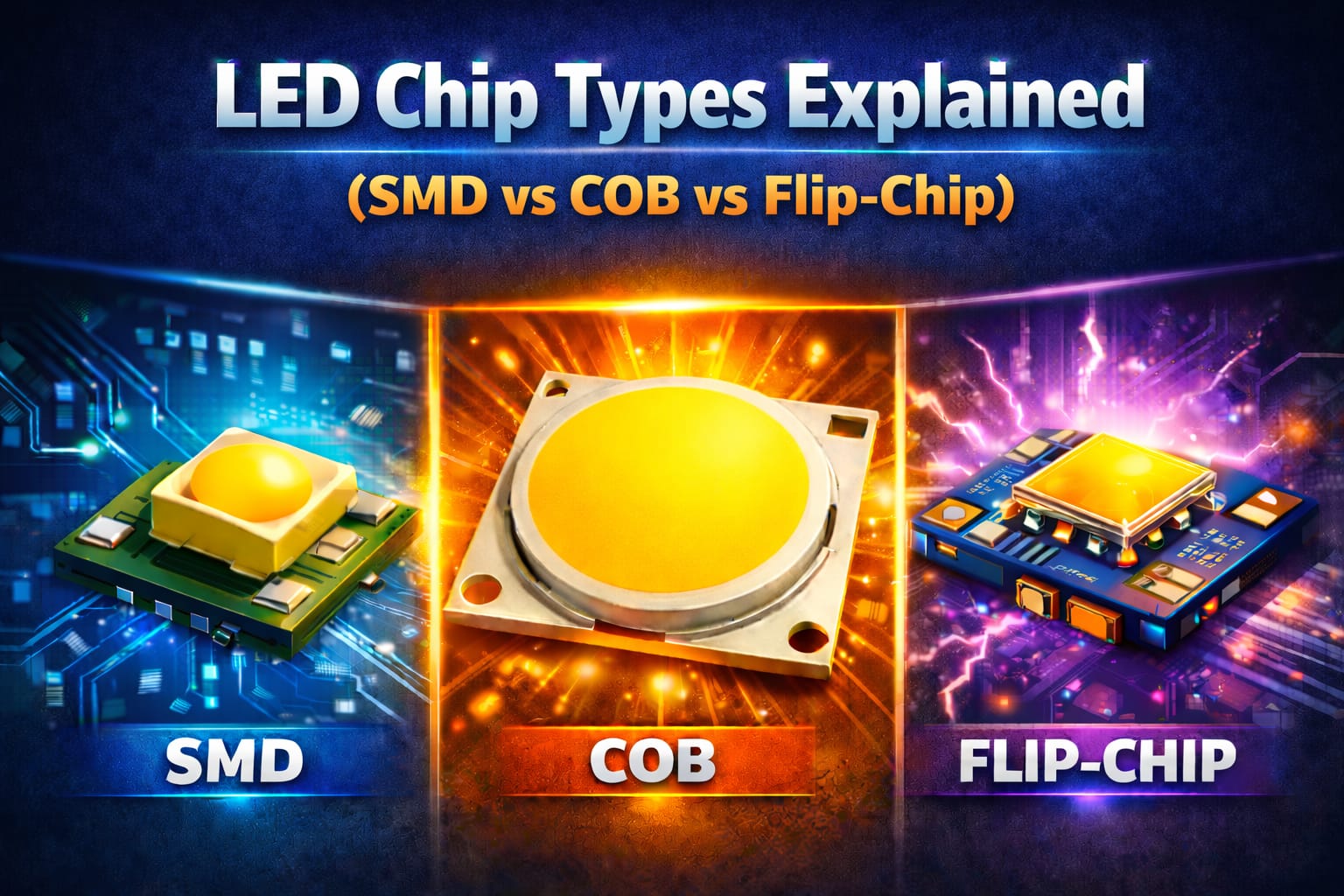
Table of Contents:
- Quick Answer
- SMD vs COB vs Flip-Chip Comparison
- What Are SMD LED Chips?
- What Are COB LED Chips?
- What Are Flip-Chip LEDs?
- Performance, Heat and Light Quality
- Cost, Lifespan and Reliability
- Best Uses for Each LED Chip Type
- Future Developments in LED Chip Design
- Which LED Chip Type Should You Choose?
- Key Takeaways
- Sharing This Guide
SMD vs COB vs Flip-Chip Comparison
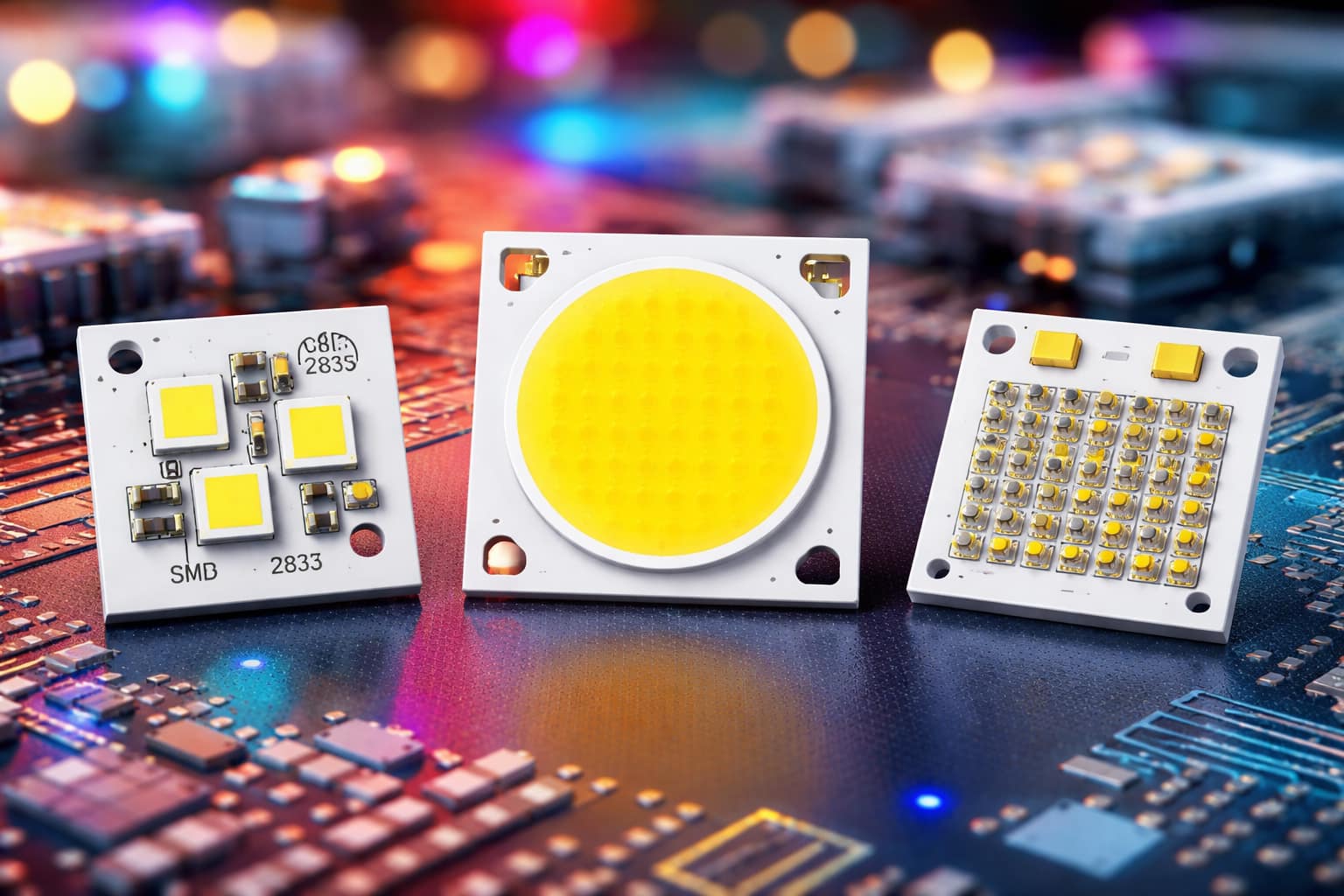
The fastest way to compare LED chip types is to look at what each one does best. SMD gives manufacturers layout flexibility and lower cost. COB creates a denser, more continuous emitting surface. Flip-chip improves the way heat and electricity move through the LED package.
SMD
Best for: LED strips, smart bulbs, RGB effects, general-purpose lighting
Main advantage: Flexible, affordable and widely available
Main trade-off: Visible dots or uneven lines if chip spacing and diffusion are weak
COB
Best for: Dot-free strips, downlights, spotlights, compact high-density lighting
Main advantage: Smoother light with fewer visible hotspots
Main trade-off: More integrated, usually less modular and sometimes more expensive
Flip-Chip
Best for: Premium, high-output, commercial, outdoor and long-hour fixtures
Main advantage: Better heat path and high-performance potential
Main trade-off: Higher manufacturing complexity and cost
Do not choose an LED product by chip type alone. First decide whether you need lower cost, smoother light, stronger output, RGB control or long-hour reliability. Then compare the chip type together with the driver, diffuser, heatsink and overall fixture design.
What Are SMD LED Chips?
SMD stands for Surface-Mount Device. It is the most familiar LED chip format in everyday lighting because individual LED packages can be mounted directly onto a circuit board using standard electronics assembly methods. This makes SMD practical for LED strips, bulbs, panels, smart lights and many decorative fixtures.
Each SMD package contains one or more LED dies, electrical connections, phosphor conversion and protective encapsulation. Package numbers usually refer to dimensions: a 3528 package is about 3.5 mm by 2.8 mm, while a 5050 package is about 5.0 mm by 5.0 mm. Those numbers help identify the package size, but they do not prove brightness, quality or lifespan by themselves.
The biggest strength of SMD LED chips is flexibility. Manufacturers can place many emitters across a board, tune spacing, combine white and RGB chips, or create addressable effects for pixel-level control. That is why SMD remains common in SMD strip lighting setups, smart bulbs and color-changing products.
The weakness is visual smoothness. If SMD chips are spaced too far apart or placed behind a shallow diffuser, the light can look dotted or uneven. A high-quality SMD product can still perform very well, but chip density, driver quality, board design and heat handling usually matter more than the package number printed in the product description. For the broader basics behind these systems, see this guide to how LED lighting works.
What Are COB LED Chips?
COB stands for Chip on Board. Instead of mounting many fully packaged LEDs onto a board, COB technology bonds multiple bare LED dies directly onto a substrate and covers the array with phosphor and encapsulation. The result is a denser, more continuous light-emitting surface.
That tighter arrangement is the main reason COB lighting looks smoother than many traditional SMD designs. It can reduce the dotted appearance you often see on lower-density LED strips and can create cleaner beams in compact downlights and spotlights. If you want a deeper product-focused explanation, this guide to COB strip lighting solutions explains how COB strips work in real installations.
COB can also simplify optics. A more unified light source is easier to shape with reflectors and lenses than a board full of separated emitters. In the right fixture, that can mean better beam control, fewer multiple shadows and a higher-quality appearance. This is especially useful when the light source is visible, such as under shelves, inside cabinets, along accent edges or in shallow channels.
If your current LED strip shows clear hotspots or uneven lines of light, switching from a low-density SMD strip to a 24V dotless COB LED strip with high CRI for smoother visible light lines can be a practical upgrade. It makes the most sense in places where you see the light line directly, not just the glow it creates.
The trade-off is that COB modules are more integrated. When a COB module fails, you generally replace the module or product rather than repairing individual dies. That is not always a problem for consumer lighting, but it matters in installations where serviceability is important.
What Are Flip-Chip LEDs?
Flip-chip LED design changes how the LED die is mounted. Instead of using traditional wire bonds on top of the chip, the die is flipped and connected through solder bumps on its underside. This puts the active structure closer to the substrate and removes wire bonds from the light-emitting surface.
That design can improve two important things at once: light extraction and heat flow. With no wire bonds blocking the surface, more light can leave the chip cleanly. At the same time, the thermal path from the junction to the substrate becomes more direct, which helps reduce operating temperatures and support higher drive currents.
This is why flip-chip LEDs often appear in premium or high-performance applications. They are not always necessary for basic residential products, but they can offer real advantages in demanding fixtures where output, efficiency and reliability need to stay high over long operating hours. The U.S. Department of Energy’s LED lighting guidance also highlights how thermal conditions affect efficiency and longevity.
The drawback is cost and manufacturing complexity. Flip-chip production demands precise alignment, advanced packaging equipment and careful material matching. If those details are handled well, the chip can be very robust. If the surrounding fixture, driver or thermal design is weak, the premium chip alone will not save the product.
Performance, Heat and Light Quality
When people compare SMD vs COB vs flip-chip LED chips, they often start with brightness and efficiency. In broad terms, many SMD products sit around 100 to 150 lumens per watt, COB products commonly reach roughly 120 to 160 lm/W, and higher-end flip-chip designs can push beyond that. These are only reference ranges because the actual result also depends on binning, phosphor quality, thermal design and driver performance. For more context, see this guide to lumens per watt efficiency.
Light quality is not controlled by chip type alone. All three formats can achieve respectable CRI ratings, but premium products usually perform better because of tighter phosphor control and better temperature stability. COB tends to look more uniform because the emitting surface is denser, while SMD can still deliver excellent color if the manufacturer uses careful binning and good board design.
Heat is one of the biggest reasons LED products lose brightness early, shift color or fail sooner than expected. SMD spreads heat across multiple packages and relies heavily on the board, thermal vias and fixture body. COB bonds many dies onto a unified substrate, which can help spread heat from a compact module. Flip-chip usually shortens the heat path even more by connecting the die directly through its underside.
Even so, chip type is only part of the thermal story. A cheap COB module in a badly designed enclosure can still run hot, while a well-built SMD product can stay cool and stable for years. Proper heatsink design, board thickness, enclosure size and driver quality often decide whether the LEDs can actually deliver their rated performance. For more detail, this guide explains LED heat dissipation methods.
Dimming, flicker and driver stability also depend more on the electrical design than on the chip package itself. In higher-output systems, understanding constant current vs voltage drivers can be just as important as understanding the LED chips.
Do not assume a brighter or more advanced chip automatically creates better lighting. Without good shielding, optics, diffusion and cooling, a premium chip can simply make a fixture harsher, hotter or less comfortable to use.
Cost, Lifespan and Reliability
SMD usually has the lowest entry cost because it is mass-produced at huge scale and fits many low-cost to mid-range products. That makes it the default choice for residential bulbs, strips, smart lights and general-purpose fixtures where affordability matters.
COB often costs more at the component level, but it can be worth it when smooth appearance, dense output or compact beam control matter. If you are lighting a visible shelf edge, cabinet channel, display area or compact spotlight, the smoother result can justify the premium because the finished light looks cleaner.
Flip-chip tends to be the most expensive option because the packaging process is more advanced and the chips are often used in higher-performance products. That higher price can make sense in high-hour installations where efficiency, temperature stability and long-term reliability are more important than the lowest upfront cost.
With good thermal control, SMD products commonly fall in the 25,000 to 50,000 hour range, while many COB products fall around 40,000 to 70,000 hours. Premium flip-chip systems can push beyond that. These ranges are rough guides, not guarantees, because lifespan depends heavily on heat, driver quality, enclosure design and operating conditions.
Different chip types can also fail in different ways. SMD can suffer from package fatigue, bond issues or board-level thermal stress. COB can see phosphor wear, substrate stress or module-level degradation. Flip-chip removes wire bonds but introduces its own packaging concerns around solder bumps and material interfaces. In all cases, the practical question is not just whether the light still turns on, but whether it still delivers useful brightness, stable color and acceptable efficiency after years of use.
Best Uses for Each LED Chip Type
SMD is still the most common choice for residential lighting. It works well in LED strips, retrofit bulbs, smart lighting products and color-changing systems where flexibility, cost and broad compatibility matter most. Products that rely on segmented control or dynamic effects often use discrete emitters, including setups built around addressable LED strip control.
COB is often better for premium strip applications, downlights, spotlights and compact fixtures where smoother output and high density are more important than modular repair. It is especially useful when the light source is easy to see directly or when the beam needs to look clean through a shallow diffuser.
For ceiling upgrades where color quality, dimming and practical installation matter, a CRI 90+ adjustable white recessed LED downlight kit can be a better fit than a basic low-CRI retrofit. It makes sense for kitchens, hallways and living areas where you want selectable color temperature and smoother everyday ceiling lighting.
Flip-chip is usually easier to justify in demanding commercial, industrial, outdoor, automotive or high-output products. In those applications, better heat transfer, compact packaging and long-hour performance can matter more than initial price.
COB can also be useful in horticultural, studio and task-lighting products where dense photon output or smooth beam quality matters. Flip-chip becomes more relevant as products push for higher brightness in tighter spaces. SMD remains the practical choice when the project needs affordability, flexible layout or RGB control more than a perfectly continuous light source.
Future Developments in LED Chip Design
LED packaging is still evolving. Mini-LED and micro-LED technologies are pushing chip sizes smaller, opening the door to denser control, finer optical precision and new display or adaptive-lighting applications. These technologies sit beyond most everyday fixtures today, but they show where the industry is moving.
Material improvements are also helping manufacturers raise efficiency, reduce thermal bottlenecks and improve color quality across different chip formats. Better phosphors, improved substrates and more advanced packaging methods can gradually narrow the gap between standard and premium designs.
For buyers, the important point is simple: newer chip technology can help, but it does not replace good fixture engineering. The best results still come from matching the chip type to the use case and checking the full product design before buying. For more related guides, visit the LED knowledge center.
Which LED Chip Type Should You Choose?
Choose the chip type that fits the product’s job, not the one that sounds most advanced. In many everyday situations, the best LED chip type is simply the one that gives you the right balance of output, appearance, efficiency and price.
- Choose SMD for affordable bulbs, flexible LED strips, RGB effects, smart lighting and general-purpose residential use.
- Choose COB when you want smoother light lines, fewer visible dots, compact high density or cleaner beam quality.
- Choose flip-chip when thermal performance, efficiency and long operating hours matter more than upfront cost.
- Choose based on the whole product, not just the chip label: driver, diffuser, heatsink, optics and build quality can change the final result.
- Do not pay extra for a premium chip if the fixture around it is poorly designed.
Key Takeaways
SMD, COB and flip-chip LEDs all solve different lighting problems. SMD is versatile and widely used, COB delivers smoother and denser light, and flip-chip stands out when efficiency and thermal performance are pushed harder.
If the question is SMD vs COB for home lighting, SMD usually wins on cost and flexibility, while COB wins on smooth appearance and reduced hotspots. If the question is COB vs flip-chip, COB is usually about visual uniformity, while flip-chip is more about high-performance thermal and electrical design.
The smartest choice is the one that matches the application. Look beyond the chip label and compare the diffuser, driver, heatsink, optics and build quality before deciding which LED product is best for your project.
Sharing This Guide
If you found this guide helpful, save it for later or send it to someone comparing SMD, COB and flip-chip LED technologies for a new lighting project.
Share using the links below
Interested in learning more? Browse all related articles in our category section.