Why Are My LED Lights Dim? 9 Fixes Before Replacing Bulbs
If your LED lights look dim, do not replace the bulbs first. Check the lumen rating, dirty covers, shades, dimmer compatibility, color temperature, fixture design, and room conditions before assuming the bulb is defective.
Most dim LED problems come from a mismatch between the bulb, fixture, and room, not a mysterious failure. If several lights dim at once, or the brightness changes when appliances turn on, the issue may involve voltage drop, wiring, or the LED driver instead.
Quick Answer
If you are wondering why your LED lights are dim, start with the simplest checks: confirm the lumens, clean the fixture, remove the shade or diffuser for a test, and make sure any dimmer is LED-compatible. If one bulb is dim, the problem is usually local. If several lights are dim, check for circuit, voltage, or driver issues.
- Check the lumens, not just the watt-equivalent rating.
- Clean the bulb, cover, glass dome, and diffuser.
- Test the bulb without a shade or enclosed cover.
- Try a cooler or neutral color temperature if the room feels dull.
- Compare the bulb in another fixture to isolate the problem.
- Make sure your dimmer switch is compatible with LED bulbs.
- Watch for voltage drop if several lights dim together.
- Match the bulb output to the room size and task.
- Replace the bulb, fixture, or dimmer only after the basic checks.
Table of Contents:
- Quick Answer
- First Signs Your LED Lights Are Too Dim
- 9 Fixes Before Replacing Bulbs
- Fix 1: Check Lumens, Not Watts
- Fix 2: Clean the Bulb, Cover, and Diffuser
- Fix 3: Test the Shade or Enclosed Fixture
- Fix 4: Check Color Temperature
- Fix 5: Compare the Bulb in Another Fixture
- Fix 6: Check Dimmer Compatibility
- Fix 7: Watch for Voltage Drop or Wiring Issues
- Fix 8: Match Brightness to the Room
- Fix 9: Replace the Bulb, Fixture, or Dimmer
- Mistakes That Keep Rooms Dull
- FAQ
- Key Takeaways
- Sharing This Guide
First Signs Your LED Lights Are Too Dim
Eye strain at your desk, dull-looking walls, dark corners, and shadows on work surfaces are often the first clues. You may start asking, “Why are my LED lights dim?” even though the bulb still turns on normally.
Sometimes the room is not dark everywhere. The light may be weak in one corner, too soft under a shade, or not strong enough for cooking, reading, cleaning, or working. That usually points to a setup problem rather than total bulb failure.
Before replacing anything, check the basics: lumens, fixture shape, dust, bulb age, color temperature, and whether there is a dimmer on the circuit. A good LED troubleshooting checklist for common home issues can also help you separate simple fixes from electrical problems.
9 Fixes Before Replacing Bulbs
The best way to fix dim LED lights is to test one cause at a time. Start with the free checks, then move toward compatibility and replacement only if the room still feels underlit.
Fix 1: Check Lumens, Not Watts
One of the biggest reasons LED lights look dim is that the bulb does not produce enough lumens for the room. A “60W equivalent” LED can still feel weak in a large room, a deep fixture, or a space with dark walls and poor reflection.
With LED lighting, watts mainly describe energy use, while lumens describe visible brightness. If you are still choosing bulbs by wattage, read this practical guide to lumens versus watts before buying another replacement.
If the fixture, shade, and room clearly need more output, a higher-lumen LED bulb for rooms that still look dim can be a better fix than replacing the same weak brightness level again.
If two bulbs use similar wattage but one has much higher lumens, the higher-lumen bulb will usually look brighter. Do not assume watt-equivalent labels tell the whole story.
Fix 2: Clean the Bulb, Cover, and Diffuser
Sometimes the answer is simple. Dust on the bulb, grime inside a glass dome, or a yellowed diffuser can reduce usable brightness by a noticeable amount. Because the change happens slowly, many people adapt to the lower light without realizing how much output has been lost.
Turn the light off, let the bulb cool, and clean the cover or diffuser safely. This matters most in kitchens, bathrooms, laundry rooms, and utility spaces, where moisture, grease, lint, and residue build up faster.
Fix 3: Test the Shade or Enclosed Fixture
Dark lampshades, frosted covers, decorative cages, deep recessed fixtures, and enclosed domes can block or scatter more light than expected. If the bulb looks weak only inside one fixture, the fixture may be limiting the brightness.
Test the same bulb in an open lamp or fixture for a few minutes. If it suddenly looks much brighter, the LED bulb may be fine, and the shade, diffuser, or fixture design is the real bottleneck.
Also check the bulb label. Some LED bulbs are not designed for enclosed fixtures because heat buildup can reduce performance, shorten lifespan, or cause inconsistent brightness.
Fix 4: Check Color Temperature
A bulb can have enough lumens and still feel dim if the color temperature does not fit the room. Very warm light can look cozy but may feel dull in kitchens, at desks, around vanities, in garages, and in task areas.
To make LED lights look brighter without changing the fixture, try moving from overly warm light to neutral white. The room may feel cleaner and more usable even if the lumen rating stays similar.
Fix 5: Compare the Bulb in Another Fixture
If one LED bulb looks dim, move it to a different compatible fixture and compare it with another bulb. This quick test helps you decide whether the problem follows the bulb or stays with the fixture.
If the same bulb looks dim everywhere, it may have low lumen output, poor quality, heat damage, or driver degradation. If it looks normal elsewhere, the original fixture, cover, dimmer, or circuit is more likely to blame.
Fix 6: Check Dimmer Compatibility
A dimmer switch can make LED bulbs look weak even when the slider appears to be at full brightness. Older dimmers designed for incandescent bulbs may not work properly with LED electronics, minimum load requirements, or modern LED drivers.
If your lights are dim, flicker, buzz, pulse, or never reach full brightness, the issue may be dimmer compatibility rather than the bulb itself. The full explanation is covered in this guide to LED bulbs that do not dim properly.
Fix 7: Watch for Voltage Drop or Wiring Issues
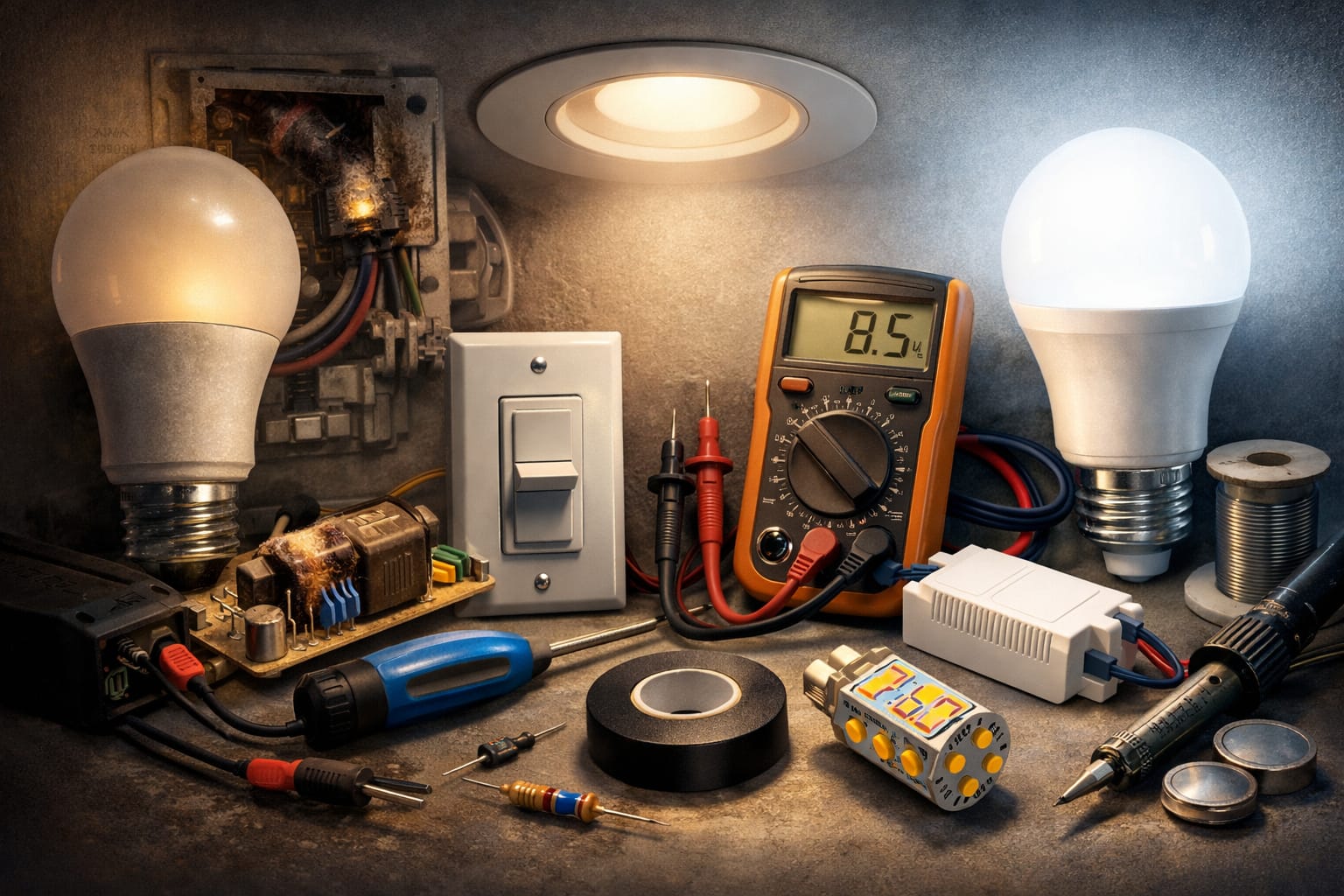
If several LED lights on the same circuit look dim, the issue may not be the bulbs. Loose connections, overloaded circuits, long wiring runs, unstable power, or voltage drop can all reduce brightness or make light output inconsistent.
A warning sign is brightness changing when large appliances start running. Another sign is multiple fixtures becoming weak at the same time. In those cases, stop swapping bulbs randomly and treat the issue as electrical.
If several fixtures dim at once, if brightness changes with appliance use, or if you notice heat, buzzing, burning smells, or repeated breaker trips, have the circuit inspected instead of continuing to test different bulbs.
Fix 8: Match Brightness to the Room
The same LED bulb can feel fine in one room and too dim in another. Kitchens, garages, bathrooms, laundry rooms, desks, and work areas usually need stronger, clearer light than bedrooms or relaxed living spaces.
Dark walls, heavy furniture, high ceilings, and poor light reflection can also make a room feel dull even when the bulb is technically working. In those cases, adding layered lighting or using a better beam spread may help more than simply choosing the highest-lumen bulb.
The U.S. Department of Energy’s LED lighting efficiency guidance is a useful reference for understanding why LED performance should be judged by output, efficiency, and application rather than wattage alone.
Fix 9: Replace the Bulb, Fixture, or Dimmer
Replacement is the right move when the bulb is too low in lumens, the fixture blocks too much light, or the dimmer is clearly incompatible. At that point, continuing to clean, adjust, and retest the same weak setup will not solve the real problem.
For large rooms, garages, countertops, and task-focused areas, switching to a higher-lumen LED bulb for large rooms, garages, or task areas can be more practical than trying to squeeze more brightness out of an undersized bulb.
It also helps to compare your setup with the ENERGY STAR guide to LED lighting basics, especially if you want clearer benchmarks for efficiency, lifespan, and output before choosing a replacement.
Mistakes That Keep Rooms Dull
One common mistake is assuming every “60W equivalent” bulb performs the same. Beam pattern, diffuser design, lumen output, color temperature, and fixture compatibility can vary a lot from product to product.
Another mistake is relying on one ceiling fixture in a room with dark walls, heavy furniture, or poor light reflection. Even a decent bulb can seem inadequate when the room absorbs light instead of reflecting it.
People also ignore packaging details such as “not for enclosed fixtures,” dimmer compatibility, beam angle, and actual lumen output. Reading the label carefully can prevent a lot of frustration before installation.
For many homeowners, the problem is a combination of low lumens, poor fixture design, and light being absorbed by the room itself. Address those issues first, and brightness will usually improve quickly. For more comparisons and specifications, the LED Knowledge Center, which has practical lighting guides, is a useful next step.
FAQ
Why Are My LED Lights Dim Even at Full Brightness?
The most common reasons are low lumen output, a restrictive fixture, a dirty cover, warm color temperature, or an incompatible dimmer. If several lights are dim at full brightness, check for voltage or wiring issues.
Can LED Bulbs Get Dimmer Over Time?
Yes. LED bulbs usually fade gradually instead of burning out suddenly. Heat, poor ventilation, low-quality drivers, and enclosed fixtures can make brightness loss happen faster.
How Do I Make LED Lights Brighter?
Clean the fixture, remove restrictive covers, use a higher-lumen bulb, choose a more suitable color temperature, improve light placement, and make sure the bulb and dimmer are compatible.
Should I Replace Dim LED Bulbs Right Away?
Not immediately. Test the bulb in another fixture, clean the cover, check lumens, and rule out dimmer or fixture problems first. Replace the bulb only when the output is clearly too low or the bulb looks dim in every compatible fixture.
Key Takeaways
Dim LED lights are usually caused by low lumen output, dirty covers, restrictive fixtures, warm color temperature, incompatible dimmers, voltage issues, or a bulb that does not fit the room.
Start with the fastest checks before replacing anything: clean the fixture, confirm the lumens, test the bulb without the shade or diffuser, compare it in another fixture, and check the dimmer.
If the room still feels underlit after those fixes, upgrade the bulb, change the fixture, replace the dimmer, or inspect the circuit. Once the light is properly matched to the room, LED lighting usually performs as expected.
Sharing This Guide
If you found this guide helpful, save it or share it with someone who is trying to figure out why their LED lights look dim.
Interested in learning more? Browse related articles in our category section.