What Is LED Binning? Why LED Color & Brightness Don’t Match
LED binning is the process manufacturers use to sort LEDs into groups with similar color, brightness, and sometimes voltage. It exists because two LEDs with the same label can still look slightly warmer, cooler, brighter, or dimmer once they are installed side by side.
This guide explains why LED color and brightness do not always match, how color binning and brightness binning work, what MacAdam steps mean, and what to check before buying LEDs for projects where consistency matters.
It is most useful if you are comparing LED strips, fixtures, replacement modules, retail lighting, hospitality lighting, display lighting, or any installation where several LEDs need to look visually consistent.
Quick Answer
LED binning explained simply: manufacturers test LEDs after production and group them into bins based on measured color, light output, and sometimes electrical behavior. The tighter the bin, the more consistent the finished product is likely to look.
- Color binning reduces visible tint and CCT differences between LEDs.
- Brightness binning reduces uneven light output between fixtures or strips.
- LED bin codes help manufacturers and buyers identify the actual performance group.
- MacAdam steps describe how visible a color difference is likely to be.
- Tighter bins usually improve consistency but can increase cost, lead time, or sourcing difficulty.
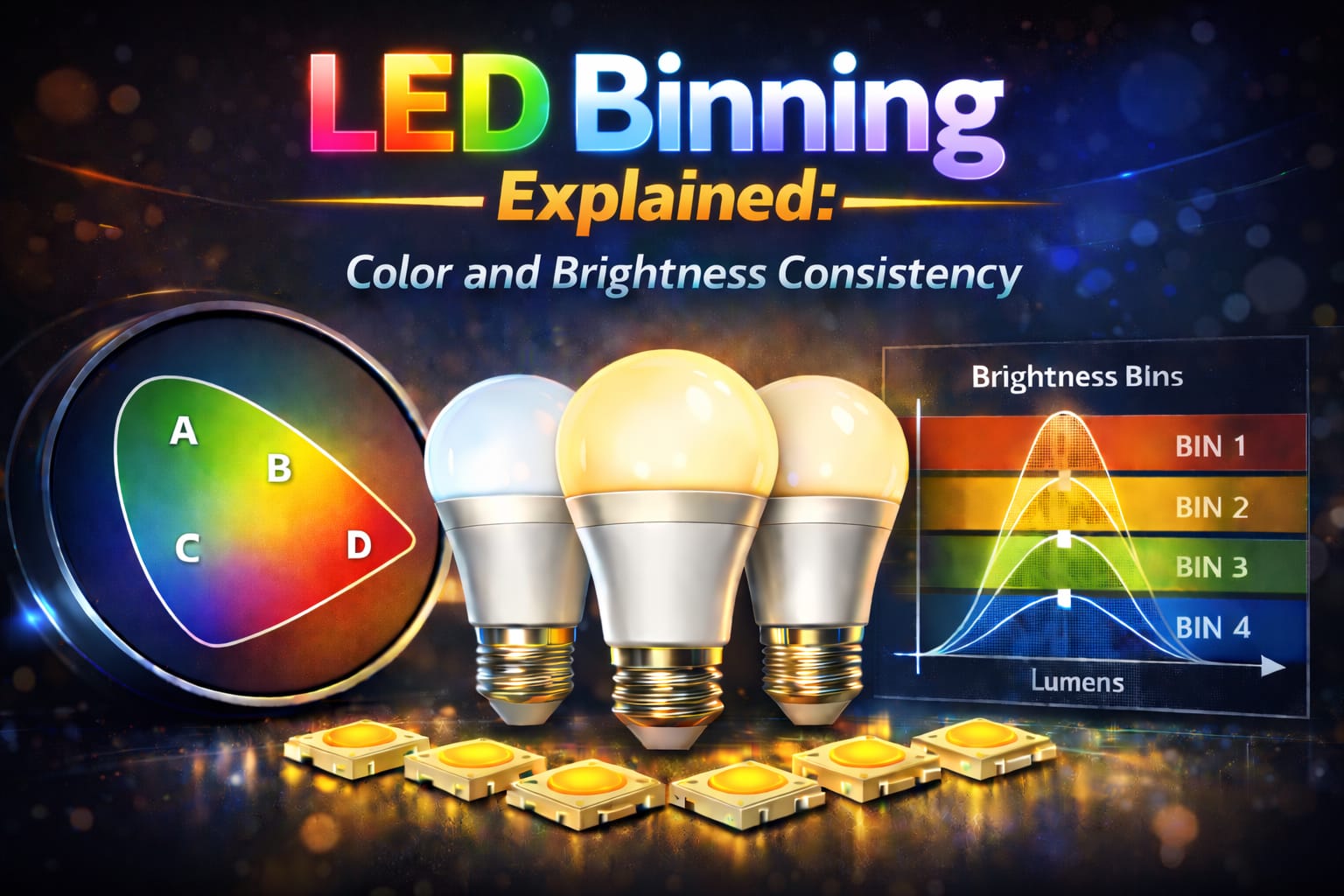
Table of Contents:
- What LED Binning Means
- Why LEDs Vary in Color and Brightness
- Color Binning and MacAdam Steps
- Brightness Binning and Flux Categories
- How to Read LED Bin Codes and Specifications
- Why LED Binning Matters in Real Projects
- How Manufacturers Test and Sort LEDs
- What to Check Before Buying LEDs for Consistent Color
- How to Avoid Mismatched Replacement LEDs Later
- FAQ
- Key Takeaways
- Sharing This Guide
What LED Binning Means
LED binning means measuring LEDs after manufacturing and sorting them into performance groups, or bins. Those groups usually cover color point, luminous flux, and sometimes forward voltage or other electrical characteristics.
The reason this matters is simple: LED production is very precise, but it does not produce perfectly identical chips. One LED may land slightly above the target brightness range, another may sit slightly below it, and another may shift a little warmer or cooler in color. Without binning, all of those LEDs could end up in the same product and create visible mismatch.
A bin is not automatically a sign of better or worse quality. It is a way of organizing normal manufacturing variation so finished lamps, fixtures, and LED strips can be built with more predictable results. For more background on the basic LED structure behind this variation, NeoLEDHub’s guide to how LED lighting works is a useful companion.
If you buy several LED fixtures with the same Kelvin rating and lumen rating, they can still look different if they come from broad or mixed bins. Tighter binning reduces that risk by keeping the LEDs closer together in measured color and output.
Why LEDs Vary in Color and Brightness
LEDs vary because tiny differences during manufacturing can shift the final result. Material composition, layer thickness, doping, phosphor application, wafer position, drive current, and test temperature can all affect how an LED performs once it is measured.
Variation often follows patterns across a wafer. Chips near the center can behave a little differently from chips near the edge because growth conditions and temperatures are never perfectly uniform across the entire surface. That does not mean edge dies are automatically poor, but it explains why production naturally spreads across a range instead of landing at one identical point.
White LEDs add another layer of variation because phosphor conversion affects the final color point. Slight differences in the blue chip or phosphor process can move the LED warmer, cooler, greener, or rosier than expected. If you want to understand that part in more detail, NeoLEDHub’s guide to LED phosphor technology explains how phosphors shape white LED output.
This is why two products with the same printed specs can still look different in a room. The label may say 3000K or 800 lumens, but the actual LEDs inside still need to be close enough in binning to look consistent when compared directly.
Color Binning and MacAdam Steps
Color binning groups LEDs by chromaticity so products with similar color end up together. Instead of relying only on broad labels like warm white, neutral white, or cool white, manufacturers measure where each LED sits on a color space chart and assign it to a defined range.
This is important because two LEDs can both be sold as 3000K and still not look identical. One may appear slightly pink, another slightly green, and another slightly yellow. In a single lamp that may not be obvious, but in a row of downlights, a cove light, a retail shelf, or a hospitality corridor, those tint shifts can stand out quickly.
MacAdam steps help describe how visible those color differences are likely to be. A smaller step value means tighter color consistency. A 1-step tolerance is very tight, a 3-step tolerance is commonly used for high-quality general lighting, and 5-step or 7-step tolerances allow more visible variation when cost or availability matters more than perfect matching.
For white LEDs, ANSI chromaticity regions are often used as a common reference point for nominal color temperatures such as 2700K, 3000K, 3500K, or 4000K. They help manufacturers and buyers speak the same language, but they do not guarantee that every LED inside a broad range will look identical. Tighter binning inside that range is still what improves visual consistency.
Viewing distance, fixture spacing, wall color, surface reflectivity, brightness level, and room context all affect how noticeable a bin difference becomes. A small tint shift may disappear outdoors but look obvious on a white ceiling or next to several matching fixtures. For a deeper explanation of visible color difference, NeoLEDHub’s article on MacAdam steps goes further into how step sizes are interpreted.
If the LEDs will be seen next to each other, color binning matters more. If the product is hidden, isolated, or used in a low-sensitivity area, a wider bin may be acceptable.
Brightness Binning and Flux Categories
Brightness binning sorts LEDs by luminous flux so chips with similar light output are grouped together. This is the part of LED binning that deals with brightness variation control. If output varies too much inside the same product line, one fixture can look stronger or weaker than another even when the color looks right.
Manufacturers measure output at a defined drive current and temperature, then place each LED into a flux range. Narrower ranges give designers better control over final lumen output, while wider ranges make products easier and cheaper to supply. NeoLEDHub’s lumens per watt guide is useful if you want more context on why output and efficiency are closely related but not the same thing.
Flux bins are usually identified with manufacturer codes tied to measured lumen ranges. A fixture designer who wants predictable results may choose one bin or a small group of acceptable bins instead of mixing a wide spread together.
That does not mean every project needs the tightest possible flux matching. A retail wall wash, display case, or continuous linear run may justify tighter brightness control than a warehouse, utility area, or exterior pathway light. The right level depends on how easily people can compare one light source with another.
How to Read LED Bin Codes and Specifications
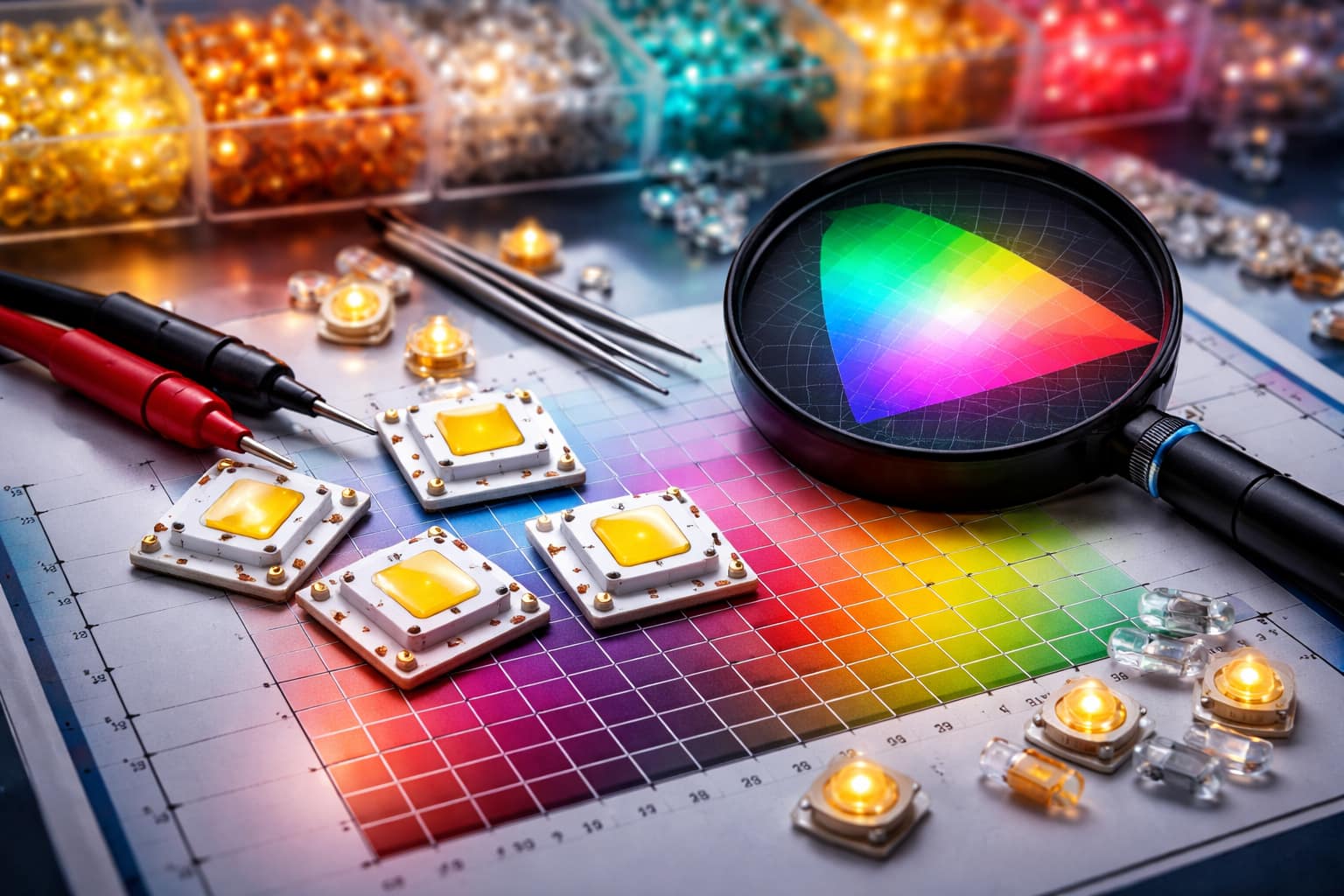
LED bin codes are manufacturer-specific labels that identify the measured performance group of an LED. They may represent color, brightness, forward voltage, or several parameters at once. These codes can look technical, but they are often more useful than a simple marketing label when consistency matters.
A datasheet may show separate codes for chromaticity bins, flux bins, and voltage bins. In professional products, the specification may also reference MacAdam step limits or a stated color consistency promise. A phrase like “3-step MacAdam ellipse or better” is much clearer than a vague claim such as “high color consistency.”
Some products control several parameters at once. For example, color and brightness may be tightly selected, while forward voltage is also sorted to support predictable driver behavior and thermal performance. The more parameters are controlled, the more predictable the product can be, but the narrower the supply stream usually becomes.
What to Look for in a Specification
- ✓Named color consistency target, such as 3-step MacAdam or better
- ✓Clear CCT range instead of only a broad color name
- ✓Flux or lumen tolerance information
- ✓Batch, lot, or bin code documentation for repeat orders
- ✓Replacement guidance if future matching is important
Availability also matters. A theoretically perfect bin may not be easy to source in large quantities or across multiple orders. Good specifications balance visual goals with realistic supply expectations instead of choosing the narrowest possible bin by default.
Why LED Binning Matters in Real Projects
Poor bin control shows up visually faster than many buyers expect. Adjacent fixtures can look warmer, cooler, dimmer, or brighter even when they carry the same rated CCT and lumen label. In spaces where uniformity matters, that can make an installation feel cheaper or less professional almost immediately.
This is why premium linear lighting, architectural products, museums, hospitality spaces, retail environments, display cases, shelves, and visible COB LED strips or other LED strip runs tend to care more about binning than low-cost general utility lighting. The more directly people compare the lights, the more visible bin differences become.
Long-term consistency matters too. Even if a new installation looks good on day one, replacement parts from a different batch can stand out later if the binning or tint control is not close enough. That is one of the main reasons professionals pay attention to bin codes instead of buying only by headline specs.
Best fit for tighter binning: visible rows of fixtures, continuous LED strips, white ceilings, retail shelves, hospitality corridors, galleries, medical spaces, and any project where a warmer, cooler, brighter, or dimmer unit would be easy to spot.
The right binning standard is the one that matches the sensitivity of the application. Art galleries, luxury hospitality, high-end retail, and medical spaces may justify 2-step or 3-step tolerances. Warehouses, utility areas, and some exterior applications can often accept wider bins without causing real problems.
How Manufacturers Test and Sort LEDs
LED binning depends on measurement, not guesswork. Manufacturers use calibrated instruments to measure chromaticity, luminous flux, voltage, and other parameters under controlled conditions. Integrating spheres, spectrometers, and temperature-controlled test setups help make results comparable from one LED to the next.
After measurement, automated systems assign LEDs to the appropriate bins physically or electronically. In large-scale production this happens quickly, but the principle is straightforward: test the LED, compare the result to the manufacturer’s bin structure, then sort it into the matching category.
Buyers and manufacturers may also use incoming inspection, spot checks, and sample verification to confirm that delivered products match the expected binning performance. Portable colorimeters can be useful in the field when a project needs extra quality control during installation.
Commercial lighting specifications often reference ANSI chromaticity regions, MacAdam step limits, and manufacturer consistency guarantees. The U.S. Department of Energy LED lighting guidance and the ENERGY STAR guide to LED lighting basics are not detailed binning manuals, but they are useful references when comparing general LED quality expectations and consistency claims.
What to Check Before Buying LEDs for Consistent Color
If you are buying LEDs for a project where visible consistency matters, do not judge products only by Kelvin, lumens, or wattage. Those numbers are useful, but they do not tell you everything about how closely multiple units will match once installed together.
Do not assume that the same Kelvin rating, lumen rating, or product name guarantees a perfect visual match. LEDs from different batches, broad bins, or mixed suppliers can still look warmer, cooler, brighter, or dimmer once installed together.
Look for products that publish a color consistency target, give a clear CCT range, explain lumen tolerance, and support repeat orders with batch or bin information. Established suppliers are more likely to maintain tighter controls and provide useful data, although brand name alone does not guarantee perfect matching.
What Should You Choose?
- Single lamp or hidden accent: standard binning is usually acceptable.
- Visible LED strip run: choose the same brand, same CCT, same batch if possible, and consider high-CRI COB LED strips with better color consistency.
- Retail, hospitality, gallery, or display lighting: ask for tighter MacAdam tolerance and documented bin control.
- Large phased project: confirm repeat-order availability and replacement strategy before buying.
- Budget-sensitive utility area: a wider bin may be fine if the lights are not compared directly.
Tighter bins usually cost more because they represent a smaller portion of total production. That does not automatically make them overpriced. In projects where mismatched color or uneven brightness would be obvious, that premium can be cheaper than replacing inconsistent fixtures later.
Lead time and availability also affect bin choice. Common bins are easier to source quickly, while specialty bins may require longer manufacturing windows or higher order quantities. The practical goal is not always the tightest possible bin, but the tightest bin that can be sourced reliably for the full scope of the job.
How to Avoid Mismatched Replacement LEDs Later
Even good binning can be undermined by poor project handling. Batch tracking, lot documentation, and organized installation practices help maintain consistency from delivery through commissioning. When replacement parts are needed later, those records make it easier to match what was installed originally.
In mixed or phased projects, placement strategy can also reduce visible differences. If slight variation is unavoidable, separating batches by room, zone, shelf, or visual area may make differences less obvious. This is not a substitute for proper bin control, but it can limit the impact when perfect matching is not realistic.
Maintenance planning should take binning into account, especially in projects with visible fixture rows, continuous runs, or architecturally sensitive spaces. Keeping spare units from the original production batch can make future replacements much less risky.
Aging also matters. LEDs do not all drift in exactly the same way over time, so even a technically matching replacement may look different if the older fixtures have already shifted after years of use. That is why serious projects document bin details, product version, batch information, and replacement requirements from the start.
Will LED Binning Become Less Important?
Manufacturing improvements continue to tighten natural production spreads, which reduces how much sorting is needed to reach a given quality target. Better epitaxial growth, cleaner phosphor control, stronger process monitoring, and smarter automation all help narrow the output range before binning even begins.
That does not mean binning will disappear. It means manufacturers may be able to reach tighter consistency levels with better yield and less waste. In practice, future improvements are likely to make good consistency easier to achieve, not make sorting irrelevant.
The broader LED Knowledge Center is a useful place to keep exploring related topics like chip behavior, color control, phosphor conversion, and long-term LED performance.
FAQ
Does LED Binning Matter for Home Lighting?
Yes, but the level of importance depends on the application. For one isolated lamp, small bin differences may not matter. For several LED bulbs for recessed lighting, visible LED strips, kitchen shelves, coves, or replacement lamps placed near each other, better binning can prevent obvious color or brightness mismatch.
Is a Lower MacAdam Step Always Better?
A lower MacAdam step usually means better color consistency, but it is not always necessary. A 2-step or 3-step tolerance may be worth it for high-visibility projects, while wider tolerances may be acceptable for utility lighting, outdoor areas, or spaces where fixtures are not compared directly.
Can Two LEDs with the Same Kelvin Rating Still Look Different?
Yes. Kelvin describes the general color temperature, but it does not fully describe tint, chromaticity tolerance, brightness tolerance, or batch variation. That is why two 3000K LEDs can still look slightly different if their bins are not close enough.
Should I Buy All LED Strips or Fixtures from the Same Batch?
If the lights will be installed next to each other, buying from the same batch is usually safer. It does not guarantee perfect matching, but it reduces the risk of mixing LEDs from different bin ranges or production runs. For ceiling layouts with several fixtures, matching LED downlight multipacks with CRI over 90 can be safer than mixing separate lights from different orders.
Key Takeaways
LED binning is the process of sorting LEDs by color, brightness, and sometimes voltage so finished products look and perform more consistently. It exists because LED manufacturing always produces some degree of natural variation.
Color binning controls tint and CCT differences, brightness binning controls output differences, LED bin codes identify measured performance groups, and MacAdam steps help describe how much color variation people can actually see.
If a project depends on visual uniformity, LED binning is not a small technical detail. It is one of the main reasons a lighting installation looks polished instead of patchy.
Sharing This Guide
If you found this guide helpful, save it for later or share it with someone trying to understand why LED color and brightness do not always match perfectly.
Interested in learning more? Browse all related articles in our LED Basics category section.