LED Phosphor Technology: How Blue LEDs Become White Light
LED phosphor technology is the reason most white LEDs can produce usable white light from a blue LED chip. The chip creates blue light, the phosphor coating converts part of it into longer wavelengths, and your eye blends the remaining blue with the converted light.
That same conversion step explains why one LED bulb can look warm and natural while another looks cool, harsh, slightly green, or less accurate on skin tones and room colors. Understanding the phosphor layer makes CRI, color temperature, efficiency, color shift, binning, and long-term LED reliability much easier to understand.
Quick Answer
Most white LEDs are made by combining a blue LED chip with a phosphor coating. The coating absorbs part of the blue light and re-emits longer wavelengths; when those wavelengths mix with the remaining blue light, your eye sees white light. That phosphor mix also affects warmth, CRI, efficiency, color shift, and long-term stability.
- Blue LED chip = primary light source
- Phosphor coating = wavelength conversion layer
- White light = converted wavelengths plus some remaining blue
- Better color quality usually requires a more complete phosphor blend, especially in the red part of the spectrum
- Efficiency and lifespan depend on phosphor chemistry, coating design, binder quality, and heat control
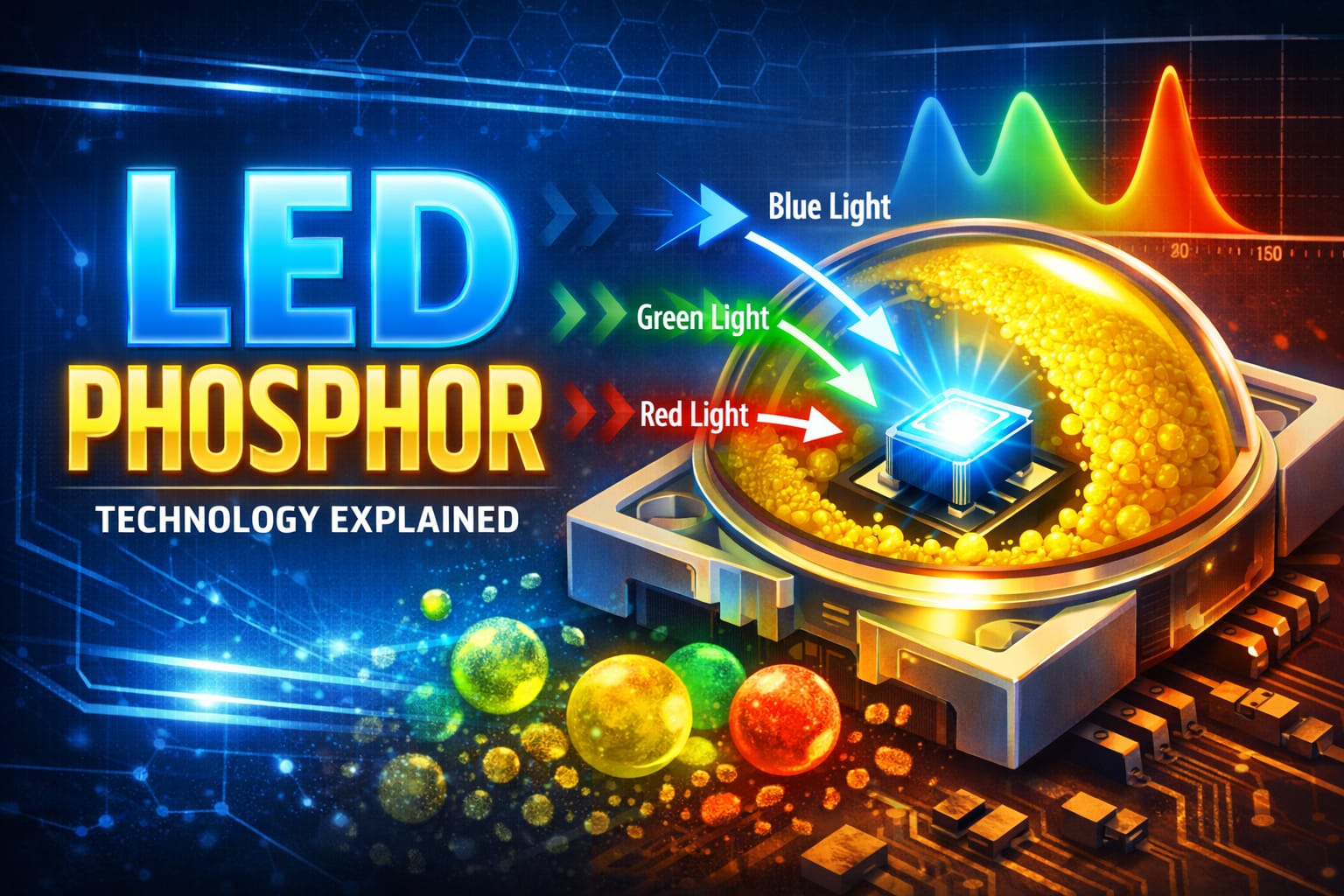
Table of Contents:
How LED Phosphor Conversion Works
LED chips emit light in narrow wavelength bands rather than broad spectra like sunlight. In most white LEDs, the starting point is blue light around 450 to 470 nanometers. On its own, that blue output is too harsh and incomplete for general illumination, so the package needs a conversion layer.
LED phosphor technology solves that problem by placing phosphor materials over or near the chip. The phosphor absorbs part of the blue photons and re-emits light at longer wavelengths, usually in the yellow, green, and red parts of the spectrum. Your eye blends those converted wavelengths with the remaining blue and perceives the result as white light. If you want the broader foundation, this guide on how LED lighting works explains where the conversion step fits inside the full LED system.
The blue LED chip is the foundation of most modern white LED products. Gallium nitride made efficient blue-emitting chips commercially viable, which unlocked mainstream white LED lighting. NeoLEDHub’s guide to LED chip types gives useful extra context if you want to compare chip designs more closely.
Inside the LED
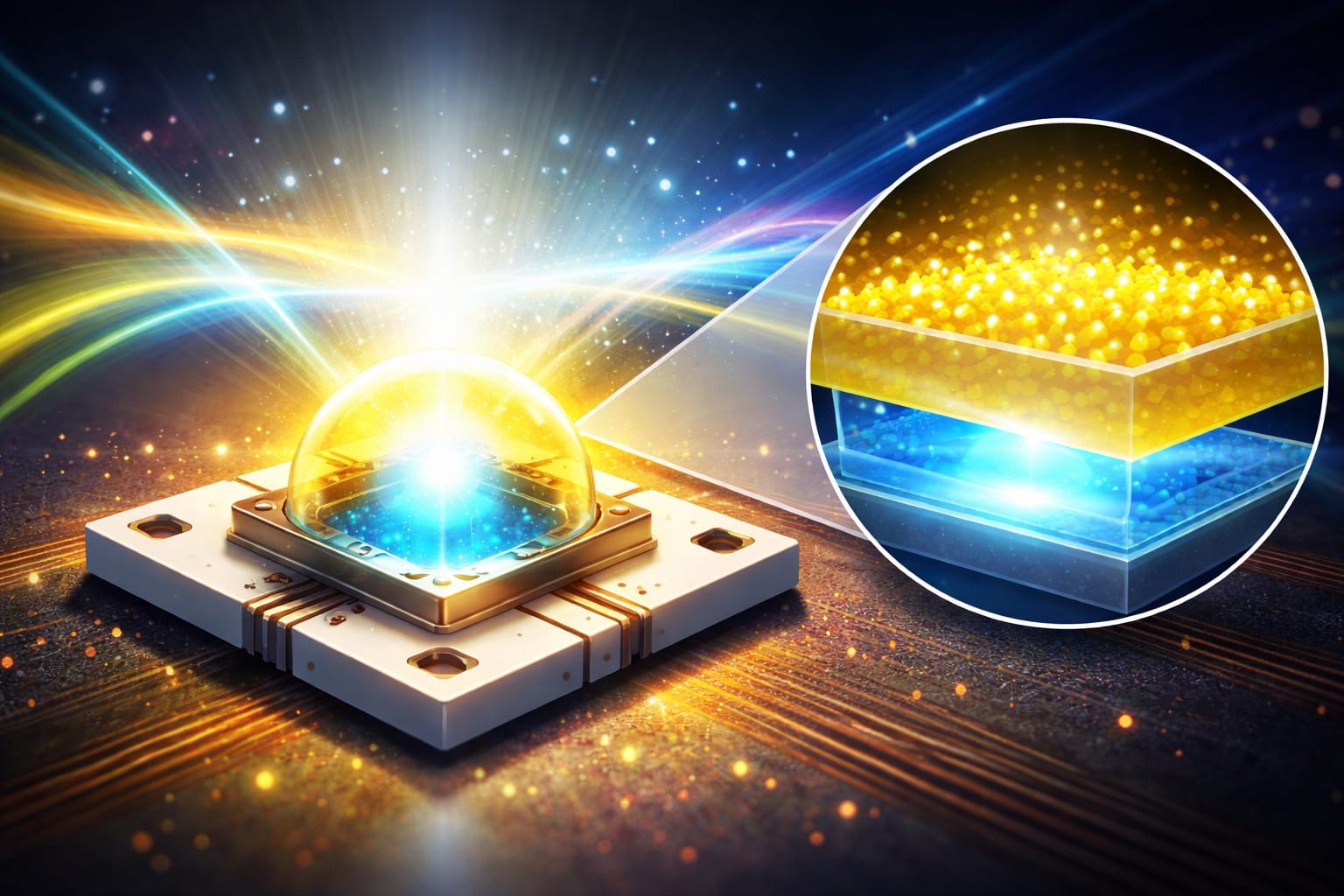
What actually happens inside a white LED? A blue chip creates the initial light, the phosphor converts part of that blue into other colors, and your eye blends everything together into light that looks white. The quality of that mix is what separates harsh-looking white light from balanced, comfortable white light.
What the Phosphor Coating Does
The phosphor coating is where blue light becomes broader-spectrum output. In many standard white LEDs, the best-known material is yttrium aluminum garnet doped with cerium, often written as YAG:Ce. It converts blue light efficiently and produces a strong yellow-green component that mixes well with the remaining blue.
Coating thickness changes how much blue light gets absorbed before leaving the package. Thicker layers usually push the output warmer, while thinner layers let more blue through and generally produce cooler white tones. Manufacturers can apply phosphor directly over the chip or use a remote phosphor design to reduce heat stress and improve uniformity in some applications.
The phosphor particles also need a transparent binder. Better products often use silicone resin because it handles heat more reliably and is less likely to yellow than epoxy. More advanced white LED phosphor systems use multiple materials, including red-emitting phosphors, to improve color rendering and fill spectral gaps, although this usually comes with an efficiency tradeoff.
How Phosphor Affects White Light, CRI, and Color Temperature
White light emission in phosphor-converted LEDs comes from mixing unconverted blue light with converted wavelengths from the phosphor layer. The result can look white to the eye even though the spectrum is not perfectly smooth like natural daylight.
Basic phosphor systems often have a strong blue peak and a broad yellow-green region, but less red spectral content. That is why some lower-cost white LEDs can make skin tones, wood finishes, artwork, food, and saturated colors look flatter or less accurate. Higher-CRI systems add red-emitting phosphors to make the spectrum more complete, especially for warmer residential lighting.
If color accuracy matters, do not choose only by wattage or brightness. Look for CRI 90 LED bulbs with selectable color temperature when lighting kitchens, bathrooms, wardrobes, artwork, desks, or any space where natural-looking color is important.
Color temperature also comes from the phosphor balance. More converted yellow-red content usually creates warmer white light, while more remaining blue tends to create cooler white light. NeoLEDHub’s guide to color temperature explained connects warm white, neutral white, and cool white labels back to the underlying spectrum.
In practical terms, phosphor design affects whether a white LED looks clean, warm, harsh, greenish, bluish, or naturally balanced in real rooms.
Efficiency, Heat, and Long-Term Color Stability
Conversion efficiency tells you how well the phosphor system turns incoming blue photons into useful visible output. Some energy is always lost as heat, and larger wavelength shifts usually mean bigger losses. That is why red conversion is more expensive from an energy standpoint than yellow conversion, and why warm white or high-CRI LEDs can trail cooler white LEDs in lumens per watt.
Overall LED efficacy combines chip efficiency, phosphor efficiency, optical extraction, and thermal design. In typical general-lighting products, phosphor-converted systems commonly land in a broad range around 100 to 150 lumens per watt depending on color quality targets, package design, and operating conditions. This lumens per watt guide explains what those efficiency figures mean in practice.
Heat is one of the most important limits. As the phosphor coating warms up, conversion efficiency can drop and color output can shift slightly, a behavior often described as thermal quenching. Good package cooling and heat sink design help protect chip efficiency, preserve color quality, and slow long-term aging. NeoLEDHub’s guide to LED heat sink and cooling design explains how the thermal side connects to reliability.
Do not use high-output LED bulbs inside fully enclosed fixtures unless the bulb is rated for enclosed use. Trapped heat can accelerate phosphor degradation, reduce brightness, and cause visible color shift over time.
No phosphor system stays perfectly unchanged forever. Heat, high-energy blue light, binder aging, and repeated thermal stress can gradually cause dimming, tint shift, or uneven light quality. Color shift matters because phosphors do not always age evenly; if one part of the conversion layer weakens faster, the LED can drift cooler, greener, or less pleasant. NeoLEDHub’s LED light degradation guide connects phosphor aging with the broader ways LEDs lose performance over time.
Manufacturing, Binning, and Quality Differences
Phosphor quality depends on chemistry, binder choice, coating thickness, and process control. Small variations in powder synthesis, dispensing, curing, or package geometry can show up later as brightness variation, tint inconsistency, or uneven color from one LED to another.
Finished LEDs need to be sorted by brightness and color so products stay inside target tolerances. That is where LED binning becomes important. Even good phosphor-converted LEDs show natural variation, so binning helps deliver a stable final product rather than leaving visible mismatch between bulbs or batches.
Not all phosphor-converted LEDs perform the same way. Higher-end products usually use purer phosphor materials, more stable binders, better package design, and tighter process control. CRI is one useful indicator: basic white LED systems often land around CRI 80, while refined multi-phosphor systems can reach the 90 to 95 range with better spectral balance, especially in reds.
If two LED bulbs have similar wattage and lumens, the one with tighter color consistency, higher CRI, better thermal design, and credible testing is usually the safer choice for rooms where light quality matters.
Certification does not reveal every detail of the phosphor formulation, but it helps filter out weaker products. Programs such as ENERGY STAR and DesignLights Consortium rely on testing for efficiency, color, lumen maintenance, and long-term stability. The U.S. Department of Energy LED lighting guidance and the ENERGY STAR guide to LED lighting basics are useful consumer-facing references for understanding quality and efficiency claims.
Where Phosphor Quality Matters Most
Different applications ask different things from phosphor-converted LEDs. Residential lighting often prioritizes pleasant color temperature and good color rendering, while commercial or outdoor lighting may accept lower CRI in exchange for higher efficiency, visibility, or output.
Phosphor quality is especially noticeable in kitchens, bathrooms, bedrooms, wardrobes, artwork, retail displays, and camera-facing spaces because people quickly notice when skin tones, fabrics, food, wood, or painted surfaces look wrong. In those spaces, choosing only by brightness can produce a light that is powerful but visually uncomfortable.
Specialty applications push the idea further. Horticultural lighting uses spectral recipes tuned for plant response, medical and inspection lighting often need exceptional color rendering, and display backlighting uses narrow-band conversion materials for wider color gamut. Traditional phosphors are still the standard, but quantum dots, narrow-band phosphors, and tunable white systems continue to improve spectral control. For home lighting, tunable white smart bulbs for adjustable color temperature bring that same idea into everyday use by letting the light shift from warmer evening tones to cooler task-friendly white when needed.
That flexibility is one of the biggest reasons LED phosphor technology has become so dominant. It allows one core architecture to be adapted across bulbs, strips, commercial fixtures, displays, and specialty lighting. The broader LED Knowledge Center is a good place to explore those application differences in more detail.
FAQ
What Is LED Phosphor Technology?
LED phosphor technology is the wavelength conversion system used in most white LEDs. A blue LED chip creates the initial light, and a phosphor coating converts part of that blue light into longer wavelengths so the final output appears white.
Why Do White LEDs Usually Start With Blue Light?
Blue light has enough energy to excite common LED phosphor materials. The phosphor can then re-emit part of that energy as yellow, green, or red light, which mix with the remaining blue light to create white light.
Does Phosphor Affect CRI?
Yes. The phosphor mix strongly affects CRI because it shapes the final spectrum. Basic phosphor systems may produce acceptable white light but weaker red content, while multi-phosphor systems can improve color rendering and make objects look more natural.
Do LED Phosphors Wear Out?
They do not usually fail suddenly, but they can degrade gradually. Heat, blue-light exposure, binder aging, and thermal cycling can reduce output or shift color over time, especially in lower-quality LED packages or poorly cooled fixtures.
Are All White LEDs Phosphor-Converted?
Most general white LEDs are phosphor-converted, but not every white-light system works the same way. Some designs use different LED combinations or more specialized conversion materials, especially in displays, tunable systems, and high-end color-critical applications.
Key Takeaways
LED phosphor technology works by combining a blue LED chip with a conversion layer that re-emits longer wavelengths. The mix of converted light and remaining blue output is what creates white light emission.
Phosphor chemistry, coating thickness, binder quality, optical extraction, and temperature control all affect color quality, efficiency, and long-term stability. That is why not all white LEDs perform the same, even when their wattage or brightness looks similar.
Once you understand the blue LED chip, phosphor coating, and spectral tradeoffs behind white LEDs, topics like CRI, color temperature, binning, lumen maintenance, and color shift become much easier to understand.
Sharing This Guide
If you found this guide helpful, save it for later or share it with someone trying to understand how white LEDs actually work.
Interested in learning more? Browse all related articles in our category section.