Best LED Hallway Lights: Flush Mounts, Sconces, Recessed & Motion Sensors
The best LED hallway lights depend on how the space is used. For most homes, a low-profile flush-mount or recessed LED fixture works best for general hallway lighting, wall sconces add a more finished look, and motion-sensor or plug-in night lights are the smartest choices for late-night safety.
This guide helps you choose the right hallway lighting fixtures by ceiling height, hallway width, night use, color temperature, and fixture style, so the corridor feels safer, brighter, and more comfortable without looking harsh or overlit.
Quick Answer: Best LED Hallway Light by Situation
For most hallways, the best overall choice is a low-profile flush-mount LED ceiling light. Use recessed lights for low ceilings or narrow corridors, wall sconces for a more designed look, and motion sensor or plug-in LED night lights for safer movement at night.
- Best overall: flush-mount LED ceiling fixture
- Best for low ceilings: recessed or wafer LED lights
- Best for style: LED wall sconces
- Best for night use: motion sensor hallway lights or plug-in LED night lights
- Best upgrade: dimmers or smart controls for softer nighttime lighting
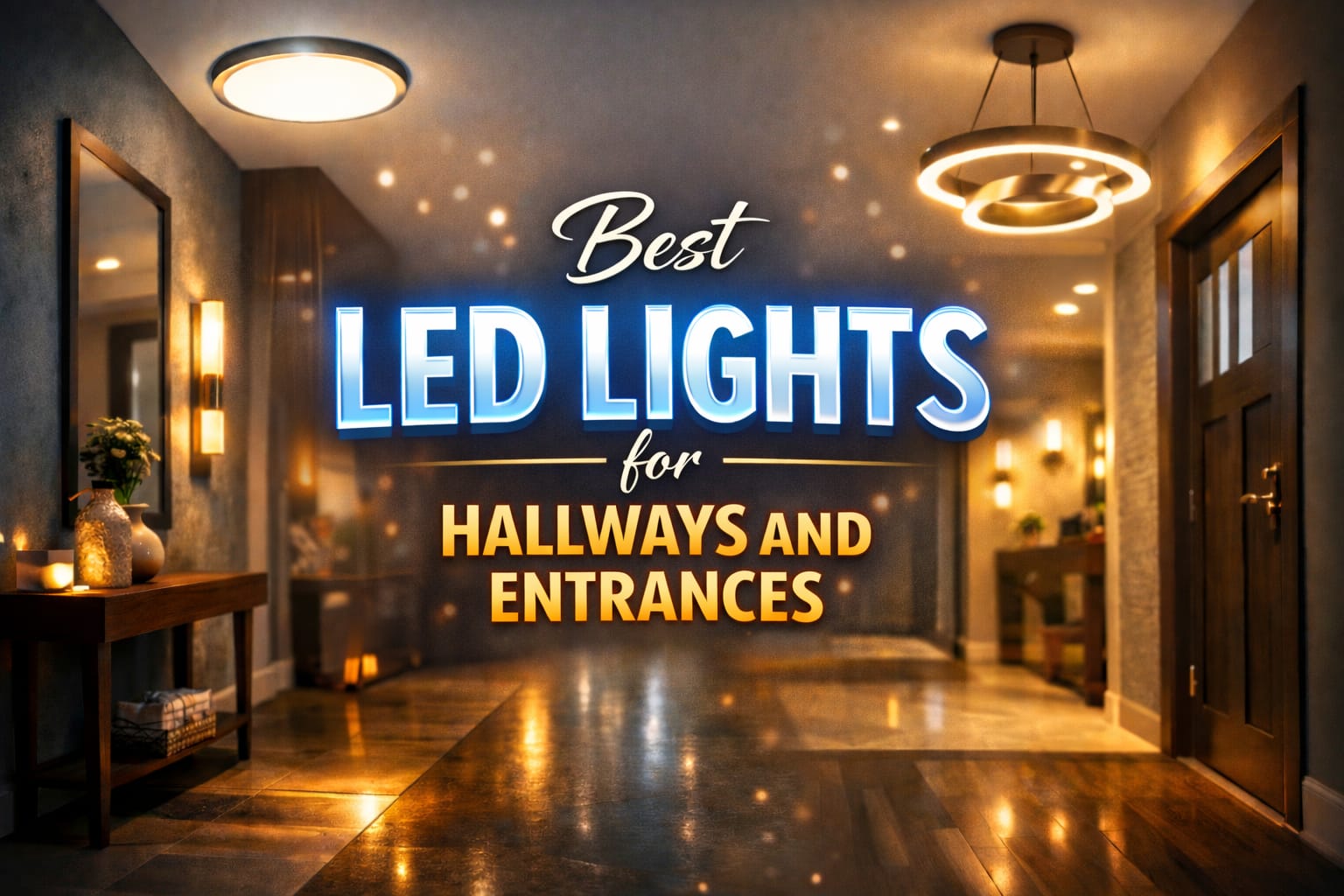
Dealing with a very tight corridor instead of a standard hallway? Our guide to lighting for narrow hallways goes into more detail about fixture scale, visual width, wall brightness, and how to avoid making the space feel boxed in.
Table of Contents:
- Quick Answer
- How Bright Should Hallway Lights Be?
- Best Overall: Flush-Mount LED Ceiling Fixtures
- Best for Style: LED Wall Sconces
- Best for Low Ceilings: Recessed LED Hallway Lights
- Best for Night Use: Motion Sensor Hallway Lights
- Dimmers and Smart Controls
- Best Color Temperature for Hallways
- Spacing, Placement, and Entrance Lighting
- Which Hallway Light Should You Choose?
- FAQ
- Sharing This Guide
How Bright Should Hallway Lights Be?
Hallway lighting should make movement safe without making the corridor feel exposed, cold, or overlit. A useful starting point is 10 to 20 lumens per square foot, adjusted for ceiling height, hallway length, wall color, and how much natural light reaches the space.
A short hallway with pale walls may only need modest output. A long corridor, darker paint color, L-shaped layout, or hallway that connects to stairs may need stronger or more evenly spaced LED lighting. The goal is not maximum brightness. The goal is even visibility across the floor, doorways, corners, and transitions.
If your hallway connects to steps or landings, treat the area as both a hallway and a stairway transition. You want good visibility at each end and no dark gap in the middle. For that kind of layout, our guide to lighting design for staircases is one of the most relevant next reads.
For late-night movement, you usually do not need the main hallway fixture at full brightness. A low-level plug-in LED night light, a small motion-activated path light, or a dimmed ceiling fixture can make trips to the bathroom, the stairs, or children’s rooms much safer without waking everyone up.
Best Overall: Flush-Mount LED Ceiling Fixtures
For most people looking for the best LED hallway lights, ceiling-mounted fixtures are still the safest all-around answer. They provide broad, dependable illumination, work well in long or straight corridors, and suit both modern and traditional interiors.
Flush-mount fixtures are usually the best choice for standard-height hallways because they keep a slim profile and avoid visual clutter. A simple fixture with a diffused lens normally performs better than a decorative light that creates glare, sharp shadows, or uneven brightness along the corridor.
A low-profile LED ceiling light for hallways is a practical fit here when you want broad general lighting, adjustable color temperature, and a fixture that does not become the main focal point.
Semi-flush fixtures can work in taller hallways, but they need enough clearance to avoid making the space feel cramped. In a narrow or busy hallway, simpler is usually better: a clean LED ceiling fixture, soft diffusion, and a comfortable warm or neutral white output.
If the fixture is bright enough but still feels uncomfortable, this guide on how to reduce glare in hallway lighting explains how diffusion, placement, and beam control can make the space easier on the eyes.
Linear LED fixtures can also be a strong option in longer corridors because they naturally follow the shape of the hallway. They often spread light more evenly along the length of the space and can look cleaner than several small round fixtures in a row, especially in minimalist or modern entrance lighting designs.
Best for Style: LED Wall Sconces
LED wall sconces are one of the best hallway lighting fixtures when style matters as much as visibility. They add character, make the hallway feel more finished, and can visually widen a corridor by drawing attention to the walls instead of only lighting the floor.
Sconces work best when they are mounted high enough to avoid glare and spaced in a rhythm that feels intentional rather than crowded. Softly diffused, shaded, or uplight sconces are usually better than harsh directional beams in residential hallways because they make the space feel comfortable instead of clinical.
A simple modern LED wall sconce works especially well in corridors and entrance areas where you want the lighting to feel more designed without relying on a strong overhead fixture alone.
If your hallway doubles as a gallery, sconces or directional fixtures can also frame artwork, photographs, textured walls, or trim details. In that case, look for good color rendering so wall colors and artwork do not appear flat or dull.
Best for Low Ceilings: Recessed LED Hallway Lights
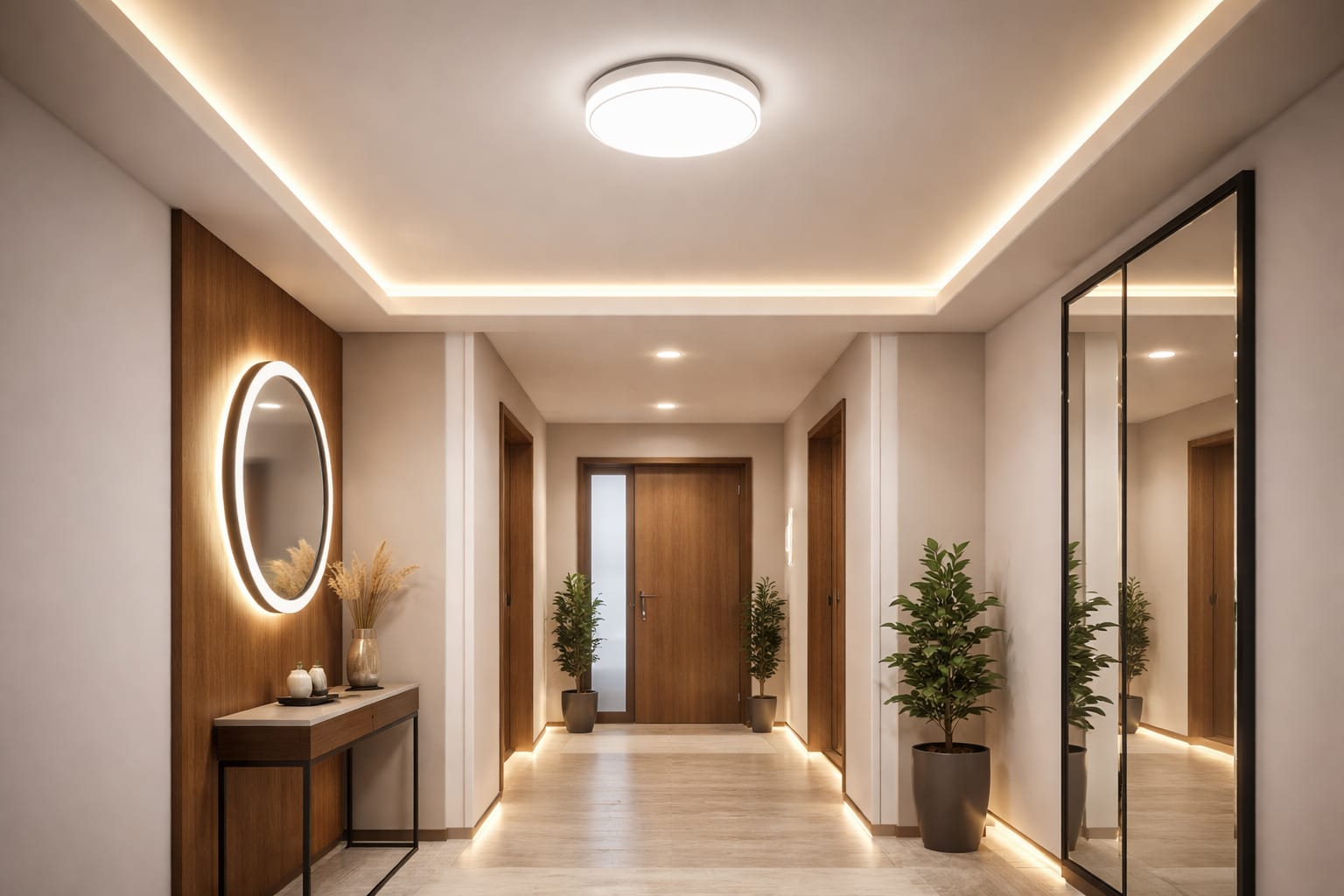
Recessed LED hallway lights are the best choice when you want clean lines and almost no visual bulk on the ceiling. They are especially useful in low ceilings, narrow corridors, contemporary homes, and hallways where a hanging or semi-flush fixture would feel too heavy.
The main mistakes are poor spacing and trims that create too much glare. In many hallways, a few well-positioned recessed or wafer LED lights are better than overloading the ceiling with too many fixtures. The light should overlap softly, not create alternating bright spots and dark patches.
If the ceiling is low, recessed lighting is often one of the smartest ways to avoid crowding the space. Our guide to lighting for low ceilings covers fixture depth, visual comfort, and placement in more detail.
If your hallway uses recessed cans instead of integrated fixtures, this guide to the best LED bulbs for recessed lighting can help you choose bulbs with the right brightness, beam spread, and color temperature.
Adjustable trims can help if your hallway has artwork, alcoves, or one wall that needs more emphasis. They are not necessary in every hallway, but they are useful when standard downlighting feels too flat or when you want to avoid the tunnel effect.
If you are unsure whether to choose flush-mount or recessed lighting, let ceiling height be your first deciding factor. Standard ceilings usually suit flush mounts. Low ceilings usually benefit from the least bulky option.
Best for Night Use: Motion Sensor Hallway Lights
Motion sensor hallway lights are one of the most practical upgrades for homes where people regularly walk through the corridor with their hands full, children move around at night, or lights are often left on by mistake. They improve convenience, safety, and energy use without changing the whole lighting plan.
The best motion sensor setup turns on before you fully enter the hallway, stays on long enough to feel natural, and turns off without leaving the light running for too long. In most homes, two to five minutes is enough for bedrooms, upstairs landings, bathroom routes, entryways, and short corridors.
Sensor placement matters more than people think. A sensor should detect movement as you approach the hallway, not only after you are already inside it. Avoid placing sensors where they trigger constantly from nearby living spaces unless that is your intention. Reliable activation feels invisible. Poor activation becomes annoying very quickly.
For low-level nighttime guidance near bedroom doors, bathroom paths, stair edges, or the end of a hallway, a plug-in motion sensor LED night light can be more comfortable than switching on the main ceiling fixture.
If your main goal is to reduce wasted runtime, our guide to energy savings using motion sensors is closely related to this section.
Dimmers and Smart Controls
Dimming is one of the most underrated upgrades for hallway lighting. Full brightness is useful during the day, but at night it can feel excessive, especially if the hallway connects to bedrooms, a bathroom, or a staircase. A dimmable setup lets the same LED hallway light work for both daytime visibility and softer nighttime movement.
Good dimming should be smooth, stable, and usable across a practical range. If you plan to dim hallway lighting regularly, make sure the fixture, bulb, and dimmer are compatible. Otherwise, you may get buzzing, flicker, unstable brightness, or a poor dimming range.
Smart lighting also fits hallways well because these are high-use spaces with predictable routines. Schedules, voice control, motion triggers, remote shutoff, and evening scenes can all be useful, but the smartest setup is not always the most complicated one. In many homes, a dimmable LED fixture and a motion sensor switch are enough.
Preset scenes are useful if your hallway is part of a broader smart home setup. A brighter arrival scene and a softer bedtime scene can make the space more comfortable without manual adjustments every time.
Best Color Temperature for Hallways
Color temperature has a major effect on how hallway lighting feels. Warm white, around 2700K to 3000K, usually creates the most welcoming result in residential spaces. Neutral white, around 3500K to 4000K, works well for hallways that need a cleaner, brighter, more functional look.
Very cool white light often feels too clinical for most homes unless there is a specific design reason for it. Hallways connect rooms, so consistency matters. If your entrance, corridor, bedrooms, and nearby living spaces all have noticeably different whites, the transition can feel awkward.
For a full breakdown of how these tones behave, see Color Temperature Explained.
Color rendering also matters if the hallway includes artwork, colored walls, wood trim, or decorative finishes. A CRI of 80 or higher is suitable for many hallways, but higher CRI lighting can make the corridor feel more natural and less flat when finishes and wall colors are part of the design.
The U.S. Department of Energy explains that choosing LEDs is not only about efficiency but also about selecting lighting that fits the application. Its LED lighting guidance is a useful reference for understanding performance, efficiency, and application fit.
Spacing, Placement, and Entrance Lighting
Even the best LED hallway lights can perform poorly if they are placed incorrectly. Too much space between fixtures creates dark patches. Fixtures placed without considering doorways, turns, stairs, or focal points can make the corridor feel uneven and awkward.
The goal is usually to create soft overlap between fixtures so the light feels continuous rather than patchy. A long straight corridor is different from an L-shaped hallway. A hallway with artwork differs from one that mainly serves bedrooms. Narrow corridors often benefit from vertical emphasis or wall washing, while wider ones can carry stronger ceiling fixtures without feeling cramped.
If your hallway has architectural features such as beams, alcoves, artwork, or strong trim details, align the lighting with those elements rather than ignoring them. Lighting looks better when it feels tied to the architecture, and this helps avoid the random builder-grade look many hallways end up with by default.
When a hallway begins at the entrance, the lighting has to do two jobs. It needs to be bright enough for tasks like finding keys, putting on shoes, or checking bags, but also warm and inviting enough to set the tone for the home. In many entries, the best approach is layered lighting: a central ceiling fixture for visibility plus a sconce, console lamp, or accent light if the space allows.
Coat closets just off the hallway often benefit from simple automatic LED lighting, especially in older homes where these spaces are poorly lit. Motion-activated strip lights or compact battery units can make small storage areas easier to use without requiring a full wiring project.
Which Hallway Light Should You Choose?
The best choice depends on the hallway size, ceiling height, style goal, and how the space is used every day.
- Choose a flush-mount LED ceiling fixture if you want the safest all-around option for most standard hallways
- Choose recessed or wafer LED lights if the ceiling is low, the corridor is narrow, or you want the cleanest ceiling line
- Choose LED wall sconces if the hallway is visible from living areas or you want it to feel more designed
- Choose motion sensor hallway lights if the space is used at night, connects bedrooms and bathrooms, or lights are often left on
- Choose dimmers or smart controls if the hallway needs bright daytime lighting and softer nighttime lighting from the same setup
- Choose warm white for a softer home feel and neutral white for a cleaner, brighter corridor
FAQ
What Type of LED Light Is Best for a Hallway?
For most homes, a low-profile flush-mount LED ceiling light is the best all-around option. Recessed lights are better for low ceilings, wall sconces are better for style, and motion sensor or plug-in night lights are better for late-night safety.
Are Motion Sensor Lights Good for Hallways?
Yes. Motion sensor lights are especially useful in hallways used at night, entryways, upstairs landings, and paths between bedrooms and bathrooms. They work best when the sensor detects movement before you fully enter the corridor.
Should Hallway Lights Be Warm White or Neutral White?
Warm white around 2700K to 3000K is usually best for a welcoming home hallway. Neutral white around 3500K to 4000K works well when the hallway needs to feel brighter, cleaner, or more functional.
How Many Lights Does a Hallway Need?
It depends on the length, ceiling height, fixture output, and wall color. The safest approach is to avoid one bright light at one end and instead create even coverage with soft overlap between fixtures.
Want to compare more room-specific ideas? The LED Knowledge Center brings together lighting design, bulb buying, smart control, and troubleshooting guides so you can build a consistent setup throughout your home.
Sharing This Guide
If you found this guide helpful, you can save it for later or share it with a friend. It is especially useful for homeowners planning hallway upgrades, entrance remodels, or better night lighting.
Share using the links below
Interested in learning more? Browse all related articles in our category section.