SMD LED Strip Lights: Benefits, Uses, and Complete Guide
SMD LED strip lights are one of the most common and practical types of flexible lighting for homes, shops, offices, and decorative installations. They use surface-mounted LED chips on a flexible circuit board, which makes the strips slim, efficient, and easy to install in tight spaces.
If you are just getting started, our beginner’s guide covers the basics. It focuses specifically on how SMD strips work, their benefits, and how to choose the right version for your space.
Quick Answer
SMD LED strip lights use surface-mounted LED chips fixed directly onto a flexible board. They are popular because they are efficient, affordable, easy to install, and available in many sizes, brightness levels, and colors.
- They are good for accent lighting, task lighting, and decorative lighting.
- Common chip sizes include 3528, 5050, and 2835.
- Available in single-color, RGB, RGBW, and waterproof versions
- They usually run on 12V or 24V low-voltage systems.
- Best results come from matching the chip type, power supply, and installation surface.
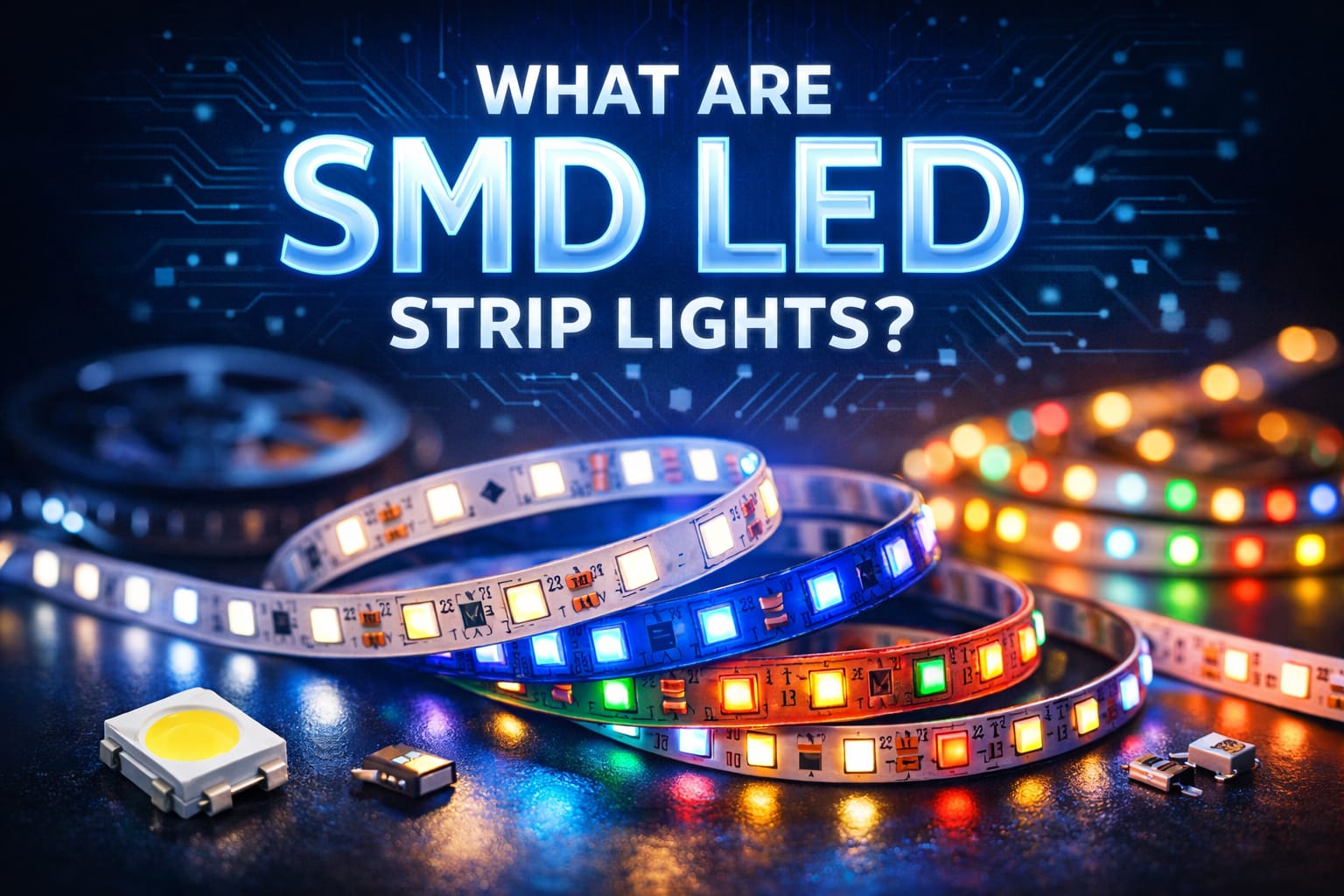
Table of Contents
Understanding the Technology
SMD LED strip lights use surface mount device (SMD) packages that are soldered directly onto flexible printed circuit boards. Unlike older through-hole designs, these components sit flat on the board’s surface. This allows the strip to remain thin, lightweight, and flexible enough to bend around corners and curved details.
Each LED package contains one or more semiconductor chips inside a protective housing that manages light output, heat, and durability. Because the packages are compact and flush-mounted to the board, the strip can fit into tight spaces, such as cabinets, shelving, coves, stair nosings, and display edges.
Most products have densities ranging from about 30 to 120 LEDs per meter. Higher-density strips tend to appear brighter and more uniform, while lower-density strips are often sufficient for decorative or low-level accent lighting. While you will still see the individual light points on most SMD strips, for many projects, the balance of performance and value is exactly what makes them appealing.
However, poorly built high-density strips can show flicker or inconsistent output over time. This is one reason many buyers choose high-density LED strip kits for more stable everyday lighting.
How manufacturing works
The manufacturing process of SMD LED strip lights directly affects their brightness, consistency, safety, and long-term reliability. Production typically begins with a flexible printed circuit board made with copper traces and carefully prepared contact points for the LED packages and supporting components. From that point on, material quality and process control become critical because they influence not only light output but also heat handling, voltage stability, and how well the strip tolerates bending, cutting, and everyday use after installation.
Assembly Process
Automated pick-and-place machines then position LED chips, resistors, and other small components with very high precision. The strip then passes through a reflow soldering process, where controlled heat melts the solder paste and permanently bonds each component to the board. This stage needs tight control because uneven heating, weak solder joints, or inaccurate component placement can lead to visible performance issues later, especially on longer runs or higher-density strips.
A well-assembled strip should have clean solder joints, stable conductivity, and consistent spacing between components across the full length of the reel. Poor assembly quality can cause flickering, dead sections, color inconsistency, or premature failure from repeated bending and daily operation, which is why manufacturing precision matters just as much as the chip type itself.
Quality Standards
After assembly, reputable manufacturers inspect and test the strips to verify electrical continuity, voltage stability, color consistency, and thermal performance. Some strips are also coated with silicone or resin layers to improve resistance to dust, humidity, and corrosion, especially in waterproof models. These checks help confirm that the strip will perform evenly from one section to the next and remain safe under normal operating conditions.
The quality of the copper, the thickness of the circuit board, the precision of the soldering, and the consistency of the LED binning all influence how well the strip performs over time. In short, two strips may appear similar, but differences in manufacturing quality often determine whether they provide stable, efficient lighting or develop problems after installation. If you want more advanced effects, consider individually controllable pixel options. These build on the same basic strip format but add control circuitry that allows different sections or pixels to display different colors and patterns.
Key advantages
One of the biggest advantages of SMD LED strip lights is their versatility. Their slim, flexible design allows them to fit into spaces where rigid fixtures would look bulky or simply would not fit. This makes them useful for under-cabinet lighting, cove lighting, shelving, displays, signage, and many other projects.
They are also highly energy efficient. Quality strips convert most of their electrical input into visible light rather than excess heat, which lowers running costs and reduces strain in enclosed installations. Their long lifespan adds even more value by reducing the frequency of replacements.
For a cleaner-looking result, pair SMD strips with an aluminum channel and diffuser. This improves heat management, protects the strip, and softens visible light points.
Installation is usually straightforward because most strips have an adhesive backing and run on low-voltage power supplies. Buyers can choose from many chip sizes, densities, colors, waterproof ratings, and control options, making it easier to match the strip to a room’s or project’s exact needs.
Common chip sizes
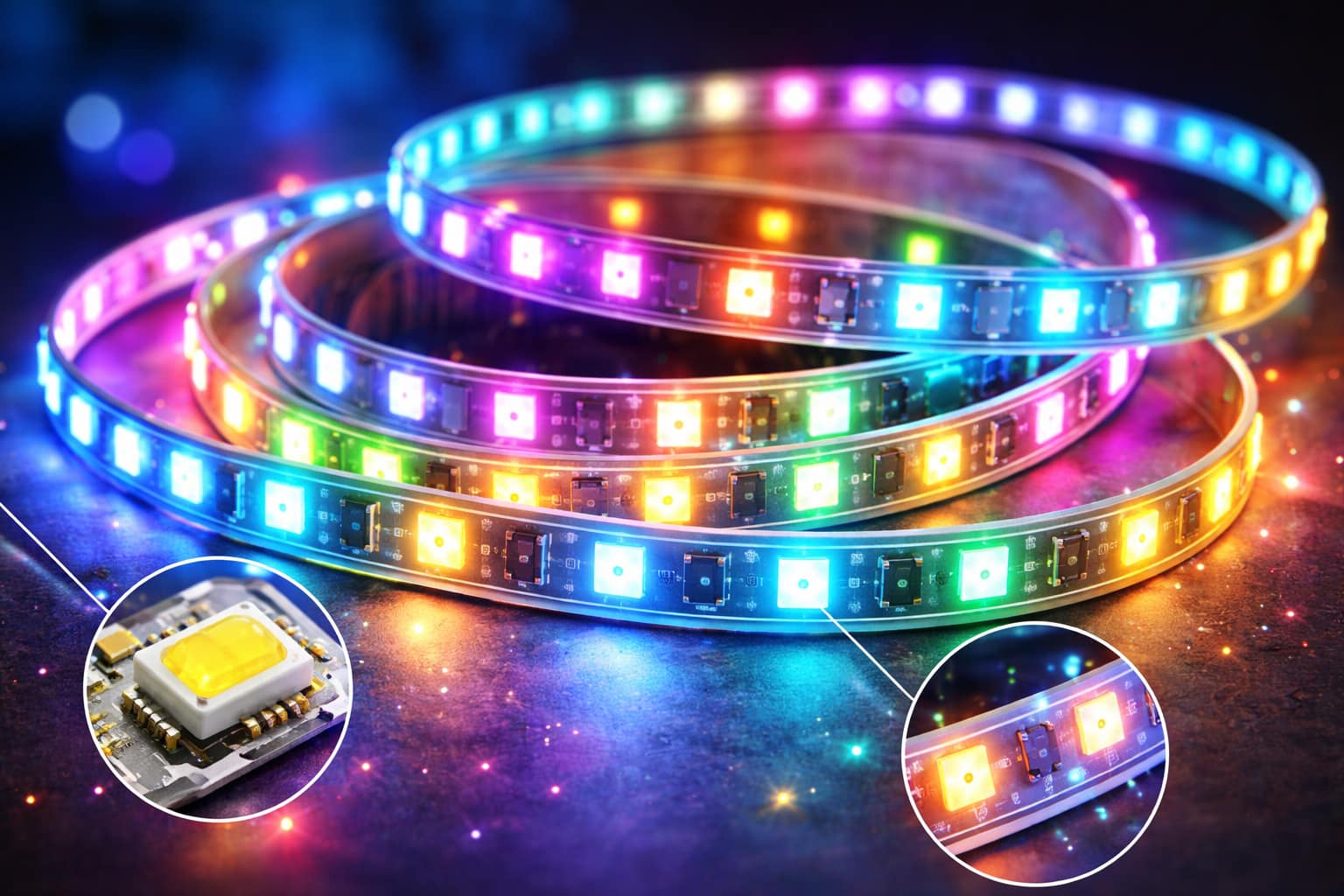
Chip size labels, such as 3528, 5050, and 2835, describe the approximate dimensions of the LED package in millimeters. These numbers are useful because they often indicate brightness potential, efficiency, and the types of applications for which the strip is best suited.
Smaller 3528 chips are commonly used for decorative lighting and lighter-duty accent applications. They typically offer moderate output, low power consumption, and decent uniformity when used at higher densities.
5050 chips are larger and often contain three emitters in one package. This makes them ideal for brighter white lighting or RGB color mixing. They are widely used when more output or dramatic visual effects are desired.
2835 chips are popular in modern strips because they deliver excellent efficiency for their size. Often, they can match or exceed the real-world performance of older options while using less power. For long ambient runs, many users prefer the efficient 2835 LED strips for better comfort and more consistent lighting.
Color options
SMD LED strip lights are available in a wide range of color configurations, making them suitable for both functional and decorative use. The right choice depends on whether you need practical everyday illumination, subtle ambient light, or a more dynamic system for visual scenes and color effects. This flexibility is one of the main reasons SMD strips are used in everything from simple home projects to more customized residential and commercial installations.
Single-color variants
Single-color strips are commonly offered in warm white, neutral white, cool white, and solid colors such as red, blue, or green. White strips are often chosen for practical lighting because color temperature strongly affects the mood and usefulness of a space. Our guide to understanding color temperature in LED lighting explains how to choose the right tone for different spaces.
Warm white creates a softer, more relaxing atmosphere, cool white feels brighter and more clinical, and neutral white offers a balanced tone that works well in many residential and commercial settings. Solid-color strips are also useful when you want a bold decorative effect, signage lighting, themed spaces, or a consistent accent color without the need for a controller.
Multi-color capabilities
For more dynamic lighting, RGB, RGBW, and tunable white strips provide additional flexibility. RGB strips mix red, green, and blue light to create a wide selection of colors, making them ideal for mood lighting, media rooms, gaming setups, and decorative accents. They are especially useful when you want one installation to deliver multiple looks instead of a fixed lighting result.
RGBW strips take it a step further by adding a dedicated white channel, which produces cleaner and more usable white light than standard RGB mixing alone. Advanced systems may also include tunable white or dual-white technology, allowing users to adjust the color temperature from warm to cool depending on the time of day, the room’s purpose, or the desired atmosphere. This makes them a strong option for spaces that need both decorative flexibility and practical everyday lighting.
Brightness levels
Brightness varies based on chip type, LED density, power draw, and strip design. Lower-output strips may suffice for ambient or decorative lighting, whereas task lighting often requires higher lumen output and better heat management.
As a rough guide, 200 to 400 lumens per meter is suitable for subtle accent lighting, and 600 to 1,000 lumens per meter is better for general ambient lighting. High-output strips can exceed 1,500 lumens per meter, making them suitable for more demanding applications, such as worktops, retail displays, and workshop areas.
According to the U.S. Department of Energy, selecting an appropriate light level improves efficiency and visual comfort. Too much brightness can create glare, while too little reduces usability and safety.
Installation Basics
A clean installation starts with planning the layout, taking careful measurements, and preparing the mounting surface. Dust, grease, and moisture can weaken the adhesive backing, so clean the area with isopropyl alcohol and allow it to dry completely before applying the strip.
Only cut the strip at the marked cut points. Cutting elsewhere can break the circuit and render the separated section unusable. If you need turns, extensions, or reconnections, ensure that the connectors or solder joints match the strip’s width and voltage.
Aluminum channels can make a significant difference, particularly for brighter installations. They improve heat dissipation, protect the strip, and enable the use of a diffuser to achieve a polished look. Many setups benefit from aluminum diffuser channels, which reduce glare and improve the final finish.
Do not assume that the adhesive backing alone is sufficient for every surface. Textured walls, dusty wood, hot areas, and outdoor locations often require clips, channels, or additional mounting support.
When making electrical connections, always check the polarity and voltage before powering on the strip. Reversed polarity will usually prevent the strip from lighting up, and using the wrong power supply can damage the LEDs or shorten their lifespan.
Power Considerations
Power planning is one of the most important parts of any LED strip setup. First, check the strip’s wattage per meter. Then, multiply it by the total run length. Finally, add some headroom so the power supply does not run at full capacity all the time.
Most SMD LED strip lights use either 12V or 24V DC systems. For longer runs, 24V is often the better choice because it reduces current and helps limit voltage drop. Our guide to LED strip voltage — 5V, 12V, and 24V compared explains where each option makes the most sense.
Longer runs may also require power injection, meaning power is fed into additional points along the strip to maintain consistent brightness from end to end. Without power injection, the far end of the strip may appear dimmer or change color slightly.
Waterproofing ratings
Ingress Protection ratings indicate how well a strip resists dust and moisture. It’s important to choose the right rating because too little protection can lead to corrosion or failure, while too much encapsulation can increase cost and reduce heat dissipation unnecessarily.
IP20 strips are designed for dry indoor areas. They are simple and affordable and usually dissipate heat well. However, they should not be exposed to splashes, humidity, or condensation.
IP65 strips have a protective coating that resists dust and water jets. This makes them a better fit for kitchens, bathrooms, and sheltered outdoor installations. For more information on what each protection level means, see our full guide to IP ratings for LED strips.
IP67 and IP68 versions are designed for more demanding environments, including areas where temporary or continuous submersion may occur. These versions require extra attention to heat buildup, particularly in long or high-output installations.
Best use cases
SMD LED strip lights are ideal for projects that require flexibility, low-profile installation, and versatile lighting output. The best use case depends on brightness, waterproofing, control options, and how visible you want the individual light points to be, but in general they work best where you want effective lighting without the visual bulk of traditional fixtures. Their slim format makes them easy to hide under edges, inside recesses, or along architectural details while still delivering useful ambient, accent, or decorative light.
Residential applications
In homes, SMD LED strip lights are commonly used under kitchen cabinets, inside wardrobes, behind televisions, along staircases, on shelves, and in ceiling coves. Their slim shape makes them especially effective for ambient and accent lighting, helping define architectural lines, highlight furniture, and add soft background light without taking up visible space.
They also work well for display shelves, gaming setups, and entertainment units because the strips can be easily hidden while still creating a strong visual impact. Dimmable versions provide even greater flexibility for everyday use, and warmer white options are often preferred in living areas where comfort and a softer atmosphere matter most.
Commercial uses
In commercial settings, SMD strips are widely used for retail displays, hospitality interiors, reception areas, signage, product shelving, and decorative architectural details. Businesses often use them to draw attention to merchandise, improve the appearance of counters and displays, or create a distinctive branded environment using white or color-changing light.
They are also practical in work areas when the correct brightness and color temperature are selected. Overall, SMD strips are ideal for lighting that is easy to hide, adaptable to different layouts, and effective for both visual impact and everyday functionality. Hotels, restaurants, bars, and shops often choose RGB or RGBW systems when they want scene changes or a more memorable atmosphere, while fixed-white strips remain common in display-focused or task-oriented zones.
Comparing Alternatives
SMD strips are the go-to choice for many projects because they offer an excellent balance of price, brightness, flexibility, and availability. While they may not be the most refined-looking option, they are often the most practical.
For a smoother, dot-free look, continuous chip arrangements are a better choice. Although they cost more, COB strips create a more seamless line of light, which works especially well in premium interiors or exposed installations.
Neon-style LED flex is another option for signage or decorative outlines. It creates a cleaner glowing line than a standard strip but is usually bulkier and less flexible for compact, precise installations.
Troubleshooting tips
Most problems with SMD LED strip lights stem from power, connections, or installation errors rather than the LEDs themselves. A few basic checks can quickly solve many issues.
If the strip does not turn on, first confirm that the power supply voltage matches the strip and that the polarity is correct. Also, check the connectors, solder points, and any inline controller to ensure that power is reaching the strip.
If one end appears dimmer, the problem is likely a voltage drop. This can usually be fixed by using shorter runs, thicker wire, a 24V system, or added power injection. If the strip flickers, check for loose connections, an undersized power supply, or an incompatible dimmer.
RGB color issues often indicate a faulty channel, controller, or mismatched strips from different production batches. Testing each color separately can help determine where the problem is located: the strip, the connector, or the controller.
Maintenance and care
SMD LED strip lights do not require much maintenance, but proper care can help them last longer and perform more consistently. Dust buildup can reduce light output and trap heat, so cleaning them occasionally with a soft, dry cloth is usually enough.
It’s also a good idea to check the connections periodically, especially in areas exposed to movement, vibration, moisture, or temperature changes. Identifying a loose connector or damaged section early on can prevent larger-scale failures later on.
Heat is still one of the main long-term risks for LED strips, so proper ventilation and aluminum mounting channels, when appropriate, can significantly impact lifespan and light stability.
Key Takeaways
SMD LED strip lights are popular because they combine flexibility, efficiency, and a wide range of options in one practical format. They are ideal for accent and decorative lighting and many everyday residential and commercial installations.
The best results come from matching the strip to the job. This involves selecting the appropriate chip size, brightness level, voltage, waterproof rating, and mounting method rather than buying based solely on price.
Once you understand how SMD strips differ from other LED formats, it becomes much easier to build a setup that looks cleaner, runs more reliably, and delivers the kind of light your space needs.
Share this guide!
If you found it helpful, save it for later or send it to someone planning an LED strip project. It is especially useful for beginners, homeowners, and DIY users who are comparing strip types.
Share using the links below.
Interested in learning more? Browse all related articles in our category section.