5V vs 12V vs 24V LED Strips: Best Voltage by Run Length
Choosing between 5V, 12V, and 24V LED strips mainly depends on run length, power source, voltage drop, and how clean you want the installation to be. For short USB-powered or pixel-style projects, 5V is convenient. For most home lighting, 12V is the safest all-around choice. For longer runs, 24V usually gives better brightness consistency with fewer power injection points.
This guide compares 5V, 12V, and 24V LED strip voltages by real use case, power supply needs, run length, safety, cost, and installation difficulty, so you can choose the right setup before buying parts.
Quick Answer
For most home LED strip projects, choose 12V. Choose 5V for short USB-powered, portable, or pixel-style setups, and choose 24V for longer runs where voltage drop, cleaner wiring, and even brightness matter more.
- Choose 5V for short runs, USB power, power banks, small decorative setups, and addressable pixel projects.
- Choose 12V for most under-cabinet lighting, shelving, accent lighting, cove lighting, and general DIY home projects.
- Choose 24V for long runs, larger rooms, cleaner wiring, fewer injection points, and more consistent brightness.
- Higher voltage usually means lower current for the same power, which helps reduce voltage drop over distance.
- Your LED strip and power supply voltage must match exactly before you check wattage, length, or controller compatibility.
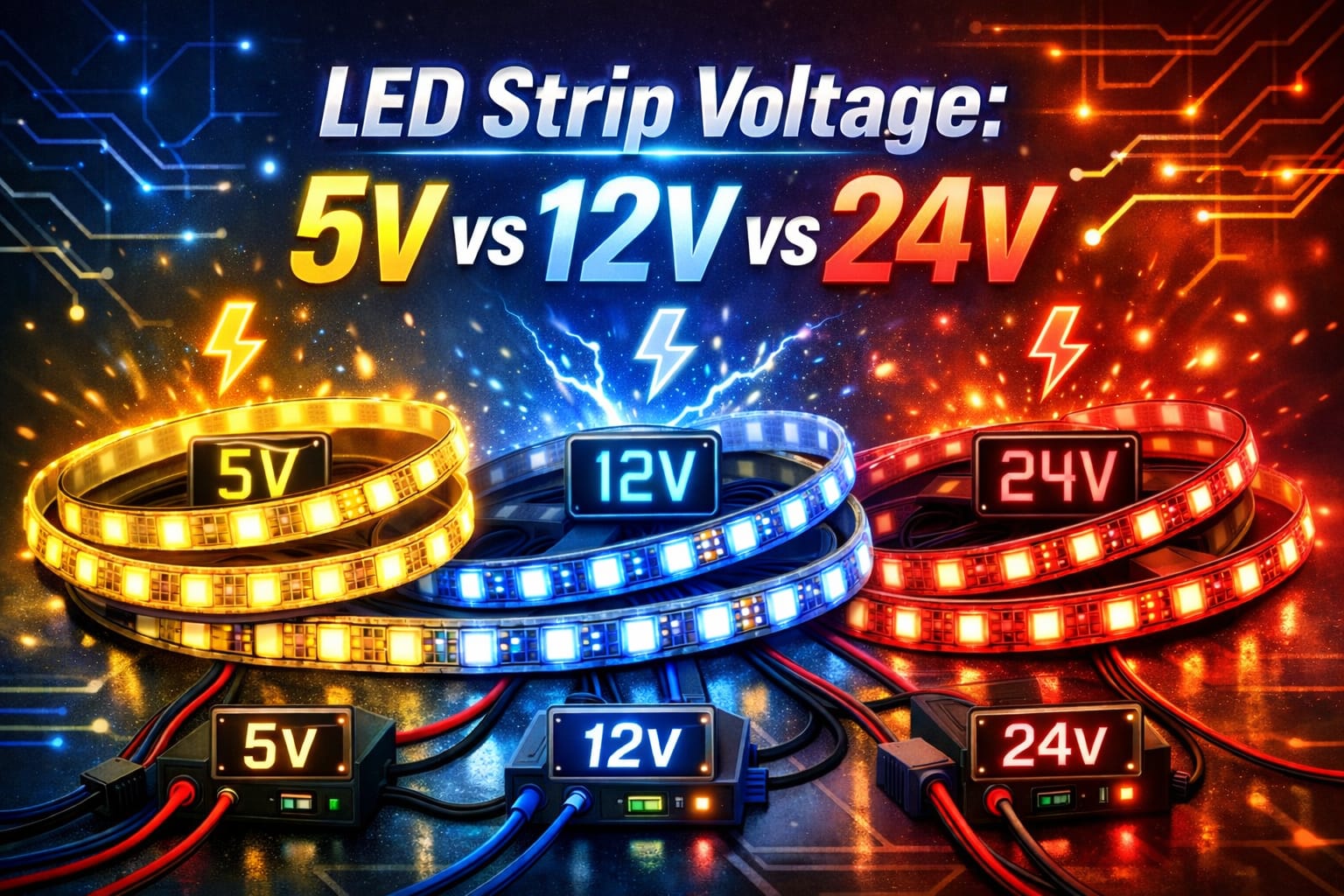
Table of Contents:
- Quick Answer
- How Voltage Affects Run Length, Brightness, and Power
- 5V LED Strips: Best for USB, Pixels, and Short Runs
- 12V LED Strips: Best for Most Home Projects
- 24V LED Strips: Best for Long Runs and Less Voltage Drop
- Voltage Drop and Run Length Guide
- How to Choose the Right LED Strip Power Supply
- Safety, Cost, and Installation Trade-Offs
- Which LED Strip Voltage Should You Choose?
- FAQ
- Key Takeaways
- Sharing This Guide
How Voltage Affects Run Length, Brightness, and Power
LED strip voltage tells you what type of DC power the strip needs to operate correctly. A 5V strip needs a 5V power supply, a 12V strip needs a 12V power supply, and a 24V strip needs a 24V power supply. If the voltage does not match, the strip may flicker, fail to light properly, overheat, or be damaged.
Most LED strips run on direct current, so a power adapter or LED driver converts household AC power into the correct low-voltage DC output. The three most common LED strip voltage options are 5V, 12V, and 24V, and each one fits a different type of project.
The voltage you choose affects current draw, wire size, run length, brightness consistency, controller compatibility, and how often you may need power injection. In simple terms, higher voltage usually handles longer runs better because the same power can be delivered with less current, which helps reduce voltage drop across the strip and wiring.
If you are still planning the basics of your layout, our complete beginner’s guide to LED strip lights is a useful next step before choosing controllers, connectors, and mounting locations.
5V LED Strips: Best for USB, Pixels, and Short Runs
5V LED strips are the lowest-voltage option commonly used in strip lighting. They are best for compact projects where convenience matters more than long-distance performance, such as USB-powered accent lighting, small desk setups, portable displays, power-bank lighting, short decorative runs, and addressable pixel projects.
Their main advantage is simple power. Many 5V strips can be powered from a USB adapter, USB port, or power bank, which makes them easy to install without a larger driver. For a short desk, shelf, monitor, model display, or small decorative area, a 5V USB-powered LED strip for short runs can be a practical option when you want simple plug-in lighting.
The trade-off is that 5V strips are much more sensitive to voltage drop. Because the starting voltage is low, even a small voltage loss along the strip or wire can cause visible dimming, color shift, or unstable output near the end of the run. In most cases, it is best to keep individual 5V runs short unless the product is specifically designed for longer lengths and power injection.
5V systems also draw more current than 12V or 24V systems at the same wattage. That means longer 5V projects may need thicker wire, better connectors, and more frequent power injection. For small, portable, or pixel-based projects, 5V works well. For general room lighting or longer continuous runs, it usually becomes less convenient than 12V or 24V.
12V LED Strips: Best for Most Home Projects
12V LED strips are usually the best all-around option for residential lighting. They offer a strong balance of safety, availability, compatibility, cost, and performance, which is why they are common for under-cabinet lighting, shelving, cove lighting, accent lighting, bedroom lighting, media walls, and many DIY home installations.
Because 12V products are widely used, you can usually find more compatible strips, dimmers, controllers, connectors, and accessories at this voltage. This includes many surface-mount diode strip options with different brightness levels, LED densities, color temperatures, and RGB or RGBW modes.
12V is also flexible because it works well in homes and is commonly used in RV, marine, and automotive-style low-voltage systems. For many medium-length projects, it is easier to source parts for 12V than 24V, especially if you are building a simple DIY setup and want broad compatibility.
With suitable wire, secure connections, and the right power supply, many 12V strips can handle around five to seven meters before voltage drop becomes too noticeable. That makes 12V a sensible choice when you need more reach than 5V but do not need the longer-run advantages of 24V.
The main limitation is that voltage drop can still appear on longer 12V runs, especially with high-density or high-wattage strips. If the far end looks dimmer, warmer, or less consistent, the issue may not be the strip itself but the length, wiring, connector quality, or power feed location.
24V LED Strips: Best for Long Runs and Less Voltage Drop
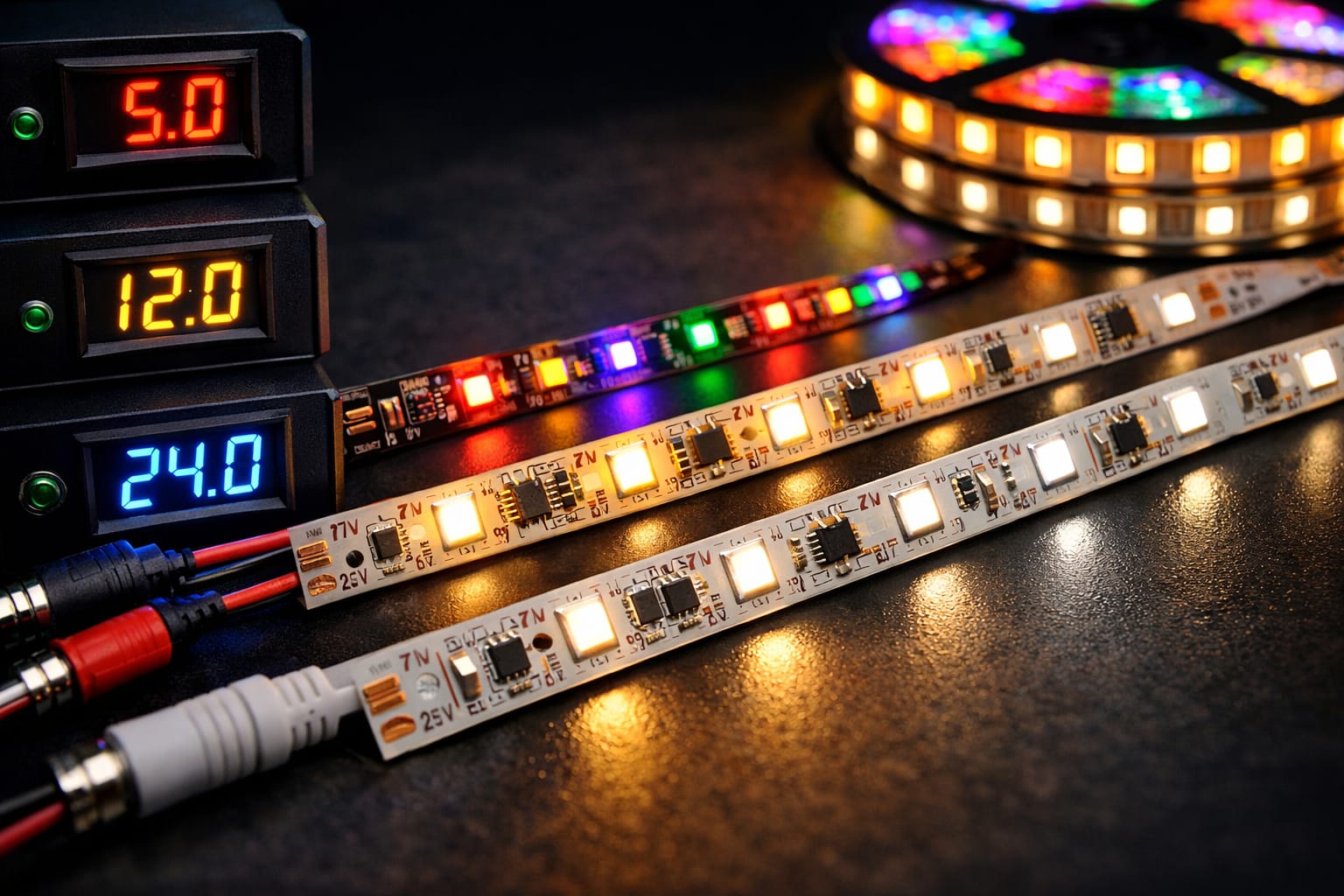
24V LED strips are usually the best choice for longer runs, larger rooms, cleaner wiring, and more professional-looking installations. Their biggest advantage is lower current draw for the same wattage, which helps reduce voltage drop and makes the brightness more consistent from the beginning to the end of the strip.
In practice, 24V can mean fewer power injection points, less stress on connectors, cleaner cable routing, and better performance across long straight runs. This is especially useful for cove lighting, ceiling details, long shelves, retail displays, architectural lighting, and larger residential spaces where uneven brightness would be easy to notice.
Many 24V strips can handle continuous runs of around ten meters or more with better brightness uniformity than lower-voltage alternatives, although the exact limit depends on the strip design, wattage per meter, copper thickness, and manufacturer specifications. For smooth, modern, dot-free lighting, chip-on-board strip installations are often worth comparing because they can create a more continuous line of light.
If your project includes a long, straight run, compare the number of feeds and injection points before buying. A 24V system may cost slightly more upfront, but it can save time and reduce wiring complexity during installation.
The main trade-off is that some 24V strips, controllers, and power supplies may cost more than basic 12V products. You may also find fewer ultra-budget options. However, for long-term installations where clean wiring and even brightness matter, the better performance often justifies the extra cost.
If your goal is a softer, more even line of light across a long run, a diffused 24V COB LED strip for long, even runs can be a better fit than a basic decorative strip, especially in visible locations where hotspots would look distracting.
Voltage Drop and Run Length Guide
Voltage drop happens when resistance in the LED strip, wire, or connections reduces voltage as electricity travels farther from the power source. The section farthest from the power supply receives less usable power, so it may look dimmer, less consistent, or slightly different in color compared with the beginning of the strip.
This can affect every strip voltage, but lower-voltage systems show the problem sooner because the same voltage loss is a larger percentage of the total voltage. A small loss on a 5V strip matters much more than the same loss on a 24V strip. That is why 5V is usually best for short runs, while 24V is better when distance matters.
As a practical planning guideline, keep 5V strips short, usually under about three meters unless the strip is designed for longer runs. Many 12V strips work well around five to seven meters. Many 24V strips can perform better around ten meters or more, depending on wattage and product design. Always check the product specifications because high-output strips may need shorter runs or more power feeds than low-output strips.
Do not assume that a higher-watt power supply will fix voltage drop by itself. If the run is too long, the wire is undersized, or the power feed is poorly placed, brightness drop may still occur even when the supply has enough total capacity.
You can reduce LED strip voltage drop by shortening the run, using thicker wire where needed, feeding power from both ends, adding power injection points, improving connector quality, or dividing the layout into separate parallel runs. Parallel runs are often cleaner than forcing one long strip to do the whole job.
For practical wiring layouts, our guide on how to connect LED strip lights explains connection methods, power injection basics, and ways to keep longer installations easier to troubleshoot.
How to Choose the Right LED Strip Power Supply
Your LED strip power supply must match the strip voltage exactly. A 12V power supply should not be used for a 24V strip, and a 24V supply should not be used for a 12V strip. Before checking wattage, controllers, dimmers, or connectors, confirm the voltage printed on the strip and the power supply label.
To size the power supply, multiply the strip wattage per meter by the total length you plan to use. Then add around 20 percent extra capacity so the unit does not run at its limit all the time. This headroom helps with reliability, heat management, and possible future expansion.
For example, if your strip uses 10 watts per meter and you plan to install 5 meters, the strip needs about 50 watts. Adding 20 percent headroom means choosing a supply around 60 watts or higher, as long as the voltage matches the strip.
A good power supply should include appropriate safety certifications and built-in protection features such as overcurrent protection, short-circuit protection, and thermal protection. Efficiency also matters because a more efficient supply wastes less energy as heat and usually runs cooler during long operating periods.
If you are building a medium-length 12V installation and the far end looks uneven, a regulated 12V LED strip power supply can help keep output more stable, but it should still be combined with correct wire sizing and sensible run lengths.
Safety, Cost, and Installation Trade-Offs
5V, 12V, and 24V LED strips are all low-voltage options, but low voltage does not mean installation details can be ignored. Use a suitable power supply, make secure connections, avoid overloaded connectors, protect wiring from damage, and allow enough ventilation around the driver or adapter so heat can escape.
According to the National Electrical Code, safe electrical installations depend on proper wiring methods, suitable equipment, and environmental conditions. Even with low-voltage LED lighting, careful installation improves reliability and reduces avoidable risk.
Cost depends on more than the price of the strip. A 5V setup may look cheaper at first, but longer runs may require heavier wire and more injection points. A 12V setup is often the most affordable and flexible for home projects. A 24V setup may cost more upfront, but it can reduce labor, simplify wiring, and improve brightness consistency on larger installations.
Brightness also affects cost. A higher-output strip usually needs more power, better heat management, and a larger power supply. If you are comparing products by brightness and not just voltage, our LED strip light brightness guide explains how different output levels behave in real spaces.
For the broader energy picture, our article on how much you can save with LED lighting explains how LED efficiency, usage time, and power consumption affect long-term running costs.
Which LED Strip Voltage Should You Choose?
The best LED strip voltage depends on the job you want the strip to do. Start with the length of the run, then check the available power source, brightness needs, controller compatibility, and how much wiring complexity you are willing to handle.
- Choose 5V if the project is short, USB-powered, portable, or built around addressable pixels.
- Choose 12V if you want the easiest all-around choice for most home accent lighting, shelves, cabinets, and DIY projects.
- Choose 24V if the run is long, the installation needs to look clean, or you want fewer power injection points.
- Choose 12V or 24V instead of 5V if the strip will be used daily or installed permanently in a room.
- Choose 24V first if brightness consistency matters more than finding the cheapest possible strip.
- If you are unsure, measure the total run length first, then choose the voltage that can support that length with the fewest wiring compromises.
FAQ
Is 12V or 24V Better for LED Strips?
12V is usually better for most simple home projects because parts are easy to find and compatibility is broad. 24V is better for longer runs because it usually suffers less voltage drop and needs fewer power injection points.
Are 5V LED Strips Good for Room Lighting?
5V LED strips can work for small room accents, short USB lighting, and decorative effects, but they are not usually the best choice for longer room lighting. For most permanent room installations, 12V or 24V is easier to manage.
Can I Use a 12V Power Supply on a 24V LED Strip?
No. The power supply voltage must match the LED strip voltage exactly. A 12V supply will not properly power a 24V strip, and using the wrong voltage can cause poor performance or damage.
How Do I Know if Voltage Drop Is a Problem?
Voltage drop is likely if the far end of the strip looks dimmer, changes color, flickers, or behaves differently from the section near the power supply. Shorter runs, thicker wire, power injection, or a higher-voltage strip can help reduce the problem.
Key Takeaways
The choice between 5V, 12V, and 24V LED strips should start with run length. 5V is best for short USB-powered and pixel-style projects, 12V is the most practical choice for most home installations, and 24V is usually better for long runs with fewer voltage drop issues.
For most homeowners, 12V offers the best balance of price, availability, compatibility, and performance. For longer runs, larger spaces, cleaner wiring, or more consistent brightness, 24V is often the smarter choice.
Whatever voltage you choose, always match the strip and power supply voltage exactly, size the power supply with extra headroom, and plan the layout before buying. Good planning prevents dim sections, unstable output, overheated connections, and unnecessary wiring problems later.
Sharing This Guide
If you found this guide helpful, save it for later or share it with someone who is comparing LED strip voltages for a home, DIY, or commercial project.
Use the links below:
Interested in learning more? Browse all related articles in our LED strips category section.