LED Chip Types Explained: SMD, COB & Other Key Differences
LED chip types matter because they affect brightness, heat handling, beam control, efficiency, and cost. SMD, COB, and flip-chip LEDs are all common, but they are built differently and do not perform exactly the same in real fixtures and lighting products.
This guide explains how each chip type works, where it performs best, and which trade-offs matter most when you are choosing LED strips, bulbs, downlights, spotlights, or higher-output commercial lighting.
Quick Answer
SMD is usually the most flexible and affordable LED chip format, COB is better for smooth and dense light output, and flip-chip is often the premium option when efficiency, heat transfer, and long-term performance matter most.
- SMD works well for general-purpose lighting, RGB products, and flexible layouts.
- COB creates a more continuous light line with fewer visible hotspots.
- Flip-chip improves thermal performance by removing wire bonds and shortening the heat path.
- No chip type is automatically “best” in every fixture.
- The right choice depends on output, glare, cost, and application.
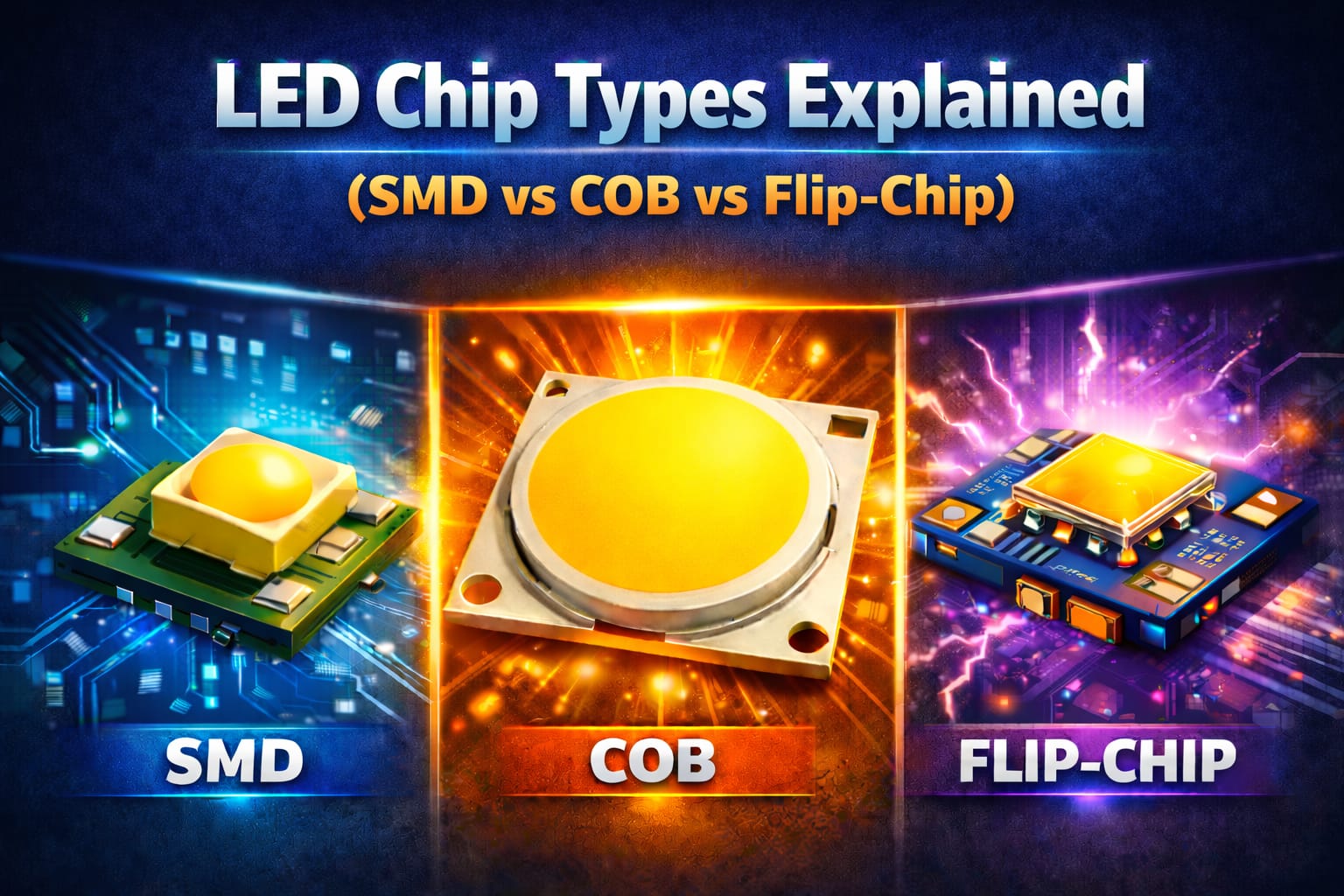
Table of Contents
SMD Basics
SMD stands for Surface-Mount Device, and it is the most familiar format in everyday LED lighting. In this design, individual LED packages are mounted onto a circuit board with automated assembly equipment. Those packages can be very small, like 2835 chips, or larger, like 5050 chips, depending on how much output, color control, and board space the product needs.
Each SMD package contains one or more LED dies along with electrical connections, phosphor conversion, and protective encapsulation. That packaged structure makes SMD LEDs easy to integrate into strips, bulbs, panels, and smart lighting products. If you want a broader look at the underlying technology, see how LED lighting works.
Package numbers usually refer to dimensions. A 3528 package measures about 3.5 mm by 2.8 mm, while a 5050 package is about 5.0 mm by 5.0 mm. That does not tell you everything about brightness or quality, but it does help explain why some SMD formats are better for compact low-power products while others are better for RGB mixing or higher output.
SMD Advantages
SMD’s biggest strength is flexibility. Manufacturers can place many individual emitters across a board, tune spacing, combine white and RGB chips, or even create addressable effects for pixel-level control. That is why SMD remains so common in strip lights, smart bulbs, decorative fixtures, and other products where layout flexibility matters as much as raw output. These configurations are especially common in SMD strip lighting setups.
Another advantage is manufacturing maturity. SMD production is highly standardized, which keeps pricing competitive and availability broad. In many cases, it is also easier to work with or replace than more integrated chip formats. The trade-off is that widely spaced SMD chips can create visible dots or uneven light lines if the diffuser and density are not chosen carefully.
Do not judge SMD quality by package size alone. Chip density, driver quality, board design, and heat handling often matter more in real-world use than the number printed on the package.
If your current setup shows clear hotspots or uneven lines of light, switching to a denser layout can make a big difference. A practical upgrade is a high-density COB LED strip for smoother, more continuous illumination, especially for shelves, cabinets, and accent edges where visible dots are distracting.
COB Fundamentals
COB stands for Chip on Board. Instead of placing many fully packaged LEDs on a board, COB technology bonds multiple bare LED dies directly onto a substrate and then covers the array with phosphor and encapsulation. The result is a much more continuous light-emitting surface with far less separation between individual emitters.
That tighter arrangement is the main reason COB lighting looks smoother than many traditional SMD designs. It can deliver high lumen density from a compact area while reducing the “dotted” appearance that you often see with lower-density strips and fixtures. You can see how this works in practical products by looking at COB strip lighting solutions.
COB modules also tend to use thermal substrates that help spread heat efficiently across the assembly. That helps support higher drive currents and strong output in compact fixtures, though it also means the module is more integrated. When a COB module fails, you generally replace the module rather than repairing individual dies.
COB Benefits
The clearest benefit of COB is visual uniformity. Because the emitting surface is denser and more continuous, you get fewer multiple shadows, less visible spacing between chips, and a cleaner beam when the product is used in strips, spotlights, and compact downlights. That is especially useful in applications where the light source is easy to see directly or through a shallow diffuser.
COB can also simplify optics. A more unified light source is easier to shape with reflectors and lenses than a spread-out field of discrete emitters. In the right fixture, that means better beam control, higher perceived quality, and fewer compromises between output and appearance. At higher production volumes, COB can also become cost-effective because it reduces packaging complexity compared with large arrays of separate SMD packages.
Flip-Chip Innovation
Flip-chip LED design changes the way the chip is mounted. Instead of using traditional wire bonds on top of the chip, the die is flipped and connected through solder bumps on its underside. This puts the active structure closer to the substrate and removes wire bonds from the light-emitting surface.
That design improves two important things at once: light extraction and heat flow. With no wire bonds blocking the surface, more light can leave the chip cleanly. At the same time, the thermal path from the junction to the substrate becomes more direct, which helps reduce operating temperatures and supports higher drive currents. The U.S. Department of Energy’s LED lighting guidance also highlights how thermal conditions affect efficiency and longevity.
That is why flip-chip LEDs often appear in premium or high-performance applications. They are not always necessary for basic residential products, but they can offer real advantages in demanding fixtures where output, efficiency, and reliability all need to stay high over long operating hours.
Flip-Chip Challenges
The main drawback is manufacturing complexity. Flip-chip production demands tighter process control, precise alignment, and more advanced packaging equipment than conventional wire-bonded designs. That increases cost and makes it less common in entry-level products.
Material matching is also critical. Differences in thermal expansion between the chip, solder bumps, and substrate can create stress over repeated heating and cooling cycles. When those details are handled well, flip-chip can be extremely robust. When they are not, the performance advantage on paper does not always translate into better long-term reliability.
Performance Comparison
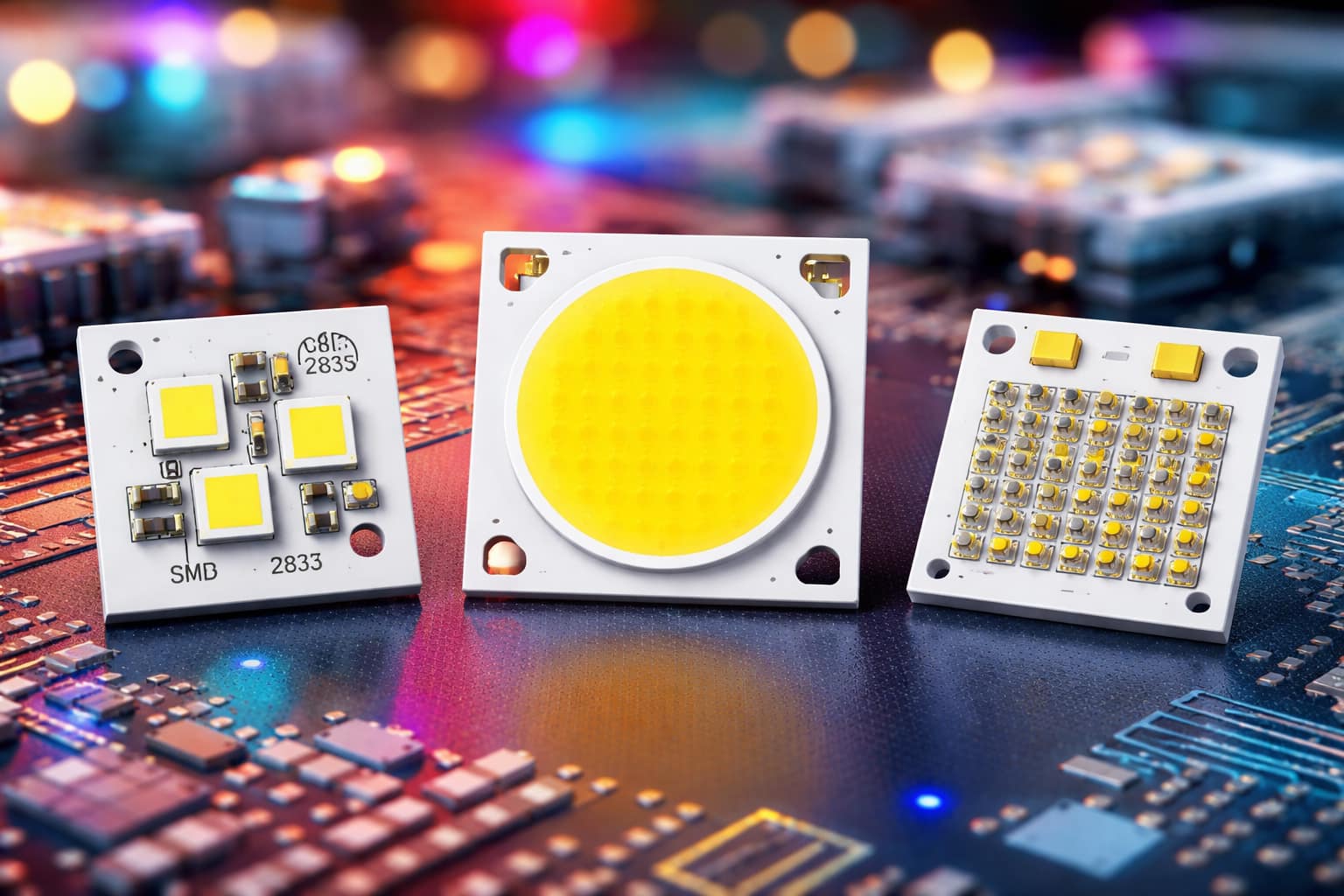
When people compare LED chip types, they usually start with efficiency. In broad terms, many SMD products land around 100 to 150 lumens per watt, COB commonly reaches roughly 120 to 160 lm/W, and higher-end flip-chip designs can push beyond that. Those are useful reference points, but the actual result still depends on binning, phosphor quality, thermal design, and driver performance. For a deeper look at efficiency, see lumens per watt efficiency.
Color quality can also vary. All three formats can achieve respectable CRI ratings, but premium designs often perform better because of tighter phosphor control and better thermal stability. COB tends to look more uniform across the emitting surface, while SMD can benefit from careful binning and chip selection for tighter color consistency.
Dimming behavior is not controlled by the chip type alone, but the architecture still matters. SMD formats are widely used in products that need fine zoning or RGB effects. COB often holds a stable visual appearance during dimming because the source remains uniform. Flip-chip can help reduce color shift under higher drive conditions because it handles heat more effectively.
Real-World Metrics
Lab numbers and installed performance are not always the same thing. A chip that looks excellent in a controlled test can lose its advantage in a poorly cooled fixture or a low-quality strip with a weak driver. That is one reason COB and flip-chip often look stronger in demanding environments: their thermal paths usually make it easier to preserve output under stress.
It is also worth remembering that power factor, flicker behavior, and driver stability depend more on the electrical design than on the chip package itself. In higher-output systems, that is why understanding constant current vs voltage drivers matters just as much as understanding the LEDs.
Thermal Management
Heat is one of the biggest reasons LED products lose brightness early, shift color, or fail sooner than expected. SMD designs spread heat across multiple packages and rely on the board, thermal vias, and fixture body to carry that heat away. That can work very well, but performance depends heavily on board quality and spacing.
COB improves heat spreading by bonding many dies onto a unified substrate. That larger thermal path helps support strong output from compact modules, which is one reason COB is so common in downlights and other high-density fixtures. Flip-chip usually goes a step further by shortening the path from the active junction directly into the substrate, which can lower thermal resistance even more. Proper implementation still depends on good heatsink design, as explained in this guide to LED heat dissipation methods.
That does not mean SMD is automatically poor at thermal management. Well-designed SMD products can perform extremely well. The difference is that SMD relies more on the broader fixture design to stay cool, while COB and flip-chip often have more thermal advantage built into the light source itself. The ENERGY STAR guide to LED lighting basics is also useful if you want a practical overview of why heat and efficiency are so closely linked.
Cooling Requirements
Cooling needs rise with output, enclosure size, and ambient temperature. In general, high-density SMD arrays often need more board area or more aggressive heatsinking to stay within safe limits. COB modules usually reach strong output with more compact cooling because the heat path is better integrated. Flip-chip designs can push that further, especially in premium fixtures designed for sustained higher loads.
When comparing LED products, do not look at the chip type in isolation. The housing, board thickness, heatsink, and driver quality often decide whether the LEDs can actually deliver their rated performance.
Exact cooling thresholds vary by fixture, so it is better to treat chip type as part of the thermal story rather than the whole story. A cheap COB module in a badly designed enclosure can still run hot, while a well-built SMD product can stay cool and stable for years.
Optical Characteristics
Chip architecture also changes how the light behaves optically. SMD uses many discrete emitters, so the fixture or diffuser has to blend those points into a smooth result. That is fine in many bulbs, panels, and strips, but if spacing is wide or the diffuser is shallow, you can see individual points and multiple shadow edges.
COB behaves more like a single dense source, which makes it easier to build compact spotlights, downlights, and strips with a cleaner visual line. That more unified emitting area can also improve beam shaping because reflectors and lenses are dealing with one stronger source instead of many separated points.
Flip-chip generally keeps the same broad beam behavior as other LED sources, but it can improve uniformity and total light extraction by removing obstructions from the chip surface. The difference is often subtle to the eye in basic products, yet it matters more in precision optics and higher-end systems where every efficiency gain counts.
Glare Control
A stronger, denser light source can look impressive, but it can also create glare if the fixture does not manage it well. COB and higher-output flip-chip systems are especially sensitive here because they can produce intense brightness from a small area. SMD can also cause glare, but it often spreads the brightness across more points, which changes the visual effect.
Do not assume a brighter or more advanced chip automatically creates better lighting. Without good shielding, optics, or diffusion, it can simply make a fixture harsher and less comfortable to use.
That is why source brightness and optical control should always be considered together. If glare reduction matters in your space, it helps to review broader fixture strategies as well, not just the chip format, especially in rooms that need direct-view comfort and visual softness.
Manufacturing Complexity
SMD is the most established manufacturing route. It fits well into standard electronics assembly lines, uses mature surface-mount processes, and benefits from huge global production volume. That is one reason SMD products dominate many consumer categories.
COB needs more specialized die bonding, coating, and encapsulation steps because the dies are mounted directly to the substrate rather than enclosed in individual packages. That makes production more specialized, but it also enables the denser and more unified light output that COB is known for.
Flip-chip is usually the most demanding from a production standpoint. It requires advanced bump formation, precise bonding, and stricter material compatibility control. That added manufacturing complexity is part of why flip-chip often sits higher in the market, even before you factor in its performance advantages.
Quality Control
Testing also happens at different points. SMD benefits from well-developed component binning before final assembly. COB is often judged more at the module level because the full coated array needs to be tested as a unit. Flip-chip can benefit from wafer-level screening before the dies are fully packaged, which helps catch problems earlier in production.
For buyers, the practical takeaway is simple: chip type influences the manufacturing path, but product quality still depends on how well the manufacturer controls consistency, thermal design, and electrical integration from start to finish.
Cost Considerations
SMD usually offers the lowest entry cost because it is mass-produced at huge scale and fits a wide range of low-cost to mid-range products. That makes it the default choice for many residential bulbs, strips, smart lights, and general-purpose fixtures where affordability matters.
COB often costs more at the component level, but it can reduce system complexity in the right design. If you need dense output, cleaner beam shaping, or smoother visual appearance, COB can justify the premium because the finished fixture may need fewer optical compromises.
Flip-chip tends to be the most expensive option because the packaging process is more advanced and the chips are often aimed at premium products. Even so, that higher upfront price can make sense in high-hour installations where better efficiency and thermal stability help reduce operating costs over time. For more background reading, the LED knowledge center includes related guides.
Value Analysis
The best value is not always the cheapest chip. In a decorative strip or a smart bulb, SMD may give you everything you need without paying extra for benefits you will never use. In a compact spotlight or dense linear strip, COB may deliver the cleaner result that justifies spending more. In harsh or high-hour environments, flip-chip can earn its place through better long-term thermal behavior and efficiency.
That is why chip pricing should be viewed alongside lifespan, serviceability, optics, and real operating conditions. A cheap light that runs hot and degrades early is not necessarily the better deal.
Application Scenarios
SMD is still the most common choice for residential lighting. It works well in LED strips, retrofit bulbs, smart lighting products, and color-changing systems where flexibility, cost, and broad compatibility matter most. Products that rely on segmented control or dynamic effects often use discrete emitters, including setups built around addressable LED strip control.
COB is often a better fit for commercial downlights, spotlights, and premium strip applications where smoother output and compact high density are more important than modular repair. It is especially useful when the light source will be seen directly or when beam quality matters.
Flip-chip shows up more often in demanding commercial, industrial, automotive, and outdoor products where efficiency and thermal resilience are critical. It is not limited to those sectors, but that is where its performance advantages are usually easiest to justify.
Specialty Uses
COB is popular in horticultural lighting because it can deliver dense photon output and pair well with fixture designs that need strong concentration from a compact area. It also works well in certain studio and task-lighting products where smooth beam quality matters.
Flip-chip is increasingly relevant in automotive and high-performance specialty lighting because compact packaging, strong thermal behavior, and rugged construction are all valuable there. Those advantages become more important as products push for higher brightness in tighter spaces.
Lifespan and Reliability
With good thermal control, SMD products commonly fall in the 25,000 to 50,000 hour range, while many COB products fall around 40,000 to 70,000 hours. Premium flip-chip systems can push beyond that. These ranges are only rough guides, but they reflect the fact that better heat handling usually supports longer useful life.
Serviceability also differs. In theory, SMD-based systems can be more modular because the emitters are discrete, though many consumer products are still replaced as a whole. COB modules are more integrated, which simplifies the light source but usually means replacing the module if something goes wrong. Flip-chip products tend to follow the same reality as other premium integrated systems: strong performance, but not always easy field repair.
The biggest reliability lesson is that chip type helps, but temperature still rules. Poor cooling, weak drivers, and enclosed fixtures can shorten lifespan no matter which chip format you choose.
Failure Modes
Different chip types tend to fail in different ways. SMD can suffer from package fatigue, bond issues, or board-level thermal stress. COB can see phosphor wear, substrate stress, or module-level degradation across the array. Flip-chip removes wire bonds but introduces its own packaging concerns, especially around solder bumps and material interfaces.
In all cases, lumen depreciation happens gradually before total failure. The practical question is not just whether the light still turns on, but whether it still delivers useful brightness, stable color, and acceptable efficiency after years of use.
Future Developments
LED packaging is still evolving. Mini-LED and micro-LED technologies are pushing chip sizes smaller, opening the door to much denser control, finer optical precision, and new display and adaptive-lighting applications. Those technologies sit beyond the scope of most everyday fixtures today, but they show where the industry is moving.
Material improvements are also continuing. Better phosphors, improved substrate design, and more advanced packaging methods are helping manufacturers raise efficiency, reduce thermal bottlenecks, and improve color quality across different chip formats.
At the same time, automation is making advanced production more scalable. That matters because it can gradually narrow the price gap between standard and premium chip architectures, bringing higher-performing technology into more mainstream lighting products.
What Should You Choose?
Choose the chip type that fits the product’s job, not the one that sounds most advanced. In many everyday situations, the best option is simply the one that gives you the right balance of output, appearance, efficiency, and price.
- Choose SMD for flexibility, RGB effects, and affordable general-purpose lighting.
- Choose COB when you want smoother light lines, compact high density, or cleaner beam quality.
- Choose flip-chip when thermal performance, efficiency, and long operating hours matter most.
- Prioritize fixture design and driver quality alongside chip type.
- Do not pay extra for a premium chip if the fixture around it is poorly designed.
Key Takeaways
SMD, COB, and flip-chip LEDs all solve different problems. SMD is versatile and widely used, COB delivers smoother and denser light, and flip-chip stands out when efficiency and thermal performance are pushed harder.
When comparing LED chip types, look beyond the label. Board design, cooling, optics, driver quality, and the way the fixture is actually built often matter just as much as the chip architecture itself.
The smartest choice is the one that matches the application. If you focus on how the light will be used, not just on which chip sounds newer or more advanced, you will usually end up with a better result.
Sharing this guide
If you found this guide helpful, save it for later or send it to someone comparing LED technologies for a new lighting project.
Share using the links below
Interested in learning more? Browse all related articles in our category section.
Pingback: Constant Current vs Constant Voltage: Critical - NeoLEDHub
Pingback: How LED Bulbs Work: Amazing Technology Explained Simply
Pingback: LED Light Degradation: What Happens Over Time - NeoLEDHub
Pingback: LED Phosphor Technology: How It Works - NeoLEDHub
Pingback: SMD vs High Power LED Explained - NeoLEDHub
Pingback: MacAdam Ellipses Explained: 1-Step, 3-Step, and LED Color Consistency - NeoLEDHub
Pingback: LED Phosphor Technology Explained: How Blue LEDs Create White Light - NeoLEDHub
Pingback: Constant Current vs Constant Voltage: Which Driver to Use
Pingback: LED Light Degradation: What L70, L80 & L90 Really Mean
Pingback: SMD vs High Power LED: Key Differences, Pros & Best Uses
Pingback: How LED Lighting Works: Beginner Guide to LED Basics