The Best Smart Lighting Ideas for Bedrooms: Cozy Setup Tips
A bedroom should feel calm at night and be useful in the morning. It should also be easy to control without having to get up every time you want to dim a lamp or change the mood. The best setups don’t rely on a single bright bulb. They combine warm light, flexible control, and a layout that matches how the room is actually used.
This guide breaks down the most effective smart bedroom lighting ideas, from ceiling bulbs and bedside lamps to LED strips and automation routines. You will learn what works, what often looks cheap, and how to design a modern, restful, and practical bedroom.
Quick Answer
The best smart lighting ideas for bedrooms use three layers: a warm, dimmable ceiling light; comfortable bedside lighting; and subtle accent lighting, such as LED strips. Keep control simple, avoid visible glare, and design scenes based on how you use the room at night.
- Start with a warm, dimmable main light.
- Add separate bedside controls for reading and winding down.
- Use hidden LED strips for depth rather than harsh brightness.
- Create a few practical scenes instead of endless effects.
- Prioritize comfort, low glare, and easy daily control.
Table of Contents:
- Quick Answer
- Why smart bedroom lighting works better than a basic bulb
- How to plan a balanced bedroom lighting layout
- Start with the ceiling light and build from there
- Use LED strips to shape the room visually
- Make bedside lighting easier to use
- Build scenes that match your evening routine
- What people get wrong in bedroom smart lighting
- A simple plan for small, medium, and large bedrooms
- Questions buyers ask before choosing bedroom smart lights
- Key Takeaways
- Sharing this guide
Why does smart bedroom lighting work better than a basic bulb?
Most people get frustrated because bedrooms have only two lighting modes: too bright or too dark. That is exactly why smart lighting ideas for bedrooms are so useful. Rather than forcing one fixture to handle everything, you can switch from a reading light to a wind-down light to a nighttime navigation light without changing bulbs or adding awkward plug-in lamps. A strong layout also allows for a more intentional approach to bedroom lighting design from the beginning.
A good setup feels invisible when it works well. With the touch of a button, the room’s character changes in seconds. This is important because bedrooms are rarely single-purpose spaces anymore. They’re used for relaxing, reading, dressing, working, and sometimes watching TV. Therefore, a flexible lighting approach fits modern habits much better than a fixed wall switch alone.
When a bedroom feels flat, the problem is usually not just brightness. It’s usually a lack of layers, dimming range, and directional contrast between overhead, bedside, and accent lighting.
What makes a bedroom feel relaxing instead of clinical?
The most successful rooms use layered lighting with warm tones and low glare. Bedrooms usually feel most comfortable around 2700K-3000K, while full-room brightness often falls within the 150–300 lux range, depending on the layout, wall color, and ceiling height. This softer target creates genuine ambient bedroom lighting rather than the harsh all-on effect that makes it difficult to unwind before sleep.
How should you plan a balanced bedroom lighting layout?
The best smart bedrooms do not try to turn every corner into a rainbow display. They use a few well-chosen fixtures that create a clean hierarchy: one general light, one bedside layer, and one accent layer. When you thoughtfully apply smart lighting ideas to a bedroom, the room feels calmer, more polished, and easier to live with every day. If you want to understand the broader system logic behind this, the smart lighting systems guide provides a helpful overview.
This balanced approach first creates an ambient glow, then adds features only where they solve a real need. Perhaps you want warm, circadian-friendly light at night, faster brightness in the morning, or a scene that turns off the entire room with one command. These are functional improvements, not gimmicks, and they are what distinguish a polished room from a cluttered tech demo.
Which lighting layers should you control separately?
Begin by dividing your bedroom lighting into three zones: ceiling, bedside, and accent. Ceiling lighting provides general visibility and helps with dressing. Bedside lighting is ideal for reading and late-night activities. Accent lighting shapes the mood, depth, and color of the room. Once these zones can be dimmed independently, your smart bedroom lighting setup will be far more useful than a single-fixture solution.
Before buying anything else, decide which controls matter most in daily use. This quick list will help you keep the setup focused and prevent wasted purchases:
- ✓ A dimmable main light for cleaning, dressing, and daytime tasks
- ✓ One bedside light on each side of the bed if two people use the room differently
- ✓ Accent lighting behind furniture, shelving, or the headboard
- ✓ One simple scene that shuts everything down for sleep
- ✓ App control plus a physical fallback for guests or quick changes
Start with the main ceiling light and build from there
If the main fixture is inadequate, the rest of the setup must compensate for it. This is why many smart lighting ideas for bedrooms start with warm, dimmable bulbs in the overhead fixture. A flexible ceiling light provides broad coverage and lets accent layers do subtle work. For many people, a practical starting point is a set of smart bulbs with a gentler evening dimming feature, so the room remains comfortable without feeling dim or dull.
Most bedrooms require warm white light, around 2700K-3000K, with about 800 lumens per bulb, which provides sufficient general lighting while allowing for dimming to a comfortable level for evening use and a calmer atmosphere before sleep. If you already use Alexa, this roundup of the best smart LED bulbs for Alexa can help you narrow down options that are easier to integrate and control consistently.
✅ Brightness range
Choose bulbs that can dim sufficiently for nighttime use yet still provide full-room visibility when needed. In bedrooms, a wide dimming range matters more than maximum output alone.
✅ Warm white quality
Look for warm scenes that feel natural, with a color temperature between 2700K and 3000K. Bedrooms benefit from a cozy light that softens the room rather than washing out skin tones or white bedding.
✅ Reliable app control
The best products respond quickly and maintain consistent lighting scenes. Delayed control undermines the simplicity that makes smart lighting enjoyable in the first place.
✅ Scene compatibility:
Choose bulbs or fixtures that can be used for bedtime, reading, and wake-up scenes. Bedroom lighting works best when every device feels like part of one system, not separate gadgets competing for attention.
What bulb color temperature feels best at night?
For bedrooms, color temperature matters as much as brightness. Warm white, between 2700K and 3000K, usually feels restful. In contrast, 4000K–5000K reads more like task lighting and may make you feel too alert late in the evening. If your bedroom also serves as a dressing area in the morning, consider tunable white with adaptive dimming to achieve a better range without forcing a cold tone at bedtime.
Use LED strips to visually shape the room
This is where many smart bedroom lighting ideas become visually interesting. They can make the room feel deeper, highlight architectural lines, and create a cleaner separation between the sleeping area and the rest of the room. When used well, they support bedroom mood lighting rather than screaming for attention. For headboards, shelving, or under-bed lighting, many people prefer RGBIC strip lights for smoother color transitions and cleaner low-level lighting.
Strips are also helpful when a bedroom needs style but has limited space for extra lamps. If you’re looking for inspiration on how accent lighting can change the atmosphere of a room, this guide to smart lighting in the living room shows how placement affects depth and visual balance in a different, yet still useful, context.
Unless the diffuser and mounting are intentional, do not leave strips fully visible. Exposed dots and bright sightlines are one of the fastest ways to make a bedroom setup look cheap.
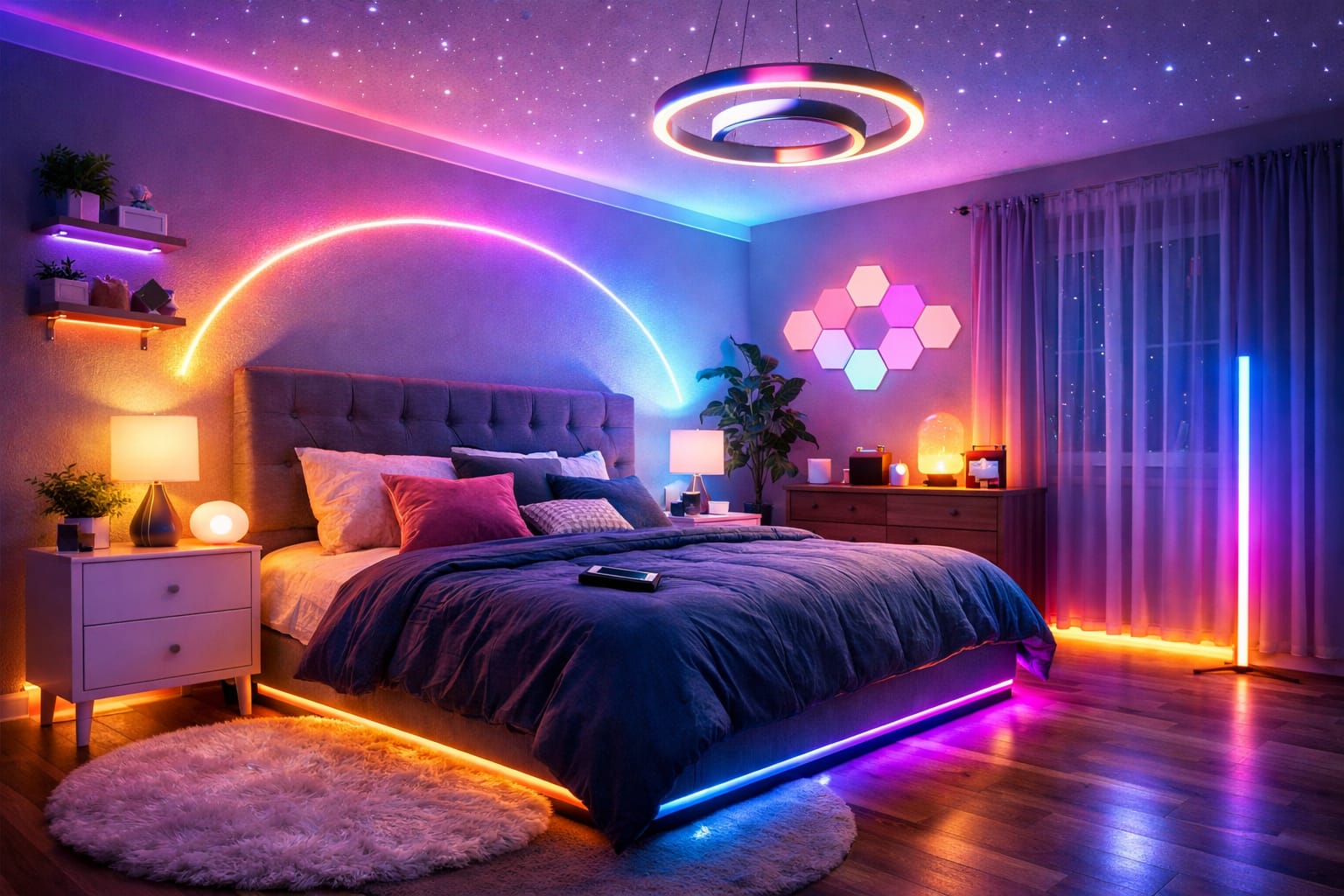
LED strips look best where there is no visible glare
The best placement hides the source and reveals only the effect. Places behind a headboard, under a floating bed, above a curtain track, or along shelving edges usually work well. This is where glare control becomes essential. Good RGB bedroom lighting should illuminate walls or surfaces without shining directly into your eyes. When smart lighting ideas for bedrooms seem overwhelming, the angle of the strip is often the real problem.
Make bedside lighting easier to use
Bedside lighting is often where smart features feel most valuable. You shouldn’t have to stand up to turn off the lights or turn on the ceiling light just to find a charger. A compact bedside lamp with dimming and scene settings solves that problem quickly. Many setups benefit from a bedside lamp with stable dimming and a softer light, which creates a smoother transition between evening reading and sleep time.
This is also the perfect place to use grouped controls. If you want both bedside lamps and strip lights to respond together, this guide on grouping smart lights in one room is useful. Once those devices behave as one zone, voice-controlled lighting becomes practical instead of feeling like a novelty that only works half the time.
Bedside scenes work better than one switch
A strong bedroom smart lighting setup allows each person to use the room differently without affecting the entire space. One bedside scene could provide a warm reading light, another could reduce the light output to 10 percent for winding down, and another could turn on a subtle under-bed glow. This is much more useful than relying on one bright fixture and hoping that dimming it alone will set the right mood.
Build scenes that match your evening routine
The most convincing smart lighting ideas for bedrooms are those built around real habits. Think in terms of routines, not products. For example, you might need a scene for getting ready, reading, having a calm conversation, and going to sleep. This is the mindset behind the best bedroom lighting setup ideas. If you want a system-level walkthrough, this smart lighting setup guide explains how to create consistent scenes, schedules, and grouped controls.
A practical sequence often works better than endless customization. For instance, a room could start at 60 percent warm white after sunset, decrease to 35 percent later in the evening, and transition to a low amber accent before bedtime. At that point, smart lighting becomes less about gadgets and more about sleep, comfort, and repeatable habits powered by simple automation.
Save one “all off except pathway” scene for late-night movement. This is one of the simplest ways to make a smart bedroom feel thoughtful rather than just colorful.
Which automations should run after sunset for the best results?
Simple rules are best. Start with the lights turning on automatically near sunset, dimming later, and switching to your lowest comfort setting close to bedtime. Good automation timing also prevents the main light from turning on at full brightness at night. If you want cleaner voice commands as part of that process, this guide to setting up voice-controlled lighting is worth reading before adding more devices.
What people get wrong about smart bedroom lighting
The biggest mistake is prioritizing effects over function. People buy color-changing products and then ignore dimming quality, placement, and nighttime usability. Another common mistake is using only saturated colors and omitting clean warm white altogether. This almost always weakens the overall atmosphere. Great LED lighting designs start with normal daily use and then add color as an option. The U.S. Department of Energy’s LED lighting efficiency guidelines also remind us that the value of LEDs is not just about style, but also about control and efficiency.
Another common issue is the poor balance between a warm ambiance and practical visibility. Bedrooms still need enough light for clothes, drawers, and cleaning. The ENERGY STAR guide to LED lighting basics is useful here because it emphasizes the importance of balancing brightness, color tone, and application. In real rooms, contrast issues usually result from relying on one intense light source with no supporting layers.
Here is a simple plan for small, medium, and large bedrooms
The size of the room changes how many smart elements you actually need. In a small room, one ceiling fixture, one bedside lamp, and one accent strip may suffice. A medium room benefits from two bedside sources and a stronger accent layer. Larger rooms often require separate controls for the sleeping and dressing areas. Considering room scale helps keep smart bedroom lighting ideas grounded in practicality instead of overwhelming the space.
If you want a broader educational foundation before expanding your setup, the LED Knowledge Center is a useful resource for reviewing lighting fundamentals. In practice, the best results come from combining thoughtful layout planning with a controlled amount of RGB and enough warm white output to keep the room functional year-round. This combination provides bedroom mood lighting that works on ordinary weekday nights.
Here are some questions buyers ask before choosing smart lights for their bedroom
This final section addresses the practical questions that typically arise when people start comparing bulbs, strips, and lamps. The answers focus on compatibility, brightness, and usefulness at night, which are often the deciding factors when designing a bedroom.
Do smart bulbs work well in a bedroom ceiling fixture?
Yes, as long as the fixture supports the bulb’s shape and any required enclosure rating. Most bedrooms require about 800 lumens per bulb and a color temperature of around 2700K-3000K to provide enough general light while still dimming low for comfortable evening use and a calmer atmosphere before sleep.
Are LED strips enough to light an entire bedroom?
Usually not. They are excellent for accent lighting, such as under-bed, shelving, or headboard lighting, but they rarely replace a main light source effectively. Most bedrooms still need a ceiling fixture or lamp for full visibility. Then, strips can add mood, depth, and softer nighttime navigation.
Is voice control useful in a bedroom?
Yes, especially when your hands are full, you’re already in bed, or you want to trigger a scene without using your phone. Voice control becomes genuinely useful when it controls grouped lights, dimming, and bedtime scenes rather than just turning a single bulb on or off.
Key Takeaways
The most effective smart lighting solutions for bedrooms solve real problems: harsh overhead lighting, poor nighttime visibility, and inconvenient controls. An ideal bedroom has a dimmable main light, comfortable bedside lighting, and one accent layer that adds depth without overwhelming the space.
When you prioritize daily usability, your choices become much easier. Focus on warm dimming, simple scenes, and placements that hide glare. A good bedroom setup should feel restful on ordinary nights, not just during the first week after installation.
The smartest upgrades are the ones you’ll still appreciate months later, such as quick bedtime scenes, better zoning, and reliable automation. Designed with comfort and habit in mind, smart bedroom lighting will continue to enhance the room long after the novelty of color effects wears off.
Share this guide!
If you found this guide helpful, save it or share it with someone who is still using old bulbs.
Interested in learning more? Browse all related articles in our category section.