Lumens Per Watt Chart: What Is a Good LED Rating?
Lumens per watt tells you how much light a bulb produces for each watt of electricity it uses. For most household LED bulbs, 90+ lm/W is a good baseline, 100–120 lm/W is strong, and 120+ lm/W is usually very efficient.
This guide gives you a simple lumens per watt chart, the formula, LED vs CFL vs incandescent comparisons, and a practical way to compare bulbs before you buy so you can avoid weak efficiency claims and choose lighting that saves energy without sacrificing brightness.
Quick Answer
Lumens per watt measures lighting efficiency: lumens show brightness, watts show power use, and lm/W shows how much visible light you get from each watt. A good everyday LED efficacy rating usually starts around 90 lm/W, while 100–120 lm/W is a strong range for most modern household LED bulbs.
- Incandescent bulbs usually land around 10–17 lm/W.
- CFLs often reach roughly 50–70 lm/W.
- Most modern household LEDs fall around 80–150 lm/W.
- Good household LED: 90+ lm/W; strong LED: 100–120 lm/W; very efficient LED: 120+ lm/W.
- Higher efficiency is useful, but brightness, CRI, color temperature, dimming, and fixture compatibility still matter.
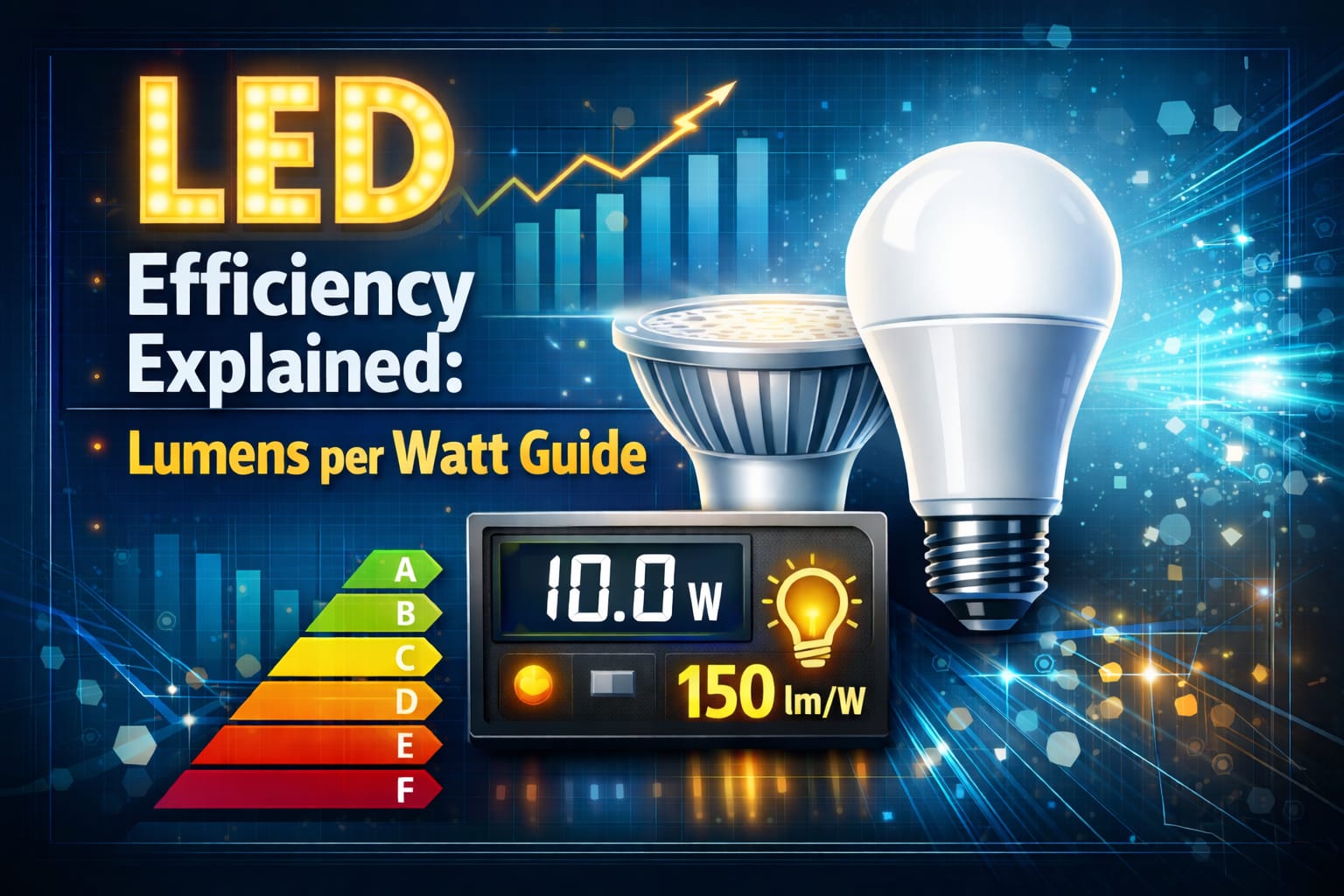
Table of Contents:
- Quick Answer
- What Lumens Per Watt Means and How to Calculate It
- Lumens Per Watt Chart by Bulb Type
- What Is a Good Lumens Per Watt Rating for LED Bulbs?
- How to Compare Bulbs Before Buying
- What Affects Real-World LED Efficiency?
- How Better Efficiency Saves Money
- Smart Buying Checklist
- FAQ
- Key Takeaways
- Sharing This Guide
What Lumens Per Watt Means and How to Calculate It
Lumens per watt measures how effectively a light source turns electrical power into visible light. Watts tell you how much electricity the bulb uses. Lumens tell you how much brightness it produces. Put those two numbers together, and you get a direct way to judge bulb efficiency without relying on vague claims like “energy saving” or “bright replacement.”
If you are still comparing old wattage habits with modern brightness labels, our lumens vs watts guide explains the difference in a simpler way before you calculate efficiency.
Formula: lumens per watt = lumens ÷ watts. If a bulb produces 800 lumens and uses 10 watts, it delivers 80 lm/W. If another bulb produces the same 800 lumens while using 8 watts, it delivers 100 lm/W, so it is more efficient at the same brightness level.
This is why lumens per watt is useful when comparing LED bulbs. Two products can look similar on the shelf, but one may deliver the same visible brightness while using less power. If you are still learning the difference between lumens, watts, drivers, and LED chips, our guide to how LED lighting works gives helpful background before you start comparing products.
A higher number usually means better lighting energy efficiency, lower electricity use, and less wasted heat. The U.S. Department of Energy LED lighting guidance also explains why LEDs use far less energy than older incandescent lighting in many household applications.
Lumens Per Watt Chart by Bulb Type
Different lighting technologies sit in very different efficiency ranges. This lumens per watt chart gives a practical baseline for comparing common bulb types before you buy.
Incandescent: 10–17 lm/W
Low efficiency, high heat output, expensive to run over time.
Halogen: 15–25 lm/W
Slightly better than incandescent, but still weak compared with LED.
CFL: 50–70 lm/W
More efficient than older bulbs, but slower to warm up and less convenient than LED.
Standard household LED: 80–120 lm/W
The best everyday choice for most homes when brightness and quality are suitable.
High-efficiency LED: 120+ lm/W
Very efficient, especially useful when many bulbs or long daily run times are involved.
LEDs dominate this comparison because they combine strong efficiency, instant-on performance, long lifespan, and better practical light quality than older technologies. For a broader bulb efficiency comparison across brightness, lifespan, color quality, and running costs, see our light bulb comparison guide.
Do not chase the highest lumens-per-watt figure blindly. A slightly less efficient bulb with better color rendering, smoother dimming, or a more suitable color temperature can still be the smarter buy for everyday living spaces.
What Is a Good Lumens Per Watt Rating for LED Bulbs?
For most household LED bulbs, anything around 90 lumens per watt or higher is a solid starting point. Once you reach 100–120 lm/W, you are usually looking at a strong everyday product that balances efficiency, price, and performance well. A rating above 120 lm/W is generally very efficient, although the real-world value still depends on the bulb’s brightness, color quality, dimming behavior, and fixture compatibility.
An LED in the 70–80 lm/W range is not automatically bad, but it is no longer impressive for a standard general-purpose bulb. It may still make sense for decorative bulbs, unusual shapes, vintage-style filaments, or specialty lamps where appearance matters more than maximum efficiency.
Commercial fixtures often aim higher because small efficiency gains matter more when they are multiplied across dozens or hundreds of luminaires. In warehouses, offices, and industrial spaces, designers often prioritize a stronger LED efficacy rating as long as the fixture still meets the project’s color, glare, beam angle, and distribution requirements.
Simple rule of thumb:
- Below 80 lm/W: weak for most standard LED bulbs.
- 80–90 lm/W: acceptable, but not especially strong.
- 90–100 lm/W: good baseline for everyday home lighting.
- 100–120 lm/W: strong efficiency for most household LED bulbs.
- 120+ lm/W: very efficient, especially when brightness and light quality are still good.
How to Compare Bulbs Before Buying
Start with the lumen number, not the old incandescent equivalent. Lumens tell you the actual light output. Then check the wattage. Once you have both numbers, you can quickly see whether a bulb is efficient, average, or poor value for the brightness it provides.
Imagine two bulbs that both produce 800 lumens. One uses 8 watts, which gives you 100 lm/W. The other uses 11 watts, which gives you about 73 lm/W. If brightness is the same, the 8-watt bulb is clearly more efficient and will cost less to run over time.
The same logic works with brighter lamps. A 1600-lumen bulb using 13 watts reaches about 123 lm/W, while a 1600-lumen bulb using 16 watts lands at 100 lm/W. That difference may not seem huge for one bulb, but it becomes more meaningful across several rooms or a whole home.
If your main problem is that a room still feels dim even after switching to LED, our guide to the best LED bulbs for brightness can help you compare higher-lumen options more practically.
If you need more brightness for a living room, garage, basement, or large open area, compare the listed lumens and watts before choosing a high-output dimmable LED bulb with clear lumen and watt specs. The point is not just to buy a brighter bulb; it is to buy one that gives you enough light without wasting unnecessary power.
It also helps to look for ENERGY STAR certification when shopping for standard household bulbs. The ENERGY STAR guide to LED lighting basics explains why certified products must meet performance, reliability, and efficiency requirements beyond basic marketing claims.
Do not compare bulbs by wattage alone. A 10-watt LED and a 10-watt incandescent bulb do not produce the same amount of useful light. Always compare lumens first, then watts, then lumens per watt.
What Affects Real-World LED Efficiency?
The number printed on the box is useful, but real-world LED efficiency depends on more than the headline lm/W rating. Chip quality plays a major role: better LED chips generate more light from the same electrical input, while cheaper chips waste more energy as heat. Our guide to LED binning and chip consistency explains why apparently similar LEDs can perform differently in brightness, color, and consistency.
Driver design matters too. The driver regulates power delivered to the LEDs, and a weak driver can reduce system efficiency, introduce flicker, cause buzzing, or shorten lifespan. Heat is another major factor. LEDs lose performance as temperatures rise, so good thermal design helps preserve both output and lighting energy efficiency over time. If you want to understand this side of performance more deeply, see our guide to LED heat sinks and cooling.
Optics and fixture design also affect what you actually see. A bulb may produce impressive raw lumen output, but poor lensing or a badly matched fixture can waste light in directions you do not need. That is why the full system matters: bulb, driver, heat management, lens, shade, and room layout all influence practical performance.
Color temperature can affect efficiency slightly. Warm white bulbs may produce a little less light per watt than cooler white versions because some energy is used in phosphor conversion to create warmer tones. In everyday home lighting, the difference is usually modest and rarely worth choosing the wrong color temperature for the room.
Dimming and aging matter as well. Quality LEDs may become slightly more efficient at lower output levels because they run cooler, but poor dimmer compatibility can cause flicker or unstable performance. Over thousands of hours, LEDs also gradually lose lumen output while drawing roughly similar wattage, which slowly lowers their effective lumens per watt.
How Better Efficiency Saves Money
Higher lumens per watt means you get the same light with less electricity. The savings per bulb may look small on a monthly bill, but over several years of use, especially across a whole house, the difference becomes much easier to notice.
For example, if one bulb gives you the brightness you want at 8 watts and another needs 11 watts for similar brightness, the more efficient bulb will always cost less to operate. Extend that across 15 or 20 bulbs and several years of use, and the efficiency gap can be large enough to matter more than a small difference in purchase price.
That is why a slightly more expensive but better-rated bulb often turns out to be the better buy. The purchase price matters, but total cost of ownership matters more. If you want stronger real-world savings without sacrificing brightness, a high-output dimmable LED bulb that balances brightness and energy use can make more sense than a cheaper low-efficiency alternative.
If you want to see how these wattage differences add up across a home, our article on LED energy savings explains the bigger picture of long-term lighting costs.
Smart Buying Checklist
Lumens per watt is one of the best quick filters for judging bulb efficiency, but it should not be the only thing you check. Use it as a first-pass comparison, then confirm that the bulb actually fits your room, fixture, and comfort needs.
- For everyday home bulbs: aim for at least 90 lm/W when possible.
- For stronger efficiency: look for 100–120 lm/W with good reviews and reliable specs.
- For large rooms: compare total lumens first, then check watts and lm/W.
- For comfort: check CRI, color temperature, and whether the bulb is suitable for the mood of the room.
- For dimming: confirm dimmer compatibility before buying.
- For enclosed fixtures: make sure the bulb is rated for enclosed use to avoid overheating and faster degradation.
- For long-term value: compare warranty, reviews, brand reputation, and efficiency together.
The goal is not to find the single highest number on the shelf. It is to find the bulb that gives you strong efficiency without sacrificing brightness, color quality, lifespan, or daily comfort. For broader learning beyond this one metric, the NeoLEDHub LED Knowledge Center is a useful place to keep comparing lighting options with more confidence.
FAQ
Is 100 Lumens Per Watt Good?
Yes. For a household LED bulb, 100 lumens per watt is a strong efficiency rating. It means the bulb is producing a good amount of light for the electricity it uses, especially if brightness, color quality, and dimming performance are also suitable.
What Is a Good Lumens Per Watt Rating for LED Bulbs?
For most standard LED bulbs, 90+ lm/W is a good baseline, 100–120 lm/W is strong, and 120+ lm/W is very efficient. Lower ratings can still be acceptable for decorative or specialty bulbs, but they are less impressive for general-purpose lighting.
Is Higher Lumens Per Watt Always Better?
Not always. Higher efficiency is useful, but the best bulb also needs the right brightness, color temperature, CRI, beam spread, dimming support, and fixture compatibility. A slightly lower-efficiency bulb can be the better choice if it performs better in the room.
Why Do Two LED Bulbs with the Same Lumens Use Different Watts?
They may use different LED chips, drivers, optics, thermal designs, or quality standards. The bulb that produces the same lumens with fewer watts has the better lumens-per-watt rating, but you should still check reviews, lifespan, color quality, and dimming behavior before choosing.
Key Takeaways
Lumens per watt is one of the clearest ways to judge bulb efficiency because it shows how much visible light you get for each watt of electricity used. Higher numbers usually mean better value when brightness between products is otherwise similar.
For most homes, a good LED efficacy rating starts around 90 lm/W, with many strong everyday bulbs landing between 100 and 120 lm/W. A rating above 120 lm/W is very efficient, but it should still be checked against CRI, color temperature, dimming behavior, lifespan, and fixture compatibility.
If you use this metric as part of a practical bulb comparison, you can choose lighting that gives enough brightness, wastes less energy, and avoids products that sound efficient but do not deliver much real advantage in everyday use.
Sharing This Guide
If you found this guide helpful, save it for later or share it with someone comparing LED efficiency and long-term energy costs.
Interested in learning more? Browse all related articles in our category section.