LED Heat Sink Guide: Cooling, Sizing & Passive vs Active
An LED heat sink helps stop high-power LEDs from overheating, dimming early, shifting color, or failing before they should. The right cooling setup gives heat a clear path away from the LED chip; the wrong one traps heat even if the light still seems to work at first.
This LED heat sink guide explains how cooling works, when passive aluminum cooling is enough, when active LED heat sinks make sense, and what to check before choosing a heat sink for COB modules, spotlights, grow lights, compact fixtures, or other high-power LED setups.
Quick Answer
An LED heat sink moves heat away from the LED chip so the light can stay brighter, more stable, and more reliable over time. For most low and mid-power LEDs, a passive aluminum heat sink with enough surface area and airflow is usually enough. For high-power LEDs, compact fixtures, hot rooms, or enclosed housings, you may need a larger heat sink, better thermal contact, or active cooling.
- Use passive cooling for most household LEDs, light strips, small modules, and normal fixtures.
- Use a larger heat sink when wattage, heat density, or operating time increases.
- Consider active cooling when the LED is powerful, enclosed, or exposed to high ambient temperatures.
- Do not size a heat sink by wattage alone; airflow, mounting, surface area, and thermal contact matter too.
- Good LED temperature control protects brightness, color stability, efficiency, and lifespan.
If you are trying to understand why LEDs lose output over time, our guide on LED light degradation explains how heat, lumen loss, color shift, and long-term reliability are connected in real products.
Table of Contents:
How LED Heat Sink Cooling Works
LEDs are efficient, but they do not stay cool internally. A meaningful part of the electrical power going into an LED still becomes heat, especially in higher-output products such as COB modules, spotlights, grow lights, compact fixtures, and dense LED arrays.
The challenge is heat concentration. The heat starts in a very small semiconductor area, so the LED junction temperature can rise quickly unless there is a strong thermal path away from the chip. This becomes especially important when comparing SMD LEDs with high-power LEDs, because higher-output designs usually place more thermal stress on the board, package, and heat sink. If that path is weak, LED heat sink performance drops and the LED can lose output, shift color, or age faster than expected.
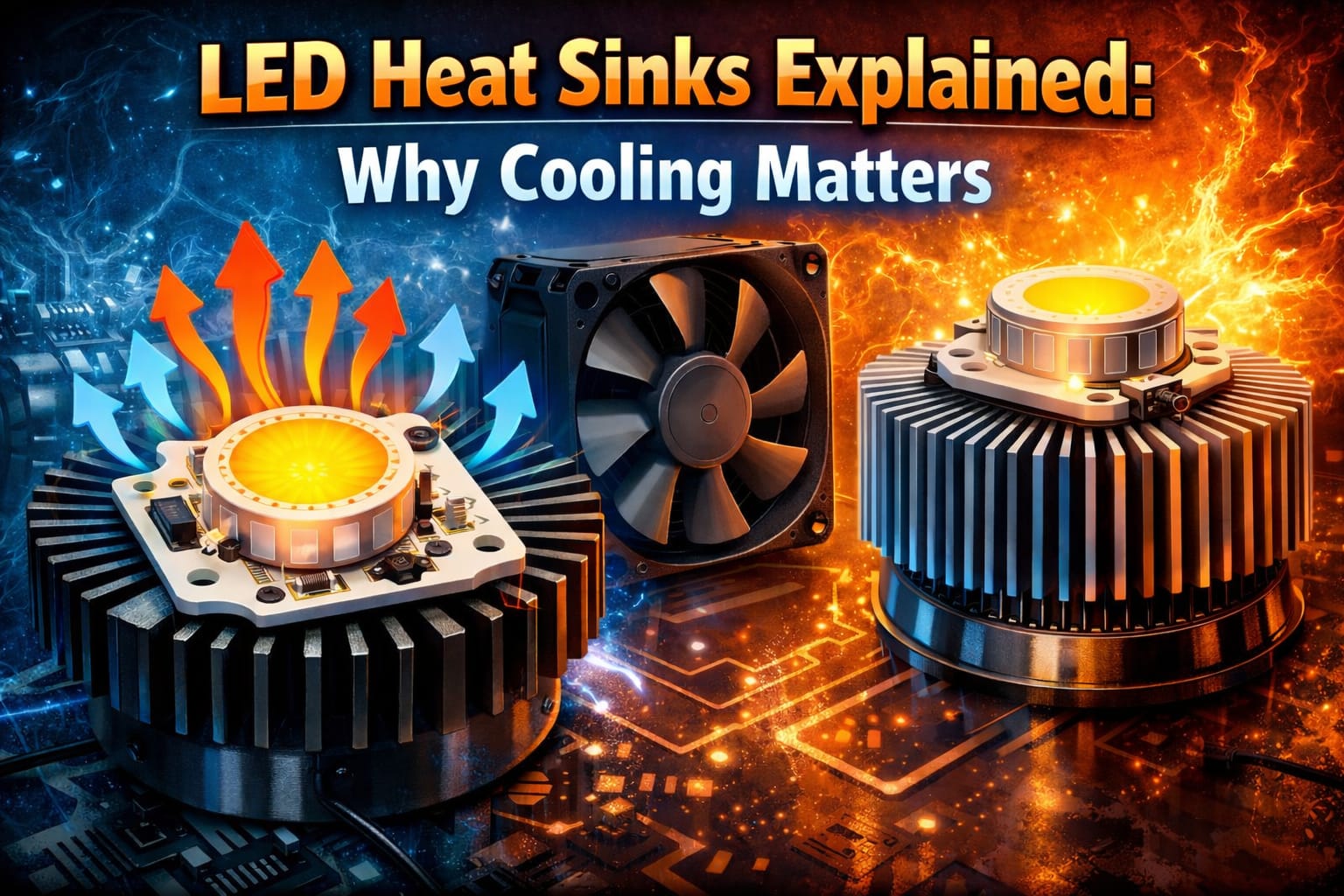
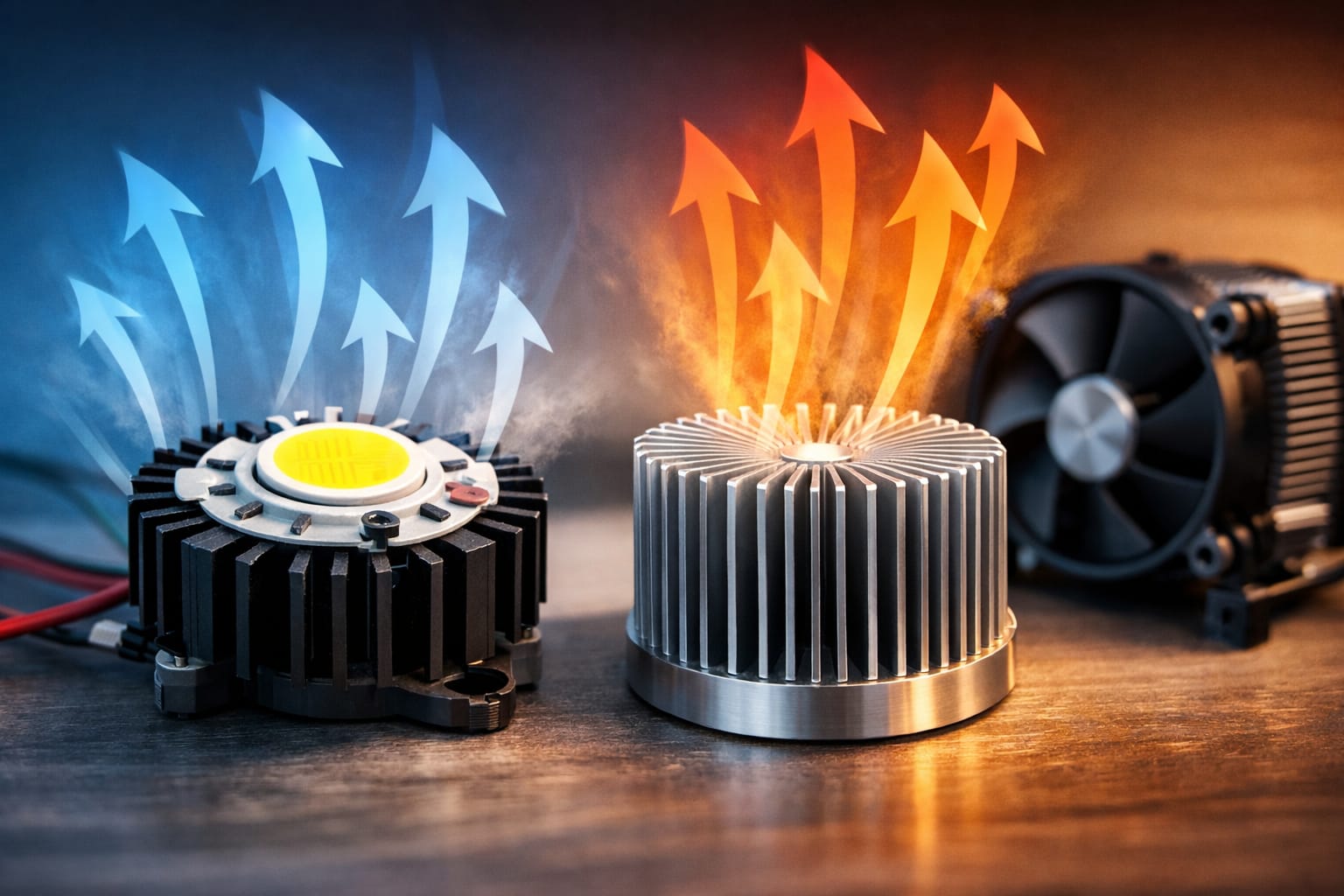
A heat sink does not make heat disappear. It conducts heat away from the LED package or board, spreads it across a larger metal body, and releases it into the surrounding air through convection and radiation. That is why many LED heat sinks use fins, pins, or ribbed shapes instead of a plain flat block: more surface area gives heat more room to escape.
The complete path matters: LED junction, board or substrate, thermal interface material, heat sink, and surrounding air. If one part of that chain is poorly designed or badly installed, the whole cooling system becomes less effective. For a wider technical background, our guide on how LED lighting works explains why such a small light source can create a serious thermal management challenge.
Simple way to think about it: a heat sink is the escape route for heat. If that route is too small, badly attached, blocked by an enclosure, or surrounded by hot air, the LED runs hotter than it should.
Temperature affects LED performance in three practical ways. First, light output can fall as the LED gets hotter. Second, color can drift over time, especially in applications where consistent white light matters. Third, lifespan can shorten because heat accelerates stress on the LED package, driver, solder joints, and surrounding materials. The U.S. Department of Energy also notes that drive current, thermal path, and ambient temperature all influence LED junction temperature in its thermal management overview for LEDs.
Do not judge LED cooling only by whether the outside of the fixture feels warm. A warm body can be normal if it is moving heat away. The more important question is whether the LED junction temperature stays controlled over time.
Passive vs Active LED Cooling: Which One Do You Need?
Passive LED cooling relies on the heat sink itself and natural airflow. This is the most common choice for everyday LED products because it is quiet, simple, and dependable. With no fan or moving part, passive cooling usually needs less maintenance and has fewer failure points.
Active LED heat sinks add powered airflow, usually from a fan or blower. This can move heat away faster and allows a smaller or more compact system to handle a higher thermal load. Active cooling is more common in high-power LEDs, projectors, grow lights, dense enclosures, and designs where passive cooling alone does not provide enough margin.
For most buyers, the decision is practical. Passive cooling is usually enough for normal household fixtures, many LED strips, and mid-power modules with decent airflow. Active cooling becomes more relevant when wattage rises, the enclosure gets smaller, the room is warm, or the LED must stay bright for long sessions.
If a design is already pushing thermal limits, upgrading to a larger aluminum LED heat sink for high-wattage builds can improve stability before you add the extra noise, dust sensitivity, and failure risk of a fan.
Active cooling can solve heat problems, but it also adds noise, dust buildup, wiring complexity, and another component that can fail. In many LED setups, a larger passive heat sink with better airflow is the more reliable long-term choice.
Aluminum vs Copper LED Heat Sinks
Aluminum is the most common LED heat sink material because it offers a strong balance of thermal performance, weight, cost, corrosion resistance, and manufacturability. For most real-world LED products, aluminum is the most practical choice.
Copper conducts heat better than aluminum, but it is heavier and more expensive. That makes it useful for specialized high-performance builds, compact designs with very high heat density, or hybrid designs that use a copper base with aluminum fins. For ordinary fixtures, copper is not automatically the better value.
Surface finish can also matter. Black anodized aluminum can improve radiative heat transfer in some designs, but the real-world difference depends on airflow, surface area, orientation, and enclosure design. Material choice is important, but it cannot compensate for a heat sink that is too small, poorly mounted, or trapped inside a hot housing.
How to Size and Install an LED Heat Sink
One of the biggest mistakes in LED heat sink cooling is assuming that any chunk of metal will do the job. Good sizing depends on how much heat the LED produces, how warm the environment gets, how much airflow is available, how the sink is mounted, and how much reliability margin you want.
Wattage is only the starting point. A 20W LED in open air can be easier to cool than a lower-power LED trapped inside a tight sealed fixture. Higher ambient temperature means less thermal headroom. Poor airflow means you need more surface area. This also matters with high-brightness LED strips, where long runs, dense LEDs, and enclosed channels can make heat buildup more noticeable. Horizontal fins can trap warm air more easily than fin layouts that allow natural vertical airflow.
Driver behavior also matters because current, voltage, and power regulation affect how much heat the LED system has to handle. If you are comparing power supply types, our guide to constant current vs constant voltage LED drivers explains why the driver choice can influence heat load and long-term stability.
Better rule of thumb: size the heat sink for the worst realistic condition, not the easiest one. A setup that works on a cool open bench can struggle inside a warm ceiling, enclosed housing, cabinet, or grow light frame.
Before choosing the final size, check that you can:
- Leave enough surface area for the heat to spread and escape.
- Keep fins open to airflow instead of pressing them against walls or covers.
- Use a thin, even thermal interface layer; too much paste can hurt performance.
- Mount the LED module firmly and evenly so there are no air gaps.
- Keep the LED driver away from the hottest part of the heat sink when possible.
Installation quality can make a good heat sink perform badly. Uneven surfaces, loose screws, dirt, dust, dry thermal pads, or poor alignment can all increase thermal resistance. For screw-mounted LED modules or heat sinks with firm mechanical pressure, using non-conductive thermal paste for better LED heat sink contact can help reduce tiny air gaps between the LED board and the metal surface. Airflow mistakes are just as common: crowding several hot fixtures together, placing fins where air cannot move, or putting a powerful LED inside a nearly sealed enclosure can ruin an otherwise decent design.
For broader buying context, our LED lighting buying guide can help you spot fixtures where poor cooling, weak drivers, or low-quality construction may reduce real-world reliability.
Signs Your LED Heat Sink Is Too Small or Poorly Ventilated
When LED cooling is not good enough, the warning signs often appear before complete failure. The fixture may start bright and then look dimmer after warming up. White light may shift in color. Output may become unstable. In active systems, rising fan noise or repeated fan failure can also point to thermal stress.
Premature driver failure can be another clue, especially when the driver sits too close to the LED module and shares the same heat problem. Thermal management should be treated as a full-system issue, not just a heat sink issue. Optical design can also interact with cooling, because pushing more light through a compact fixture often increases heat density. Our guide to LED optical systems explains how light output, optics, and fixture design work together.
If you keep seeing output loss, shortened life, color drift, or repeat failures in high-power LEDs, cooling should be one of the first things you check. Very often, the hidden cause is not the LED chip itself but the thermal path around it.
What Should You Choose?
For most buyers and builders, the right LED heat sink choice comes down to power level, enclosure size, airflow, operating time, and how much reliability margin you want built into the system.
- For low-power household LEDs: passive aluminum cooling is usually enough if the fixture has decent airflow.
- For compact mid-power systems: surface area, thermal contact, and enclosure ventilation matter more than many people expect.
- For high-power LEDs in tight spaces: active cooling may be necessary, but first check whether a larger passive heat sink with more cooling surface can give you enough thermal headroom.
- For hot, dusty, or enclosed environments: design more conservatively and avoid relying on the smallest possible heat sink.
- For long-term reliability: choose more cooling margin, better mounting, and cleaner airflow rather than chasing only maximum brightness.
FAQ
Do All LED Lights Need a Heat Sink?
Not every small LED needs a visible separate heat sink, but every LED needs some way to move heat away from the chip. In many bulbs and fixtures, the body, board, or metal housing acts as part of the thermal path.
Is Passive or Active LED Cooling Better?
Passive cooling is usually better for quiet, simple, low-maintenance lighting. Active cooling is better when the LED is powerful, compact, enclosed, or running in warm conditions where passive cooling does not provide enough margin.
What Happens if an LED Heat Sink Is Too Small?
A heat sink that is too small can let the LED run hotter than intended. That can reduce brightness, speed up lumen depreciation, cause color shift, stress the driver, and shorten the useful life of the product.
Is Aluminum or Copper Better for LED Heat Sinks?
Copper conducts heat better, but aluminum is lighter, cheaper, easier to manufacture, and good enough for most LED heat sinks. Copper makes more sense in specialized high-performance designs or hybrid heat sinks where extra heat spreading is worth the added cost and weight.
Key Takeaways
LED heat sink cooling matters because LEDs still generate heat, and that heat directly affects brightness, color stability, efficiency, and lifespan. A heat sink spreads concentrated heat across a larger surface so it can escape more effectively.
Passive cooling works for many household and mid-power applications, while active cooling becomes more useful in high-power, compact, enclosed, or warm environments. Aluminum is the most practical heat sink material in most cases, while copper is usually reserved for more specialized builds.
The safest long-term approach is simple: size cooling conservatively, keep airflow open, use good thermal contact, and do not underestimate how much heat dissipation influences real-world LED reliability.
Sharing This Guide
If you found this guide helpful, you can save it for later or share it with someone choosing LED modules, high-power fixtures, grow lights, spotlights, or DIY lighting builds.
Share using the links below
Interested in learning more? Browse all related articles in our LED Basics category section.