Constant Current vs Constant Voltage LED Drivers: 12V/24V or mA?
Choosing between constant current and constant voltage comes down to the LED product label. If it is rated in milliamps, such as 350mA or 700mA, use a constant current driver. If it is rated 12VDC or 24VDC, use a constant voltage power supply.
Mixing the two can cause flickering, dim output, overheating, shortened lifespan, or no light at all. This guide shows how to read the label, size the driver correctly, check dimming compatibility, and avoid choosing by wattage alone.
Quick Answer: Use mA for Constant Current, 12V/24V for Constant Voltage
Use a constant current driver when the LED product label shows a current rating, such as 350mA, 500mA, or 700mA. Use a constant voltage power supply when the label shows 12VDC or 24VDC, because most LED strip lights and low-voltage accent systems are designed for fixed-voltage power.
- Constant current keeps amperage fixed and lets voltage vary within a safe operating range.
- Constant voltage keeps voltage fixed and lets the connected LED load draw the current it needs.
- mA-rated LEDs, high-power LED arrays, and many fixture modules usually need constant current.
- 12V or 24V LED strips, signage, shelf lighting, and accent lighting usually need constant voltage.
- Do not choose by wattage alone. Match the driver type first, then check wattage, voltage range, dimming, wiring, and installation limits.
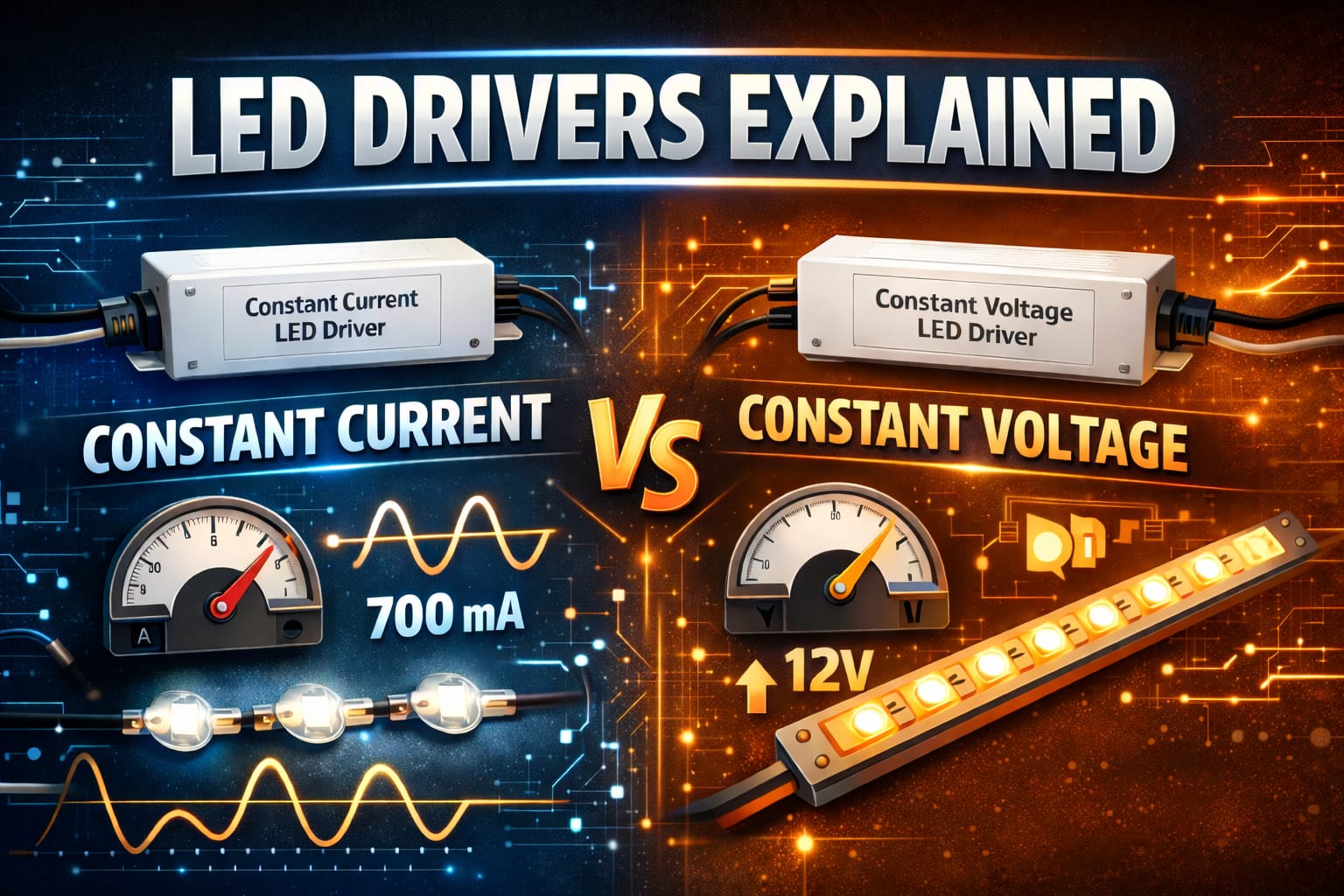
Table of Contents:
- Quick Answer
- Constant Current vs Constant Voltage: Main Difference
- How Constant Current LED Drivers Work
- How Constant Voltage LED Drivers Work
- How to Choose the Right LED Driver From the Label
- How to Size the Driver
- Dimming, Wiring and Troubleshooting Checks
- Which LED Driver Should You Choose?
- FAQ
- Key Takeaways
- Sharing This Guide
Constant Current vs Constant Voltage: Main Difference
The main difference is what the driver controls. A constant current LED driver controls the current flowing through the LEDs, while a constant voltage driver holds the output voltage steady. That one difference determines which LED products each driver can safely power.
Constant current is used when the LEDs need external current regulation. The driver adjusts its voltage output within a specified range so the LEDs receive the target current. This protects the LED junctions and helps keep brightness stable as temperature and forward voltage change.
Constant voltage works the other way around. The power supply delivers a fixed voltage, usually 12V or 24V, and the connected product controls current internally. That is why it suits LED strips, pre-engineered modules, signage, and low-voltage lighting systems with built-in resistors or onboard regulation.
Quick label guide:
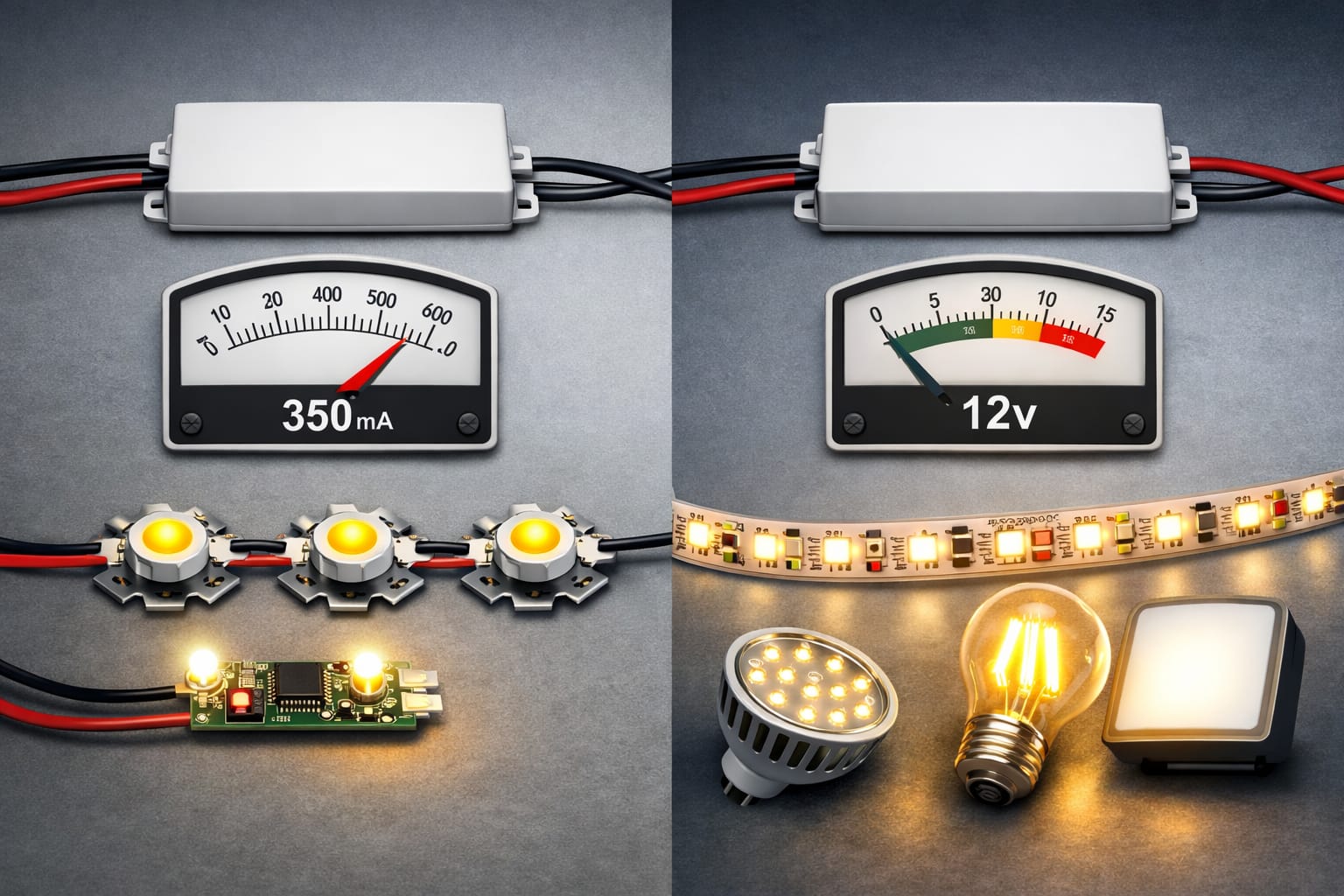
350mA, 500mA, 700mA, 1050mA
Use a constant current driver for high-power LEDs, COB modules, and fixture boards. Check the driver’s voltage range and dimming method before buying.
12VDC or 24VDC
Use a constant voltage power supply for LED strips, signage, and under-cabinet lighting. Check total wattage, headroom, and voltage drop.
Only wattage is shown
Do not choose a driver from wattage alone. Look for current, voltage, or the original driver specs before replacing it.
How Constant Current LED Drivers Work
A constant current driver continuously monitors the output and adjusts voltage to hold the target amperage. If the LEDs warm up and their forward voltage drops slightly, the driver lowers voltage while keeping the current on target. That active current regulation is one reason constant current is common in higher-performance fixtures where thermal behavior matters, especially in systems that rely on good LED heat management.
Each constant current driver has a working voltage window. For example, a 700mA driver rated for 9V to 48V can only regulate correctly if the total forward voltage of the connected LEDs falls inside that range. If the load is too small, the driver may not regulate properly. If the load is too large, it may hit its voltage limit and fail to drive the LEDs correctly.
If the LED product is labeled in milliamps but not in volts, start with the required current, then check whether the driver’s voltage range can cover the full LED load.
This setup is especially useful for series-connected LEDs because every LED in the chain receives the same current. Minor differences in forward voltage from one chip to another matter less, which helps maintain more even performance across the fixture. If you want a deeper look at how chip construction affects behavior, this guide to LED chip types is a useful companion.
How Constant Voltage LED Drivers Work
A constant voltage driver keeps the output fixed at a specific level, usually 12V or 24V. The connected LED product then draws the current it needs, assuming it was designed for that voltage in the first place. This is why constant voltage is the standard choice for most LED strip systems and other low-voltage lighting kits.
LED strips usually include resistors or small regulating components in each segment, so the strip can manage current internally. That makes installation simpler than a constant current setup. If you are dealing with flicker, dim output, or unstable strip performance, a stable 12V or 24V constant voltage power supply can help keep the voltage steady and reduce common power issues.
Another advantage is flexibility. Multiple strips or branches can connect to the same 12V or 24V supply in parallel, with each branch drawing current independently. That is one reason constant voltage works well in accent lighting, under-cabinet runs, signage, shelving lights, and other layouts where expansion and easy wiring matter. If you are unsure which strip voltage makes sense for a project, see this guide to 5V, 12V, and 24V LED strips.
How to Choose the Right LED Driver From the Label
The best place to start is the label on the LED product. If it says 12VDC or 24VDC, it needs a constant voltage supply that matches that exact voltage. If it is rated at 350mA, 500mA, 700mA, or another current value, it usually needs a constant current LED driver that can deliver that amperage within the correct voltage range.
Do not assume wattage alone tells you which driver to buy. A 12V strip and a 700mA COB module can have similar wattage, but they require completely different driver types.
In retrofit situations, the existing driver often tells the story. A 12V or 24V power supply usually points to strips or modules with internal current control. A driver labeled with a current output usually means the LEDs depend on external current regulation. When specs are unclear, matching the original driver type is safer than guessing.
It also helps to think about future changes. Constant voltage systems are generally easier to expand because new branches can be added to the same power bus if enough capacity remains. Constant current setups can be more efficient and precise, but they are less forgiving if the LED load changes later.
Simple label rule:
- ✓ If the label gives mA first, choose constant current and check the voltage range.
- ✓ If the label gives 12VDC or 24VDC, choose constant voltage and calculate total wattage.
- ✓ If the label only gives watts, look for more specs before buying a replacement driver.
How to Size the Driver: mA, Voltage Range and Wattage Headroom
For constant current, sizing starts with the target current and the total forward voltage of the LED chain. If five LEDs each have a forward voltage of 3.6V, the load is about 18V total. A 700mA driver can power that setup only if 18V falls inside its regulation range. It is also smart to leave some headroom instead of running the driver at its maximum limit.
For constant voltage, sizing usually starts with current draw or watts per meter. Add up the wattage of every connected strip or module, then choose a power supply with extra capacity above that total. A common practical rule is to leave about 20% to 25% headroom, especially when the supply will run for long periods or sit inside an enclosure.
For longer 24V strip runs, a 24V 5A 120W LED power supply for strip lights can be a practical choice when the total strip wattage fits comfortably below the supply rating.
On longer LED strip runs, voltage drop matters too. Wire gauge, power injection, total run length, and connection quality can affect both brightness and voltage output stability. This is easier to plan when you understand LED strip brightness and power behavior before buying the supply.
For LED strips, calculate total watts first, then choose a constant voltage supply with headroom. For mA-rated LEDs, match the current first, then confirm the voltage range covers the full LED load.
Dimming, Wiring and Troubleshooting Checks
Dimming compatibility depends on both the driver type and the control method. Constant current drivers may support 0-10V, TRIAC, PWM, or DALI dimming, but only if the specific driver model is built for that method. Otherwise, you can end up with limited dimming range, buzzing, flicker, or no dimming response at all.
Constant voltage systems usually dim through a separate PWM controller placed between the power supply and the LED load. The controller switches full voltage on and off very quickly, and the duty cycle changes the perceived brightness. If you want to understand the control side in more detail, this guide to PWM vs analog dimming explains the trade-offs clearly.
Wiring rules also matter. Constant current circuits carry the specified output current while voltage varies with the LED load. Constant voltage systems hold the voltage steady, but current rises as more load is added. In both cases, undersized wire can create losses, heat, flicker, dim sections, and unreliable performance. If you are planning a more complex setup, avoiding common LED wiring mistakes can save a lot of troubleshooting later.
Common symptoms and what they usually mean:
LEDs do not light on a constant current driver: the total forward voltage may be outside the driver’s operating range.
LED strips look dim or flicker: check for overload, voltage drop, poor connections, or a weak power supply.
The driver shuts down and later comes back: heat, overload, or poor installation conditions may be triggering protection.
Dimming is unstable: the dimmer, controller, and driver may not use the same dimming method.
If you are troubleshooting an existing installation, start with the driver label, then measure voltage at the LED terminals rather than only at the power supply. The voltage at the actual load gives a much clearer picture of what the LEDs are receiving. If the system worked before and now behaves inconsistently, this guide to LED driver failure signs can help narrow down the cause.
Safety should also be part of LED driver selection. Drivers installed in tight, unventilated spaces run hotter, which can shorten lifespan or cause thermal shutdown. Outdoor setups need the right enclosure rating, and all drivers should match the intended environment. Look for recognized product certification, such as UL product certification, when safety and compliance matter.
Which LED Driver Should You Choose?
Choose the driver type your LED product was designed for, not the one that seems easier or more powerful. In most cases, the product label gives you the answer.
- Choose constant current for LEDs or fixtures rated in milliamps.
- Choose constant voltage for 12V or 24V strips, modules, signage, and low-voltage lighting systems.
- Choose constant voltage if you want easier parallel wiring and simpler future expansion.
- Choose constant current if the LED load needs precise current regulation and the fixture specs require it.
- When in doubt, follow the original driver type or the manufacturer’s electrical specification.
For most 12V LED strip projects, the practical choice is a constant voltage supply with enough wattage headroom, such as a 12V LED power supply for LED strips. For mA-rated LEDs or fixture boards, do not substitute a 12V supply unless the product documentation specifically allows it.
FAQ
Are LED Strips Constant Current or Constant Voltage?
Most LED strips are constant voltage products. If the strip is labeled 12VDC or 24VDC, it needs a matching constant voltage power supply. The strip segments usually include resistors or onboard current control, so the power supply does not regulate current directly.
Can I Use a Constant Voltage Power Supply on a Constant Current LED?
Usually no. If the LED product is rated in milliamps and depends on external current regulation, a constant voltage supply can overdrive the LEDs, cause overheating, or damage the product. Use the driver type specified by the LED manufacturer.
Is Wattage Enough to Choose an LED Driver?
No. Wattage tells you capacity, but it does not tell you whether the LED needs constant current or constant voltage. Match driver type first, then check voltage, current, wattage headroom, dimming compatibility, and installation conditions.
Why Do Constant Current Drivers Have a Voltage Range?
A constant current driver changes its output voltage to maintain the target current. The voltage range shows the minimum and maximum load voltage it can regulate. If the LED load falls outside that range, the driver may flicker, shut down, or fail to power the LEDs correctly.
Key Takeaways
The real difference between constant current and constant voltage comes down to what the driver controls. Constant current fixes amperage and adapts voltage, while constant voltage fixes voltage and lets the connected load draw current as designed.
For practical buying and installation decisions, follow the electrical rating on the LED product first. Milliamps point to constant current, while 12VDC or 24VDC points to constant voltage. After that, size the driver with enough headroom and check dimming, wiring, heat management, and installation requirements.
Getting this choice right makes the rest of the project much easier. You get more reliable performance, less troubleshooting, and a lighting system that works the way it was meant to from the start.
Sharing This Guide
If you found this guide helpful, save it for later or send it to someone planning an LED installation. It is especially useful for homeowners, DIY users, and anyone comparing LED driver types for the first time.
Share using the links below.
Interested in learning more? Browse all related articles in our LED Basics category section.