How to Read LED Bulb Labels: Lumens, Kelvin, CRI & Watts
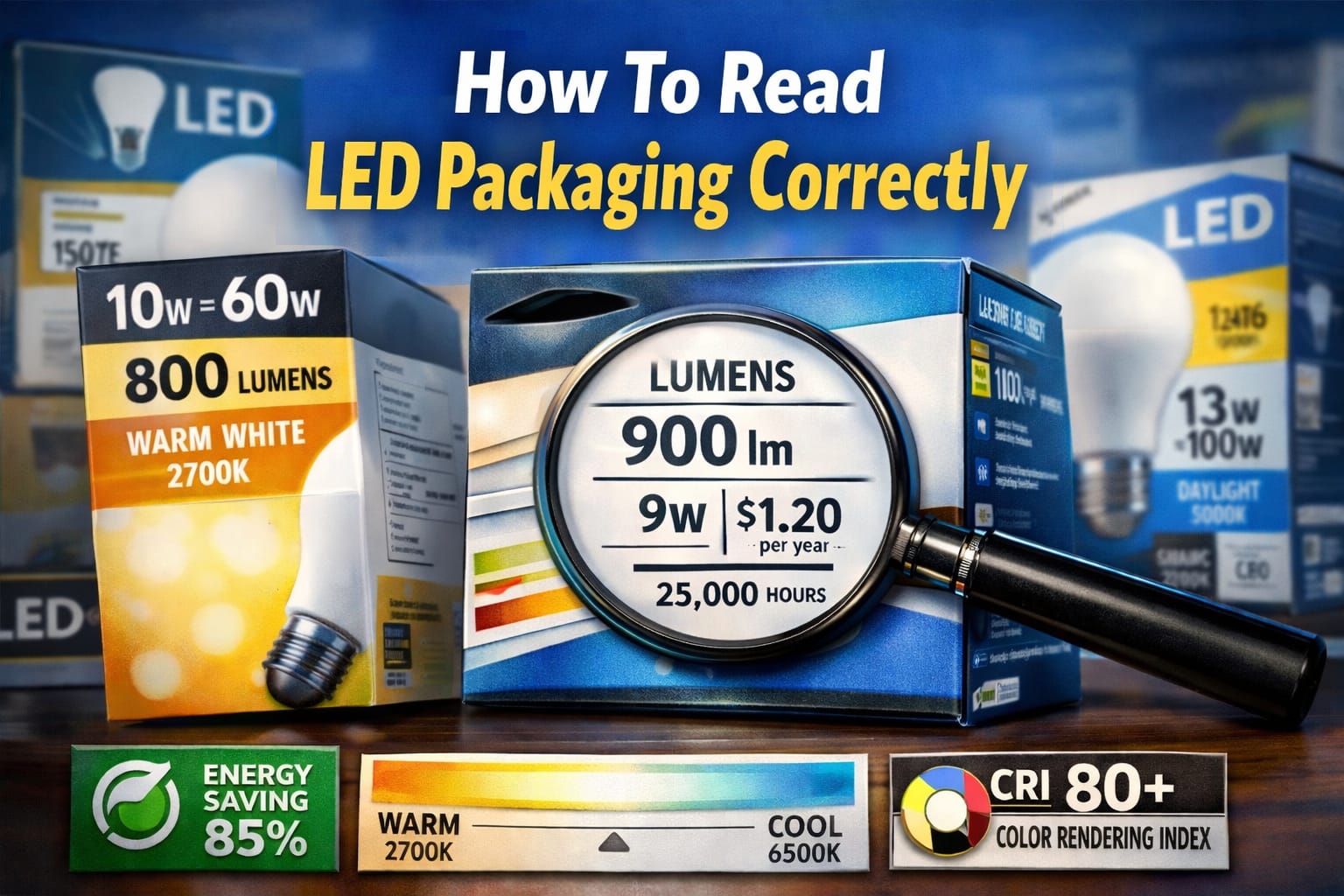
To read LED bulb labels correctly, check lumens first, not watts. Then compare Kelvin, CRI, actual wattage, dimming support, base type, bulb shape, fixture rating, and warranty before you buy.
This guide is for anyone standing in front of a bulb box, comparing products online, or trying to avoid buying an LED bulb that is too dim, too cold, non-dimmable, incompatible with the fixture, or disappointing once installed.
Quick Answer: What to Check First on an LED Bulb Label
The most important LED bulb label information is brightness, color, efficiency, and compatibility. If you only check a few things before buying, use this order:
- Lumens for brightness, instead of choosing by wattage alone.
- Kelvin for warm white, neutral white, or daylight color.
- CRI if accurate colors matter in kitchens, bathrooms, closets, or work areas.
- Actual watts and estimated energy cost for efficiency.
- Dimmable or non-dimmable before using the bulb with a dimmer switch.
- Base type, bulb shape, and fixture rating to make sure it fits and can be used safely.
If you want a broader buying framework before comparing bulb labels, our LED lighting buying guide explains how brightness, color, fixture compatibility, and room use work together in real-world decisions.
Table of Contents:
- Quick Answer: What to Check First
- How to Read LED Bulb Labels Step by Step
- How to Read the Lighting Facts Label
- Lumens vs Watts: Choose Brightness First
- Kelvin and CRI: Color Quality on the Box
- Watts, Energy Cost, Lifespan and Warranty
- Dimming, Fixture Ratings, Base Type and Certifications
- Smart, RGB and Special Features Worth Checking
- Common LED Label Mistakes
- What Should You Choose?
- FAQ
- Key Takeaways
- Sharing This Guide
How to Read LED Bulb Labels Step by Step
The easiest way to read LED bulb packaging is to ignore the marketing words on the front of the box at first and focus on practical buying questions. Ask yourself: how bright should the bulb be, what color should the light feel like, will it dim, will it fit the socket, and is it rated for the fixture or location where you plan to use it?
Most buying mistakes happen when people only look at phrases like “60W replacement,” “soft white,” “daylight,” or “long life” without checking the actual LED bulb label information behind those claims. Two similar-looking bulbs can behave very differently once installed. One may dim smoothly while another flickers. One may work safely in an enclosed fixture while another overheats. One may look warm and comfortable while another makes the room feel harsh or clinical.
A good LED label should help you compare brightness, color temperature, energy use, lifespan, fixture compatibility, and special features without relying only on brand promises. If you are comparing LED bulbs against other bulb types, our light bulb comparison guide can help you understand what differs among LED, incandescent, halogen, and other common bulb types. Once you know what each number means, buying LED bulbs becomes much faster and much more accurate.
Read the box like a checklist, not like an advertisement. Choose brightness by lumens, comfort by Kelvin, color quality by CRI, and safety by the fixture rating.
How to Read the Lighting Facts Label
The Lighting Facts label is one of the best places to start because it gives you standardized information instead of vague packaging claims. It works a bit like a nutrition label for light bulbs, showing key details such as brightness, estimated energy cost, life, light appearance, and energy use.
This matters because the front of a bulb box often highlights the most attractive selling point, while the Lighting Facts label helps you compare products more fairly. If two bulbs both say “soft white” or “60W replacement,” the label can still reveal differences in lumens, wattage, expected life, and color appearance.
The Federal Trade Commission’s Lighting Facts guidance explains how standardized lighting labels help consumers compare light output, energy cost, life, light appearance, and wattage more easily.
When the front of the box sounds impressive but the data panel is vague, trust the data panel first. Clear specs are usually a better buying signal than broad claims like “bright,” “premium,” or “long-lasting.”
Lumens vs Watts: Choose Brightness First
Lumens tell you how much light the bulb produces. Watts tell you how much electricity it uses. That is why the most important lumens vs watts LED bulb rule is simple: choose brightness by lumens and use watts only as an efficiency check.
This is different from old incandescent shopping habits, where people often bought bulbs by wattage. With LEDs, a lower-watt bulb can be brighter than a higher-watt bulb if it is more efficient. The U.S. Department of Energy also explains that lumens are the useful number for understanding brightness on modern light bulb labels.
As a rough buying guide:
- 450 lumens: low-output bulb, often close to an old 40W incandescent bulb.
- 800 lumens: common household brightness, often close to an old 60W bulb.
- 1,100 to 1,600 lumens: brighter room lighting or task lighting.
- 2,000+ lumens: stronger output for garages, utility spaces, workshops, and larger areas.
For a standard home bulb, A19 LED bulbs with 800 lumens, 3000K light, CRI 90, and dimming support are a useful example of what a clear label should show: brightness, color temperature, color quality, wattage, base type, and fixture rating before you buy.
For larger utility areas, the label priorities change. A living room lamp may need warm light and good dimming, while a garage, laundry room, or workshop usually needs higher lumens, efficient wattage, and a beam pattern that spreads light evenly.
If a bulb says “60W replacement,” still check the lumens. The replacement claim is only a shortcut; the lumen number tells you the actual light output.
For official background on brightness labels, see the Energy.gov guide to lumens and the Lighting Facts label.
Kelvin and CRI: Color Quality on the Box
After brightness, color is usually the next thing that determines whether a bulb feels right in the room. Kelvin tells you whether the light looks warm, neutral, or cool. CRI tells you how naturally colors appear under the bulb. Both numbers matter because a bulb can be bright enough but still feel uncomfortable or make colors look dull.
For a deeper breakdown of warm, neutral, and daylight bulbs, see our color temperature explained guide. For quick buying decisions, use these Kelvin ranges:
- 2700K–3000K: warm white, softer and more relaxed for bedrooms, living rooms, and cozy lamps.
- 3500K–4000K: neutral white, cleaner and more balanced for kitchens, hallways, bathrooms, and general use.
- 5000K+: cool white or daylight, crisper and more task-focused for garages, laundry rooms, workshops, or areas where clarity matters more than warmth.
CRI stands for Color Rendering Index. It measures how naturally colors appear under the light. A CRI of 80 is common and acceptable for many standard bulbs, but a CRI of 90 or higher is usually better for kitchens, bathrooms, wardrobes, art areas, makeup mirrors, and rooms where skin tones, food, fabrics, or paint colors need to look accurate.
If the box does not show CRI at all, be careful in color-sensitive rooms. It does not automatically mean the bulb is bad, but it may mean the manufacturer is not trying to highlight color quality.
Fast room rule: choose 2700K–3000K for comfort, 3500K–4000K for balanced everyday spaces, and 5000K+ only when you want a clearer, brighter task-light feel.
Watts, Energy Cost, Lifespan and Warranty
Wattage still matters on LED bulb labels, but not because it tells you brightness. With LEDs, wattage mainly tells you how much electricity the bulb uses. Two bulbs can have similar brightness but different wattage, and the lower-watt option is usually more efficient if the light output is the same.
Many packages also show a wattage equivalent, such as “60W replacement” or “100W replacement.” This helps shoppers translate old incandescent habits into LED terms, but it should not be the final decision point. Lumens are still the better brightness measure.
You may also see estimated yearly energy cost. This is based on standard testing assumptions, so your actual cost will depend on your electricity rate and how often the bulb is used. Even so, it can be helpful when comparing two bulbs with similar brightness.
Lifespan claims also need context. LED boxes may advertise 15,000, 25,000, or even 50,000 hours, but those numbers are usually based on test conditions. Real-world lifespan depends on heat, switching frequency, fixture design, electrical conditions, and product quality.
A bulb in a cool, open fixture usually has a better chance of lasting longer than one installed inside a hot, enclosed fitting. That is why warranty information is useful. A clear warranty can be a stronger trust signal than a vague “long life” claim.
Dimming, Fixture Ratings, Base Type and Certifications
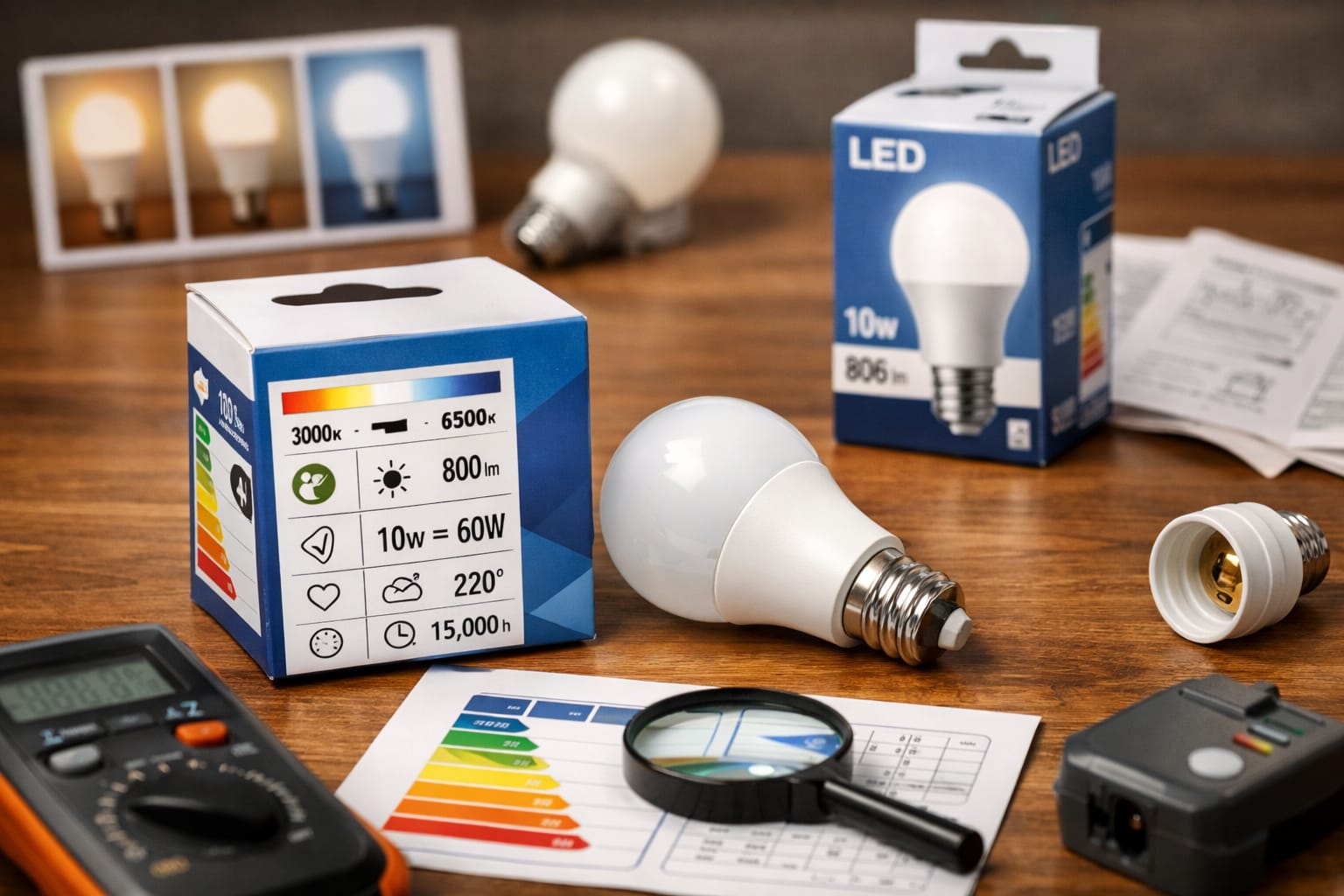
Compatibility details are easy to skip, but they are often the difference between a good bulb and a frustrating purchase. Before buying, check whether the bulb is dimmable, whether it is rated for your fixture type, whether the base matches your socket, and whether the package shows safety or efficiency certifications.
Assume a bulb is not dimmable unless the box clearly says it is. Using a non-dimmable LED bulb with a dimmer switch can cause flickering, buzzing, poor dimming range, early failure, or inconsistent performance. Even when a bulb is dimmable, it is still smart to check whether the manufacturer mentions compatible dimmer types.
Fixture ratings are just as important:
- Enclosed fixture rated: suitable for sealed or poorly ventilated fixtures where heat can build up.
- Damp rated: suitable for moisture-prone areas without direct water exposure.
- Wet rated: suitable for direct water exposure, outdoor use, or exposed locations.
Base type and shape also matter. E26 is the standard household screw base in North America, but many fixtures use E12, GU10, GU24, or other bases. Shape terms such as A19, BR30, PAR38, candle, globe, and tube describe the bulb’s physical form and how it spreads light.
For recessed cans or wider downlight fixtures, BR30 dimmable LED bulbs with selectable color temperature, 90 CRI, and damp rating are a better example to check because shape, beam spread, dimming support, and room rating matter more than they do with a standard A19 bulb.
You should also look for recognized safety or efficiency marks such as UL, ETL, or ENERGY STAR where relevant. Certifications do not guarantee that a bulb is perfect for every situation, but they can help separate more carefully tested products from vague low-cost options. The ENERGY STAR light bulb guidance is a useful reference for understanding efficiency and performance expectations.
Even if a bulb has the right brightness and color, it can still be the wrong product if it is not rated for your dimmer, fixture, moisture level, socket, or installation area.
Smart, RGB and Special Features Worth Checking
Some LED bulbs include features that go beyond the basic Lighting Facts label. These may include smart home support, tunable white, full RGB color, motion activation, app control, schedules, scenes, voice assistant compatibility, or remote control options.
If you are considering a smart LED bulb with tunable white, dimming, 90+ CRI, and Alexa/Google support, check the label or product page for app support, Wi-Fi or Bluetooth requirements, hub requirements, voice assistant compatibility, color temperature range, and whether the bulb can still work normally from the wall switch.
If you are considering RGB or decorative LED products, do not focus only on color effects. Check the voltage, power supply, control method, installation requirements, app compatibility, and whether the product is damp rated or wet rated for the place where you plan to use it.
Special features are useful only when the basic specs are right first. A smart bulb that is too dim, the wrong color temperature, incompatible with your app, or unsuitable for the fixture will still be a poor purchase.
Common LED Label Mistakes
The most common mistake is buying by wattage equivalent alone. A “60W replacement” claim can be useful, but it should not replace the lumen number. If you want predictable brightness, check lumens first.
The second mistake is ignoring color temperature. A bulb can have enough brightness but still feel wrong if the Kelvin rating does not match the room. Warm white usually feels better in comfort spaces, while neutral or daylight-style bulbs work better in task-focused spaces.
The third mistake is assuming every LED bulb works with every dimmer or fixture. Dimming support, enclosed fixture rating, damp rating, wet rating, base type, and bulb shape should all be checked before buying, especially when replacing bulbs in older fixtures.
Finally, do not ignore missing information. A budget bulb is not automatically bad, but if the package avoids important details like CRI, dimming support, fixture rating, warranty, or certifications, compare it carefully before choosing it over a clearer alternative. Our cheap vs premium LED bulbs guide explains when paying more is actually useful and when a lower-cost bulb may still be enough.
For more help with bulb types, LED specs, troubleshooting, and buying decisions, visit the LED Knowledge Center.
What Should You Choose?
The best LED bulb choice depends on where the bulb will be used. Instead of looking for one perfect bulb for every room, match the label specs to the space and the problem you want to solve.
- Bedroom or living room: look for 2700K–3000K, suitable lumens, and dimming support if needed. These specs keep the light warm, comfortable, and easy to control.
- Kitchen or bathroom: prioritize 3500K–4000K, CRI 90+ if possible, and damp rating where needed. This improves clarity and color accuracy for daily tasks.
- Recessed cans or downlights: check for BR30 or compatible shape, dimming support, beam spread, CRI, and damp rating where needed. Recessed fixtures depend more on shape, heat conditions, and trim compatibility, so a recessed lighting bulb guide is more useful than choosing by lumens alone.
- Desk or task area: choose enough lumens, a neutral or cool color temperature, low flicker, and good dimming. This helps visibility without making the space feel too harsh.
- Garage or utility space: focus on higher lumens, efficient watts, wide coverage, and a suitable fixture type. These areas usually need strong, practical output more than cozy ambience.
- Outdoor or moisture-prone area: check for a damp or wet rating, the correct fixture type, and safe installation details. This prevents using indoor-only products where moisture or water exposure matters.
FAQ
What is the most important number on an LED bulb label?
Lumens are usually the most important number because they tell you how bright the bulb will be. Watts matter for energy use, but lumens matter more for choosing the right brightness.
Should I choose LED bulbs by watts or lumens?
Choose by lumens first. Watts only tell you how much power the bulb uses. A more efficient LED bulb can use fewer watts while still producing the same or more light.
What does Kelvin mean on LED bulb packaging?
Kelvin tells you the color temperature of the light. Lower numbers like 2700K look warmer and softer. Higher numbers like 5000K look cooler, brighter, and more daylight-like.
Is CRI important when buying LED bulbs?
CRI is important if you care about accurate colors. For kitchens, bathrooms, closets, makeup areas, art spaces, and rooms with colorful decor, a CRI of 90 or higher is usually a better choice.
How do I know if an LED bulb will work in my fixture?
Check the base type, bulb shape, dimming support, and fixture rating. If the bulb will be used in an enclosed fixture, a damp area, a wet area, or a dimmer-controlled fixture, the packaging should clearly say it is suitable for that use.
Key Takeaways
The best way to read LED bulb labels is to start with lumens for brightness, then compare Kelvin, CRI, watts, dimming support, base type, bulb shape, and fixture rating.
Do not choose by “60W replacement” alone. That phrase can help you understand the old incandescent equivalent, but the actual lumen number gives you a clearer idea of brightness.
A good LED bulb is not just bright. It should match the room, socket, dimmer, fixture type, color preference, and installation environment.
Sharing This Guide
If you found it helpful, save it for later or share it with someone comparing LED bulbs. It is especially useful for beginners, homeowners, renters, and DIY buyers who want to understand bulb labels before purchasing.
Share using the links below
Interested in learning more? Browse related articles in our category section.