How Much Electricity Does an LED Bulb Use? Watts, kWh & Cost
Most household LED bulbs use about 6 to 10 watts. A 9-watt LED bulb used for 5 hours a day consumes about 0.045 kWh daily, which is less than 1 cent per day at $0.20 per kWh. Brighter 100-watt-equivalent LED bulbs usually use around 13 to 15 watts.
This guide is for homeowners who want a quick, practical answer before choosing a bulb. You will see the average power consumption of LED bulbs, how to calculate the monthly cost, how LED watts compare with old incandescent bulbs, and what to check before buying the right bulb for each room.
Quick Answer
A typical LED bulb uses about 6 to 10 watts for everyday home lighting. A 9W LED used for 5 hours per day uses about 1.35 kWh per month. At $0.20 per kWh, that is roughly $0.27 per month for one bulb.
Table of Contents:
Typical LED Bulb Wattage and Real Electricity Use
The typical power consumption of an LED bulb depends mainly on brightness. For basic household lighting, many LED bulbs use around 6 to 10 watts. Higher-output bulbs designed to replace older 75W or 100W incandescent bulbs usually use more, often around 10 to 15 watts depending on the model.
That difference comes from efficiency, driver design and brightness targets, not from bulb shape alone. If you want the deeper explanation behind useful light output and lower power draw, our guide to LED lighting efficiency explains why modern LEDs can deliver practical brightness with far less electricity.
That means the answer to “how many watts does an LED bulb use?” is not one fixed number. A small bedside bulb, a bright kitchen bulb, a decorative filament LED and a smart color bulb may all have different wattage because they are built for different brightness levels, electronics and use cases.
A bulb that uses 8 or 9 watts for several hours a day is already very efficient. Bigger savings usually come from replacing many old bulbs or upgrading the lights that stay on the longest.
This is why LED energy savings become more noticeable when you replace several high-use bulbs instead of focusing only on one lamp. The small wattage difference matters most when it is multiplied across rooms, daily hours and months of use.
The label on the bulb box shows the rated input watts. Real-world power draw is usually close to that number, although small differences can happen because of driver design, voltage, dimmers, smart features or fixture conditions. If you want to check the exact draw of one lamp, a plug-in electricity usage monitor can measure the real wattage instead of relying only on package claims.
Watts, Lumens and LED Bulb Equivalents
Watts tell you how much electricity the bulb uses. Lumens tell you how much visible light it produces. This is the reason LED bulb energy consumption can be low while the room still looks bright. A good LED bulb gives similar useful light with much lower electrical input.
If the difference still feels confusing, our lumens vs watts guide explains why brightness and electricity use are not the same thing. That distinction matters because choosing only by wattage can leave a room too dim, while choosing by lumens helps you match the light level you actually need.
A classic 40W incandescent bulb is commonly associated with about 450 lumens, a 60W incandescent with about 800 lumens, and a 100W incandescent with about 1,600 lumens. ENERGY STAR explains that brightness is measured in lumens rather than watts, which is why comparing lumen output is the best way to choose a modern replacement bulb.
40W Incandescent Equivalent
Usually around 450 lumens. Many LED replacements use about 6 to 8 watts, depending on efficiency and design.
60W Incandescent Equivalent
Usually around 800 lumens. Many LED replacements use about 8 to 10 watts, making this the most common household comparison.
100W Incandescent Equivalent
Usually around 1,600 lumens. LED replacements often use about 13 to 15 watts, although some high-output models may vary.
For a quick replacement reference, use our LED wattage equivalent chart to compare old incandescent watts with modern LED wattage. It is especially useful when you know the old bulb was 40W, 60W or 100W but you are not sure which LED wattage to choose.
For a deeper official reference on brightness, you can compare common lumen levels in the ENERGY STAR guide to bulb brightness. The main buying rule is simple: choose the lumens you need first, then compare watts to estimate electricity cost.
How to Calculate LED Bulb Electricity Cost
To calculate LED bulb electricity cost, use this simple formula: watts ÷ 1,000 × hours used × electricity rate. This converts wattage into kilowatt-hours, which is the unit electricity companies use on the bill.
Example: 9W LED bulb used for 5 hours per day
9 ÷ 1,000 × 5 = 0.045 kWh per day.
0.045 × 30 = 1.35 kWh per month.
At $0.20 per kWh, the monthly cost is about $0.27 for one bulb.
The cost per hour of an LED bulb is usually very low, but the yearly total becomes more meaningful when several lights are used every day. If you want to estimate the bigger household impact, our guide to monthly savings from switching to LEDs shows how those small wattage differences add up across multiple fixtures.
LED vs Incandescent Electricity Use: 10W vs 60W
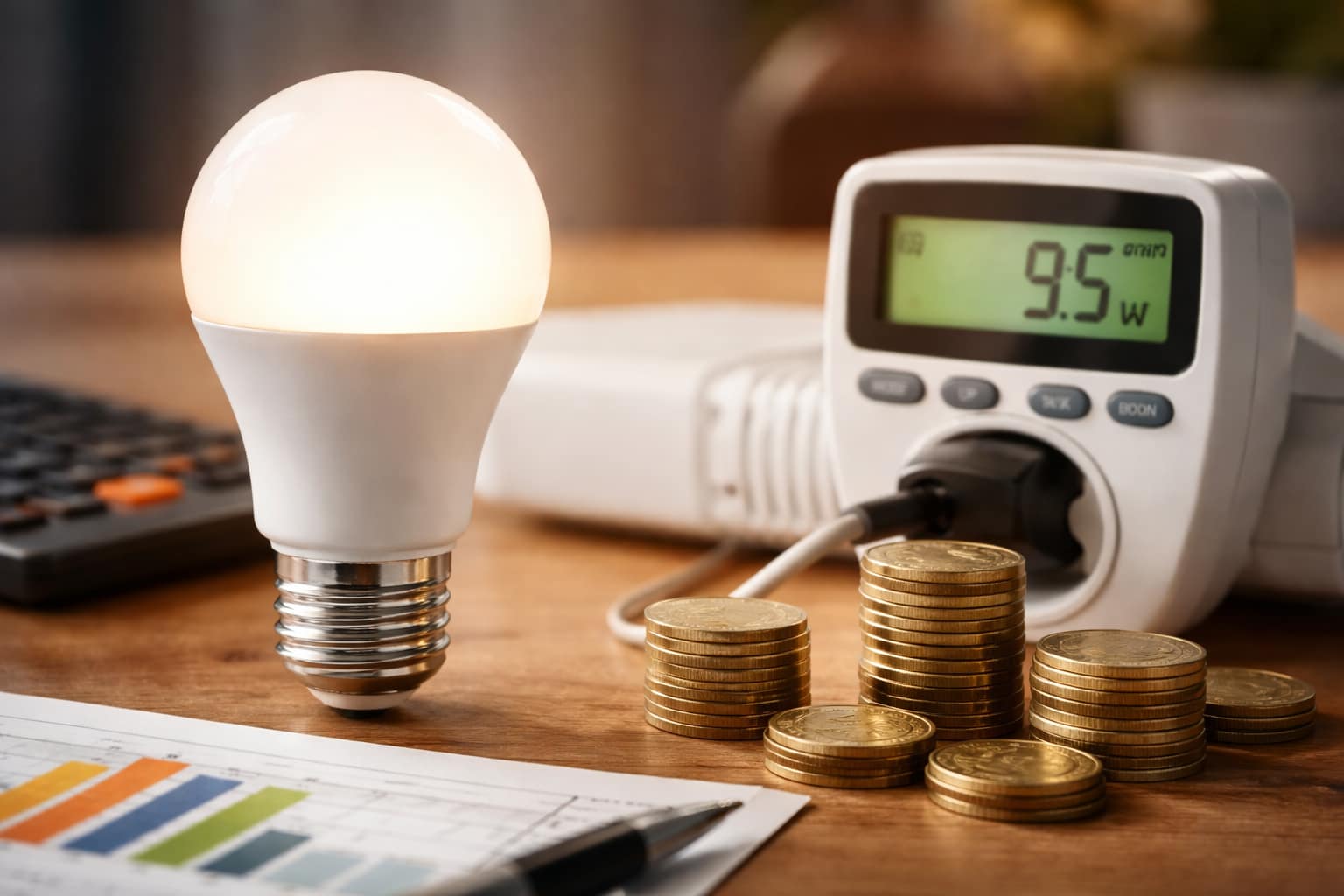
The clearest comparison is a 60W incandescent bulb versus an 8W to 10W LED bulb with similar brightness. The incandescent bulb uses much more electricity because it creates light by heating a filament. The LED uses semiconductor technology to produce light with far less wasted heat.
For a direct bill-focused comparison, see our full breakdown of LED vs incandescent electricity cost. That comparison is useful when you want to see how the same room changes financially after replacing older bulbs with LED alternatives.
The U.S. Department of Energy says residential LEDs, especially ENERGY STAR rated products, use at least 75% less energy and last much longer than incandescent lighting. In everyday terms, that means a room can feel similarly bright while the bulb pulls only a fraction of the power from the wall.
This is why the average power consumption of LED bulbs matters most when replacing older bulbs. If you replace one rarely used lamp, the savings may be small. If you replace kitchen, hallway, porch and living room bulbs that run for hours, the savings become more visible.
Do not compare decorative filament LEDs, smart color bulbs and high-output utility bulbs as if they serve the same purpose. Their wattage can differ because their brightness targets, electronics and design priorities are different.
For more context on the official energy-saving side of LEDs, see the U.S. Department of Energy page on residential LED lighting.
What to Check Before Buying an LED Bulb
Before buying, check rated watts, lumen output, color temperature, dimmability and fixture compatibility. These details are more useful than shape alone because they tell you whether the bulb will be bright enough, efficient enough and suitable for the fixture.
✅ Rated wattage
Use the input watts to estimate running cost. For most home bulbs, 6 to 10 watts is common, while brighter replacements can be higher.
✅ Lumen output
Choose lumens first if you want the same brightness as an older bulb. This prevents under-lighting a room just to chase a lower watt number.
✅ Color temperature
Warm white is often better for bedrooms and living rooms, while cooler light may feel more practical in kitchens, garages or task areas.
✅ Dimming and fixture match
Use dimmable bulbs only with compatible dimmers. Also check enclosed-fixture ratings if the bulb will sit inside a covered fixture where heat can build up.
For most rooms, a 60W-equivalent LED bulb using around 8 to 10 watts is the safest everyday replacement. For brighter kitchens, utility rooms or large lamps, look for a 100W-equivalent LED bulb and compare lumens before comparing watts.
Smart Bulbs, Dimmers and Real-World Power Draw
Smart LED bulbs can use slightly more electricity than basic LEDs because they include radios, processors and extra control electronics. Some also draw a tiny standby load when the light is off so they can respond to an app, schedule or voice assistant.
That does not make smart bulbs inefficient. Compared with incandescent lighting, the energy saving is still significant. It simply means you should compare smart bulbs with other smart bulbs of similar brightness, not with the lowest-watt basic LED on the shelf.
Dimmers can also affect the real-world experience. A mismatched dimmer may cause buzzing, flicker, limited dimming range or unstable behavior. If you are troubleshooting a dimmer, standby draw or a bulb that seems to use more power than expected, a plug-in power meter can help compare the same bulb under the same conditions.
Simple Ways to Lower Lighting Bills
Once you understand LED bulb power consumption, the best strategy is to upgrade the lights that run the longest and choose the right brightness for each space. The lowest-watt bulb is not always the best choice if it leaves the room too dim and forces you to use extra lamps.
- ✓ Replace bulbs in fixtures used four to eight hours a day before replacing rarely used lamps.
- ✓ Compare lumens first so you keep the brightness you actually need.
- ✓ Use the electricity cost formula before judging a bulb by price alone.
- ✓ Check enclosed-fixture ratings to avoid heat-related performance issues.
- ✓ Prioritize porch lights, kitchen lights, hallway lights and other high-use fixtures first.
Upgrading one porch light that stays on all night may matter more than replacing several decorative bulbs that are only switched on occasionally.
FAQ
How many watts does a typical household LED bulb use?
A typical household LED bulb usually uses about 6 to 10 watts for brightness similar to many old 40W to 60W incandescent bulbs. Higher-output models that replace 100W incandescent bulbs often use around 13 to 15 watts.
How much does it cost to run an LED bulb per month?
A 9W LED used for 5 hours a day uses about 1.35 kWh per month. At $0.20 per kWh, that costs about $0.27 per month for one bulb.
Does leaving LED bulbs on for hours make them expensive to run?
Leaving LED bulbs on for hours does add cost, but the amount is usually small because LED wattage is low. The total becomes more important when many lights are used every day.
Why do some LED bulbs use more power than others?
Some LED bulbs use more power because they are built for higher lumen output, better color quality, dimming support, smart-home features or stronger drivers.
Should I choose the lowest-watt LED bulb?
Not always. Choose the right lumen output first, then compare watts. A very low-watt bulb may save slightly more energy but feel too dim for the room.
Key Takeaways
Most standard household LED bulbs use about 6 to 10 watts. Brighter versions, including many 100W-equivalent bulbs, often use around 13 to 15 watts.
To estimate LED bulb electricity cost, use watts ÷ 1,000 × hours used × your electricity rate. A 9W LED used for 5 hours a day costs only a small amount each month, but several high-use fixtures can add up over a year.
The best buying decision is not always the bulb with the lowest wattage. Choose the right lumens first, then compare watts, fixture compatibility and real usage hours.
Sharing This Guide
If you found this guide helpful, save it or share it with someone who is still using older bulbs.
Interested in learning more? Browse all related articles in our energy saving LED lighting section.