Why Do LED Lights Glow When Off? Causes & Safe Fixes
If your LED lights glow when they’re off, the usual cause is a tiny standby or leakage current, not necessarily a bad bulb. The most common triggers are illuminated switches, old dimmers, smart controls, switched neutral wiring, capacitive coupling, or a very sensitive LED driver circuit.
Start with the simple checks first: test another LED bulb, check whether the switch or dimmer has electronics, and watch for warning signs like buzzing, heat, flickering, burning smells, or several rooms affected. This guide explains what is usually harmless, what you can troubleshoot safely, and when to call an electrician.
Table of Contents:
- Why LED Lights Glow When Off
- Common Reasons LED Bulbs Glow After Being Switched Off
- Is It Dangerous If LED Lights Glow When Off?
- Check Illuminated Switches, Smart Switches, and Dimmers
- Residual Current and Capacitive Coupling Explained
- How to Fix LED Lights That Glow When Off
- When to Call an Electrician
- FAQ
- Key Takeaways
- Sharing This Guide
Quick answer: LED bulbs can glow faintly after being switched off because a tiny amount of electricity is still reaching the bulb or its driver. The most common causes are illuminated switches, incompatible dimmers, smart controls, switched neutral wiring, long parallel wire runs, and residual current in LED circuits. A faint glow alone is often harmless, but heat, buzzing, heavy flicker, burning smells, or problems across several rooms should be inspected.
Why LED Lights Glow When Off
LEDs are much more sensitive than traditional incandescent bulbs. An old filament bulb usually needed a significant amount of power before it produced visible light. An LED can react to a much smaller current, which is one reason LEDs are efficient, but also why they reveal electrical quirks that older bulbs often hid completely.
Most LED bulbs contain an electronic driver circuit that converts household current into a form suitable for the LED chips. Even a very small charge can partially energize that driver and create a faint glow. When LED lights glow when off, it usually means that leftover, leaking, or induced current is still present somewhere in the circuit.
In many cases, this effect is harmless. However, it can also point to dimmer compatibility problems, poor switch selection, switched neutral wiring, or installation patterns that need attention. If you are experiencing other LED problems too, our LED lighting troubleshooting guide provides more context for diagnosing related issues.
Common Reasons LED Bulbs Glow After Being Switched Off
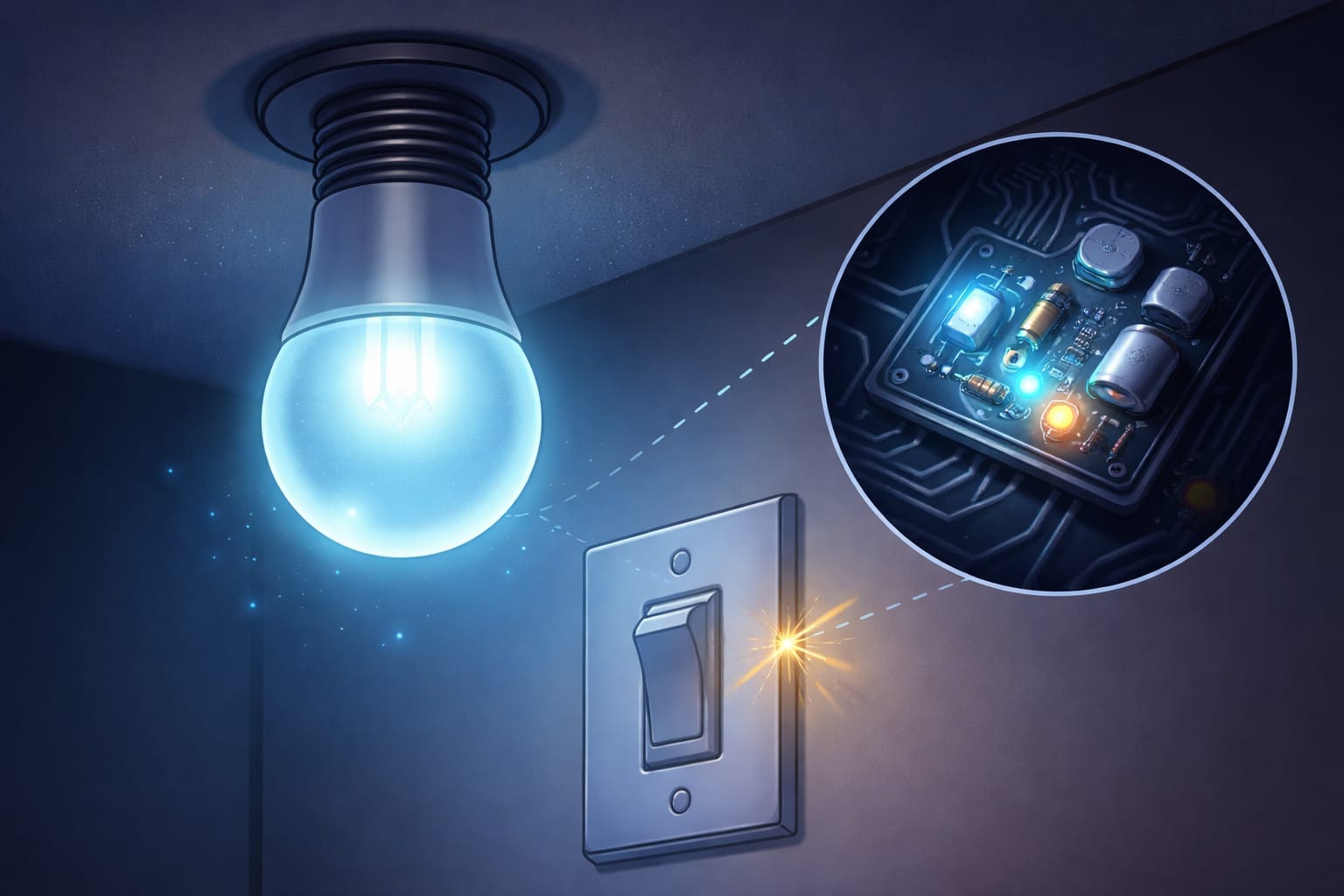
Although the problem may sound strange, the causes are usually familiar once you know where to look. Illuminated switches are one of the most common reasons. Their locator light needs a small amount of electricity, which can sometimes pass through the bulb circuit. With incandescent bulbs, this would rarely be noticeable. With LEDs, that trace current can be enough to produce a dim glow.
Incompatible dimmers are another major cause. Older dimmers designed for incandescent bulbs were not built around low-power LED electronics. When the match is poor, you may see a glow, flickering, buzzing, or unstable behavior even when the light appears to be switched off. If this sounds familiar, check our guides on LED bulbs not dimming properly and LED lights flickering.
Tiny leakage currents can also remain in the wiring when the switch is off. This residual current in LED lights may come from the switch, nearby wiring, smart controls, or the installation layout itself.
The current is usually too small to power anything substantial, but it may still be enough to make a sensitive LED bulb glow faintly in a dark room.
Another possibility is switched neutral wiring. If the switch interrupts the neutral wire instead of the live wire, the bulb may remain connected to the energized side of the circuit. This can create a small current path and a real safety concern. This is not something to ignore if you suspect it.
Some bulbs are also more prone to afterglow than others. Higher-quality LED bulbs usually handle small stray currents better than cheaper bulbs with weaker driver circuits. If the afterglow issue only happens with one brand or model, the bulb design may be part of the problem.
Is It Dangerous If LED Lights Glow When Off?
Usually, a faint LED glow on its own is not an emergency. In many homes, it is a compatibility issue rather than a major electrical fault. However, it should not be dismissed automatically because it can sometimes point to a switch, dimmer, or wiring problem that needs further inspection.
More caution is warranted if the glow appears with buzzing, noticeable flickering, heat at the switch or bulb base, or if the problem started suddenly after years of normal use. It also deserves attention if the issue appears in several rooms or begins after wiring work, fixture replacement, or smart switch installation.
If your bulbs also buzz, overheat, or burn out prematurely, that usually indicates a broader compatibility or circuit issue. In that case, compare your symptoms with our articles on LED bulb buzzing and LED bulbs burning out.
A faint glow alone is usually harmless. However, a glow combined with heat, a burning smell, heavy flicker, breaker trips, or sudden changes after wiring work should be treated much more seriously.
Check Illuminated Switches, Smart Switches, and Dimmers
One common explanation for why LED lights glow when off is that the switch itself is allowing a small amount of current to pass. This is especially common with illuminated switches, motion-sensor controls, smart switches, timer switches, and older dimmers that are not properly matched to LED loads.
A switch with an indicator light or onboard electronics needs standby power. That standby current may use the bulb circuit as its path. With incandescent bulbs, you would probably never notice. With LEDs, however, the same small current can become visible as a faint afterglow.
Older dimmers are another frequent cause. Many dimmers require a minimum load to work properly, and LEDs often fall below that range. This can result in a faint glow, inconsistent shutoff, or a bulb that never seems to disconnect fully. Replacing the dimmer with an LED-compatible dimmer switch often fixes this type of mismatch, especially when the bulb itself works normally on a standard switch.
Residual Current and Capacitive Coupling Explained
This is the technical part, but the basic idea is simple. When wires run close together for long distances, they can influence each other electrically even without a direct fault. This is known as the capacitive coupling effect. In practical terms, nearby live conductors can induce a very small charge in the switched-off lighting wire.
That tiny charge may slowly feed the bulb through the circuit, creating a faint glow. This is more likely with longer cable runs, older installations, multi-way switching arrangements, and areas where several conductors run tightly together.
Capacitive coupling is one reason an LED bulb can glow even when the switch appears to be off. It does not automatically mean the wiring is dangerous, but it can explain why the problem is limited to one room, one circuit, or one fixture type.
Poor wiring practices can make the issue worse. If you suspect installation mistakes, our guide to common LED wiring mistakes is a helpful companion to this article.
How to Fix LED Lights That Glow When Off
The best fix depends on the cause, so start with the safest and simplest checks. First, test a flicker-free A19 LED bulb from a trusted brand. If the glow disappears, the original bulb was probably more sensitive to leakage current or had a weaker LED driver circuit.
If the circuit uses a dimmer, especially an older one, replacing it with an LED-rated model is one of the most effective solutions. If possible, temporarily bypass the dimmer or test the bulb with a standard switch to confirm whether the dimmer is the source of the problem.
If the switch has a locator light, smart control, motion sensor, or timer function, that device may be supplying the tiny standby current causing the glow. In that case, the solution may be a different switch type, a compatible smart control, or a proper bypass installed by an electrician.
In some cases, an electrician can install an LED load capacitor for glow issues to give stray current another path and stop the bulb from glowing. This is most relevant when the cause is minor leakage, switching electronics, or a minimum-load problem rather than a dangerous defect.
If the switch is interrupting the neutral wire instead of the live wire, this should be corrected properly. This is not just an afterglow issue. It is also a safety issue.
The most practical troubleshooting order is simple: test another bulb first, check for an illuminated switch or dimmer second, and only then suspect wiring layout, capacitive coupling, or circuit design.
When to Call an Electrician
Some light bulb issues are simple compatibility problems. Others are not. You should call a professional if you suspect the switch is interrupting the neutral wire, if the glow started suddenly with no change to the bulb or switch, or if several circuits or rooms are affected at the same time.
You should also call an electrician if there is buzzing, heat, frequent flickering, breaker trips, or if the issue is in a bathroom, an outdoor fixture, or a damp location. The same applies if you are not comfortable safely testing live wiring.
An electrician can determine whether you are dealing with harmless standby current, capacitive coupling, a bad switch, or an actual wiring fault. This matters because the correct solution can vary greatly depending on the cause.
If you want to learn more about related LED behavior and installation issues, check out the LED Knowledge Center.
FAQ
Why Does My LED Bulb Glow Faintly When Switched Off?
A faint glow usually means a tiny amount of current is still reaching the bulb. This can come from an illuminated switch, an older dimmer, smart controls, residual current in the circuit, or capacitive coupling between nearby wires.
Will Changing the LED Bulb Fix the Glow?
Sometimes, yes. If one LED bulb glows but another brand does not, the original bulb may have a more sensitive driver circuit. If several bulbs glow on the same switch or dimmer, the control device or wiring layout is more likely to be the cause.
Can an Old Dimmer Make LED Lights Glow When Off?
Yes. Many older dimmers were designed for incandescent bulbs and need a higher minimum load than LED bulbs provide. This mismatch can cause glowing, flickering, buzzing, poor dimming, or inconsistent shutoff.
Should I Worry If Several LED Lights Glow When Off?
Yes, it deserves more attention. One faintly glowing bulb is often a compatibility issue, but LED lights glowing in several rooms or circuits can point to a wider switch, dimmer, wiring, or installation problem that should be checked properly.
Key Takeaways
- A faint LED glow when off is usually caused by tiny standby, leakage, residual, or induced current.
- Illuminated switches, smart switches, older dimmers, and sensitive LED driver circuits are common causes.
- A faint glow alone is often harmless, but heat, buzzing, burning smells, breaker trips, or sudden changes need attention.
- The safest troubleshooting order is to test another bulb, check the switch or dimmer, then consider wiring layout.
- Call an electrician if you suspect switched neutral wiring, multiple affected circuits, or any signs of overheating or electrical faults.
Sharing This Guide
If this helped you understand why LED lights glow when off, save it or send it to someone dealing with the same issue.
Interested in learning more? Browse all related articles in our category section.