Why are LED bulbs burning out so quickly? Main Causes and Solutions
LED bulbs are designed to last for years, so frequent failure usually indicates a genuine issue rather than mere coincidence. In most homes, the main causes are trapped heat, unstable power, poor bulb quality, incompatible dimmers, or fixture conditions that push the driver electronics beyond their limits.
This guide explains the most common reasons LED bulbs burn out quickly, how to identify the cause, and how to make your next bulb last much longer.
Quick Answer
If your LED bulbs are burning out quickly, it is usually due to excess heat, voltage issues, dimmer incompatibility, low-quality drivers, or an unsuited fixture.
- Check whether the bulb is rated for enclosed fixtures.
- Look for loose sockets, flicker, buzzing, or surge damage.
- Use LED-compatible dimmers where dimming is involved.
- Choose higher-quality bulbs for hot or hard-to-reach locations.
- Track where failures occur to spot patterns faster.
Table of Contents:
- Quick Answer
- Understanding Expected Lifespan Claims
- Heat-related failure mechanisms
- Electrical Supply Issues
- Quality and Manufacturing Defects
- Installation and fixture problems
- Environmental stress factors
- Diagnosing the root cause
- Immediate corrective actions
- Long-term preventive measures
- Smart replacement strategies
- Warranty and return options
- Key Takeaways
- Share this guide
Understanding expected lifespan claims
LED lifespan claims are usually based on controlled lab testing rather than the less predictable conditions found in real homes. Manufacturers often quote ratings of 25,000 to 50,000 hours, but these numbers assume stable voltage, moderate temperatures, and operating conditions that do not always match everyday use.
Another detail that many people miss is that the rated life does not indicate the exact moment when a bulb stops working. In many cases, it refers to the point at which the bulb’s brightness drops to about 70 percent of its original level. However, a bulb that dies completely after only a few months or years is likely experiencing heat, power, or quality control issues rather than normal aging. For a closer look at how these ratings work in practice, see the LED bulb lifespan guide.
Usage time also adds up faster than many people expect. A bulb that runs for five hours a day will reach 25,000 hours in less than fourteen years. If yours are failing much sooner, it’s worth checking beyond the bulb itself: the fixture, the dimmer, and the electrical environment around it.
When troubleshooting a dimmed circuit, using an LED-rated dimmer switch with smooth low-end control can solve performance issues and reduce long-term stress on the bulb driver.
Heat-related failure mechanisms
Heat is one of the main reasons LED bulbs fail prematurely. The LED chips themselves are durable, but the internal driver contains electronic parts that do not age well when temperatures stay too high for too long. Capacitors are especially vulnerable; once they drift out of spec, the entire bulb can fail, even if the light-emitting components are intact.
Enclosed fixtures are a common problem. Many bulbs are not designed for fully sealed ceiling lights, globe fixtures, or recessed housings that trap heat around the base. When a bulb meant for open-air use is placed in one of these fixtures, its internal temperature can rise dramatically, reducing its lifespan from years to months.
Bulb design matters, too. Lower-cost models often cut corners by using subpar heat sinks, thermal materials, and drivers. Better bulbs usually have more effective thermal management, allowing them to operate for longer periods without overheating the electronics inside.
Electrical supply issues
Unstable voltage can wear out LED drivers much faster than expected. These drivers are designed to regulate incoming power; however, wide swings above or below standard household voltage force them to work harder. This increases internal heat and electrical stress over time.
Short voltage spikes can be even more damaging. Lightning activity, utility switching, or large appliances cycling on and off can send surges through the circuit. Even if the bulb does not fail immediately, the damage can weaken its components to the point that they fail within the next few weeks or months. If you suspect repeated power stress, a voltage-regulating outlet protector for sensitive electronics can provide an extra layer of protection.
Poor power quality can also manifest in more subtle ways. Harmonic distortion from electronics and motor-driven appliances can make the waveform less clean, and LED drivers do not always handle that well. Over time, this extra workload can contribute to failures that seem random until you notice they keep happening on the same circuit. Related symptoms sometimes manifest as buzzing or humming from LED bulbs.
Quality and manufacturing defects
Not all LED bulbs are built to the same standard. Cheap bulbs often cut corners in one place that most buyers never see: the driver. A weak driver with low-grade capacitors, poor thermal design, or little safety margin may work at first, but will perform poorly in normal household conditions.
Manufacturing defects can explain why one bulb from a pack lasts years while another fails almost immediately. Cold solder joints, uneven thermal compound, and inconsistent assembly can create hidden weak points that only become apparent after the bulb has been in use for some time.
This is also why ultra-cheap, no-name bulbs are risky. Even if the packaging claims an impressive lifespan, the internal parts may not live up to that standard. While buying from established brands does not guarantee perfection, it usually improves your odds of getting better components and more consistent quality control.
Installation and fixture problems
Sometimes, the bulb is not the real issue. The fixture itself can create conditions that shorten the bulb’s lifespan from the start. For example, recessed housings, poorly ventilated ceiling lights, and old fixtures designed around incandescent heat patterns can create tougher conditions for LED drivers.
Dimmer mismatch is another common cause. An incompatible dimmer can cause a bulb to flicker, buzz, shut off unexpectedly, or wear out faster, even if the light appears to work properly. The stress quietly builds in the driver until failure becomes obvious. If you notice flicker as well as early burnout, this could be a strong indication. You may also find related information in guides about persistent LED flickering.
Loose sockets and poor contact matter, too. When the connection is unstable, the bulb experiences repeated mini power interruptions and inrush events that slowly damage the electronics. Corrosion, worn contacts, and poorly fitting bases can contribute to this kind of stress.
Don’t just keep replacing bulbs in the same hot or enclosed fixture without first fixing the underlying issue. Repeating the same setup will usually result in the same early failure.
Environmental stress factors
Some locations are simply tougher on bulbs. Outdoor fixtures, garages, attics, and damp spaces subject LEDs to greater temperature fluctuations, moisture, and harsher operating conditions than lab tests used for marketing claims.
Moisture is especially damaging because it can corrode internal components over time, even in bulbs labeled for damp locations. As the fixture cools down, if condensation forms, tiny amounts of water can reach places they should not, slowly weakening solder joints, traces, and insulation.
Vibration can also shorten bulb life. Ceiling fans, garage door movement, and nearby machinery put repeated mechanical stress on internal parts. In these areas, it is usually worth the extra cost to purchase a sturdier bulb with better construction.
Diagnosing the root cause
The best place to start is pattern tracking. If failures keep happening in the same room or fixture, the cause is probably local. However, if bulbs are dying all over the house, the issue may be related to voltage, surge exposure, or a run of poor-quality products.
It helps to note the installation date, bulb model, fixture type, and how long each bulb lasts. This basic record often reveals whether the problem follows a specific location, brand, or use case. For a broader troubleshooting framework, the complete LED troubleshooting guide is a useful next step.
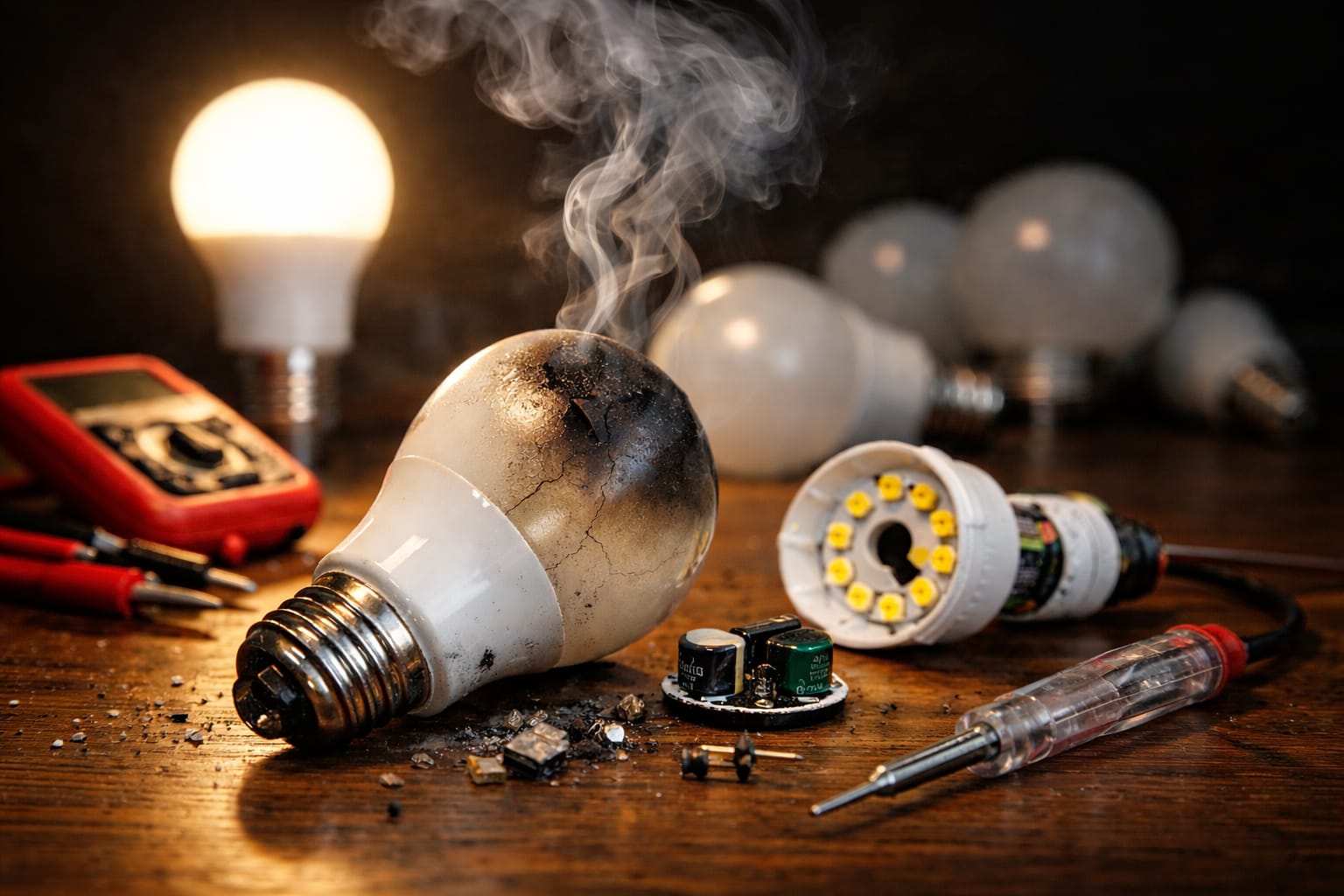
If you are comfortable doing so, you can also help by checking the voltage at the fixture with a multimeter. Large deviations from normal household voltage, especially when appliances are turned on or off, may indicate a power issue rather than a bulb issue. Failed bulbs can also provide clues, such as discoloration, bulging, or overheating near the base.
Immediate corrective actions
The fastest, most practical solution is to replace the failed bulb with one that matches the fixture’s conditions. If the fixture is enclosed, use a bulb rated for enclosed fixtures. If the location is damp, hot, or exposed to vibration, choose a model designed for that environment instead of assuming that any standard household bulb will suffice.
If the circuit is dimmed, verify that the dimmer and bulb are compatible. Switching to an LED-specific dimmer often improves performance immediately and reduces the long-term stress that quietly destroys drivers.
It is also smart to inspect the socket and tighten loose connections, if possible, as well as look for signs of corrosion or overheating. In homes with frequent surge activity, whole-house surge protection can make a meaningful difference by shielding the lighting system from repeated spike damage.
Long-term preventive measures
A better strategy is to stop treating every failed bulb as an isolated event. Often, paying more for a higher-quality bulb is cheaper in the long run when you consider repeat purchases, wasted time, and the hassle of changing bulbs in hard-to-reach places.
Improving airflow around the bulb can be more helpful than many people expect. In the right fixture, even a small change in clearance or ventilation can lower the operating temperature enough to protect the driver for years. Many users achieve better results by switching to an adjustable socket extender, which provides additional ventilation space where appropriate and safe.
If failures continue to occur and the pattern is unclear, it may be time to have the electrical system inspected. Loose neutrals, poor grounding, unstable voltage, and other hidden issues can damage more than just light bulbs. The U.S. Department of Energy notes that proper product selection and good system conditions both matter for lighting efficiency and longevity. For broader LED fundamentals, the LED Knowledge Center is a solid resource.
Smart replacement strategies
When a bulb fails early, replacing it with the same model is not always best. A better approach is to determine why it failed and then choose a bulb that better fits the actual conditions. This may entail switching brands, transitioning to an enclosed-fixture-rated bulb, or adjusting the dimmer rather than solely blaming the lamp.
In multi-bulb fixtures, replacing the full set makes sense if the remaining lamps are likely to fail soon. This prevents mismatched brightness or color and reduces the likelihood of having to repeatedly return to the same fixture.
It’s also helpful to keep a few spares from brands that have performed well in your home. Once you find a bulb that can withstand a demanding location, having the same model on hand will save you time and ensure a consistent setup.
Warranty and return options
Many high-quality LED bulbs come with multi-year warranties, and you may qualify for a replacement if the bulb fails early. If a bulb dies far earlier than expected, keep the receipt and the packaging, if possible, and take note of where the bulb was used. This will make the claims process much easier.
Contacting the manufacturer directly is often faster than dealing with the retailer, especially for well-known lighting brands. In some cases, support teams can tell you whether the failure pattern suggests a defect or a setup issue.
Retailer return policies matter, too. In locations where changing bulbs is difficult or reliability matters more than the lowest price, it is often worth buying from sellers with straightforward return policies rather than seeking the cheapest option.
Key Takeaways
A pattern of LED bulbs burning out quickly usually points to heat, unstable power, dimmer incompatibility, poor fixture conditions, or weak internal driver components. In most cases, the problem is fixable once you identify the cause.
Start by checking the fixture type and whether the bulb is rated for enclosed fixtures. Also check whether the circuit uses a compatible LED dimmer. Small upgrades in bulb quality, ventilation, and electrical protection can make a significant impact.
The goal is not just to replace failed bulbs more quickly. Rather, the goal is to build a setup that will allow the next bulb to reach its expected lifespan.
Share this guide!
If it helped you troubleshoot repeated bulb failures, save it or send it to someone dealing with the same problem.
Interested in learning more? Browse all related articles in our category section.