How to Choose LED Strip Lights: What to Check Before You Buy
The first step in choosing LED strip lights is matching the strip to the job. Brightness, color mode, voltage, waterproofing, and installation method all affect the final setup’s performance in a real space.
Whether you are lighting kitchen cabinets, adding accent lighting to a bedroom, or planning an outdoor setup, making the right choice will save you time, prevent compatibility issues, and produce a cleaner result. If you are new to strip lighting, our beginner’s guide is a helpful place to start before making the decisions below.
Quick Answer
Choose LED strip lights based on where you will install them, how bright they need to be, and whether you want simple white light, color effects, or smart control.
- Use higher lumens for task lighting and lower lumens for an ambient glow.
- Pick 12V for shorter runs and 24V for longer, more stable setups.
- Match the IP rating to the environment, especially in bathrooms or outdoors.
- Check the compatibility of the controller, dimmer, and smart home features before buying.
- Budget for the full system, not just the strip itself.
Table of Contents
- Quick Answer
- Understanding the Basics
- Brightness Requirements
- Selecting Color Options
- Temperature Considerations
- Voltage and power needs
- Planning Your Installation
- Waterproof Protection
- Smart Control Features
- Length and Sizing
- Quality Indicators
- Avoiding Common Errors
- Budget Considerations
- What should you choose?
- Key Takeaways
- Share this guide!
Understanding the Basics
When learning how to choose LED strip lights, start with the format itself. These products use small light-emitting diodes (LEDs) mounted on a flexible circuit board, making them useful for shelves, ceilings, cabinets, desks, stairs, and other areas where regular bulbs would be awkward or too bulky.
There is more variety than many first-time buyers expect. Some strips prioritize affordability, some focus on seamless light output, and some are built for advanced effects or smart control. If you want a broader overview before making a choice, our guide to all types of LED strip lights explains the main differences between the most common formats.
Most LED strips run on low-voltage power, typically 12V or 24V. This makes them ideal for home use, offering strong light output, solid efficiency, and a wide range of design options. Modern kits can also include dimming, color control, and automation features that were once limited to more expensive lighting systems.
If flicker is a concern, especially in bedrooms or media rooms, a reliable smart LED strip kit can help maintain a steadier light output across different brightness settings.
Brightness Requirements
Brightness is one of the most important factors when choosing LED strip lights. Most strips are rated in lumens per meter; that number indicates how much visible light the strip can produce. A higher lumen output works better for task lighting, while a lower output is usually sufficient for decorative or ambient use.
LED density matters, too. A strip with 60 LEDs per meter works well for many accent applications, but a strip with 120 or 240 LEDs per meter creates a brighter, more uniform line of light with fewer visible gaps between emitters.
For more information on selecting the appropriate output level for various rooms, refer to our guide on LED strip light brightness, which explains how lumens impact real-world applications. Selecting the appropriate brightness helps you avoid lighting that feels too weak or unnecessarily harsh.
Task versus ambient lighting
For task lighting, a stronger output is usually needed so that the light is useful for work. Under-cabinet kitchen lighting, workshop benches, desks, and hobby stations often benefit from strips with an output of at least 1000 lumens per meter, depending on placement and diffuser use.
Ambient lighting is different. If the goal is to soften a room, highlight a ceiling detail, or add a gentle glow behind furniture, a range of 200 to 600 lumens per meter often feels more comfortable and visually balanced.
Selecting Color Options
Another important decision is whether you need simple white light or more flexibility. Single-color strips are often the easiest choice for practical lighting because they provide consistent output, such as warm or cool white, or a fixed color for a decorative effect.
RGB strips add color-changing capability by mixing red, green, and blue diodes. These strips are popular for entertainment areas, bedrooms, gaming setups, and accent projects, where mood and customization matter more than perfect white light. If you are deciding between formats, our comparison of RGB vs. RGBIC LED strips explains the strengths of each.
RGBW strips take it a step further by adding a dedicated white channel. This makes them a good choice if you want colorful scenes and clean everyday white lighting from the same setup.
Temperature Considerations
Color temperature, measured in Kelvin, has a significant impact on the ambiance of a room. Warm white strips in the 2700K to 3000K range typically work well in bedrooms and living rooms, as well as other spaces where a calmer, more comfortable atmosphere is desired. If your main goal is bedroom lighting, our bedroom lighting design guide shows how strips can fit into a more complete setup.
Cooler options around 5000K to 6500K create a crisper look that suits garages, utility rooms, and some bathrooms. Neutral white, usually around 4000K, sits in the middle and works well for general-purpose lighting where you want clarity without a cold or overly clinical feel.
Tunable white strips are worth considering if you want more flexibility. They let you adjust the color temperature across a wider range, which can be useful for changing the mood of a room or matching the light to different times of day.
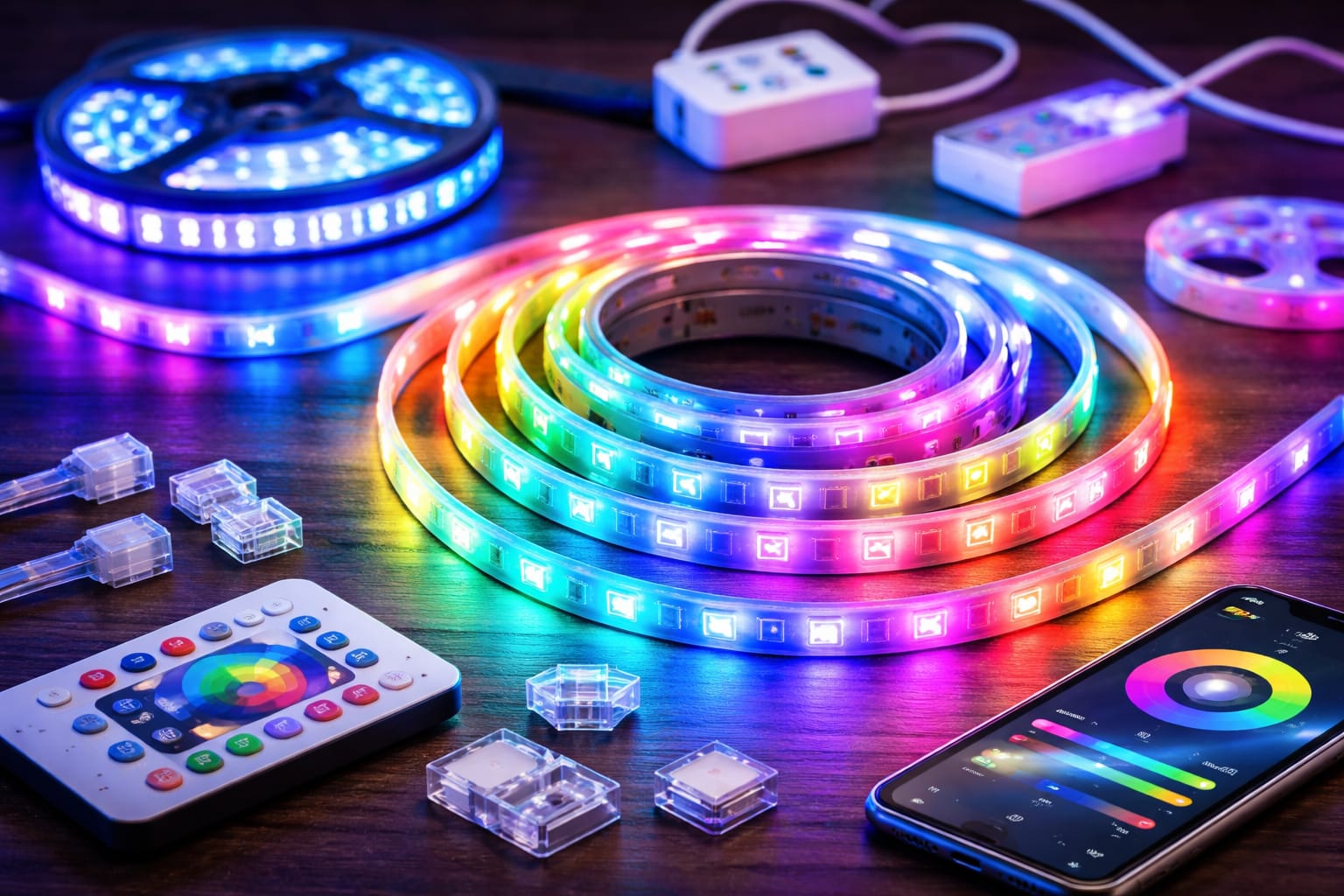
Understanding Kelvin Ratings
Lower Kelvin values look warmer and more yellow, while higher values look cooler and bluer. That simple difference has a big effect on comfort, focus, and the overall mood of a room.
As a general rule, kitchens often benefit from 4000K to 5000K for better visibility, while home theaters and relaxation areas usually feel better around 2700K to 3000K. Matching color temperature to the room’s purpose almost always leads to a better result than choosing by appearance alone.
Voltage and power needs
Power planning is easy to overlook, but it is essential. Every strip has a wattage-per-meter rating, and multiplying that by the total run length tells you how much power the system needs. It is smart to leave some extra headroom rather than running a power supply at its limit.
A good rule is to add at least 20% capacity above your calculated load. An undersized power supply can cause dimming, flicker, overheating, or early failure.
For many home installations, 12V strips work well on shorter runs. For longer distances, 24V strips are often the better choice because they reduce current draw and help minimize voltage drop.
It also pays to choose a quality power supply. Good units include protection against short circuits, overheating, and overloads, which improves both safety and long-term reliability.
Planning Your Installation
Proper installation planning is essential for optimal performance and appearance. Many LED strips have an adhesive backing that works well on clean, smooth surfaces for simple projects. However, for a cleaner finish and better heat management, aluminum channels are often the better long-term solution.
They can protect the strip, improve heat dissipation, and create a more polished line of light, especially when paired with a diffuser. They are particularly useful for visible installations, as they keep the strip itself out of sight.
Before starting, think through wire routing, connector positions, and where the power supply will go. For more complex layouts, an LED strip connector kit can facilitate and standardize segment connections during installation.
Surface Preparation
Good adhesion starts with surface preparation. Dust, grease, and moisture are common reasons strips peel away after only a short time, so properly cleaning the mounting area matters more than many buyers expect.
Wipe the surface with isopropyl alcohol, allow it to dry completely, and install the strip at a moderate room temperature, if possible. These small steps can make a big difference in how well the adhesive holds over time.
Waterproof Protection
IP ratings indicate how much protection a strip has against dust and moisture. For dry indoor areas, IP20 strips are usually sufficient. They are often cheaper, slimmer, and better at dissipating heat because they lack an added protective coating.
For kitchens, bathrooms, and covered outdoor areas, IP65 strips are a safer choice because they can withstand splashes and light moisture. For harsher environments, IP67 and IP68 options offer stronger protection, including resistance to heavy exposure or submersion.
If you want a fuller explanation of what those ratings mean in practice, check out this guide to IP ratings for LED strips, which explains how to match protection levels to real installations. Selecting the appropriate rating helps prevent premature failure and avoid unnecessary costs.
Smart Control Features
Smart features are becoming an important part of the decision-making process. Many modern LED strips support app control, voice assistants, schedules, scenes, and color presets. This makes them far more flexible than simple remote-only kits.
If you enjoy regularly changing the mood of a room, app-based control can be genuinely useful. You can quickly adjust the brightness, color, timing, and effects without touching the strip or controller.
Automation can also improve convenience. Features like timers, wake-up routines, and bedtime dimming are practical, not gimmicky, especially in spaces like bedrooms and hallways that benefit from predictable lighting.
Checking compatibility is essential
Before buying a smart strip, confirm that the strip, controller, app, and voice ecosystem are compatible. Compatibility issues often arise when buyers mix platforms or assume that Wi-Fi, Bluetooth, Alexa, and Google Home support are interchangeable.
It is also worth looking for products that meet recognized quality standards. According to the U.S. Department of Energy, well-certified LED lighting is more likely to deliver reliable performance and efficiency than poorly tested generic products.
Length and Sizing
Getting the length right is not just about measuring the space. You also need to consider reel size, maximum run length, and connection locations. Most standard reels are five meters long, though some brands offer longer options.
Long runs can create a voltage drop, meaning the far end of the strip may appear dimmer or a slightly different color. This is why planning power injection or choosing a higher-voltage strip is important for larger installations.
In bigger projects, parallel wiring or multiple power feed points can help keep brightness consistent across the full installation. It adds a little complexity up front, but usually leads to a much better result.
Cutting and Connecting
LED strips can only be cut at marked points. Cutting in the wrong place can damage the circuit and leave part of the strip unusable, so it is always worth double-checking before trimming.
For joining sections, soldering is usually the most reliable choice for permanent installations. Clip-on connectors are faster and easier for beginners, though they can be less dependable in awkward placements or high-use setups. If you want a smoother finished look, an LED diffuser channel can also help reduce hotspots and visible diode glare.
Quality Indicators
Not all LED strips are built to the same standard. Better products tend to use more consistent diodes, stronger circuit boards, and higher-quality adhesives, which improves both performance and lifespan.
The circuit board matters more than many buyers realize. Thicker copper traces handle current better and can reduce heat buildup, while stronger PCB construction usually means fewer failures over time.
It is also a good sign when the product includes certifications such as CE, RoHS, or UL, along with a meaningful warranty. Reputable brands usually make these details easy to find instead of hiding them in vague product listings.
Avoiding Common Errors
Many LED strip problems begin before the strip is even switched on. Buyers often underestimate power needs, ignore heat management, or choose a strip based on looks alone without checking practical details like voltage, IP rating, or controller compatibility.
Poor heat dissipation can shorten the life of high-density strips, especially in enclosed spaces. In exposed or high-output installations, channels and diffusers often do more than improve appearance. They can also help the strip run more safely and consistently.
Another common mistake is rushing the mounting process. Even a high-quality strip can malfunction prematurely if the adhesive is applied to a dirty, textured, or damp surface.
Preventing Voltage Drop
Voltage drop is one of the most common performance issues in longer installations. When too much distance is covered from a single feed point, the far end of the strip may appear dimmer or a slightly different color.
As a rough guide, 12V systems often require power injection more frequently than 24V systems. Using the right wire gauge and following the manufacturer’s run-length recommendations will help prevent uneven output.
Budget Considerations
Budget matters, but the cheapest strip is not always the most economical choice. Basic, single-color options are often affordable and work well for simple accent lighting. RGB, RGBW, and smart kits usually cost more because they include extra components and control features.
Mid-range products often offer the best value for many homeowners. They typically offer better adhesives, more stable light output, and more reliable controllers without the premium price tag.
The key is to budget for the entire setup. Power supplies, controllers, channels, connectors, and extension wiring can add significantly to the final cost, so plan for the complete system from the beginning.
What should you choose?
The best LED strip lights depend less on brand hype and more on how you plan to use them. First, consider the application. Then, match the brightness, voltage, control options, and protection level to the space.
- Choose single-color white strips for simple, practical lighting.
- Choose RGB or RGBW if mood lighting and flexibility are important to you.
- Select 24V for longer runs where voltage drop could be an issue.
- Select an IP rating of IP65 or higher for damp areas or outdoor exposure.
- Select channels and diffusers for a cleaner, more finished appearance.
Key Takeaways
When choosing LED strip lights, a few practical decisions must be made: how bright the strip should be, what color mode is needed, how long the strip will be, and whether the installation area requires moisture protection or smart control.
Focus on the full system rather than the strip alone. Check the voltage, power supply sizing, controller compatibility, mounting method, and IP rating before buying, especially if the installation will be permanent or span a long distance.
A little planning upfront makes the finished result look better, last longer, and work more reliably. Once you understand the room, its purpose, and its installation limitations, choosing the right LED strip becomes much easier.
Share this guide!
If you found this guide useful, save it for later or share it with someone planning an LED strip project. It is especially helpful for beginners, homeowners, and DIY users who are comparing their options.
Share using the links below.
Interested in learning more? Browse related articles in our LED Knowledge Center.
Pingback: Monthly Savings Switching to LEDs: Smart Home Guide
Pingback: Best LED Strip Lights for Bedrooms (Cozy Setup) - NeoLEDHub
Pingback: SMD vs High Power LED Explained - NeoLEDHub
Pingback: Best LED Strip Lights for TV Backlighting - NeoLEDHub
Pingback: How to Hide LED Strip Lights for a Clean Look - NeoLEDHub
Pingback: Best Waterproof LED Strip Lights for Bathrooms, Kitchens & Outdoors - NeoLEDHub
Pingback: Best LED Strip Lights for Bedrooms: What Actually Looks Cozy - NeoLEDHub
Pingback: High-Brightness LED Strips: Best Uses, Benefits & Buying Tips
Pingback: Best LED Strip Lights for Gaming Rooms: Top RGB Picks & Setup Tips - NeoLEDHub