Types of LED Strip Lights: Which One to Choose?
Understanding the different types of LED strip lights can help you transform any space with efficient and well-planned illumination. Whether you want accent lighting for your kitchen, a softer glow for your bedroom, or color effects for your entertainment area, knowing how each option differs makes it easier to choose the right strip for your project.
Quick Answer
LED strip lights differ in terms of color, brightness, waterproofing, and control. The best choice depends on your space, the desired look, and the level of control and flexibility needed.
- Single-color strips are ideal for simple, everyday lighting.
- RGB and RGBW strips add color effects.
- COB and high-density strips provide a smoother look.
- IP ratings are important in damp or outdoor areas.
Single Color LED Strip Lights
Single-color strips are the simplest option in the broader world of LED strip lights. Each strip produces one fixed color temperature or hue across its full length. White versions are the most common, with warm white, neutral white, and cool white being the main choices.
Warm white strips typically operate at around 2,700 to 3,000 Kelvin (K), creating cozy ambient lighting that works well in living rooms and bedrooms. Neutral white usually falls between 4,000 and 4,500 Kelvin (K), providing balanced illumination for kitchens and workspaces. Cool white strips exceed 5000K and deliver crisp, energizing light suitable for task-focused areas.
Single-color strips also come in red, blue, green, amber, and other solid hues. They work especially well in accent lighting setups where you want one consistent color without effects or mode changes. They are often used in signage, automotive accents, and stage setups. If long runs start to look patchy or uneven, some people switch to an LED strip designed for more consistent brightness across the entire installation.
Multicolor LED Strip Lights
If plain white light seems too limiting, multicolor strips offer much more freedom to customize a space’s appearance while maintaining the flexibility that makes strip lighting so popular.
They are a strong choice for people who want one lighting system to do more than one job. A room can feel clean and practical with white light during the day, then shift to a more decorative or immersive look in the evening. That flexibility is one reason multicolor strips are so common in bedrooms, media areas, gaming setups, and modern living spaces.
RGB strips
They are one of the most popular LED strip light options for homes and businesses. Each section contains red, green, and blue diodes, and by adjusting their intensity, the strip can produce millions of colors.
This makes them ideal for dynamic lighting displays and entertainment spaces. Users can control the color output with dedicated controllers or smartphone apps, easily switching shades or creating smooth transitions. Gaming rooms, home theaters, and retail displays often benefit from this kind of flexible lighting.
However, standard RGB strips do not produce clean white light. When red, green, and blue are mixed to simulate white, the result is often pale or slightly off. This is why manufacturers developed upgraded versions with dedicated white channels. If you’re new to this technology, check out our beginner’s guide to LED strip basics before delving deeper.
RGBW strips
RGBW strips add a white diode to the standard RGB setup, making them one of the most practical and versatile strip light options. The extra channel allows you to enjoy vivid colors and proper white illumination from the same strip. The white diode usually provides warm or cool white light, depending on the model.
These strips are ideal for applications requiring both colorful accent lighting and functional white illumination. They are frequently chosen for kitchen under-cabinet installations, bedroom cove lighting, and hospitality venues for their dual-purpose capability. Users can switch between colored mood lighting and practical white light as needed.
RGBWW and RGBCCT options are also available
More advanced models have two additional white channels and are typically sold as RGBWW or RGBCCT strips. These versions include warm and cool white diodes alongside the three color channels. This setup allows you to adjust the white light temperature independently while maintaining full color control.
These sophisticated strips are favored for their exceptional versatility in high-end residential projects and professional installations. Users have complete control over color and white light characteristics, making it easier to adapt lighting to different activities and preferences throughout the day.
Control quality also matters more than many buyers expect. Multicolor strips rely heavily on the controller and app experience, so weak software or limited remotes can make transitions feel clumsy and reduce the value of the strip itself. If you plan to use the strip often, it is worth choosing a setup with reliable dimming, scene memory, and easy switching between white light and color modes.
Tunable White Strips
Tunable white strips, often sold as CCT adjustable strips, focus entirely on white light rather than color effects. They contain both warm and cool white diodes, enabling you to adjust the color temperature while maintaining a relatively consistent brightness.
This approach is ideal for those who want lighting that feels more natural throughout the day. For example, you might prefer a cooler, more energizing light around 5000K in the morning and warmer tones closer to 2700K in the evening. Healthcare spaces, offices that prioritize employee wellness, and smart homes are increasingly using this kind of lighting. If the temperature shifts look abrupt or uneven, a strip designed for smoother white blending can make long sessions feel easier on the eyes.
Tunable strips require controllers that can manage two separate channels at once. Many also integrate with home automation systems, making scheduled temperature changes easy throughout the day. The U.S. Department of Energy highlights the importance of choosing the right lighting for comfort and efficiency in work environments.
Use cooler settings during the day and warmer ones at night to maximize the value of tunable white strips.
Density and Light Smoothness
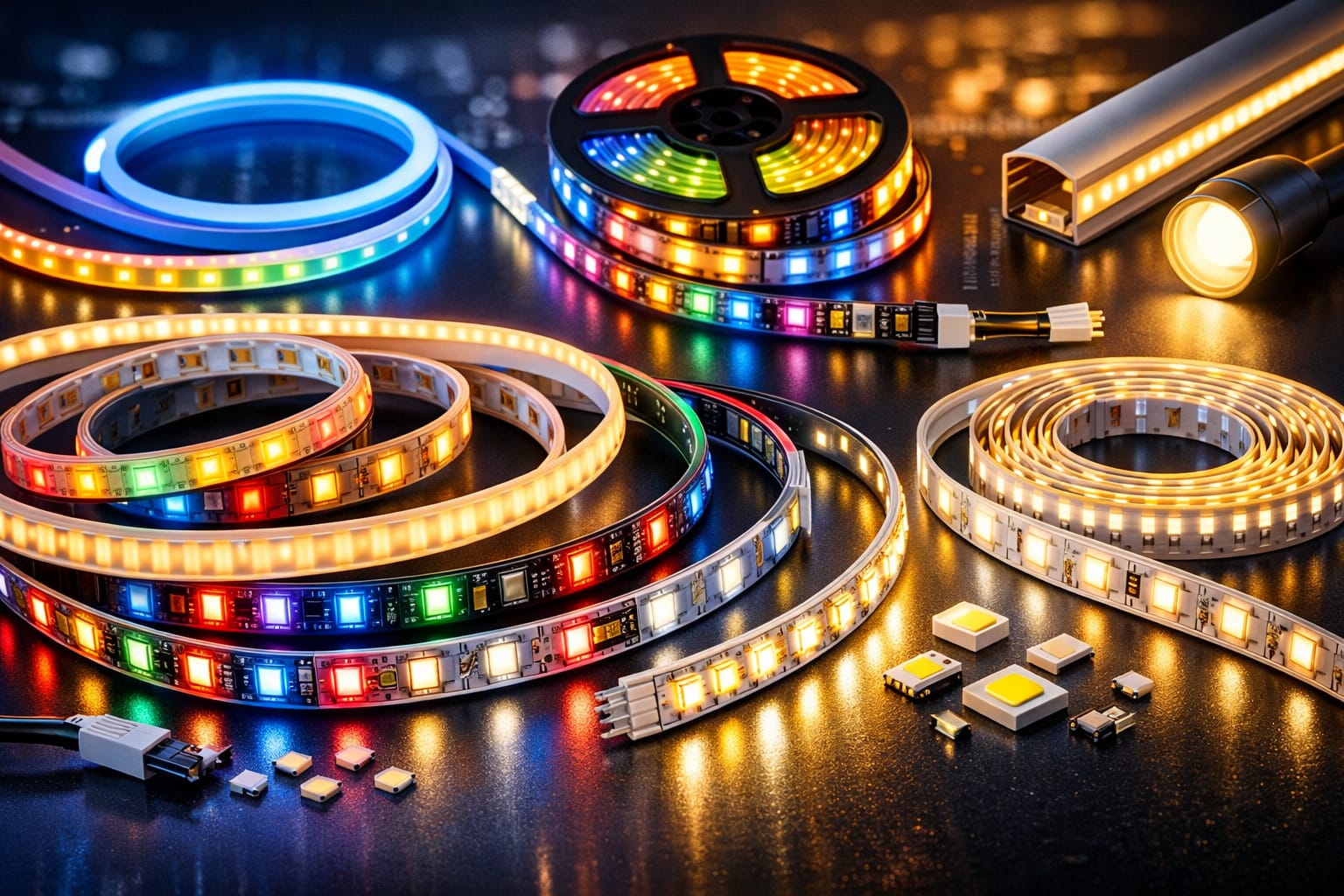
Brightness is only part of the story here because diode spacing also affects how smooth or dotted the finished light appears during use.
In indirect lighting, lower-density strips can still look very good if the LEDs stay hidden from normal view. But when the strip is visible or reflected on glossy surfaces, spacing becomes much more noticeable. That is why smoothness depends not just on brightness, but also on where the strip is mounted and how exposed the light source is.
Standard density strips
Most entry-level strip lights use standard density, with 30 to 60 diodes per meter. This is sufficient for general accent lighting, pathway illumination, and decorative setups. Standard density strips are often the most budget-friendly option when maximum brightness is not a priority.
Power consumption stays moderate with standard configurations, making them easier to wire and control. Longer runs are often more manageable because voltage drop is less aggressive than with higher-density alternatives. Budget-conscious projects and large-scale installations often choose standard density for these practical advantages.
High-density strips
High-density strips pack 120 or more diodes per meter, resulting in brighter output and a smoother line of light. Compared with standard strips, they do a much better job of reducing visible hotspots and dotted-looking light. Professional installations that require smoother light quality often use high-density formats.
Cove lighting, display cases, and architectural features benefit from high-density strips because they reduce the dotted appearance common with lower-density options. However, power requirements increase accordingly, so a solid power supply and careful electrical planning are necessary. Heat also builds up more quickly, which is why aluminum channels are often recommended for better thermal management.
COB strips
COB strips offer some of the smoothest light distribution available in strip form. Instead of widely spaced LEDs, they use many tiny diodes mounted closely together under a phosphor coating. The result looks much more like a continuous line of light than a row of separate points. If you want to explore this technology further, our dedicated guide on COB LED strip lights covers it in much greater depth.
This construction method eliminates visible LED spotting, making COB strips ideal for applications where reflected light reveals imperfections in the strips. Linear cove lighting, closet lighting, and display shelving beautifully showcase the advantages of COB technology. The premium pricing reflects the advanced construction involved in making these strips.
The mounting profile also affects the final look. A standard strip can appear smoother when it sits deeper inside a channel or farther behind a diffuser, while even a high-quality strip may still show hotspots if it is too close to the visible edge. For that reason, density should always be considered together with the installation method rather than treated as an isolated specification.
Waterproof and IP-Rated Strips
One major way LED strip lights differ is in how well they handle dust and moisture. Waterproof ratings follow the International Protection (IP) code system, which tells you how much environmental exposure a strip can safely handle. It’s important to understand the difference whenever you plan to install strips outdoors or in damp areas.
Non-waterproof strips carry an IP20 rating, which is suitable only for dry indoor areas. IP65-rated strips have a silicone coating that protects against dust and water spray. This makes them suitable for bathrooms, covered patios, and light outdoor use. They are a popular choice for flexible LED lighting in semi-protected spaces.
IP67 and IP68 ratings offer protection against direct water exposure; IP68 provides the highest level of resistance. These fully waterproof strips are used for pool features, fountains, and other locations where water contact is expected. Silicone extrusion completely encases the strip, creating a waterproof seal around the electrical components. These more robust strips are commonly used for underwater accent lighting, boat applications, and landscape features.
However, waterproof coatings affect heat dissipation and flexibility. Silicone sleeves trap more heat than bare strips, which can shorten the lifespan of high-power applications. The coating adds thickness, making the strip less flexible and complicating installation in tight spaces. Therefore, it is important to balance protection needs against these trade-offs.
Smart LED Strip Lights
Smart LED strips offer wireless connectivity, allowing you to control them via a smartphone, voice assistant, or home automation system. Depending on the model, they may use Wi-Fi, Bluetooth, or Zigbee instead of a separate physical controller.
Popular platforms like Amazon Alexa, Google Home, and Apple HomeKit are compatible with smart LED strips. Users can create schedules, trigger color changes based on events, and connect the strips to broader smart home routines. Voice control adds hands-free convenience, especially in kitchens and entertainment spaces.
Some smart strips have music synchronization features that allow them to pulse and change colors in time with audio. This feature is popular among gaming enthusiasts and home theater owners for a more immersive experience. Advanced models can also support multiple zones, allowing you to control different strip segments independently from one system.
However, smart features add cost and complexity compared with basic strips. Network reliability is important because connectivity problems can interfere with control. Some users still prefer traditional controllers for their simplicity and reliable local operation. For technical details on how these systems function, read our article on how LED strip lights work.
Voltage and Run Length
Power and run length become more important as installations grow larger. Often, voltage is the detail that separates an easy setup from a frustrating one.
As strip lengths increase, the goal is not just to make the full run light up, but to keep brightness even from beginning to end. A strip can still turn on across a long distance and yet look weaker at the far end. Choosing the right voltage early helps reduce those issues and makes the rest of the electrical planning much easier.
12V strips
12V strips are the most common option for home LED strip installations. They are easy to find, work with a wide range of controllers, and simplify power supply selection. Most DIY and residential projects stick with 12V because it is a practical and accessible choice.
The maximum run length before a noticeable voltage drop occurs is typically about 5 meters for standard-density strips. Higher-density versions may require power injection sooner. The low voltage reduces the risk of electric shock while still providing enough power for most applications. Automotive and RV installations commonly use 12V strips because they match vehicle electrical systems.
24V strips
They draw less current for the same brightness, which allows for longer continuous runs before voltage drop becomes problematic. This makes them a good choice for commercial jobs and larger residential projects, as fewer power injection points can save time and materials.
Lower current draw may also allow for thinner wire in some setups, reducing costs. Professional installers often prefer 24V strips because of their technical advantages in larger projects. Although it is not quite as universal as 12V, compatibility with controllers and accessories is still good.
High Voltage Strips
Some specialty strips run at 48V, 110V, or even 220V AC directly. These are niche options, usually intended for specific commercial or industrial applications. Their main advantage is the ability to cover very long distances with little to no power injection.
However, safety concerns increase as voltage increases, so proper precautions and professional installation are much more important here. Direct AC strips eliminate the need for large power supplies but often sacrifice some dimming flexibility and control options. Most residential users should avoid these products unless they are working with a qualified electrician.
Power injection points, wire size, and power supply capacity still matter even with a better voltage choice. Good planning in those areas helps prevent dim ends, inconsistent color, and unnecessary troubleshooting later. For larger projects, that preparation can make the installation look cleaner and perform more reliably over time.
Specialized Strip Designs
Some strip formats are designed for visual effects or unusual mounting situations. This makes them more specialized, but also more useful for specific projects.
These designs are especially helpful when a standard strip would force visual compromises. If a project needs animation, edge lighting, or a smoother exposed glow, using a more specialized format from the start often produces a cleaner and more satisfying result than trying to adapt a basic strip beyond its strengths.
Addressable Strips
Addressable RGB strips allow you to control each LED or small group of LEDs independently. This allows for complex animations, running patterns, and pixel-style effects that standard strips cannot achieve. Each controllable segment acts as its own light source and responds to programmed commands.
Popular addressable chips include the WS2812B, the SK6812, and the APA102. Each chip has different speed and control characteristics. Programming these strips requires compatible controllers and often custom code for more advanced effects. Addressable technology is well-suited for entertainment venues, digital signage, and ambitious home projects. Some users transition to an addressable strip with finer segment control if individual pixels appear too harsh or create visible hotspots, as this helps soften the visual effect in complex animations.
Side Emitting Strips
Most strips emit light outward from the mounting surface, but side-emitting versions emit light parallel to the surface. This makes them useful for edge-lit panels, sign channel lighting, and slim architectural details. Side-emitting flexible LED lighting can create effects that standard strip formats cannot.
They are especially useful in tight spaces where a front-facing strip would either be visible or create glare. In narrow recesses, curved details, and thin decorative borders, side-emitting formats can guide light more naturally along the structure. That makes them a smart choice when the direction of the light matters just as much as the amount of light.
Neon Flex
Neon flex uses a flexible silicone housing around small LEDs to imitate the look of traditional glass neon. It creates a smooth, continuous glow without visible LED dots. Neon flex is ideal for signage, architectural outlining, and artistic installations, offering the distinctive look of neon while maintaining the efficiency and safety of LEDs.
Another advantage is that neon flex often delivers a more polished visual result even when the lighting remains exposed. Standard strips usually need a profile or diffuser to soften the look, while neon flex already provides that smooth presentation. This is one reason it works so well in decorative applications where the light source itself is meant to be part of the design.
How to Choose the Right Strip
The first step in choosing between different types of LED strip lights is to consider where the strip will go, what kind of light you want, how you want to control it, and how much you want to spend. For dry indoor spaces, non-waterproof strips are often the better value because they cost less and dissipate heat more effectively.
Your color needs will quickly narrow down the list of options. Static white applications only require single-color strips with the correct temperature. Projects that require the occasional color accent often work well with basic RGB strips. Installations that require both white light and color typically require RGBW or RGBCCT options.
Brightness and finish also matter. Accent lighting and indirect applications often work well with standard strips containing 60 diodes per meter. Task lighting, display cases, and spots where the strip itself may be visible often require high-density or COB options. Balance the upfront cost with long-term satisfaction regarding light quality and appearance. If your project is a bedroom, our guide on the best LED strip lights for bedrooms explains exactly what to look for in that context.
Control preferences also influence the decision. Smart integration adds convenience and automation but also introduces complexity and dependence on stable connectivity. Manual or remote-controlled systems are reliable and sufficient for many spaces and do not require network setup.
Installation Considerations
Proper installation significantly impacts the longevity and performance of LED strip lights. Clean, dry, smooth surfaces help the adhesive backing stick properly, reducing the chance of sagging or peeling later on. A quick wipe with a degreaser removes oils that would otherwise weaken the bond.
Aluminum channels improve the finished look and help with heat management. These profiles hold strips in place in surface-mounted or recessed setups. Diffusers can make the light appear softer and more even. Channels also protect the strips from damage and create better paths for heat dissipation, which is especially useful for high-density installations.
Do not use an undersized power supply or non-waterproof strips in damp areas.
Calculating the total wattage with a safety margin built in is required for power supply sizing. Inadequate power supplies can cause dimming, flickering, or premature failure. Most manufacturers recommend leaving about a 20% margin for more reliable operation. The power supply should match the strip voltage exactly while providing enough current for the entire length of the strip.
Voltage drop calculations help prevent dim ends on longer runs. Adding power at multiple points helps maintain consistent brightness across the installation. Both strip density and construction affect how quickly voltage drop occurs. Many installers use voltage drop calculators to size the wiring and power injection more accurately.
Wire gauge should follow electrical code requirements based on the current load and run distance. Undersized wire creates resistance, generates heat, and reduces efficiency. Color coding helps identify positive and negative conductors, reducing the chance of connection errors during installation. Soldered connections are often more reliable than connector blocks in permanent setups. For a broader overview of LED concepts and terminology, refer to our LED Knowledge Center.
What should you choose?
First, decide on the look you want. Then, narrow your choices by location, brightness, and control method. The best strip is the one that suits your space without making you pay for unnecessary features.
- If you want simple white light, choose single color or tunable white.
- If you want color effects, choose RGB or RGBW.
- For smoother light lines, choose high-density or COB.
- If you need water resistance, select the appropriate IP rating.
Key Takeaways
LED strip lights differ in color control, density, waterproofing, and voltage. The best option depends on the room, the desired effect, and the installation requirements.
Prioritize the job over the marketing copy. Then, before you buy, confirm brightness, controller compatibility, and protection requirements.
With a little planning, you can prevent uneven lighting, wasted money, and wiring headaches. Once you understand the main types of LED strip lights, choosing the right one becomes much easier.
Sharing this guide
If this guide helped you, save it for later or share it with someone else who is planning a strip lighting project. It is especially helpful for beginners, homeowners, and DIY enthusiasts.
Share it using the links below:
Interested in learning more? Browse related articles in our category section.