SMD vs High-Power LEDs: Key Differences, Pros & Best Uses
SMD and high-power LEDs are built for different jobs. SMD packages are small, easy to place in large numbers, and ideal for broad, even lighting. High-power LEDs are larger, run at much higher current, and are better suited to applications that need strong output from fewer light sources.
That difference affects brightness per package, beam control, cooling demands, assembly methods, and overall cost. It also connects back to how LED lighting works at the component level.
If you are comparing SMD vs high power LED options for a fixture, strip, spotlight, or custom build, the right choice usually comes down to heat management, optical needs, and how concentrated the light needs to be.
Quick Answer
Use SMD LEDs when you need compact size, lower cost per package, and smooth, distributed light. Choose high-power LEDs when you need intense output, tighter beam control, and fewer light sources with more punch.
- SMD LEDs are common in bulbs, strips, panels, and general lighting.
- High-power LEDs are common in spotlights, projectors, headlights, and floodlights.
- SMD designs spread heat across more components and board area.
- High-power LEDs need much better thermal management per package.
- Neither type is automatically better; it depends on the application.
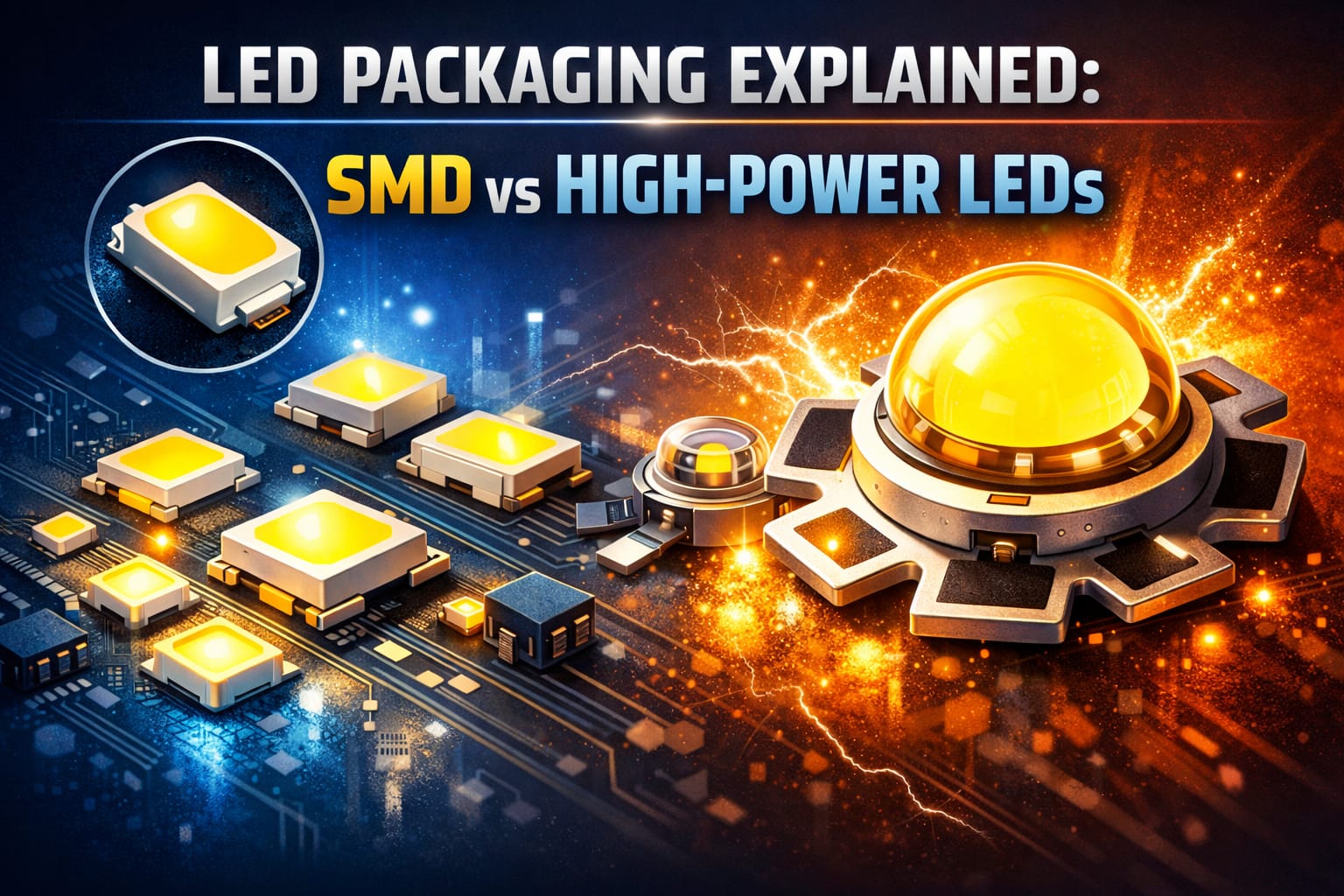
Table of Contents
Core Differences Between SMD and High-Power LEDs
The biggest difference is how each LED package is meant to deliver light. SMD LEDs are small surface-mounted components designed to be used in groups. They work well when you want light spread across a board, strip, or panel. High-power LEDs are designed to push much more output from each individual package, which makes them a better fit for directional or high-intensity lighting.
Current handling also separates the two. Many SMD LEDs run in the tens or low hundreds of milliamps, while high-power LEDs commonly run at 350 mA, 700 mA, or much more. That difference in drive current affects heat, efficiency under load, optical design, and long-term reliability.
The design philosophy behind the packages is different too. SMD parts prioritize compact size, automated placement, and board density. High-power packages prioritize heat flow, stronger substrates, and better control over the light source. That is why LED chip architecture and package style matter so much when you compare them.
In simple terms, SMD is usually the better choice when you want many small emitters working together. High-power LED packages make more sense when you want fewer emitters doing much heavier work.
Do not compare SMD and high-power LEDs by brightness alone. The better question is whether you need wide, even coverage or concentrated light from fewer points.
Package Size and Layout Impact
SMD packages are physically small and built for efficient board use. Common sizes such as 2835, 3528, and 5050 make it possible to place many LEDs in a limited area. This is one reason SMD technology dominates LED strips, retrofit bulbs, backlights, and flat-panel fixtures.
That compact footprint gives designers flexibility. You can spread light evenly, create long linear runs, and reduce the harsh point-source look that comes from using only a few powerful emitters. In many applications, multiple small sources simply look better and produce more uniform illumination.
High-power LEDs take the opposite approach. Their packages are larger because they need stronger thermal paths, more robust mounting, and in many cases a better interface with optics or reflectors. You use fewer of them, but each one does far more work. That is useful in spotlights, projectors, and other fixtures where a concentrated source makes the optical system easier to design.
This layout difference changes the whole fixture. With SMD, the board often becomes a distributed light engine. With high-power LEDs, the fixture is usually built around thermal management and beam control first, then output.
If you need a component built to handle higher output with more demanding thermal loads, a high power LED chip for stable performance can make more sense than pushing a small SMD package beyond its intended range.
Power and Output Differences
Power handling is one of the clearest dividing lines in an SMD vs high power LED comparison. Many standard SMD packages operate around 0.1 to 0.5 watts per package, though some can go higher depending on design. High-power LEDs usually start around 1 watt and can go far beyond that when paired with proper cooling.
That does not mean every high-power LED system is automatically brighter than every SMD system. A large SMD array can easily outperform a small high-power setup in total lumens. The real difference is brightness per package and how concentrated the light is. High-power LEDs produce much more output from each emitter, while SMD systems rely on numbers and distribution.
Efficiency can be similar when both types are driven correctly, although real-world results depend on drive current, temperature, and optical losses. Many modern SMD packages and many high-power packages both deliver strong lm/W figures, which is why understanding lumens per watt is more useful than focusing only on wattage.
Beam behavior matters too. SMD LEDs usually start with a wide native emission pattern, which works well for general illumination. High-power LEDs are more often paired with secondary optics, lenses, or reflectors to produce tighter, more controlled beams.
Typical ranges at a glance:
- SMD LED power per package: often around 0.1 to 0.5 W
- High-power LED power per package: often around 1 to 10 W or more
- SMD lumen output per package: usually modest, but scalable across large arrays
- High-power LED lumen output per package: much higher from each emitter
- SMD beam style: broad and distributed
- High-power beam style: more concentrated and easier to control optically
Cooling and Thermal Design
Thermal management is where high-power LEDs become much more demanding. Because each package handles more current and produces more concentrated heat, the path from the LED junction to the surrounding air has to be much better. That usually means metal-core boards, dedicated thermal pads, heat sinks, thermal interface material, and sometimes active cooling.
SMD LEDs are easier to manage thermally when they are used within their intended range. Their heat is spread across many small components and across more board area, so passive cooling is often enough. That does not make them immune to overheating, but it does make the thermal problem easier in many general-lighting products.
Once you try to push more output into a small space, the gap gets wider. A board full of heavily driven SMD packages can still run hot, and a poorly designed SMD fixture can fail early. But in general, high-power LEDs punish bad thermal design much faster. If the heat sink, interface, or airflow is inadequate, output drops, color can shift, and lifespan suffers. That is why LED heat sink design matters so much with high-output builds.
The U.S. Department of Energy also notes that heat management is a major factor in LED performance and lifespan, especially when systems are pushed hard in enclosed or high-output fixtures. Their LED lighting guidance is a useful reminder that good LEDs still depend on good thermal design.
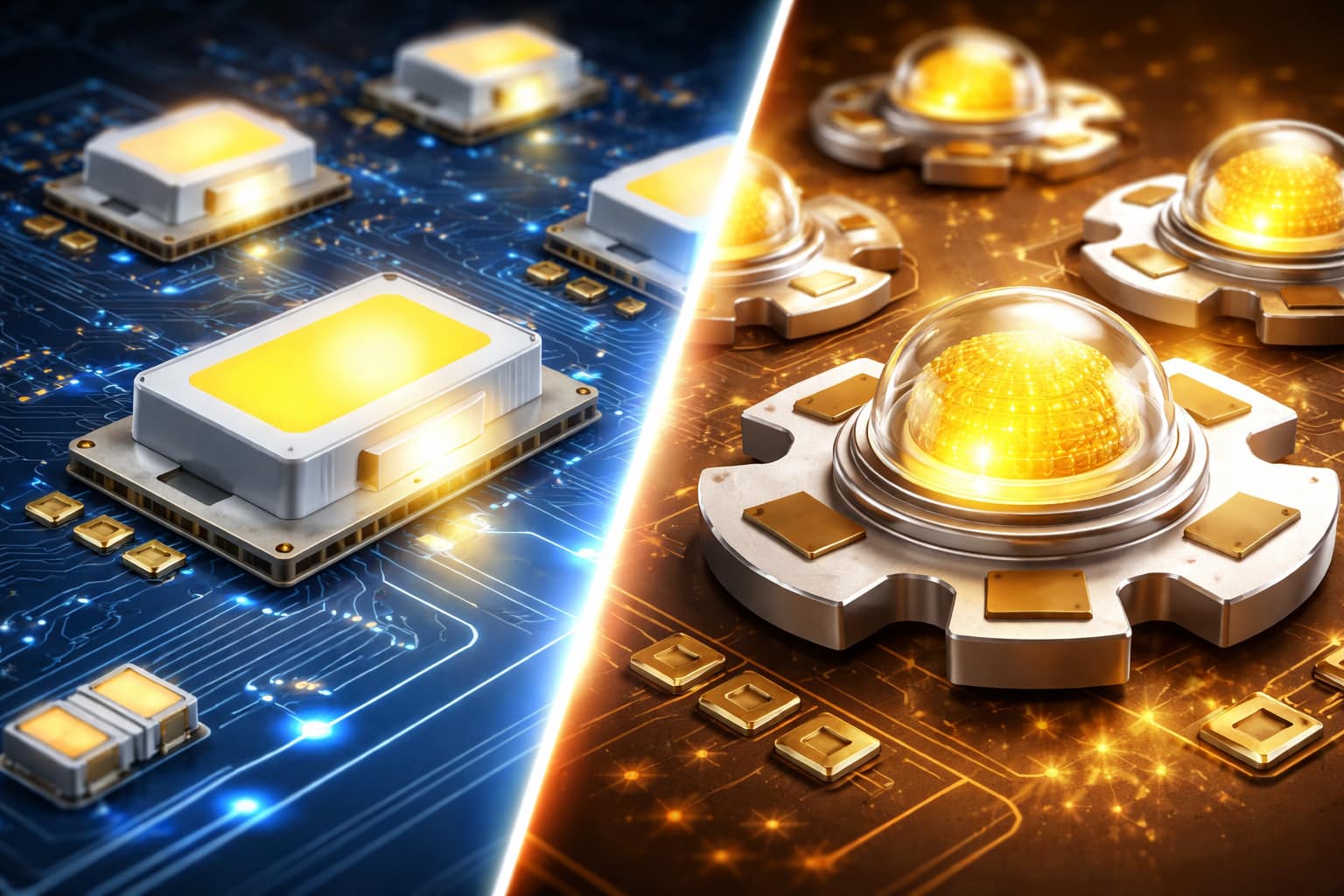
As a rule, SMD designs spread the heat problem out. High-power designs concentrate it. That single difference influences materials, enclosure design, reliability, and cost.
A high-power LED can look impressive on paper, but without the right heat sink and thermal path, it may lose output or fail sooner than a modest SMD array.
Assembly and Cost Considerations
SMD technology fits modern high-volume manufacturing extremely well. Automated pick-and-place lines, reflow soldering, and standard PCB workflows make it easy to build products with dozens or hundreds of emitters quickly and consistently. That is one reason SMD dominates mass-market lighting.
High-power LEDs usually require more attention per unit. The mechanical interface matters more, the thermal interface matters more, and optical alignment often matters more. Even when assembly is still automated, the system around the LED is typically more specialized and more expensive.
Component pricing reflects that difference. Small SMD packages are often very cheap in volume. High-power packages cost much more per emitter, and the surrounding hardware can raise total fixture cost further. On the other hand, using fewer high-output packages can simplify some designs and reduce part count in applications where concentrated light is the goal.
So the cheaper option depends on the full system, not just the LED package. If you need broad general illumination over a large area, SMD usually wins on cost and manufacturing efficiency. If you need focused output, better optical control, and fewer light sources, a high-power design can still be the more practical choice.
For buyers looking at long-term value rather than sticker price alone, the ENERGY STAR LED overview is a good reminder that efficiency, thermal quality, and expected lifespan all influence the real cost of ownership.
Common Applications for Each Type
SMD LEDs are the default choice in many everyday products. You will find them in LED bulbs, strips, tubes, flat panels, decorative lighting, backlighting, and many consumer fixtures. Their small size and wide distribution make them ideal when smooth coverage matters more than intense point-source output.
They also work very well in linear and flexible products. If you have ever looked at strip lighting, under-cabinet lighting, or dense panel lights, you have already seen why SMD layouts are so useful. They allow designers to create more even-looking light with many emitters working together instead of relying on only a few powerful sources.
High-power LEDs are more common where output needs to be concentrated and directed. Spotlights, flashlights, projectors, automotive headlights, floodlights, and many commercial accent fixtures use high-power packages because they work well with lenses and reflectors and can produce strong brightness from a small number of emitters.
Automotive lighting is a good example of the split. Decorative or distributed functions may rely on SMD arrays, while headlights and other high-intensity functions are more likely to use high-power emitters. The same pattern shows up in architectural lighting: broad ambient fixtures often lean toward SMD, while narrow-beam accents often lean toward high-power packages.
Lifespan and Reliability
Neither package type automatically lasts longer in every situation. Lifespan depends much more on thermal design, drive current, material quality, and operating environment than on whether the LED is labeled SMD or high-power.
A well-designed SMD array can run for tens of thousands of hours with stable output. A well-cooled high-power LED can do the same. The problem is that high-power packages are usually less forgiving. Because they operate under more intense thermal stress, bad design decisions show up faster and more severely.
Failure modes can differ too. SMD systems may suffer from board-level issues, solder fatigue, uneven heat spreading, or gradual degradation across many emitters. High-power systems are more likely to struggle with junction temperature, phosphor stress, thermal interface problems, or heat sink limitations.
If reliability matters, the smartest approach is to evaluate the full thermal path, drive conditions, and manufacturer quality instead of assuming one package family is always better. Good design beats package labels every time.
What Should You Choose?
Choose based on the kind of light your product needs to deliver, not just on package size or headline wattage. SMD is usually the better fit for broad, even illumination, while high-power LED packages are better when intensity and beam control matter most.
- Choose SMD for strips, bulbs, panels, and other distributed lighting designs.
- Choose high-power LEDs for spotlights, projectors, floodlights, and focused beams.
- Choose SMD when board density, lower cost, and easier scaling matter most.
- Choose high-power LEDs when you need more output from fewer emitters.
- Whichever type you pick, make thermal design part of the decision from the start.
Key Takeaways
SMD and high-power LEDs solve different lighting problems. SMD packages are compact, scalable, and well suited to even illumination across strips, panels, and general lighting products, while high-power LEDs are designed for stronger output per emitter and better directional control.
When comparing SMD vs high power LED options, focus on thermal design, beam shape, output concentration, and system cost rather than looking only at watts or package size. A well-designed fixture can perform very well with either approach when the application matches the package style.
For most broad residential and decorative lighting, SMD is the more natural fit. For intense, focused, or specialty lighting, high-power LEDs often make more sense. The better choice is the one that fits the job instead of forcing the LED to operate outside its intended range.
Sharing this guide
If you found this guide helpful, save it for later or share it with someone comparing LED package types for a project, fixture, or custom build.
Share using the links below
Interested in learning more? Browse all related articles in our category section.
Pingback: LED Binning Explained: What It Means - NeoLEDHub
Pingback: Reflector vs Lens in LED Optical Systems - NeoLEDHub
Pingback: Reflector vs Lens in LED Optical Systems: Key Differences