Lumens vs Watts: What Really Tells You a Bulb Is Brighter?
For decades, people bought light bulbs by wattage, but watts do not tell you how bright a bulb looks. They tell you how much electricity it uses. If you have ever switched to LEDs and ended up with light that felt dimmer or brighter than expected, that is usually where the confusion starts.
This guide explains the real difference between lumens and watts, shows how to estimate the right brightness for a room, and covers the other bulb details that matter before you buy.
Quick Answer
Lumens measure brightness. Watts measure electricity use. If you want to know which bulb will look brighter, compare lumens first and use wattage only to check efficiency and fixture limits.
- More lumens means more visible light
- More watts means more power consumption, not necessarily more brightness
- An 800-lumen LED can match the brightness of a 60W incandescent
- Choose bulbs by target lumens, then confirm compatibility and color temperature
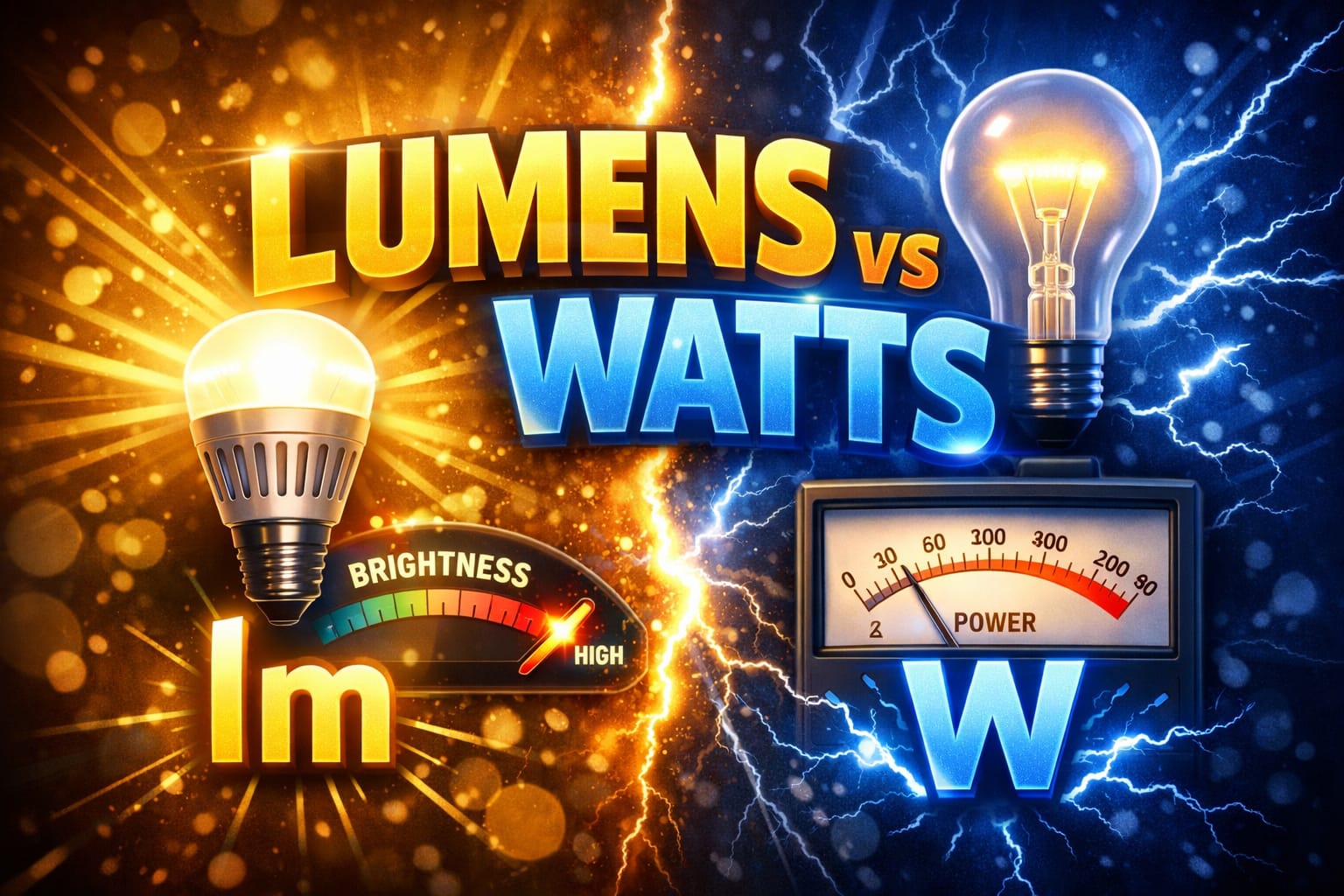
Table of Contents
- Quick Answer
- What Are Lumens and Why They Matter
- What Are Watts in Lighting
- The Key Difference Between Lumens and Watts
- Why We Switched from Watts to Lumens
- Lumens to Watts Conversion Guide
- How to Calculate Your Lighting Needs
- Understanding Luminous Efficacy
- Practical Tips for Choosing Bulbs
- Common Mistakes to Avoid
- What Should You Choose?
- Key Takeaways
- Sharing this guide
What Are Lumens and Why They Matter
Lumens are the standard measurement of visible light output. When you see “lm” on a bulb package, that number tells you how much light the bulb produces. More lumens means more visible light.
That makes lumens the number that matters most when you are judging how a room will actually look and feel. Two bulbs with the same lumen rating can appear similarly bright even if one uses far less electricity. If you want room-by-room targets, see our how many lumens per room guide.
Shop by lumens first, not by the “equivalent wattage” printed on the box. The equivalency label is only a shortcut. The lumen number is the actual brightness measurement.
Most modern bulb packaging now puts lumens in a much more visible place, which makes it easier to compare LED, CFL, and older bulb types without guessing. A practical starting point for many everyday rooms is an 800-lumen smart bulb with dimming control if you want flexible brightness from one bulb.
What Are Watts in Lighting
Watts measure electrical power consumption, not brightness. A 60-watt bulb draws 60 watts when it is on. That affects energy use and running cost, but it does not tell you how much visible light reaches the room.
That old shortcut worked reasonably well when most bulbs were incandescent and used similar technology. Once LEDs became common, it stopped being reliable. A 10W LED can easily match or beat the brightness of a traditional 60W bulb.
Wattage still matters for one practical reason: you should not exceed a fixture’s maximum rating. Even so, LEDs usually draw so little power that this is far less restrictive than it used to be. If you are new to the technology, our guide on what LED bulbs are is a helpful place to start.
The Key Difference Between Lumens and Watts
Lumens measure light output. Watts measure energy input. One tells you how bright the bulb looks. The other tells you how much power it draws. They answer different questions, so they should not be used interchangeably.
A common example makes this clear. An incandescent bulb that produces around 800 lumens typically uses about 60 watts. An LED can deliver those same 800 lumens with roughly 8 to 10 watts. The brightness is similar, but the energy use is much lower. For the technical side of that jump in efficiency, read how LED lighting works.
The same pattern continues at higher output levels. A bulb producing around 1600 lumens may need about 100 watts in older incandescent form, while an LED equivalent often lands around 14 to 18 watts. If your room still feels underlit after switching, the issue may be placement, beam spread, or bulb quality rather than wattage alone. Our guide on why LED lights look dim covers the usual causes.
Why We Switched from Watts to Lumens
Once efficient lighting became mainstream, wattage stopped being a reliable way to judge brightness. Consumers needed a better comparison point, and lumens filled that role because they describe the actual light output rather than the electricity consumed.
That shift also changed bulb packaging. Retailers, manufacturers, and consumer guidance from sources such as the U.S. Department of Energy started putting more emphasis on lumens so buyers could compare bulbs across technologies more easily. “Replaces 60W” labels still exist, but they are mainly there to help people move away from an old habit.
Use “replaces 60W” only as a rough reference. The lumen figure is the better number for real comparisons, especially when you are choosing between different bulb brands or technologies.
Lumens to Watts Conversion Guide
If you still think in old incandescent wattages, this is the easiest way to translate them into modern brightness levels and typical LED power draw.
Standard Brightness Conversions
A 40W incandescent usually produces around 450 lumens. An LED replacement often needs only 4 to 5 watts, which makes it a good fit for accent lamps, nightstands, and decorative fixtures.
A 60W incandescent is typically around 800 lumens. That remains one of the most common household brightness levels. In LED form, it usually draws about 8 to 10 watts and works well for table lamps, bedroom lighting, and many general-use fixtures.
A 75W incandescent lands around 1100 lumens, with an LED equivalent often using 11 to 13 watts. This level is useful in kitchens, living rooms, and work surfaces that need a bit more brightness than a standard lamp.
A 100W incandescent produces about 1600 lumens. An LED equivalent usually needs only 14 to 18 watts, which makes it a practical choice for garages, utility spaces, or anywhere clear task lighting matters.
Higher Output Applications
Modern LEDs can reach 2000 to 3000 lumens while using only about 20 to 30 watts. That is where the efficiency gap becomes especially obvious. You get strong brightness for garages, basements, outdoor security lighting, and other high-output areas without the heavy energy use older bulbs would require.
How to Calculate Your Lighting Needs
A simple starting point is to multiply the room’s square footage by a rough lumen target for that kind of space. That gives you a total brightness goal, which you can then split across ceiling lights, lamps, vanity fixtures, or task lighting.
Living rooms, bedrooms, and dining rooms often work well at around 10 to 20 lumens per square foot. A 200-square-foot bedroom might need roughly 2000 to 4000 lumens total depending on how soft or bright you want it to feel.
Kitchens and bathrooms usually need more concentrated light, especially near mirrors, counters, and prep zones. Many setups land closer to 50 to 75 lumens per square foot once overhead and task lighting are combined.
Task-heavy spaces such as home offices, workshops, and craft rooms often benefit from 75 to 100 lumens per square foot in the areas where detail work happens. For more exact room examples, our full lumens per room guide breaks the numbers down further.
Understanding Luminous Efficacy
Luminous efficacy, measured in lumens per watt, shows how efficiently a bulb turns electricity into visible light. It is one of the clearest ways to compare different lighting technologies because it combines brightness and energy use in a single number.
Traditional incandescent bulbs usually manage only around 10 to 17 lumens per watt, which means a lot of their energy is lost as heat. CFLs improved that, but they still had drawbacks such as warm-up time, mercury content, and inconsistent light quality.
Modern LEDs often reach 80 to 100 or more lumens per watt, which is why they can deliver the same brightness with a fraction of the electricity. If you want a deeper look at this measurement, our lumens per watt guide explains what counts as efficient in real-world terms.
Very cheap bulbs can overpromise on efficiency or lose output quickly over time. If consistent brightness matters, stick with reputable brands and look for recognized certification where available.
Practical Tips for Choosing Bulbs
Start with the lumen rating on the front of the package. That tells you the brightness level you are actually buying. Use wattage afterward to confirm the bulb is efficient and safe for your fixture. For a broader checklist, see our LED lighting buying guide.
Check color temperature alongside lumens. Brightness affects visibility, but color temperature affects mood and comfort. Warm white bulbs around 2700 to 3000K suit bedrooms and living spaces, while cooler tones often work better in kitchens, bathrooms, and work zones. Our color temperature guide covers the differences in more detail.
If you want dimming, make sure the bulb and the dimmer are actually compatible. Not every LED dims smoothly. And if you want schedule control without replacing a switch, a compact smart plug can be a simple upgrade for lamps and smaller fixtures.
For makeup areas, closets, studios, or anywhere color accuracy matters, pay attention to CRI. A CRI above 90 is a strong choice for detail-sensitive spaces, while 80+ is generally acceptable for everyday household use.
Common Mistakes to Avoid
The biggest mistake is still buying by wattage alone. Many people reach for the number that feels familiar without checking lumens, and that is exactly how rooms end up dimmer or brighter than intended.
Another common problem is assuming all bulbs with the same lumen rating perform equally. Build quality, beam angle, color rendering, and driver stability can all affect how effective the light feels in practice.
Fixture compatibility is also easy to overlook. Enclosed fittings, recessed housings, and older dimmer switches can all cause trouble if the bulb is not rated for that setup. A bulb can be efficient on paper and still be the wrong choice for the fixture.
People also tend to underestimate how much light they need because LEDs are marketed as efficient and compact. Saving energy does not mean settling for weak brightness. It usually means you can choose the right lumen level without worrying nearly as much about wattage.
Finally, avoid depending on one overhead fixture to do everything. Layered lighting nearly always feels better because it spreads brightness more evenly and reduces the harsh contrast that makes rooms feel flat or uncomfortable.
What Should You Choose?
Choose your next bulb by the brightness you want, not by the watt number you are used to seeing. In most cases, the right decision comes down to target lumens, room use, and compatibility details.
- Around 450 lumens works well for softer accent lighting and small lamps
- Around 800 lumens is a solid everyday target for many standard household bulbs
- 1100 to 1600 lumens suits brighter kitchens, bathrooms, and task-focused rooms
- Pick color temperature based on the room, not just the lumen number
- Use wattage mainly to check efficiency and fixture safety, not brightness
Key Takeaways
The difference between lumens and watts is simple once you separate brightness from energy use. Lumens tell you how much light you will see, while watts tell you how much electricity the bulb draws.
In practical terms, that means you should choose a bulb by its lumen output first, then check color temperature, CRI, dimming support, and fixture compatibility before you buy. That approach gives you a much better chance of getting the room to feel right the first time.
As LED technology keeps improving, it gets easier to buy the brightness you want while using less energy than ever before. The better you understand these numbers now, the easier it becomes to make future lighting upgrades.
Sharing this guide
If you found this guide helpful, save it or share it with someone who is still shopping by watt labels alone.
Interested in learning more? Browse related articles in our LED basics category.