LED Light Left on All Night? Cost, Safety & When to Worry
If you left an LED light on all night, the cost is usually much lower than most people expect. A single 5W to 10W LED running for about 8 hours often costs around 1–2 cents or less, depending on your electricity rate.
The bigger question is whether this happened once, happens every night, or involves several bulbs, bright rooms, LED strips, or smart devices left running together. In most cases, one forgotten LED bulb is not a bill problem, but repeated overnight lighting can still be worth controlling.
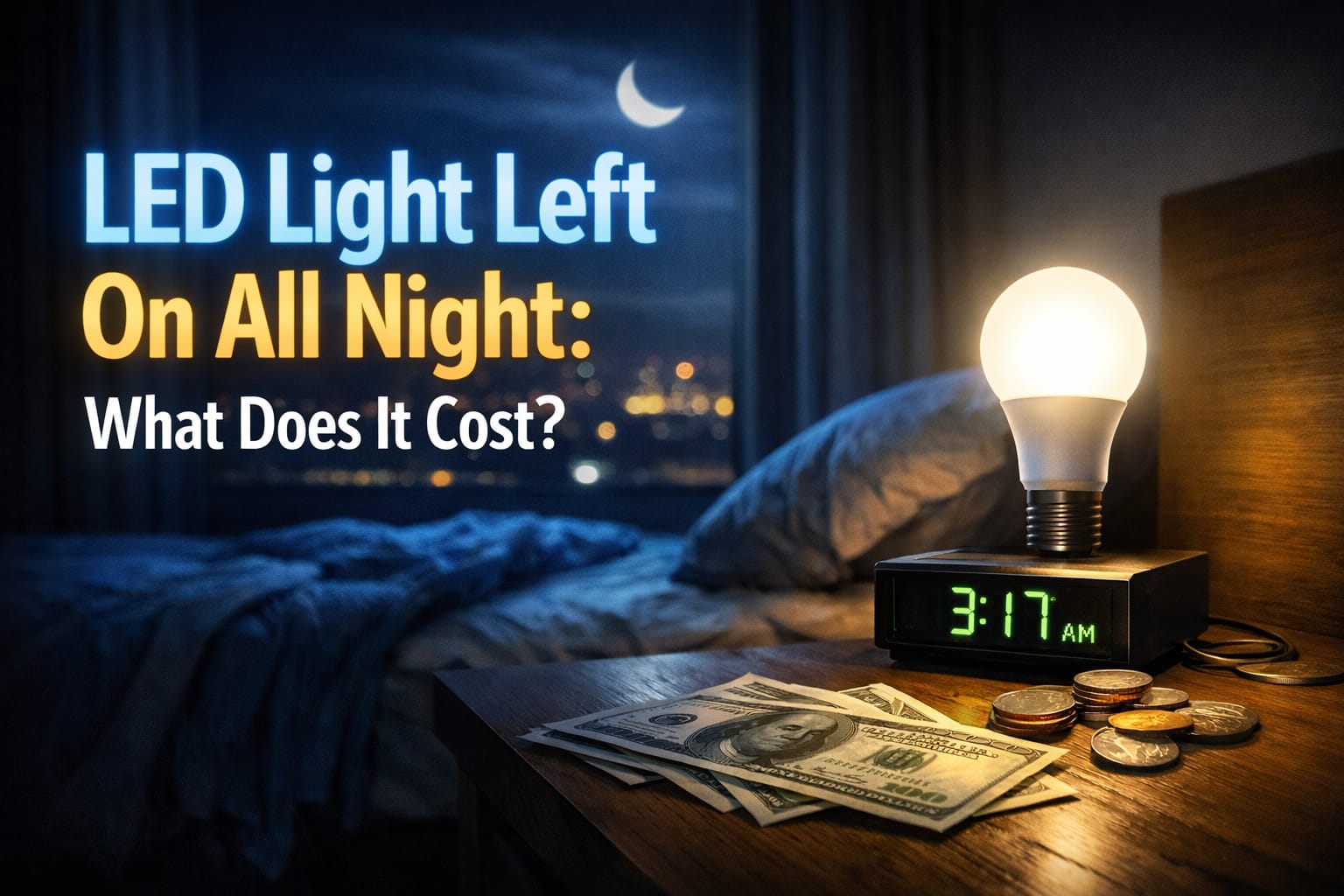
Table of Contents:
- How Much Does One LED Light Cost Overnight?
- The Quick Formula
- Real Cost per Night for Common Bulbs
- What Changes the Total?
- Why LEDs Still Cost So Little
- One Bulb vs. a Whole Room
- Is It Safe to Leave an LED Light on All Night?
- Best Ways to Stop Leaving LED Lights on Overnight
- Common Estimating Mistakes
- When It Becomes a Real Problem
- Common Questions About Overnight LED Cost
- Sharing This Guide
Quick answer: A single 5W to 10W LED light left on for 8 hours usually costs around 1–2 cents or less, depending on your electricity rate. One accidental night is rarely a problem; repeated overnight use across several lights matters more.
How Much Does One LED Light Cost Overnight?
For a single modern bulb, usually not much. In most homes, an LED light left on all night costs far less than people imagine because LED bulbs use much less power than older types of lighting. This is why a forgotten lamp often feels more expensive emotionally than it appears on the bill.
What matters most is not only that the light stayed on overnight. What matters are the wattage, the number of hours, your electricity rate, and how often the habit repeats. One low-watt bulb for one night is rarely significant. Several bulbs in multiple rooms every night can become more noticeable.
If you’re curious about the reasons behind the low cost of overnight lighting, our guide to LED energy savings explains how modern bulbs use significantly less power than older technology.
If a bedside lamp is left on overnight, cost is usually not the main concern. Comfort, sleep disruption, bulb color temperature, and glare often matter more than electricity costs.
The Quick Formula
If you want to calculate the cost of using an LED light per hour or per night, the math is simple:
Watts × hours ÷ 1000 = kilowatt-hours (kWh).
kWh × electricity rate = cost.
For example, if a 9W LED light is used for eight hours, it uses 0.072 kWh. If your electricity rate is $0.15 per kWh, one night of use costs just over one cent. If your rate is higher, the cost increases, but the bulb still uses a very small amount of electricity.
The key point is that overnight LED lighting usually does not result in a high bill unless the habit repeats across many fixtures, rooms, or connected lighting products.
Real Cost per Night for Common Bulbs
To understand the cost of leaving LED lights on overnight, it helps to look at a few common bulb sizes. These examples assume eight hours of overnight use:
- 5W LED: 0.040 kWh
- 9W LED: 0.072 kWh
- 12W LED: 0.096 kWh overnight
At $0.15 per kWh, that works out to:
- $0.006 per night for the 5W bulb
- $0.011 per night for the 9W bulb
- $0.014 per night for the 12W bulb
Therefore, leaving a single LED light on all night is usually not a significant cost. The bigger issue is repetition. A few cents here and there may not matter much, but multiple bulbs across many nights can add up.
If you are comparing that to older lighting, the LED vs. incandescent electricity cost guide shows why old assumptions about “leaving lights on” no longer apply to LEDs.
What Changes the Total?
Three things primarily affect the result:
- ✓ The bulb wattage
- ✓ The number of hours it runs
- ✓ The price you pay per kWh
The same LED light left on all night can cost significantly more in an area with expensive electricity. This explains why two people online can discuss the same bulb and arrive at different totals. The bulb did not change. The rate did.
The U.S. Department of Energy’s LED lighting guidance is useful here because it reinforces this basic idea. LEDs are efficient, but operating costs still depend on how and where they are used.
Why LEDs Still Cost So Little
LEDs are inexpensive to operate because they produce useful light with much less wasted energy than older bulbs. This efficiency is precisely why the cost of leaving LED lights on overnight is usually modest. Older bulbs could make the same mistake seem expensive because they consumed far more power for a similar level of brightness.
This also explains why whole-home upgrades matter more than one forgotten lamp. The savings from the first bulb might not seem dramatic, but when the same efficiency improvement happens across multiple rooms, the monthly savings become much more noticeable.
This guide to monthly savings from switching to LEDs shows how overnight costs add up over time.
One Bulb vs. a Whole Room
Leaving a single LED light on all night is rarely a financial problem. However, a room with several bulbs, accent lights, LED strips, or connected devices is a different story. None of these items may be expensive individually, but collectively, they can transform a minimal nightly cost into a more noticeable monthly expense.
This is where the question becomes useful: Are you leaving one low-watt lamp on for safety or comfort, or are you accidentally leaving multiple fixtures on in unused spaces? These are very different habits with very different annual totals.
If you want to understand what repeated use looks like over longer periods, knowing how much LED lights save per year can help you connect the dots between small daily numbers and full-year results.
Is It Safe to Leave an LED Light on All Night?
In normal use, a properly installed LED bulb in a suitable fixture is usually safe to leave on overnight. The more important questions are whether the bulb is in good condition, whether the fixture is rated for the bulb, whether the light creates glare, and whether it is actually needed for safety or comfort.
Sometimes an LED light left on all night is reasonable. Hallway lighting, children’s room lighting, low-level bathroom lighting, and gentle bedside lights can improve safety and comfort. In these cases, the right question is not “Should this ever be on overnight?” but “Is this the right bulb and brightness for overnight use?”
A lower-wattage, warm bulb often makes more sense than a bright, task-oriented one. It keeps costs low, avoids overlighting the room, and supports comfort much better. If you need a better option for overnight use, a warm low-watt LED night light is often a smarter choice than leaving a brighter, general-purpose lamp on.
This is especially true in bedrooms, nurseries, and late-night routes through the house, where glare is almost as important as energy use.
Best Ways to Stop Leaving LED Lights on Overnight
Automation often strikes the best balance. Rather than wondering if leaving an LED light on all night is acceptable, you can make the lamp operate only during the hours when it is needed. This provides comfort and convenience without making long runtime the default.
Timers, motion sensors, smart plugs, and smart routines are useful for areas such as hallways, stairs, bathrooms, and bedrooms, where people want effortless control. If the lamp is usually forgotten rather than intentionally left on, a plug-in timer for overnight lights can solve the problem easily by shutting the lamp off automatically.
- ✓ Use a low-watt warm LED bulb when comfort matters more than brightness
- ✓ Use a plug-in timer if the same lamp is left on by habit
- ✓ Use motion-sensor lighting for hallways, bathrooms, and stairs
- ✓ Use smart routines when you want lights to turn off automatically at a fixed time
For broader guidance, the LED Knowledge Center collects related energy, comfort, and control topics to help with these decisions.
Common Estimating Mistakes
The biggest mistake is assuming that every bright bulb is expensive to run. A bulb can appear bright in a dark room and still use very little electricity. Brightness and energy use are related but not identical, and this misconception leads to many bad estimates.
Another mistake is forgetting about the other connected devices around the bulb. Smart hubs, sensors, and always-on connected lighting equipment can draw background power beyond the bulb itself. If your setup includes smart products, our article on smart light standby power usage is relevant because the background drain can sometimes matter more than the power usage of a single lamp.
Do not estimate lighting costs based on brightness alone. A harsh-looking bulb may be too exposed, have an unflattering color temperature, or be poorly placed rather than expensive to operate.
Why People Still Mix Up Brightness and Wattage
People often still connect brightness with watts because that made more sense with older bulbs. However, with LEDs, this correlation is much less reliable. A bright modern bulb can use significantly less electricity than older lighting.
If you want an easier way to understand this, lumens vs. watts makes it much simpler to estimate a bulb’s power and efficiency.
When It Becomes a Real Problem
An LED light left on all night only becomes a real problem when it is part of a repeating pattern, such as several fixtures, higher wattages than necessary, bright rooms left empty, or connected systems that never really rest. One night is trivial. Repeated habits are where the annual number starts to become meaningful.
It also becomes a quality-of-life problem when the light causes more discomfort than benefit. If the bulb is too bright for sleep, too cool for the room, or too harsh on your eyes, the bigger issue may be how the room feels rather than the cost of the electricity. The ENERGY STAR LED Lighting Basics page is useful because it emphasizes that even efficient bulbs can differ greatly in output, quality, and application.
Yes, there is a cost, but it is manageable in most homes. The best approach is not to panic. It is about understanding the math, checking how often the habit repeats, and addressing the few cases where the pattern actually matters.
The easiest way to reduce waste overnight without inconvenience is usually a lower-output bulb, a timer, or better automation rather than constant manual switching.
Key Takeaways
For most households, leaving an LED light on all night costs far less than people expect. The exact amount depends on the wattage and runtime of the bulb and the local electricity rate, but a modern bulb usually adds only a small amount to the bill.
One forgotten LED bulb is rarely worth worrying about. Repeated overnight lighting across several fixtures, bright rooms, LED strips, or connected devices is where the cost and waste become more noticeable.
The best solution is usually simple: choose low-watt warm lighting for overnight comfort, avoid unnecessary brightness, and use timers, motion sensors, or routines when lights are often forgotten.
Common Questions About Overnight LED Cost
Does Leaving One LED Light On All Night Really Affect The Bill?
Usually, only slightly. The cost for one modern bulb is often around 1–2 cents or less per night, depending on the wattage and electricity rate.
Is It Safe To Leave LED Lights On All Night?
A properly installed LED bulb in a suitable fixture is usually safe for normal overnight use. You should be more cautious if the fixture is damaged, the bulb flickers, the lamp overheats, or the light is too bright for sleep.
Which Matters More: The Bulb Staying On Overnight Or The Wattage?
Wattage matters more. Overnight use only becomes expensive when the bulb uses more power, runs for many hours repeatedly, or is used across several fixtures at once.
What Is The Best Light To Leave On Overnight?
A warm, low-watt LED night light or dim lamp is usually better than a bright general-purpose bulb. For hallways, bathrooms, and stairs, a motion-sensor light can provide guidance without staying on all night.
When Should You Actually Worry About Leaving LED Lights On?
Worry less about one accidental night and more about repeated habits, multiple fixtures, unnecessary brightness, and connected devices drawing background power all the time.
Sharing This Guide
Share this guide if you found it helpful. Save it or share it with someone trying to figure out whether overnight LED use really affects the electric bill.
Interested in learning more? Browse all related articles in our category section.