How Much Electricity Does an LED Bulb Use?
Many people look at a bulb box, see a tiny watt number, and still wonder whether that really changes the electric bill. If you have ever asked how much electricity does an LED bulb use, the short answer is usually “far less than older bulbs,” but the real answer depends on brightness, daily use, and local electricity rates.
This guide breaks the topic down in plain language so you can estimate running cost, understand LED efficiency, and see why low-watt lighting often delivers the same practical brightness with much less waste. You will also learn what numbers on the package matter most before you buy.
Table of Contents
- What determines LED power draw
- Typical wattage and real usage
- Watts, brightness, and real-world output
- Why LEDs need less power
- Common mistakes about running cost
- What to check before you buy
- How to calculate daily, monthly, and yearly cost
- Examples for common bulb sizes
- Do smart features change power use?
- LEDs compared with older bulbs
- Checklist for lower lighting bills
- When rated watts and actual draw differ
- Why small wattage gaps matter
- Questions homeowners ask about LED power
What determines LED power draw
The number of watts an LED bulb uses depends mainly on its brightness target, chip quality, driver design, and any added features such as dimming or smart controls. That is why two bulbs with a similar shape can pull slightly different amounts of power while still lighting the same room. In everyday terms, power draw is the actual amount of electricity the bulb uses when running: the label shows the rated input, while real use reflects what happens when the bulb is actually on.
Bulb makers also design products for different goals. One model may focus on maximum output, another on softer comfort, and another on smart-home convenience. If you want a wider context for these tradeoffs, our guide to LED lighting efficiency explained shows how performance, brightness, and power connect in real homes. That broader view helps when you compare labels instead of assuming every LED behaves exactly the same way.
How much electricity does an LED bulb use
For most homes, the direct answer to how many watts does an LED bulb use is about 6 to 10 watts for a standard bulb that replaces an old 40W or 60W incandescent. A brighter model meant to replace a 100W incandescent often uses around 13 to 15 watts. So when people ask how much electricity does an LED bulb use, the answer is usually a very small number compared with the older bulb they are replacing.
A bulb that uses 8 or 9 watts for several hours a day is already operating in a very efficient range, so the bigger bill savings usually come from replacing many old bulbs, not obsessing over a fraction of a watt on one lamp.
That difference becomes even clearer when you look at long-term billing instead of just the package label. Our article on LED energy savings explains why small watt numbers matter once you multiply them across months and across multiple fixtures. It also answers a common user concern: yes, LED bulb power use is a valid thing to check, but the financial impact depends more on quantity and hours of use than on a single lamp.
If you want to check real draw instead of relying only on package claims, a plug-in energy monitor can help you measure consumption while comparing bulbs in the same room. It is a simple way to turn guesses into measured numbers, especially when you are comparing similar models.
Watts, brightness, and real-world output
One reason this topic feels confusing is that watts do not tell you brightness by themselves. They tell you how much power the bulb consumes. Lumens tell you how much visible light you get. A classic 40W incandescent typically produced about 450 lumens, a 60W bulb about 800 lumens, and a 100W bulb about 1600 lumens. An LED can often hit those same brightness levels using only 6–8W, 8–10W, or 13–15W respectively.
That is the core of LED bulb energy consumption: lower electrical input for a similar useful output. When you ask how much electricity does an LED bulb use, you should really pair the question with brightness. Otherwise, you might compare a dim decorative bulb to a bright task bulb and draw the wrong conclusion. Our LED wattage equivalent chart is useful here because it connects the old incandescent language many people remember to the modern LED numbers they see today.
Why LED bulbs use so little power
LEDs are efficient because they convert more electricity into visible light and less into wasted heat. Old incandescent bulbs use a large share of their energy to heat a filament, which is why they feel hot and burn through power quickly. In contrast, modern LEDs use semiconductor technology and compact drivers to deliver much better electricity savings from the same wall switch. That is the real reason the answer to how much electricity does an LED bulb use is almost always “less than you expect.”
The science behind this is well documented. The U.S. Department of Energy LED lighting efficiency guidance explains that LEDs use substantially less energy and last much longer than older lighting technologies. In practical home use, that means less waste, lower replacement frequency, and better control over power consumption lighting across an entire house, not just in one fixture.
What people get wrong about running costs
A common mistake is thinking that all LEDs cost almost nothing to run, so the details do not matter. They do matter, just at a smaller scale. If a bulb uses 9 watts instead of 6 watts, the difference still exists every hour it is on. Another mistake is forgetting that energy billing is based on kilowatt-hours, not on wattage alone. The phrase kilowatt-hours may sound technical, but it simply means converting the bulb’s watt draw into billable energy over time.
People also underestimate how often lights are left on in kitchens, hallways, porches, and living rooms. That is why our comparison of LED vs incandescent electricity cost tends to surprise readers. The question is not just how much electricity does an LED bulb use in isolation, but how much electricity older bulbs would have used for the same brightness during the same schedule.
Do not compare decorative filament LEDs, smart color bulbs, and high-output utility bulbs as if they serve the same job. Their wattage can differ because their brightness targets and electronics differ too.
What to check before you buy
Before buying, look at the rated watts, lumen output, color temperature, dimmability, and whether the bulb is meant for enclosed fixtures. Those details tell you more than the bulb shape alone. They also help answer how much electricity does an LED bulb use in a way that matches your real goal, whether that goal is a cozy bedside lamp or a brighter kitchen ceiling fixture. If you are unsure how to decode the box, our guide to reading LED packaging is a helpful reference.
✅ Rated wattage
Check the actual input watts first, because this is the base figure used to estimate operating cost. A standard household LED often falls between 6 and 10 watts, while brighter bulbs can go higher.
✅ Lumen output
Look for lumens, not just watts, when you want the same visible brightness as an older bulb. That keeps your comparison fair and prevents under-lighting a room just to chase a lower watt number.
✅ Driver quality
A better driver helps regulate current more cleanly, which can improve consistency and reduce strange behavior in dimmers or enclosed fixtures. Cheap electronics may still light up, but not always as smoothly.
✅ Fixture match
Make sure the bulb is suitable for the fixture, especially if heat buildup, dimmers, or smart controls are involved. A mismatched bulb can perform worse even if the wattage number looks good on paper.
How to calculate daily, monthly, and yearly cost
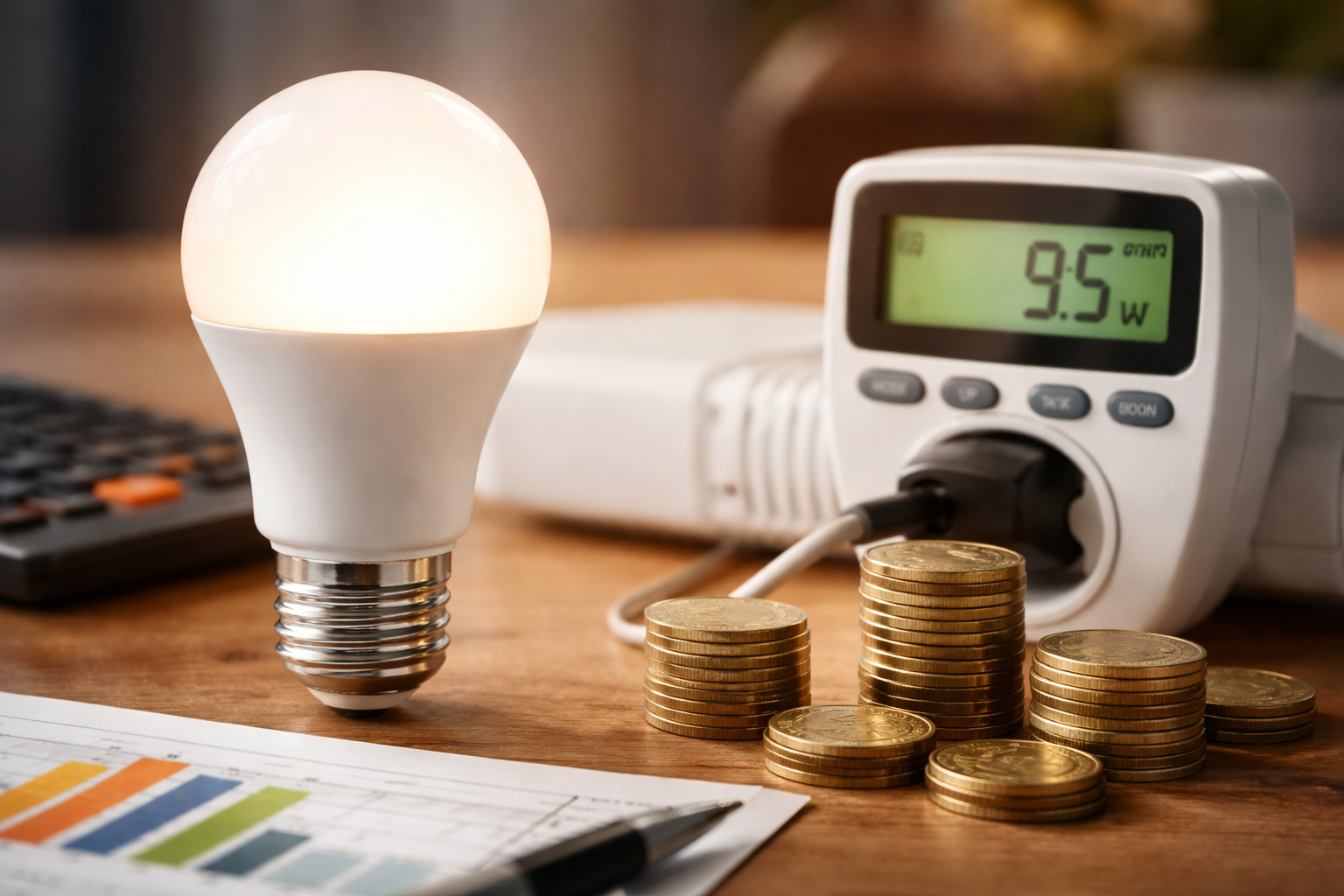
The simple formula is watts ÷ 1000 × hours used × your electricity rate. So a 9.5W bulb running for 5 hours a day uses 0.0475 kWh per day. Multiply that by your local rate and you get the daily cost. That makes LED bulb electricity cost much easier to understand, because you are no longer guessing from the box. You are turning rated draw into a real billing estimate.
This is also where the phrase cost per hour LED bulb becomes useful. If the rate is €0.20 per kWh, that same 9.5W lamp costs well under one cent per hour to run. One lamp will not transform your bill overnight, but several high-use fixtures absolutely add up. For a broader household view, see our piece on monthly savings from switching to LEDs, which shows how repeated daily use compounds over time.
Examples for common bulb sizes
A bulb replacing a 40W incandescent will often consume only 6 to 8 watts, while a 60W replacement usually sits around 8 to 10 watts. If you move up to a bright 100W equivalent, expect something like 13 to 15 watts. Those figures answer how many watts does an LED bulb use in the most practical way possible: by connecting old brightness expectations to modern energy use. This is the most relevant answer for readers shopping room by room.
Once you scale that across a home, the yearly picture gets clearer. A house with ten frequently used bulbs can save a meaningful amount simply because LED bulb energy use remains low every single day. Our article on how much LED lights save per year explores those cumulative savings in a more complete scenario-based way.
If you want to confirm actual power with a meter while comparing rooms or usage habits, a small plug-in power meter makes testing straightforward. It helps separate marketing claims from measured draw, which is especially useful when several bulbs claim similar performance.
Can smart features change power use?
Yes, but usually not by an enormous amount. Smart bulbs often use slightly more power than a plain LED because they include radios, processors, and extra control circuitry. Even when off, some smart bulbs still draw a tiny standby load so they can respond to app commands or voice assistants. So if you compare smart and non-smart models, the answer can be slightly higher for smart bulbs of similar brightness.
That does not make smart bulbs a bad choice. It just means you should compare like with like. The ENERGY STAR guide to LED lighting basics helps explain the broader performance picture, including how efficient designs still offer meaningful savings even when features are added. In short, smarter electronics can raise consumption slightly, but the gap versus incandescent lighting remains very large.
How LEDs compare with older bulbs
This is where the answer becomes most persuasive. A 60W incandescent that produces about 800 lumens can often be replaced by an 8W to 10W LED. That is a dramatic shift in LED vs incandescent energy use without asking you to accept a darker room. The real win is not theoretical efficiency on a lab sheet. It is similar brightness with far less wasted heat and far less money sent through the meter.
If someone is still unsure how much power an LED bulb uses compared with familiar older bulbs, this direct replacement framing usually clears up the confusion. It also explains why LEDs became the standard choice for homes focused on lower bills, less maintenance, and better long-term control of lighting costs.
Simple checklist for lower lighting bills
Once you understand how much power an LED bulb uses, the next step is applying that knowledge consistently around the house. The quickest savings usually come from replacing the most-used bulbs first, matching lumens correctly, and avoiding oversized lamps in rooms that do not need them. Keep this short checklist in mind when choosing where to upgrade first.
- ✓ Replace bulbs in fixtures used 4 to 8 hours a day before rarely used lamps.
- ✓ Compare lumens first so you do not sacrifice needed brightness just to chase a lower watt number.
- ✓ Use dimmable bulbs only with compatible dimmers when that feature is actually needed.
- ✓ Check enclosed-fixture ratings to avoid heat-related performance issues.
- ✓ Estimate yearly use, not just sticker price, before deciding which bulb is truly cheaper.
When rated watts and actual draw differ
In normal use, an LED bulb’s measured draw is usually close to its rated wattage, but slight differences can happen. Driver behavior, line voltage, dimmer compatibility, and standby electronics may nudge the number up or down a bit. That is why someone can ask how much electricity does an LED bulb use, test it with a meter, and see a reading that is not perfectly identical to the package. Small variation is normal; huge variation is not.
When troubleshooting that kind of variation, it helps to use a meter under the same conditions each time. A plug-in energy checker is useful when you are comparing dimmer settings, fixture types, or standby draw from smart lamps. That way, you are evaluating both the bulb and the setup instead of blaming the lamp for a system issue.
Why small wattage gaps matter over time
It is easy to dismiss a difference of 2 or 3 watts as meaningless, but repeated use changes the story. Imagine several bulbs running every evening in a kitchen, hallway, bathroom, and porch. The question of how much electricity does an LED bulb use becomes more important when the answer is multiplied across 30 days, 12 months, and many fixtures. Small differences can turn into noticeable savings when the usage pattern is heavy enough.
That is why the best buying decision is not always the bulb with the lowest watts on the shelf. The better decision is the bulb that gives the right brightness, stable performance, and a sensible operating cost for its actual job. Good selection is about balancing wattage, output, and lifespan instead of chasing one number in isolation.
Prioritize the bulbs that stay on the longest each day. Upgrading one porch light used all night can matter more than replacing several decorative bulbs that are only switched on occasionally.
Questions homeowners ask about LED power
The final point of confusion usually comes from mixing three separate questions together: how many watts a bulb draws, how bright it looks, and how much it costs to run. The answers below separate those issues clearly, so you can make sense of labels, compare products faster, and estimate real household savings with more confidence.
How many watts does a typical household LED bulb use?
A typical household LED bulb usually uses about 6 to 10 watts for brightness similar to many old 40W to 60W incandescent bulbs. Higher-output models that replace 100W incandescent bulbs often use around 13 to 15 watts, which is still far lower than older lighting for comparable everyday brightness.
Does leaving LED bulbs on for hours make them expensive to run?
Leaving LED bulbs on for hours does add cost, but the amount is usually small because the wattage is low. For example, a 9.5W bulb used 5 hours a day consumes only 0.0475 kWh daily, so the monthly operating cost remains modest in most homes.
Why do some LED bulbs use more power than others if they look similar?
Some LED bulbs use more power because they are designed for higher lumen output, better color quality, dimming support, or smart-home features. Two bulbs may look similar on the outside, yet one can draw several more watts because the electronics and performance targets inside are different.
Key Takeaways
The practical answer to how much electricity does an LED bulb use is that most standard household models use only a small amount of power, often between 6 and 10 watts, while brighter versions may reach around 13 to 15 watts. That low draw is the reason LED bulb energy consumption stays well below traditional incandescent lighting.
When choosing bulbs, compare lumens first, then use the watt figure to estimate LED bulb electricity cost over the hours you actually use the fixture. Matching brightness properly matters more than chasing the absolute lowest number on the box, because comfort, coverage, and reliability still determine whether the upgrade feels worthwhile.
Over time, the best savings usually come from replacing the bulbs that stay on the longest and from understanding real LED bulb power use in daily conditions. Once you start thinking in terms of brightness, usage hours, and running cost, lighting choices become much easier and much more strategic.
Sharing this guide
If you found this guide helpful, save it or share it with someone who is still using older bulbs.
Interested in learning more? Browse all related articles in our category section.