LED Light Degradation: L70, Lifespan & Brightness Loss
LED light degradation is why an LED can still turn on but look noticeably dimmer than when it was new. Instead of burning out suddenly, most LEDs slowly lose brightness over time. L70, L80, and L90 ratings show how much light remains, how useful the LED still is, and when replacement starts to make sense.
This guide explains why LED lights get dimmer over time, what L70 LED lifespan really means, how lumen maintenance ratings work, what speeds brightness loss up, and how to choose LEDs that stay useful for longer. If you want the technical basics first, our guide on how LED lighting works is a useful companion.
Quick Answer
LED light degradation means an LED gets dimmer gradually instead of failing all at once. L70 means the LED is still producing 70% of its original light output, L80 means 80%, and L90 means 90%. Heat, driver quality, operating current, and build quality all affect how quickly that brightness loss happens.
- L70 is the most common useful-life benchmark for LED lifespan.
- L70 means 70% of the original light remains, not that 70% has been lost.
- Higher ratings like L80 and L90 mean stricter brightness retention.
- Heat is one of the biggest causes of faster LED brightness loss.
- An LED can still work electrically even when it has become too dim for the space.
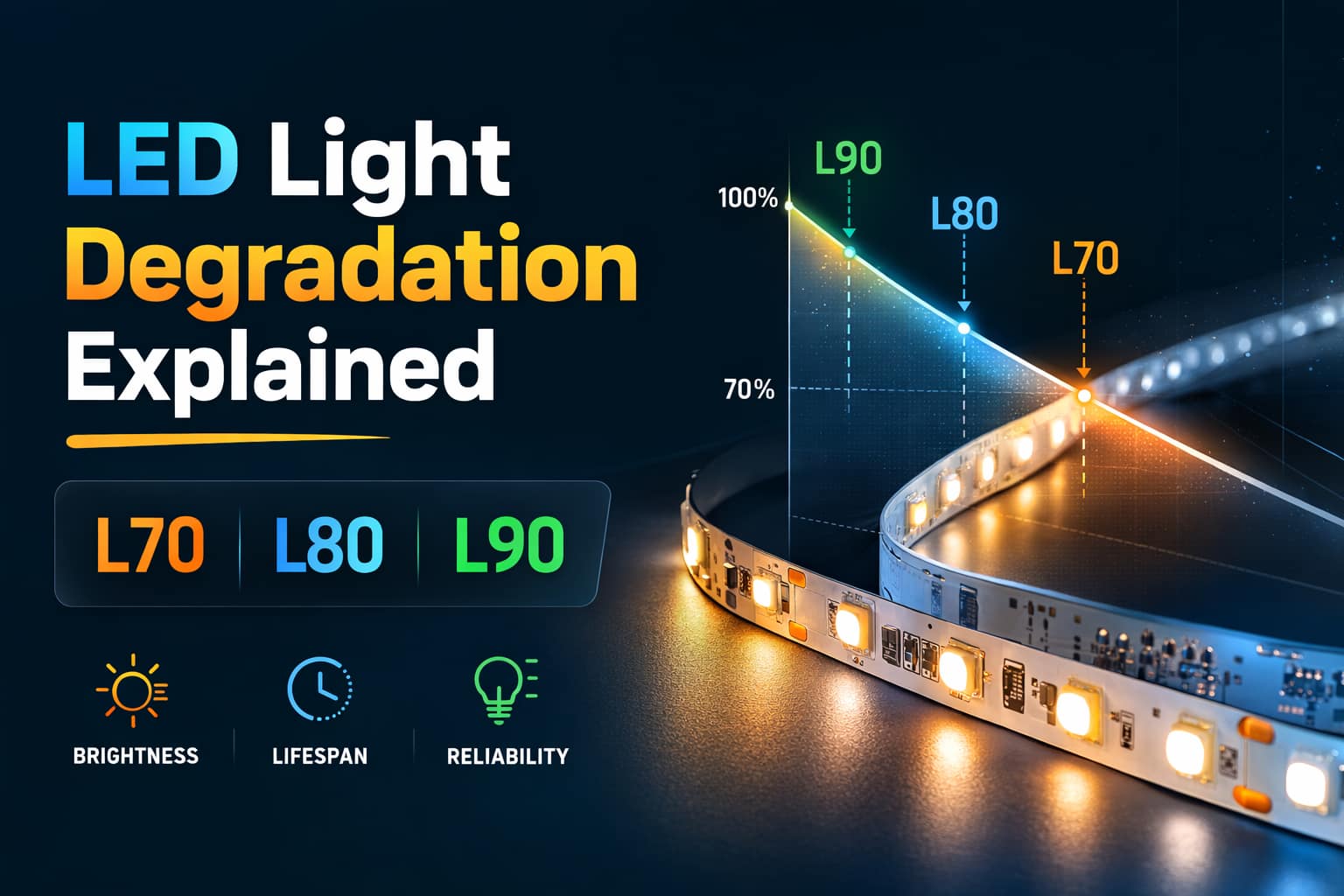
Table of Contents:
- What LED Light Degradation Means
- What L70, L80, and L90 Mean
- How Lumen Maintenance Ratings Work
- Why LEDs Get Dimmer Over Time
- How Heat Speeds Up Degradation
- How Driver Quality Affects LED Lifespan
- What LED Brightness Loss Looks Like in Real Use
- How LEDs Compare to Other Bulbs
- How to Slow LED Light Degradation
- When to Replace a Degrading LED
- FAQ
- Key Takeaways
- Sharing This Guide
What LED Light Degradation Means
LED light degradation is the gradual reduction in light output that occurs while the LED is still technically working. That is an important difference. Many people assume a bulb is either “working” or “dead,” but LEDs live in a middle zone for a long time where they still turn on, yet produce less useful light than when they were new.
This is why brightness decline matters more for LEDs than sudden burnout. In many cases, the LED itself still runs, but the light level has dropped enough that the fixture no longer performs as intended. For some rooms, that is only a minor annoyance. In offices, task lighting, retail, or other spaces where illumination levels matter, it becomes a real performance issue.
If you have ever wondered why an old LED fixture feels duller even though it has not failed completely, LED brightness loss is usually the answer. This gradual fading is normal to some extent, but the speed of that decline varies a lot from one product to another.
What L70, L80, and L90 Mean
L70, L80, and L90 are shorthand ways of describing how much light an LED still produces compared to its original output. If a product reaches L70, it means the light output has fallen to 70% of what it was when new. L80 means 80%, and L90 means 90%.
The lower the number after the L, the more brightness loss the rating allows before the product is considered to have reached the end of its useful life. That is why L70 LED lifespan is the most common benchmark in product specs. It represents a practical middle ground where the fixture still works, but the light loss has become significant enough to matter in many applications. In simple terms, L70 means “still working, but noticeably dimmer,” while L90 means “still very close to the original brightness.”
For a standard LED bulb lifespan claim, L70 usually tells you more than the total “hours” number alone. A bulb may still switch on after many years, but the more important question is whether it still produces enough useful brightness for the room.
L80 and L90 are stricter thresholds. They are more relevant in spaces where brightness must stay closer to the original level, such as premium commercial installations, precision work areas, or places where consistent appearance matters over long periods.
How Lumen Maintenance Ratings Work
Lumen maintenance ratings are the industry’s way of describing how well an LED holds onto its brightness over time. Instead of asking only, “How long will this LED turn on?”, these ratings ask a more useful question: “How long will this LED stay bright enough to be useful?”
Testing standards such as LM-80 and projection methods such as TM-21 are used to estimate this long-term decline. The details are technical, but the practical takeaway is simple: the rating is based on measured brightness retention over time, not just marketing claims. That makes lumen maintenance ratings far more helpful than a vague “long life” statement on a package.
Even so, these numbers are still based on controlled conditions. Real-world environments are not always as kind as the lab. That is why one fixture may meet its rating closely while another degrades faster because of heat, enclosed installation, poor airflow, or weaker electronics.
Why LEDs Get Dimmer Over Time
LEDs get dimmer because several parts of the system age gradually. The semiconductor itself changes slowly with use, the phosphor materials in white LEDs lose efficiency, optical components can discolor, and drivers or electrical parts can drift away from ideal performance. In other words, LED light degradation is rarely caused by one single thing.
The phosphor layer is especially important in white LEDs because it converts the base light into the color of light you actually see. As that layer ages, the fixture may not just dim. It can also shift slightly in color, which is one reason old LEDs sometimes feel duller or less pleasant even before they have lost a dramatic amount of raw output.
This is also why two LEDs with similar initial brightness can age very differently. One may hold its output well for years, while the other drops faster because of weaker underlying materials, thermal design, or driver quality from the start.
How Heat Speeds Up Degradation
Heat is one of the biggest reasons LED light degradation speeds up. LEDs are efficient compared to older bulbs, but they still generate heat, and that heat has to go somewhere. If it cannot escape properly, the junction temperature rises and the LED ages faster.
This is why thermal design matters so much. A fixture with a good heat sink, enough airflow, and a sensible power level will usually keep its brightness much longer than a fixture crammed into a hot enclosed space. Our guide to LED heat dissipation systems explains why this part of the design matters far more than many buyers realize.
If you use LEDs in enclosed fixtures, hot ceilings, unventilated housings, or very warm climates, expect LED brightness to decline faster over time unless the product is specifically built for those conditions. Heat does not always kill the LED outright, but it often shortens the period where the light remains acceptably bright.

How Driver Quality Affects LED Lifespan
Heat is not the whole story. The driver and operating current matter too. If an LED is pushed hard electrically, it may start brighter, but it will usually degrade faster. That is why underdriven or conservatively designed products often look better in the long run even if they are not the absolute brightest on day one.
Driver quality also matters because a weak driver can introduce current ripple, unstable output, or electrical stress that slowly damages performance. In cheaper fixtures, the driver is often one of the weakest links. So when two bulbs claim the same lifespan, the better-built one may still hold brightness better over time simply because the electronics are more stable.
This is where manufacturing quality becomes very important. Better chips, better phosphors, tighter quality control, and better thermal interfaces all help slow LED light degradation. If you want more background on chip-level differences, our guide on LED chip design differences explains why not all LEDs age the same way.
What LED Brightness Loss Looks Like in Real Use
In real life, degradation usually shows up as lighting that feels weaker, flatter, or less effective than it used to. You might not notice it right away because the change is gradual. But over time, a room that once felt bright can start to feel dull without any obvious “failure” moment.
This is why group comparisons matter. One old LED by itself might not look especially dim, but put it next to a new one and the difference often becomes obvious. In commercial spaces, that inconsistency can make an installation look tired. In homes, it may simply make reading, cooking, or task lighting less comfortable than before.
So yes, degradation is normal, but it is not meaningless. It affects real usability, not just spec sheets. That is why L70 LED lifespan is treated as a useful-life threshold rather than just an interesting engineering number. A degraded LED may still switch on perfectly, but that does not mean it is still delivering the light level the space was designed for.
How LEDs Compare to Other Bulbs
Different lighting technologies age in different ways. Incandescent bulbs usually stay relatively consistent until the filament fails. Fluorescent lamps tend to lose brightness more noticeably over time and often do so faster than LEDs. Metal halide lighting is known for even stronger lumen depreciation, especially early in its life.
That is one reason LEDs became so attractive in commercial and residential settings. Their degradation is usually slower and more predictable than many older technologies. Instead of sharp performance drops early on, quality LEDs tend to decline more gradually, which makes planning easier and reduces surprises.
If you want a broader look at how this fits into efficiency and bulb choice, the ENERGY STAR guide to LED lighting basics is a useful external reference, and our own LED bulbs vs incandescent comparison adds more practical buying context.
How to Slow LED Light Degradation
You cannot stop LED light degradation completely, but you can slow it down. The biggest win is managing heat. That means using fixtures with proper cooling, avoiding enclosed housings unless the bulb is rated for them, and not installing products in conditions that push them beyond their design limits.
Choosing better-quality products also makes a big difference. Good LEDs cost more for a reason: they often use better phosphors, better drivers, and more conservative operating conditions. That usually translates into stronger lumen maintenance ratings and slower LED brightness decline over time.
In some applications, dimming can also help. Running LEDs below maximum output reduces stress and heat, which can extend useful life. That does not make every dimmable LED automatically long-lasting, but it can help when the rest of the system is designed well.
The most practical way to reduce brightness loss is simple: avoid overheating the LED and avoid the cheapest products when long-term brightness matters.
When to Replace a Degrading LED
There is no single answer, because replacement depends on how critical the lighting is. In a garage, basement, or decorative accent fixture, you may tolerate much more dimming before caring. In a kitchen, office, or task-heavy room, you will probably want replacement earlier because the reduced output affects usability more quickly.
That is why L70 LED lifespan is such a common reference point. It signals that the product may still work, but the light output has dropped enough that replacement is often reasonable. In higher-performance settings, L80 or even L90 may be the better target for maintaining consistent light quality.
If the bulb still works but the room feels dull, replacing it with a long-lifespan LED bulb with better heat management can be more useful than waiting for complete failure. This is especially true in kitchens, offices, reading areas, and other spaces where usable brightness matters every day.
If you notice a room feels dull, a fixture looks uneven compared to others, or a task space no longer feels bright enough, those are practical signs that degradation has moved from “normal aging” into the “time to replace” stage. If you need broader maintenance context, the LED Knowledge Center is a useful next stop.
FAQ
Does L70 mean an LED is dead?
No. L70 means the LED has dropped to 70% of its original light output. It may still turn on normally, but it may no longer be bright enough for the space.
Why do LED lights get dimmer over time?
LED lights get dimmer because the chip, phosphor layer, optics, driver, and thermal materials age gradually. Heat and weak electronics usually make that brightness loss happen faster.
Is L70 better than a normal lifespan number?
L70 is usually more useful than a basic “hours” claim because it focuses on maintained brightness. A bulb that still turns on is not always useful if it has become too dim.
Should I replace an LED before it burns out?
Yes, sometimes. If the LED has become too dim for a kitchen, office, garage, or task area, replacement can make sense even if the bulb still turns on.
Key Takeaways
LED light degradation is the gradual loss of brightness that happens as LEDs age. Unlike older bulbs that often fail suddenly, LEDs usually keep working while producing less useful light.
L70, L80, and L90 describe how much original light output remains. L70 is the most common useful-life benchmark, while L80 and L90 are stricter standards for applications that need higher maintained brightness.
Heat, driver quality, operating current, and overall product quality all influence how quickly LED brightness declines over time. Better cooling and better components usually mean slower degradation and a longer useful service life.
Sharing This Guide
If you found this guide helpful, you can save it for later or share it with a friend. It’s especially useful for beginners, homeowners, and DIY users.
Share using the links below
Interested in learning more? Browse all related articles in our category section.