LED Lifespan Testing Explained: LM-80, TM-21, and L70
LED lifespan testing is how manufacturers estimate how long an LED product can keep producing useful light. Instead of waiting 25,000 or 50,000 hours in real time, the industry uses a combination of measured data and controlled projection methods to estimate long-term performance.
The LM-80 testing standard measures how LED light output changes over time under controlled temperatures, while the TM-21 projection method uses that data to estimate future lumen maintenance. Together, these methods help explain claims like L70 at 50,000 hours and make lumen maintenance testing far more meaningful than vague marketing promises.
If you want to compare LED products intelligently, understand warranty claims, or simply know what rated life really means, these are the standards that matter most.
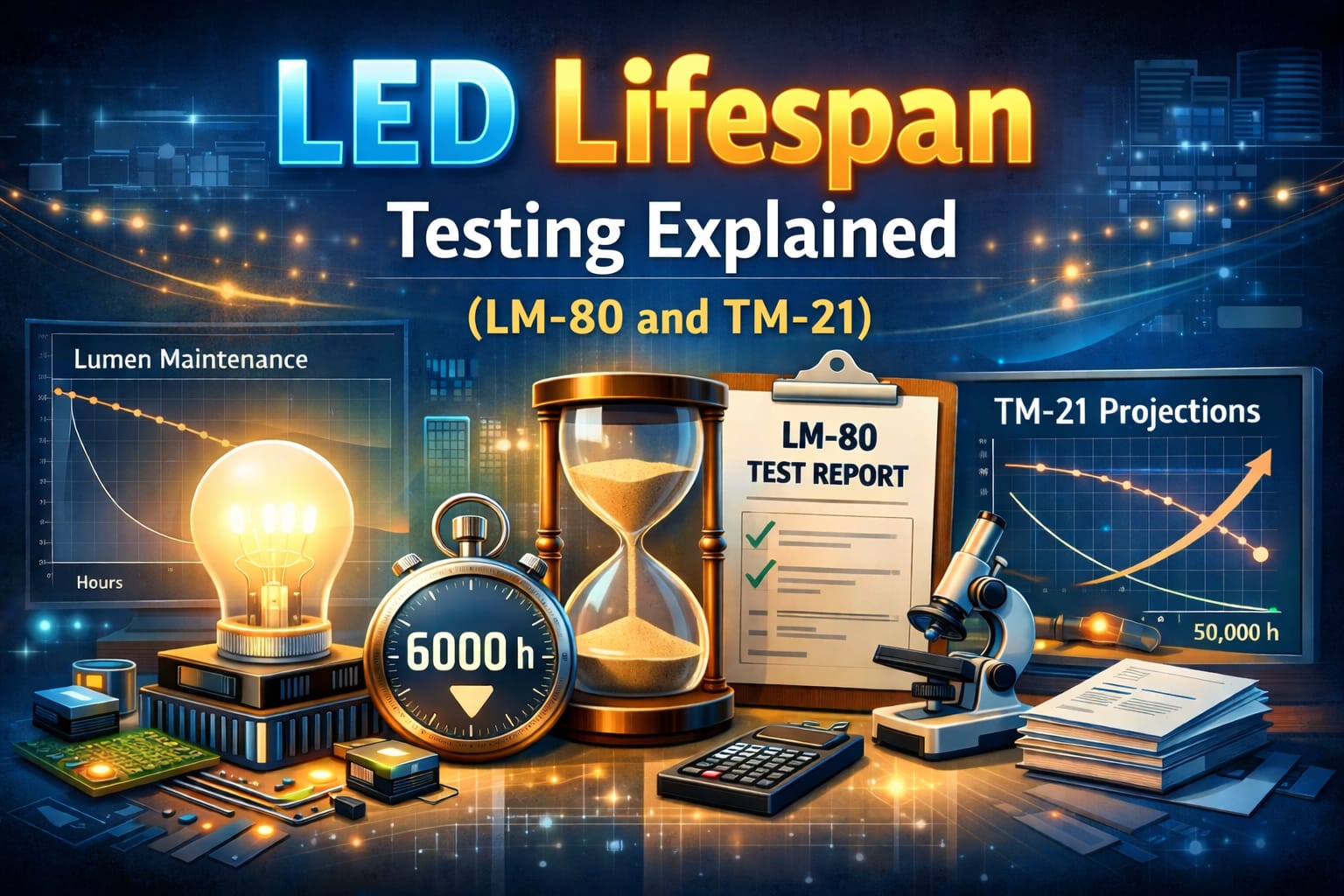
Table of Contents
Quick answer: LED lifespan testing does not usually mean running a bulb until it dies. The LM-80 testing standard measures real lumen maintenance over thousands of hours, the TM-21 projection method extends that data into future estimates, and L70 tells you when light output is projected to fall to 70% of the original level.
Why lifespan testing matters
LEDs do not usually fail the same way incandescent bulbs do. Instead of burning out suddenly, they more often lose brightness gradually. That is why lifespan in LED lighting is usually about lumen maintenance, not simply whether the product still turns on.
Before common industry standards were adopted, lifetime claims were often inconsistent or overly optimistic. One product might claim 100,000 hours with little context, while another might use a different test approach entirely. That made comparisons almost meaningless.
Standardized LED lifespan testing solved that problem by giving manufacturers, buyers, and certification programs a shared framework. It became much easier to compare products, judge reliability, and connect rated life with warranty expectations. If you want the wider context behind why LEDs dim over time, our LED light degradation guide is a useful companion to this topic.
What the LM-80 testing standard actually measures
The LM-80 testing standard is the core laboratory method used to measure how LED packages, arrays, or modules maintain light output over time. In simple terms, it tracks lumen output at regular intervals while the LEDs operate for thousands of hours under controlled conditions.
LM-80 does not directly test a finished bulb in the same way a homeowner uses it. It focuses on the LED light source itself, usually under fixed current and temperature conditions. That matters because the LED package is only one part of the full product. The driver, enclosure, heat management, and installation environment still affect real-world performance.
Typical LM-80 tests run for at least 6,000 hours, although 10,000 hours or more provide stronger data. Measurements are taken at regular intervals, often every 1,000 hours, to track how the light output changes over time. That is the foundation of serious lumen maintenance testing.
In practice, LM-80 includes controlled operating current, defined case temperatures such as 55°C and 85°C, regular lumen output measurements, multiple samples, and careful documentation of test conditions. That is why products backed by real LM-80 data usually deserve more trust than generic lifespan claims with no testing context at all. It also helps to understand how LED lighting works and why heat has such a strong effect on output stability over time.
How the TM-21 projection method works
The TM-21 projection method takes the real measured data from LM-80 and projects how lumen output is likely to continue changing beyond the test period. This is necessary because manufacturers cannot realistically test every product for 25,000, 50,000, or 100,000 hours before selling it.
So, instead of waiting years for a direct lifespan result, TM-21 uses a mathematical model based on the actual measured decline in light output. That is how the industry turns 6,000 or 10,000 hours of lab data into longer-term estimates.
The important thing is that TM-21 is not a random guess. It is a structured projection method built on real test data. But it is still a projection, not a direct measurement of decades of real-world use.
One of its best-known limits is that the reported projection should not exceed six times the actual test duration. So if the LM-80 dataset only covers 6,000 hours, the maximum reported projection is typically limited to 36,000 hours. Longer test data supports longer credible projections, which helps keep lifetime claims grounded in evidence.
What L70 really means
L70 is one of the most important ideas in LED lifespan testing. It means the point at which light output is projected to drop to 70% of the initial value. So if a product is rated at L70 50,000 hours, it means it is expected to provide at least 70% of its original brightness at 50,000 hours under the stated conditions.
That does not mean the LED stops working at 50,000 hours. It also does not mean every unit performs identically. It simply marks the point where lumen depreciation reaches a widely used threshold for practical end of life.
L90
About 90% of original output. This usually means very low visible dimming and strong retention.
L80
About 80% of original output. This often signals higher-quality performance retention.
L70
About 70% of original output. This is the most common rated-life threshold in LED specifications.
L50
About 50% of original output. At this point many standard applications will feel too dim.
Some specifications also combine lumen maintenance with failure rate, such as B50-L70. That means 50% of the sample population is expected to reach 70% of original light output by the stated hour mark. This is a more nuanced way of describing real performance spread.
If you want to understand why one LED product may age more consistently than another, our LED binning guide helps explain where some of those quality differences begin.
How the testing process works in practice
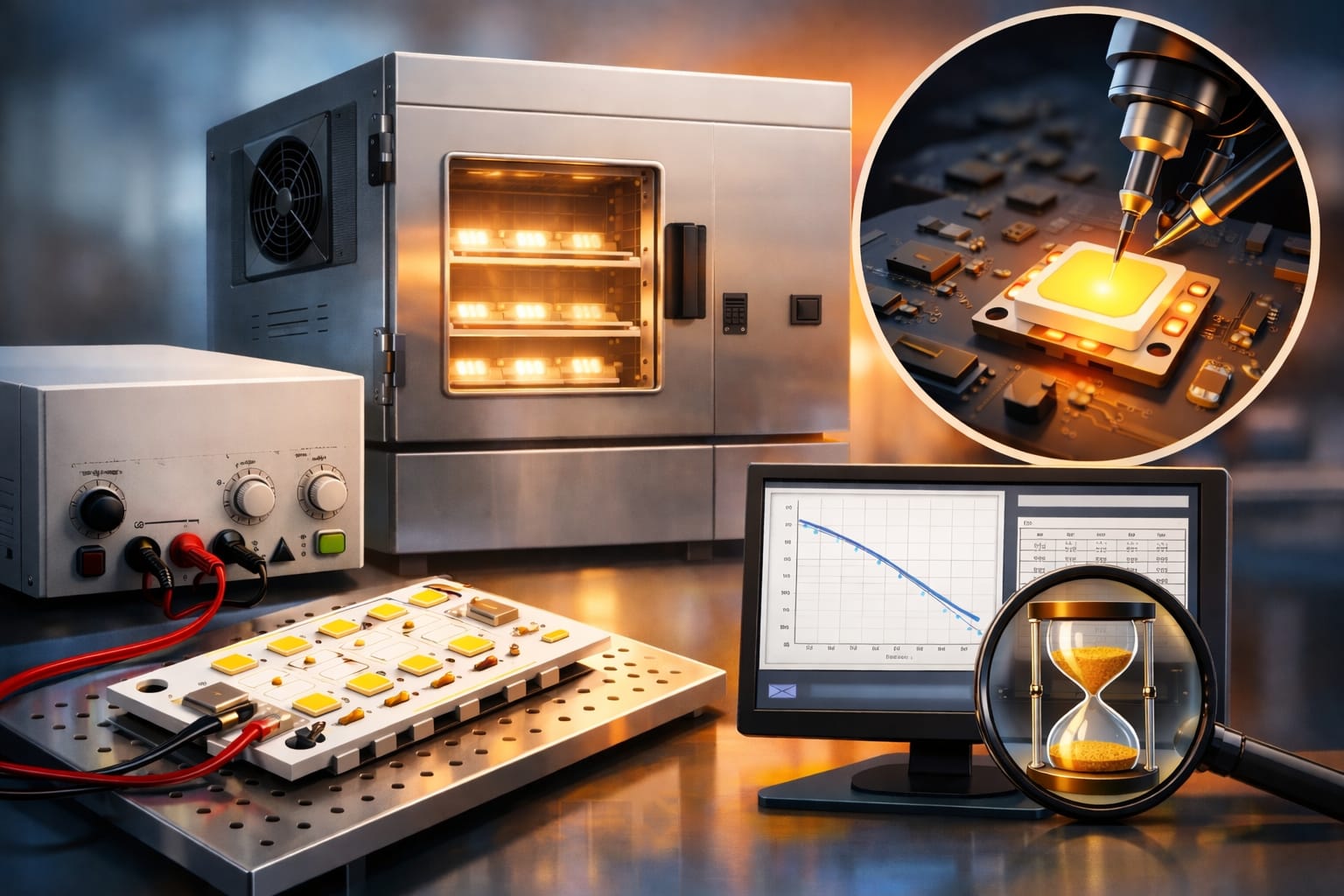
The lab process usually starts with a defined sample group, baseline measurements, and stable environmental conditions. The samples are run continuously or near continuously under controlled current and case temperature. At set intervals, technicians measure lumen output and record how it changes.
This sounds simple, but it only works if the process is consistent. Temperature stability, equipment calibration, and repeatable measurement intervals all matter. Without that discipline, the dataset becomes much less useful for any later TM-21 projection.
Regular interval measurements are important because they reveal the shape of the degradation curve. Some LEDs degrade quickly at first, then stabilize. Others degrade more steadily over time. The more reliable that trend data is, the better the eventual TM-21 projection method result will be. In other words, lifespan claims are only as good as the data behind them.
Why temperature matters so much in LED lifespan testing
Heat is one of the biggest drivers of LED degradation. The hotter the LED operates, the faster its light output usually declines. That is why LM-80 testing is performed at specific temperatures and why thermal design matters so much in real products.
A product can look impressive on paper, but if it runs too hot in a poorly ventilated fixture, it may never deliver the lifespan suggested by its rating. This is why it is useful to read lifespan claims together with information about cooling, enclosure type, and intended use environment.
That is also why our LED heat sink and cooling guide is so relevant here. Good thermal management is not a side detail. It is one of the main reasons a product either meets or misses its expected service life.
How to read lifespan claims correctly
When you see a lifespan claim, the first question should not be whether the number is high. It should be what the number actually refers to. A strong claim should tell you the maintenance threshold, the hours, and ideally the test basis.
A rating like L70 50,000 hours at 85°C is much more informative than a generic promise of “50,000-hour LED life.” The first one tells you the lumen maintenance threshold and the temperature basis. The second one may tell you almost nothing.
Third-party certification can also help. ENERGY STAR and similar programs typically require documented performance support. The ENERGY STAR LED overview and the U.S. Department of Energy LED guidance are useful starting points if you want to understand how standards and consumer protection connect.
Common misconceptions about LED rated life
One of the biggest misconceptions is that a rated life means the bulb stops working at that exact hour. That is not usually what the number means. In most LED discussions, it is about brightness retention, not sudden failure.
Another common misconception is that every product with the same hour claim is equally trustworthy. Two products can both say 50,000 hours, but one may be backed by proper LED lifespan testing while the other may rely on weaker or less transparent evidence.
A third misconception is that a higher rated life is always worth paying for. In some applications, yes. In others, not necessarily. A product installed in a hard-to-reach commercial setting deserves a stronger reliability case than a bulb used a few hours per night in a spare room.
What buyers should actually look for
If you are comparing products, look beyond the headline hour number. Stronger products usually make it easier to find the basis behind the claim, whether that means reference to the LM-80 testing standard, the TM-21 projection method, certification marks, or fuller technical documentation.
It is usually smarter to look for a clear L70, L80, or L90 rating than a vague promise of “long life.” It also helps when the claim is tied to stated test conditions, because very long hour claims with almost no detail deserve more caution. Temperature and installation conditions matter too, not just the lab projection printed on the box.
This is also where broader LED knowledge helps. Performance is not only about rated life. It also connects to efficiency, heat, consistency, and application fit. If you want the wider technical picture, the LED Knowledge Center is the best place to keep exploring the topic.
Sharing this guide
If you found this guide helpful, save it for later or share it with someone comparing LED lifespan claims and technical specifications.
Interested in learning more? Browse all related articles in our category section.