The Best LED Lights for Dining Rooms: Warm and Dimmable Picks
Selecting the ideal LED lights for a dining room involves more than just choosing an attractive fixture. Good dining room lighting makes the table feel inviting, flatters food and faces, and remains flexible enough for everyday meals, holidays, and entertaining.
This guide covers fixture types, placement rules, color temperature, dimming options, and smart features so you can build a dining space that looks and works better.
Quick Answer
For most dining rooms, the best setup is a warm, white, dimmable chandelier or pendant centered over the table. If the room needs more depth, support it with softer ambient or accent lighting.
- Choose a color temperature between 2700K and 3000K for a warmer, more flattering look. Aim for a CRI of 90 or higher so that food and décor appear more natural. Hang chandeliers or pendants between 30 and 36 inches above the table. Use LED-compatible dimmers for better control and mood. Add recessed lights or sconces only if the room requires layered lighting.
Table of Contents:
Chandelier Selection
The chandelier remains a popular choice for dining room lighting because it serves as a visual centerpiece and the main light source above the table. In many homes, a chandelier is the easiest way to make a room feel more finished while providing practical illumination for meals and conversation.
Modern LED chandeliers have several clear advantages over older incandescent designs. They use less electricity, run cooler, last longer, and often support smoother dimming when paired with the right controls. This makes them ideal for those who want one fixture to handle everyday dinners and softer evening entertaining.
As a general rule, the diameter of the fixture should be about one-third of the width of the table. For a 60-inch dining table, a 20- to 24-inch-wide chandelier often looks balanced. Larger tables and wider rooms can handle larger fixtures, but the goal remains the same: to have enough presence to appear intentional without making the room look crowded. Our LED lighting buying guide explains which specs to prioritize for each fixture type before finalizing your selection.
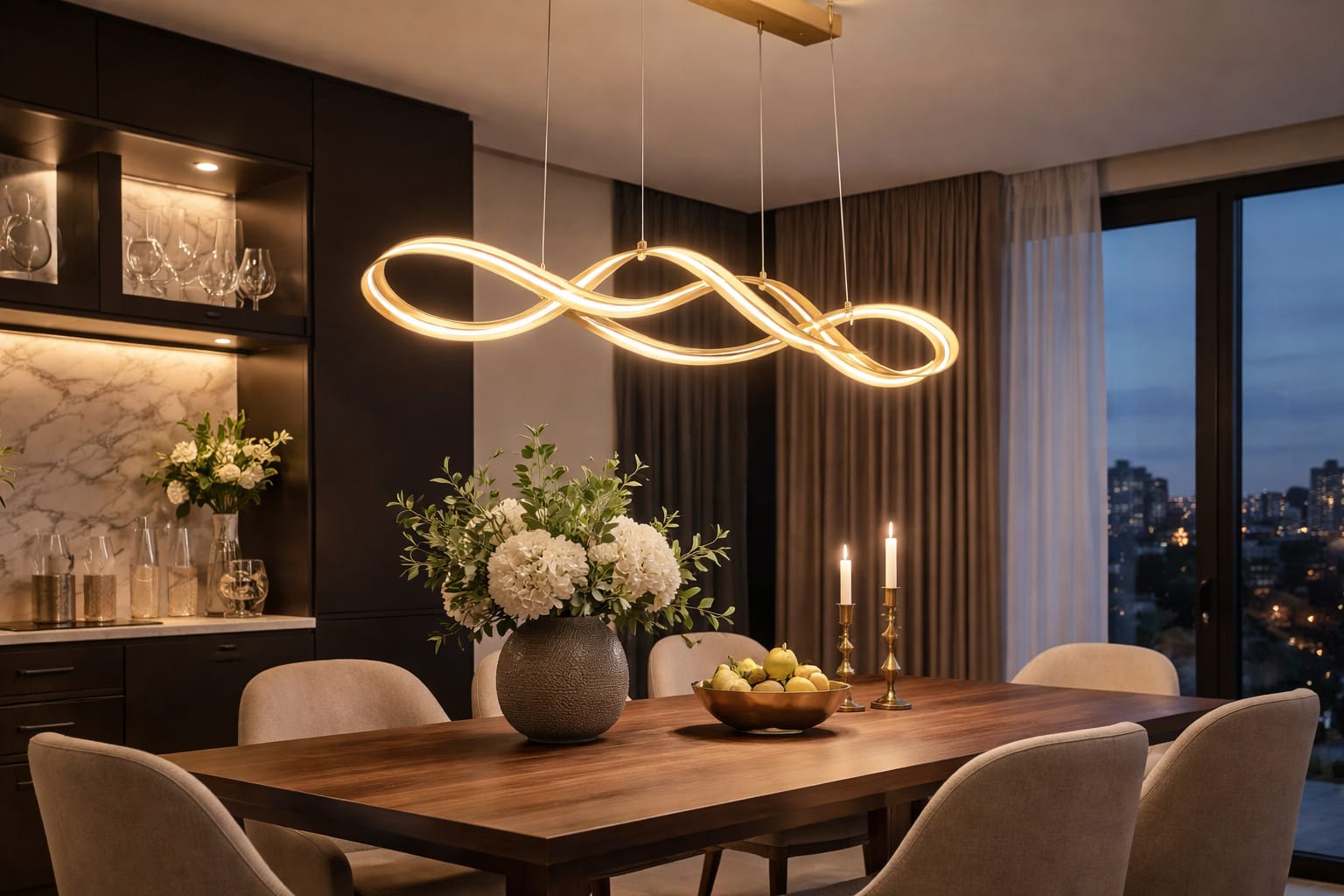
This LED ceiling chandelier is a versatile, modern fixture that works well over many dining tables. It offers a clean, geometric look, warm output, and dimmable performance that suits a wide range of spaces.
Chandelier Styles
The style of a chandelier is just as important as its output. Crystal and candle-style chandeliers are better suited to traditional dining rooms, while linear and geometric fixtures work better in contemporary spaces. Transitional options strike a balance and are often the safest choice if you want a fixture that will still look right after future furniture or décor changes.
Ceiling height also affects what looks best. Multi-tier chandeliers can add drama to taller rooms, but single-tier fixtures are usually easier to scale to rooms with standard ceilings. When in doubt, prioritize proportion and sight lines over pure decoration. The same general principle applies when choosing hallway fixtures that should complement the space instead of overpowering it.
Pendant Lights
Pendant lights are a good option if you prefer a cleaner or more modern look. Rather than relying on one central fixture, you can spread light more evenly across the table by arranging two, three, or more pendants in a row. This works especially well over rectangular tables, as a single fixture might leave the ends underlit.
For tables between 60 and 72 inches long, three pendants usually create a balanced layout. Larger tables may need four or five, while smaller, round tables may look better with one large pendant. The most important things are even spacing and consistent visual weight, so the arrangement looks intentional rather than cluttered.
Glass pendants, fabric shades, and metal finishes can change the room’s atmosphere. Exposed filament-style LEDs can make the space look more decorative, while shaded pendants soften glare and create a warmer atmosphere. Match the style to the room, but don’t overlook light quality.
If you are using multiple pendants, choose models with the same lamp shape, finish, and color temperature. Even small mismatches become obvious when they hang in a row over the table.
Adjustable Pendants
Adjustable pendants allow for more flexibility during installation because you can adjust the hanging height after seeing the fixture in the room. This is useful when ceiling height, table size, or sight lines are difficult to determine from a drawing.
Some fixtures use adjustable cords, while others use rods or telescoping parts. In practice, simpler systems are often more convenient and easier to clean. If adjustability is important to you, check how the fixture actually changes height before buying, rather than assuming that every design is equally convenient.
Recessed Lighting
Recessed lights are best used for accent lighting rather than as the main light source over the table. They brighten the perimeter of the room, soften contrast, and prevent the dining area from feeling dark when the main chandelier or pendants are dimmed.
When used well, they contribute to layered lighting by providing subtle background illumination around the room. Used poorly, however, they can make the space feel flat or overly bright. For this reason, it is usually better to install them around the edges rather than directly above the table, where they would compete with the main fixture.
Adjustable trims can highlight artwork, cabinetry, or architectural details. If your dining room opens into other spaces, recessed lighting is a practical way to maintain visual connection without relying solely on a decorative centerpiece.
Retrofit Options
If you already have recessed housings installed, LED retrofit kits are usually the easiest upgrade. They fit into many existing cans, improve efficiency quickly, and avoid the cost of tearing into the ceiling for a full replacement.
Selectable color temperature and brightness settings also make retrofits flexible, especially if you are undecided about how warm or bright you want the room to be. The same attention to fit and rating is important in more demanding spaces as well, such as in bathrooms, where fixtures are prone to moisture and require more specific product choices.
Wall Sconces
Wall sconces are useful for adding atmosphere or balance to a dining room. They can frame a buffet, illuminate dark corners, and create a layered look without cluttering the ceiling.
Uplight sconces bounce light off the ceiling to create a softer glow, while up-and-down or downlight designs add shape and contrast to the walls. The right choice depends on whether you want the room to feel calmer, brighter, or more architecturally interesting. To add a subtle accent layer, install this LED ambient strip behind a buffet or under cabinet edges to provide warm fill light without adding another visible fixture to the room.
Decorative Sconces
Sconces can also serve as wall décor. Candle-style options have a more traditional look, while geometric or minimalist designs work better in modern interiors. Even if they are not part of the same collection, sconces should feel related to the main fixture.
Coordinate finishes and overall visual weight with the chandelier or pendants. This will prevent the room from looking pieced together, especially in open-plan spaces where the dining area remains visible throughout the day.
Color Temperature
Color temperature greatly affects how a dining room feels. In most homes, the safest range is warm white light between 2700K and 3000K because it makes the room feel more comfortable and tends to flatter food, wood finishes, and skin tones.
Cooler light above 4000K often feels too clinical for dining rooms. While it can work in kitchens or other task-heavy spaces, in a dining room, it usually makes the atmosphere feel less relaxed. If your room has more than one fixture type, maintaining consistent color temperature will make the space feel more cohesive.
According to the U.S. Department of Energy’s guidance on LED lighting efficiency, choosing the right LED product involves more than just efficiency; it also involves matching light quality to the space.
CRI importance
CRI (Color Rendering Index) tells you how accurately a light source shows colors. For dining rooms, a CRI of 90 or higher is ideal because it makes food, table settings, artwork, and people look more natural.
You can get away with a lower CRI in some utility spaces, but a dining room is one place where better color quality is noticeable. If two products appear similar on paper, the CRI rating can be the detail that makes one feel noticeably more premium in real use.
Dimming Controls
Dimming is one of the most valuable features in a dining room because the same space may require bright, practical lighting one day and soft, mood-enhancing lighting the next. A fixture that looks good at full brightness but cannot dim well is a missed opportunity.
Ensure that the fixture and dimmer are compatible. LED lighting often performs poorly with the wrong dimmer, which can lead to flicker, buzzing, limited range, or uneven performance. If the manufacturer lists compatible dimmers, follow that guidance instead of guessing.
For more control, pair the dining room with automated control systems to make scene changes easier and more consistent.
Do not assume that every dimmable LED works well with every dimmer. Even high-quality fixtures can flicker or buzz if the control hardware is not designed for LED loads.
Preset Scenes
Preset scenes are especially useful in dining rooms, where the same lighting combinations are often used. For example, you might want one setting for dinner, one for entertaining, and one for cleaning up. Scene controls save time and make the room feel more polished during daily use.
They also make layered lighting more practical. Rather than adjusting each light individually, you can save a balanced mix and access it with the push of a button, via an app, or through voice control.
Fixture Height
Even a great fixture can look wrong if it hangs at the incorrect height. In most dining rooms, chandeliers and pendants should hang 30 to 36 inches above the tabletop. This keeps the light close enough to feel focused without obstructing the view across the table.
If the ceiling is higher than average, you can usually go a bit higher. The most important factor is the relationship between the table, the ceiling, and the visual weight of the fixture. Measure from the tabletop rather than the floor to ensure the fixture is positioned correctly for your dining setup.
Adjustable chains, cords, or rods make final positioning much easier. It is often helpful to hang the fixture temporarily first and then fine-tune it once you can see it in the room.
Clearance Requirements
You also need to consider floor clearance. If the fixture will hang in a walkway or in a room where people will regularly move around the table, leave enough space to avoid bumping heads and feeling visually crowded. Large, decorative fixtures can appear lower than they actually are because they occupy more space.
Wide, flatter fixtures often work better in standard-height rooms, while taller, more vertical designs usually make more sense in rooms with high ceilings.
Layered Lighting
The most effective dining room lighting plans rely on layers rather than relying on one fixture to do everything. The main overhead light illuminates the table, while ambient light softens the room. Accent lighting adds depth and draws attention to details like artwork, shelving, or a sideboard.
This is especially important if the dining room is used for activities other than meals. Some households use the table for homework, remote work, board games, and entertaining guests. Having independent control over the different lighting layers provides far more flexibility than a single all-or-nothing switch.
Try to keep the layers balanced. The overhead light should usually be the strongest source of light, while accent or wall lighting should complement the atmosphere instead of competing with it.
Accent Strategies
Accent lighting can be subtle yet make a big difference. Picture lights, cabinet strips, and hidden shelf lighting can add depth to a room without overwhelming it. These lights are especially effective in dining rooms that appear flat when the main fixture is dimmed.
If you have glass-front cabinets, artwork, or a buffet that deserves more attention, accent lighting is a better solution than installing a brighter chandelier.
Energy Efficiency
LED lighting is far more energy efficient than older incandescent options, which is especially helpful in dining rooms with multi-bulb fixtures. A chandelier that would draw a lot of power with incandescent bulbs can deliver similar usable light with much lower electricity usage once converted to LEDs.
This reduces energy costs. It also means less heat, a longer service life, and fewer replacements in hard-to-reach fixtures. According to the ENERGY STAR guide to LED lighting basics, certified LED products are tested for performance as well as efficiency.
When comparing products, consider the total cost of ownership rather than just the purchase price. A more expensive fixture can be the smarter long-term choice if it runs efficiently, dims properly, and lasts for years without trouble.
Maintenance Costs
Maintenance costs are often ignored until a fixture becomes difficult to service. This is important in dining rooms because chandeliers and tall hanging fixtures are not always easy to reach. Long-life LED lamps reduce the need for frequent replacement, saving time and money.
Better-built fixtures also tend to age better over time. Stronger drivers, better thermal design, and clearer warranties usually make a noticeable difference in long-term reliability. For broader background reading, our LED Knowledge Center covers related lighting topics in more detail.
Smart Features
Smart features can make dining room lighting more convenient, but they are most valuable when they solve a real problem. Voice and app controls, as well as scheduling, are useful if you regularly host guests, want simple scene changes, or prefer a more connected lighting setup.
App-based control allows you to set the room before guests arrive, and scheduling makes evening routines more consistent. This LED table lamp is an easy way to add soft, controllable light to smaller accent layers without replacing the main ceiling fixture.
Integration Benefits
If you already have a smart lighting setup in your home, integrating the dining room can make the whole system feel more polished. Scenes, routines, and grouped controls are often more useful than individual smart bulbs.
While energy monitoring and automation can be helpful, they are secondary benefits. The main goal should be simple, reliable control and better lighting in the room itself.
Style and Aesthetics
A dining room fixture must look good with the lights on and off. That is why shape, finish, and scale are just as important as lumen output. Traditional rooms often suit chandeliers with softer detailing, while modern interiors usually benefit from cleaner lines and simpler forms.
Coordinate finishes with nearby hardware, furniture details, and other metal accents in the room. This doesn’t mean that everything has to match perfectly; however, the fixture should feel related to the rest of the space rather than visually disconnected.
This is especially important in open floor plans where the dining room is visible from the kitchen or living area. In those spaces, the fixture becomes part of the home’s overall look, not just a practical source of light over one table.
Finish Durability
Durability matters, too, especially if you expect to keep the fixture for years. Better finishes resist tarnishing and wear more effectively, helping the fixture maintain its appearance long after installation.
Regular dusting and gentle cleaning are usually enough. Avoid harsh chemicals or abrasive cleaners that can damage coatings and make a nice fixture look old before its time.
What Should You Choose?
Most people prefer dining room lighting that looks balanced over the table, uses warm, dimmable LED light, and fits the room’s style without making the ceiling feel crowded.
- Choose a chandelier if you want a strong centerpiece
- Choose multiple pendants for a more modern look and better spread over long tables
- Add recessed lights only if the room needs extra ambient light
- Use wall sconces or accent lighting to add depth and atmosphere
- Prioritize 2700K to 3000K, CRI 90+, and dimmer compatibility over flashy features
Key Takeaways
The best LED lights for dining rooms usually combine warm light, good color quality, proper sizing, and reliable dimming. While a chandelier or pendant light is often the main decision, the best overall result comes from choosing the right fixture for the room instead of chasing trends.
To create a functional setup, focus on light with a color temperature between 2700K and 3000K, a CRI of 90 or higher, and a hanging height that feels balanced above the table. Then, decide if the room needs recessed lights, sconces, or smart controls for more flexible lighting.
A well-planned dining room does not require the most expensive fixture. It just needs lighting that looks right, feels comfortable, and adapts easily from everyday meals to special occasions.
Share this Guide!
Share this guide if you found it helpful. Save it for later or share it with someone planning a dining room update. It is especially useful for homeowners, beginners, and DIY users who are comparing fixture options.
Share using the links below:
Interested in learning more? Browse all related articles in our category section.