LED Lighting Terms: Essential Guide for Smart Buyers
Understanding LED lighting terms transforms confusing product specifications into actionable information that helps you make intelligent purchasing decisions. Modern shoppers encounter technical language on every package, from lumens and watts to color temperatures and efficiency ratings. Learning what these terms actually mean eliminates guesswork and ensures your investment delivers the brightness, color quality, and energy savings you expect from contemporary lighting technology.
This essential guide decodes the most important specifications, explaining how each measurement affects your daily experience. Whether you need task lighting for detailed work or ambient illumination for relaxation, mastering these fundamental concepts empowers you to select products perfectly matched to your specific requirements and budget constraints.
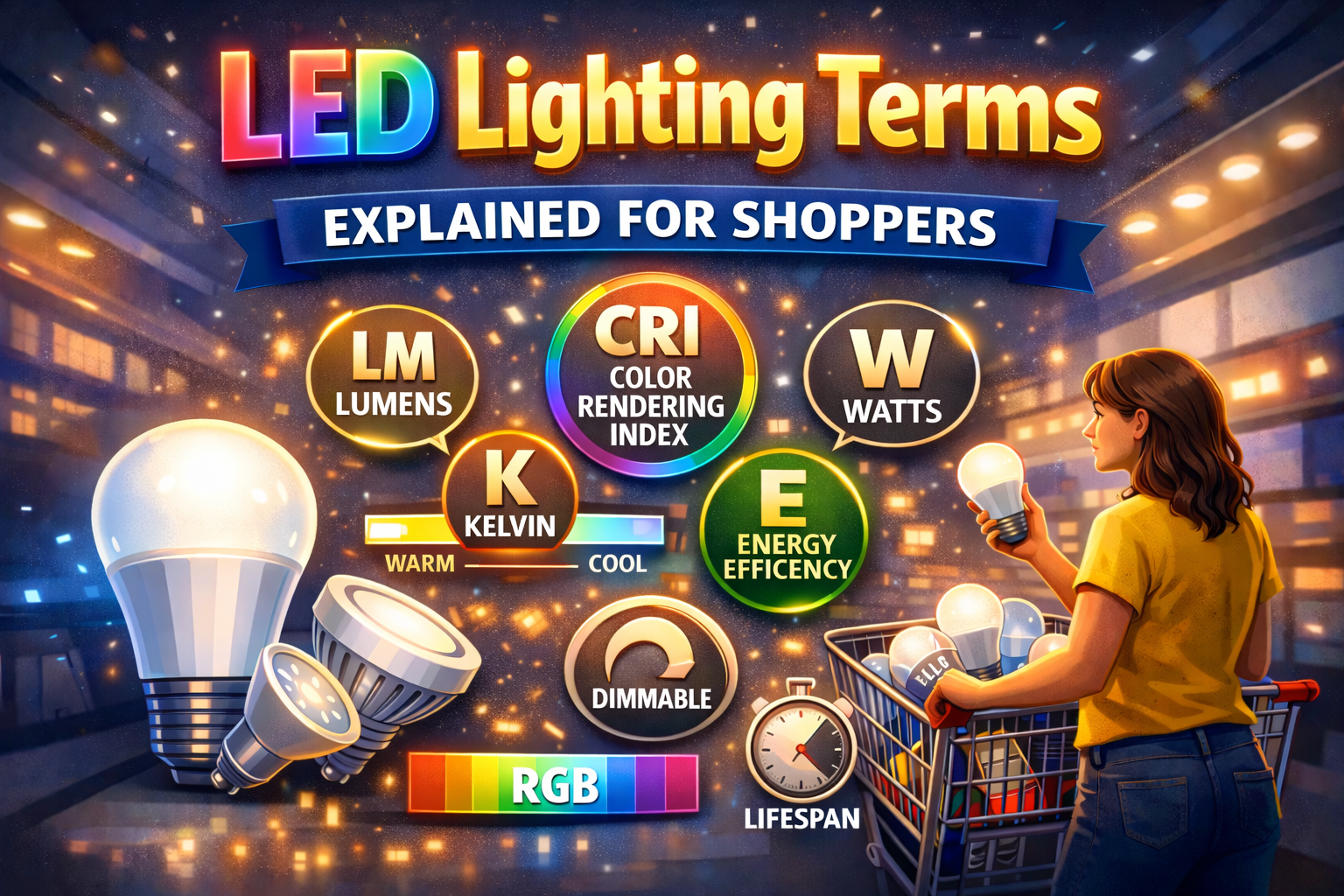
Table of Contents
- Lumens and brightness measurement
- Wattage and power consumption
- Understanding color temperature scales
- Color rendering and quality metrics
- Efficiency ratings and energy savings
- Lifespan and durability expectations
- Beam angles and light distribution
- Dimming compatibility factors
- Base types and socket standards
- Voltage requirements and safety
- Certification marks and standards
- Sharing this guide
Lumens and brightness measurement
Lumens represent the total quantity of visible light emitted by a source, providing the single most important metric for comparing brightness across different products. Traditional incandescent bulbs used wattage as a proxy for brightness, but this correlation breaks down completely with efficient modern technology. A 60-watt incandescent produces approximately 800 lumens, while an equivalent product consuming just 8-10 watts delivers identical illumination through superior energy conversion.
Understanding LED lighting terms like lumens helps you match replacement products to existing fixtures without trial and error. Residential applications typically require 450 lumens for small accent lights, 800 lumens for standard table lamps, 1100 lumens for overhead fixtures, and 1600 lumens or more for large rooms needing substantial illumination. Commercial spaces demand higher outputs, with warehouses and retail stores often specifying fixtures delivering 10,000 lumens or more per unit.
Manufacturers measure lumens using calibrated integrating spheres that capture total output regardless of beam pattern or directivity. This standardized testing ensures accurate comparisons between competing products, though real-world performance depends on additional factors including beam angle, fixture efficiency, and installation conditions. When evaluating options, prioritize lumen specifications over subjective marketing claims about brightness or intensity. For detailed comparisons across technologies, refer to comprehensive bulb technology analysis that examines output characteristics.
If you want a dependable option, a solid example is Smart Dimmable LED Bulb (Color Temperature Adjustable), which is known for stable long-term performance.
Wattage and power consumption
Wattage measures electrical power consumption rather than light output, indicating how much energy a bulb draws from your electrical system. Modern products typically consume 80-90% less power than incandescent equivalents while producing identical lumens, translating to substantial savings over the product lifetime. An 800-lumen bulb drawing 10 watts costs approximately one-sixth as much to operate as a 60-watt incandescent delivering the same brightness.
Maximum fixture wattage ratings limit total power consumption to prevent overheating and fire hazards in enclosed housings. These ratings applied primarily to heat-generating incandescent technology, but many fixtures still display conservative limits established decades ago. Installing low-wattage alternatives in fixtures rated for 60 watts poses no safety concerns even when the lumen output significantly exceeds original incandescent performance, since thermal load remains well within safe operating parameters.
Package labeling typically includes both actual wattage and an equivalent incandescent wattage for easy comparison. A bulb labeled “10W (60W equivalent)” consumes 10 watts while providing brightness matching a traditional 60-watt incandescent. This dual labeling helps shoppers unfamiliar with LED lighting terms make appropriate selections without memorizing lumen values or consulting conversion charts during purchase decisions.
Understanding color temperature scales
Kelvin scale basics
Correlated color temperature describes the color appearance of white light using the Kelvin scale, where lower values produce warmer yellowish tones and higher values create cooler bluish-white illumination. Residential lighting typically ranges from 2700K resembling traditional incandescent warmth to 5000K matching bright daylight. Office environments often specify 4000K for neutral white that balances alertness with comfort during extended work sessions.
The term “correlated” acknowledges that these sources produce white through phosphor conversion rather than thermal radiation like incandescent filaments. Despite this technical difference, the Kelvin scale provides intuitive comparison enabling shoppers to predict appearance based on numerical ratings. Understanding correlated color temperature prevents mismatches between intended ambiance and actual results when mixing multiple fixtures in shared spaces.
Application matching
Different activities benefit from specific color temperatures based on biological and psychological responses to light. Warm tones below 3000K create relaxing atmospheres appropriate for bedrooms, dining rooms, and living spaces where comfort takes priority over task performance. Cooler temperatures above 4000K enhance alertness and visual acuity, making them ideal for kitchens, workshops, and office environments requiring sustained concentration and accurate color discrimination.
Consistent correlated color temperature throughout interconnected spaces prevents jarring transitions that disrupt visual comfort. Many homeowners find that limiting their entire residence to just two temperatures—warm for private spaces and neutral for work areas—creates harmonious lighting that feels cohesive despite varying fixture styles. Professional lighting designers often specify exact Kelvin values ensuring uniform appearance across multiple product sources and manufacturers. When comparing different bulb technologies, explore detailed efficiency and color comparisons that highlight performance differences.
Color rendering and quality metrics
The color rendering index quantifies how accurately a light source reveals the true colors of illuminated objects compared to natural daylight or incandescent reference sources. This scale runs from 0 to 100, with higher values indicating better color fidelity. Residential applications benefit from CRI ratings above 80, while critical tasks like art conservation, medical procedures, or color-matching work require 90 or higher for professional-grade accuracy.
Poor color rendering index scores cause colors to appear washed out, shifted, or muddy under illumination, making tasks like makeup application, food preparation, or clothing selection unnecessarily difficult. Budget products sometimes achieve high efficiency at the expense of color quality, using narrow-spectrum phosphors that save manufacturing costs but compromise visual experience. Premium options invest in sophisticated phosphor blends delivering both excellent efficiency and natural color rendering across the full visible spectrum.
Package labeling increasingly includes color rendering index specifications as consumers recognize its importance to overall lighting quality. When comparing similar products, prioritize higher CRI ratings even if they cost slightly more, as improved color fidelity enhances daily activities from cooking to reading. The difference between CRI 80 and CRI 90 becomes immediately apparent in side-by-side comparisons, justifying the modest premium for superior visual comfort in spaces where you spend significant time.
Another practical alternative is Digital Lux Meter Light Meter, which performs reliably in everyday use.
Efficiency ratings and energy savings
Lumens per watt calculation
Efficacy expressed as lumens per watt divides total light output by power consumption, providing a universal efficiency metric for comparing different technologies and products. Incandescent bulbs achieve approximately 15 lumens per watt, compact fluorescents reach 50-70 lumens per watt, and modern alternatives deliver 80-120 lumens per watt or higher in premium products. This dramatic efficiency advantage translates directly to reduced electricity costs throughout the 15,000-50,000 hour lifespan typical of quality products.
Higher lumens per watt ratings indicate more sophisticated phosphor formulations and optimized driver electronics that convert electrical energy into visible light with minimal waste heat. Products achieving 100 lumens per watt or better represent current state-of-the-art performance, though cutting-edge research continues pushing boundaries toward theoretical maximums. When evaluating competing options at similar price points, favor higher efficacy specifications as they deliver long-term value through reduced operating expenses.
Energy Star certification
Energy Star certification from the Environmental Protection Agency indicates products meet stringent efficiency and performance requirements including minimum lumens per watt thresholds, color consistency, rapid startup, and verified lifespan claims. Certified products undergo independent laboratory testing validating manufacturer specifications, providing assurance that marketing claims reflect actual performance. This third-party verification proves especially valuable when comparing unfamiliar brands or evaluating products from overseas manufacturers.
The certification program covers various product categories with tailored requirements reflecting typical applications and user expectations. Certified bulbs must maintain at least 90% of initial light output after 6,000 hours of operation, ensuring that efficiency advantages persist throughout the service life rather than degrading rapidly. According to the Energy Star lighting guidelines, certified products save consumers substantial money while reducing environmental impact through decreased energy generation requirements.
Lifespan and durability expectations
Rated lifespan estimates indicate expected operating hours before light output degrades to 70% of initial lumens, designated as L70 in technical specifications. Quality residential products typically claim 15,000-25,000 hours, equivalent to 15-25 years at three hours daily use. Commercial-grade products for demanding applications often specify 50,000 hours or more, reflecting robust driver designs and enhanced thermal management enabling reliable performance under continuous operation.
These projections assume normal operating conditions including adequate ventilation, stable voltage supply, and moderate ambient temperatures. Installations violating these assumptions experience accelerated degradation, with enclosed fixtures, frequent switching cycles, or extreme temperatures reducing actual service life well below rated specifications. Understanding these limitations helps set realistic expectations and explains why some products fail prematurely despite seemingly generous lifespan ratings printed on packaging.
Warranty coverage provides additional insight into manufacturer confidence in product reliability and durability. Premium brands offering three to five-year warranties demonstrate commitment to quality through willingness to replace defective units at their expense. Budget options with minimal or no warranty protection signal manufacturers prioritize low acquisition cost over long-term reliability, making them risky choices for difficult-to-access installations where replacement labor exceeds product cost. Addressing potential problems like driver component failures requires understanding warranty terms and manufacturer support policies.
Beam angles and light distribution
Beam angle specifications describe how directional products distribute light across illuminated areas, measured as the included angle where intensity decreases to 50% of peak output. Narrow spot beams around 15-25 degrees concentrate light into small areas for accent lighting, highlighting artwork, or task illumination. Medium flood beams spanning 35-50 degrees provide versatile general lighting suitable for most residential applications requiring balanced coverage without excessive spillage.
Wide flood beams exceeding 60 degrees create diffuse illumination approaching omnidirectional distribution patterns similar to traditional bulbs. These wider distributions work well in table lamps, pendant fixtures, and other applications where you need light spreading in multiple directions rather than concentrated forward projection. Understanding beam characteristics helps match bulb selection to fixture geometry and room layout, ensuring appropriate coverage without dark spots or wasted light.
Mismatched beam angles create common installation problems where recessed cans produce either narrow bright spots leaving surrounding areas dark, or excessive spillage wasting light on ceilings and walls rather than work surfaces. Most manufacturers offer multiple beam options within the same product family, allowing you to optimize distribution for specific ceiling heights and spacing. When replacing existing bulbs, match beam angles unless dissatisfaction with current coverage patterns motivates intentional changes to distribution characteristics.
Dimming compatibility factors
Dimmable versus non-dimmable
Package labeling clearly distinguishes dimmable products from non-dimmable alternatives, with non-dimmable versions using simplified driver circuits that cost less but cannot interpret dimming signals from wall controls. Installing non-dimmable bulbs in dimmed circuits produces flickering, buzzing, or premature failure as incompatible electronics struggle with reduced voltage inputs they were never designed to handle. Always verify dimming capability before purchasing bulbs intended for installations with dimmer switches.
Dimmable products incorporate additional circuitry enabling smooth brightness adjustment across wide ranges, typically from 100% down to 10% or lower. Performance varies significantly between manufacturers and price points, with premium options providing flicker-free operation throughout the entire range while budget alternatives exhibit dead zones, sudden drops, or visible flicker at low settings. Reading detailed product reviews helps identify options delivering satisfactory dimming behavior before committing to large quantity purchases.
Dimmer switch compatibility
Different dimmer technologies including leading-edge, trailing-edge, and digital protocols exhibit varying compatibility with diverse bulb designs. Many manufacturers publish compatibility lists identifying which dimmer models work reliably with their products, eliminating guesswork when upgrading existing installations. Consulting these resources before purchase prevents expensive trial-and-error testing and ensures satisfactory performance matching your expectations for smooth, quiet dimming operation.
Older dimmers designed for high-wattage incandescent loads often fail with modern low-wattage alternatives due to minimum load requirements exceeding total circuit consumption. Upgrading to dimmers specifically rated for low-wattage electronic loads resolves these incompatibilities, enabling reliable control of single bulbs or small groups where total wattage falls below traditional minimums. This dimmer replacement typically proves more cost-effective than adding unnecessary bulbs to meet minimum load thresholds.
For a more permanent upgrade, many users switch to RGBIC LED Strip Lights with Smart Control, which offers consistent results over time.
Base types and socket standards
Base designations indicate the mechanical interface connecting bulbs to fixture sockets, with standardized codes ensuring proper fit and electrical contact. The E26 medium screw base represents the most common residential standard in North America, found in table lamps, ceiling fixtures, and countless other applications. Europe and many international markets use E27 bases with nearly identical dimensions but slightly different thread specifications requiring region-appropriate products.
Smaller E12 candelabra bases serve decorative fixtures including chandeliers and wall sconces where compact bulb dimensions matter more than maximum brightness. GU10 twist-lock bases provide secure mechanical retention in recessed downlights and track lighting, eliminating concerns about vibration loosening threaded connections over time. Pin-style bases including GU5.3 and G4 designations accommodate low-voltage systems requiring separate transformers for safe operation.
Matching base types ensures mechanical compatibility, but you must also verify that bulb dimensions fit within fixture housings without interference. Directional bulbs for recessed cans specify maximum diameter and overall length preventing installation conflicts with trim rings or ceiling clearances. Always check dimensional specifications alongside base type when replacing existing bulbs or selecting products for new installations to avoid purchasing incompatible items requiring return and reordering.
Voltage requirements and safety
Line voltage products designed for 120V operation in North America connect directly to standard household circuits without requiring external transformers or drivers. These self-contained units integrate all necessary electronics within the bulb envelope, simplifying installation and replacement while ensuring compatibility with existing infrastructure. Most residential applications use line voltage products due to their convenience and widespread availability across diverse form factors.
Low voltage systems operating at 12V or 24V require separate power supplies converting line voltage to safe levels for semiconductor operation. These installations offer advantages including reduced shock hazard, cooler operation, and compatibility with automotive or marine electrical systems. However, transformer quality significantly affects performance, with inadequate supplies causing flickering, reduced brightness, or premature failure despite using quality bulbs designed for low voltage service.
Universal voltage products accepting 100-277V inputs accommodate international travel, commercial applications, or situations where supply voltage might vary. These versatile designs include wide-range switching power supplies automatically adjusting to available voltage without user intervention or manual selection. Specify universal voltage capability when purchasing products for installations where voltage specifications remain uncertain or where future relocation to different electrical systems seems likely. For comprehensive technical resources, visit the lighting knowledge center covering installation and safety topics.
Certification marks and standards
UL certification from Underwriters Laboratories indicates products pass rigorous safety testing including electrical, fire, and mechanical hazard evaluation. This third-party verification confirms compliance with recognized safety standards, providing assurance that proper design and manufacturing practices minimize risks associated with electrical products. Always prioritize UL-listed products over uncertified alternatives, especially for permanently installed fixtures where failures could cause property damage or personal injury.
FCC compliance ensures products meet electromagnetic interference limits preventing disruption to radio communications, wireless networks, and other sensitive electronics. Quality manufacturers design products minimizing radiated and conducted emissions that could affect nearby equipment. Budget imports sometimes ignore these requirements, creating interference problems affecting garage door openers, wireless thermostats, or entertainment systems installed near lighting fixtures.
DLC qualification for commercial products establishes minimum performance criteria including efficiency, color quality, and durability appropriate for demanding applications. Many utility rebate programs require DLC listing as eligibility criteria for incentive payments, making certification financially beneficial beyond the technical validation it provides. When specifying products for commercial installations or seeking rebates for residential efficiency upgrades, verify appropriate certifications preventing complications during incentive application processing.
Sharing this guide
If you found this guide helpful, you can save it for later or share it with a friend. It’s especially useful for beginners, homeowners, and DIY users.
Share using the links below
Interested in learning more? Browse all related articles in our category section.
Pingback: Are LED Lights Worth It? Honest Truth Smart Buyers
Pingback: Reading LED Packaging: Essential Guide for Buyers