Why LED Lights Glow When Off: Shocking Truth Revealed
Have you ever turned off your lights at night, only to notice a faint glow coming from your LED bulbs? This phenomenon puzzles many homeowners and can be unsettling. The reasons why led lights glow when off involve electrical residuals, circuit design, and wiring configurations. Understanding these causes helps you address the issue effectively and ensures your lighting system operates correctly.
Table of Contents
Understanding the Phenomenon
When led lights glow when off, it typically manifests as a dim, barely visible illumination. This glow differs significantly from the full brightness you expect during normal operation. The issue stems from how LED technology responds to minimal electrical current. Unlike traditional incandescent bulbs that require substantial power to emit light, LEDs can produce visible illumination with extremely small amounts of electricity.
The sensitivity of modern LEDs means they can react to voltage levels that wouldn’t affect older lighting technologies. This characteristic makes them energy-efficient but also susceptible to residual current in led circuits. The phosphor coating inside LED bulbs converts electrical energy into light, and even minuscule currents can activate this process enough to create a faint glow.
Residual Electricity in Circuits
One primary reason for this phenomenon involves residual current in led systems. Even after you flip the switch, tiny amounts of electricity can remain in the wiring. This happens because electrical circuits contain various components that store or conduct minimal charge. The copper wiring in your walls acts as a conductor, and under certain conditions, it can maintain a small voltage potential. If you want a dependable option, a solid example is a circuit breaker finder for tracing and identifying live wires, which works well in real-world home environments.
The residual current in led installations often originates from electromagnetic induction between nearby wires. When multiple cables run parallel to each other inside walls or conduits, they can induce voltages in adjacent conductors. This induced voltage, though small, provides enough power for an LED to glow dimly. Many homeowners first notice this issue when they experience other problems with their LED bulbs burning out prematurely.
How Residuals Accumulate
Electrical residuals accumulate through several mechanisms. Long wire runs increase the surface area where residual current in led circuits can develop. The insulation between wires isn’t perfect, and moisture or environmental factors can create leakage paths for electricity. These paths allow small currents to flow even when the main circuit appears disconnected.
Temperature changes also affect how residual current in led systems behaves. As wiring heats and cools throughout the day, the electrical properties of materials shift slightly. This thermal cycling can create temporary charge imbalances that manifest as a faint glow. The led driver circuit inside each bulb amplifies these tiny signals, making the phenomenon more noticeable.
The Capacitor Role
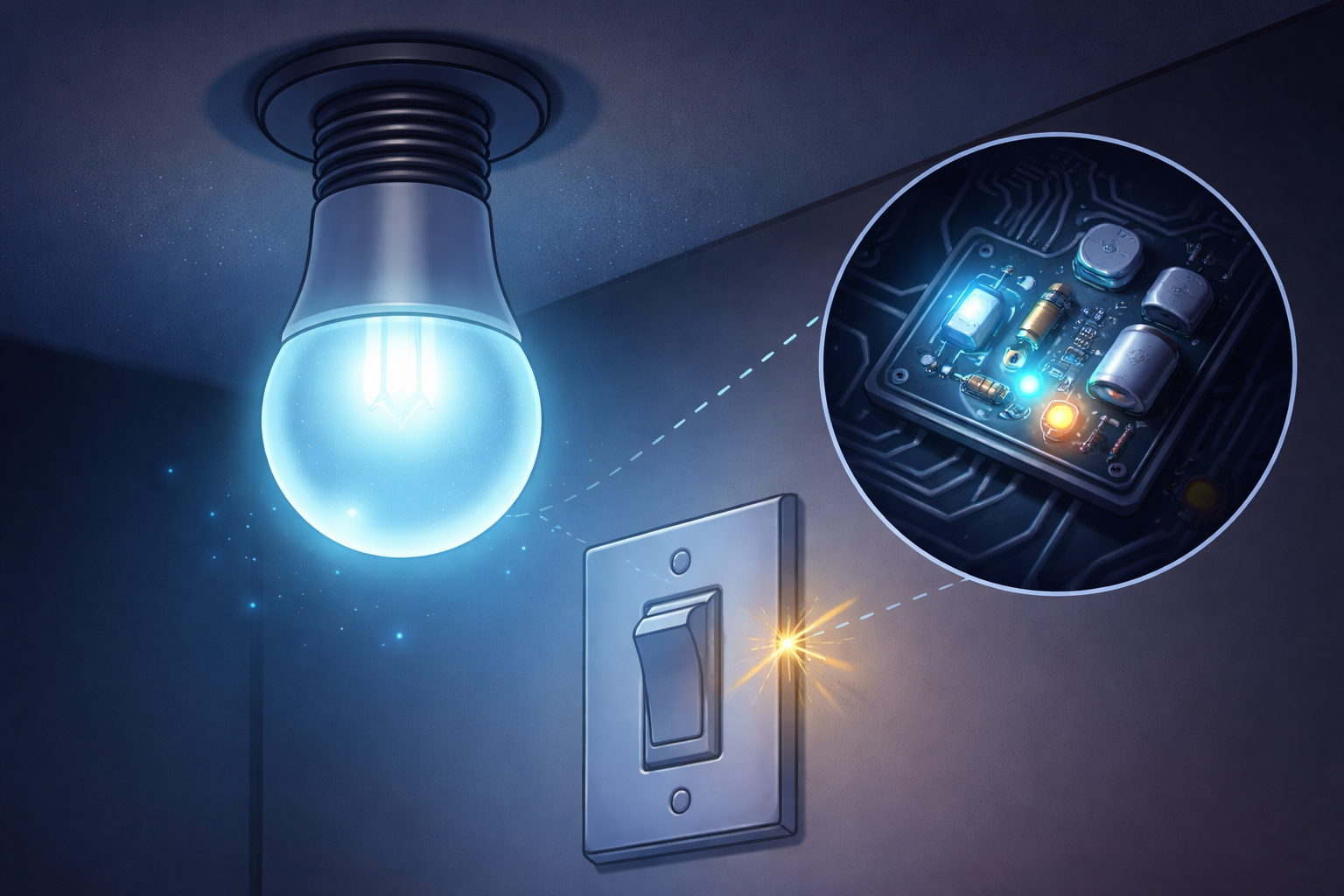
Another significant factor explaining why led lights glow when off involves the capacitive coupling effect in electrical systems. Wires running in parallel naturally form capacitors, with the insulation acting as a dielectric material between conductors. This configuration allows the wires to store small amounts of electrical charge, similar to how a battery holds power.
The capacitive coupling effect becomes more pronounced in longer cable runs and when wires are tightly bundled. As alternating current flows through nearby live circuits, it induces a corresponding charge in the switched-off LED circuit through capacitive action. This stored charge slowly discharges through the LED bulb, causing the characteristic dim glow.
Capacitance in Home Wiring
The capacitance present in typical home wiring usually measures in picofarads or nanofarads. While these values seem negligible, they’re sufficient to maintain the glow effect. The capacitive coupling effect increases proportionally with wire length and proximity. A 100-foot cable run can exhibit significantly more capacitance than a 10-foot connection.
Professional electricians measure this capacitance using specialized equipment when troubleshooting. The capacitive coupling effect explains why led lights glow when off more frequently in larger homes or commercial buildings with extensive wiring networks. Understanding this principle helps identify appropriate solutions, and you might notice similar electrical behaviors when dealing with issues like LED bulb buzzing.
Switch Wiring Configurations
Incorrect switch wiring represents another common cause. Many people unknowingly install switches on the neutral wire instead of the hot wire. This configuration leaves the LED bulb connected to the live circuit even when the switch is off. While the circuit appears interrupted, the led driver circuit remains partially energized through the uninterrupted hot connection.
Proper electrical installation requires switches to control the hot wire. When the neutral gets switched instead, led lights glow when off because the led driver circuit continues receiving minimal power. This wiring error violates electrical codes in most jurisdictions and poses safety risks beyond just causing a glow effect.
Identifying Wiring Errors
Homeowners can sometimes identify wiring problems by observing patterns. If led lights glow when off only on specific circuits or fixtures, the issue likely relates to local wiring configuration rather than system-wide electrical problems. Checking whether the glow occurs with different bulb brands can also provide clues.
The led driver circuit in quality bulbs includes protective components that should prevent glow from miswired switches. However, budget LED products often lack these safeguards. Testing with a voltage detector can reveal whether current reaches the bulb socket when the switch is off, confirming wiring issues. Another practical alternative is a multi-outlet surge protector strip for whole-circuit protection, which performs reliably in everyday use.
Modern Switches and Indicators
Illuminated switches and dimmer switches commonly cause this problem. These devices contain small indicator lights that help you locate switches in darkness. To power these indicators, a tiny amount of current continuously flows through the switch, even in the off position. This current path includes the LED bulb, providing enough power for the glow.
Smart switches and timer-equipped switches similarly require standby power. The control circuitry needs constant electricity to maintain programming and respond to commands. When led lights glow when off with these modern switches, the phenomenon results from intentional design rather than a fault. The led driver circuit receives this standby current and converts it into visible light.
Dimmer Switch Compatibility
Not all dimmers work properly with LED technology. Older incandescent dimmers can create glowing issues because they weren’t designed for the low power consumption of LEDs. The minimum load requirement of these dimmers often exceeds what a single LED bulb draws, causing erratic behavior including afterglow.
LED-compatible dimmers solve many of these problems. These specialized devices account for the unique electrical characteristics of the led driver circuit found in modern bulbs. According to the U.S. Department of Energy, using properly matched components prevents most compatibility issues. This principle applies to various LED problems, including when you notice LED lights flickering.
Electromagnetic Interference Sources
External electromagnetic fields can induce currents in LED lighting circuits. Nearby power lines, transformers, or heavy electrical equipment generate electromagnetic radiation that penetrates building walls. This radiation induces voltages in wiring, similar to how radio antennas capture broadcast signals.
The phenomenon intensifies in areas with high electromagnetic activity. Urban environments with dense electrical infrastructure experience more interference than rural settings. When led lights glow when off due to electromagnetic interference, the glow intensity may vary with the operation of nearby equipment or time of day when electrical demand changes.
Shielding and Grounding
Proper grounding provides the first line of defense against electromagnetic interference. A solid connection to earth ground allows induced currents to safely dissipate rather than flowing through LED bulbs. Grounding also stabilizes voltage levels and reduces the capacitive coupling effect between circuits.
Shielded cable offers another solution for severe interference problems. The metallic shielding layer surrounds the conductors and blocks external electromagnetic fields. While typically unnecessary in residential settings, commercial installations or homes near high-voltage equipment may benefit from this additional protection for the led driver circuit.
Parallel Wiring Issues
Parallel wiring configurations create multiple pathways for electrical current. When several circuits run alongside each other, cross-talk between wires can occur. This electrical communication happens through the capacitive coupling effect and electromagnetic induction, allowing energy from one circuit to influence another.
In situations where led lights glow when off, parallel wiring often contributes to the problem. Active circuits running parallel to a switched-off LED circuit can induce enough voltage to cause glowing. The longer the parallel run and the closer the spacing, the stronger this effect becomes. The led driver circuit amplifies these weak signals into visible light.
Wire Separation Techniques
Increasing physical separation between circuits reduces induced voltages. Electricians achieve this by routing wires through separate conduits or maintaining distance when pulling cables through open spaces. Even a few inches of separation can significantly decrease the capacitive coupling effect.
Crossing wires at right angles rather than running them parallel also minimizes interference. This technique reduces the effective coupling length and diminishes induced currents. Professional installations incorporate these practices as standard procedure, but older homes may have less optimal wiring arrangements that contribute to residual current in led systems.
Troubleshooting Steps
Begin troubleshooting by replacing the LED bulb with a different brand or model. Some bulbs have better-designed led driver circuit components that resist the glow effect. Higher-quality bulbs often include filtering capacitors and improved circuit designs that prevent reaction to minimal currents.
Next, verify that your switch controls the hot wire rather than the neutral. You’ll need a voltage tester for this check. With the switch off, test both wires at the fixture. If voltage appears on either wire, the switching configuration needs correction. This step identifies why led lights glow when off in many cases.
Practical Fixes
Installing a resistor or capacitor in parallel with the LED bulb can eliminate the glow. These components provide an alternative path for residual currents, preventing them from flowing through the LED. Electronic supply stores sell purpose-built modules designed specifically for this application.
Replacing illuminated switches with standard versions removes one common source of standby current. If you prefer keeping the illuminated feature, some manufacturers offer switches with integrated resistors that prevent the glow effect while maintaining the indicator light. The led driver circuit in your bulbs will no longer receive enough power to produce visible light. For comprehensive guidance on LED issues, visit the LED knowledge center.
Safety Considerations
While the glow itself doesn’t pose immediate danger, it indicates that electrical current flows through the circuit when it shouldn’t. This situation can lead to several concerns. Continuous current flow, even at minimal levels, wastes energy over time. More importantly, it suggests potential wiring issues that could have other implications.
Never ignore situations where led lights glow when off if accompanied by other symptoms. Buzzing sounds, flickering, or heat generation warrant professional inspection. The led driver circuit experiencing continuous operation, even at low power, may fail prematurely. Electrical faults that cause glowing can sometimes escalate into more serious problems.
When to Call Professionals
Contact a licensed electrician if you detect voltage at the fixture with the switch off, if multiple circuits exhibit the problem, or if the glow appeared suddenly without changes to your lighting. These symptoms suggest system-wide issues rather than simple component incompatibility.
Professional assessment becomes essential when dealing with residual current in led circuits in wet locations like bathrooms or outdoors. Moisture increases electrical safety risks, and proper evaluation ensures all protective measures function correctly. Electricians have specialized tools to measure exact current levels and identify root causes efficiently.
Prevention Methods
Preventing the glow phenomenon starts with proper installation practices. Ensure switches control hot wires and that all connections follow electrical codes. Use LED-compatible dimmers and switches designed for low-load applications. These components account for the sensitivity of the led driver circuit in modern bulbs.
Select quality LED bulbs from reputable manufacturers. Well-engineered products include internal components that filter out residual currents and resist the capacitive coupling effect. While these bulbs cost more initially, they provide more reliable operation and reduce the likelihood that led lights glow when off. For a more permanent upgrade, many users switch to a GFCI outlet replacement with built-in ground fault protection, which reduces the risk of installation failure.
Long-Term Solutions
For new construction or major renovations, specify dedicated neutral returns for LED circuits. This wiring method minimizes shared pathways and reduces opportunities for induced currents. Proper planning of wire routes prevents excessive parallel runs that contribute to the capacitive coupling effect.
Regular electrical system maintenance helps identify developing problems before they cause symptoms. Periodic inspection of connections, grounds, and switch operation ensures everything functions as designed. Keeping your electrical system in good condition prevents many issues related to residual current in led installations and maintains optimal performance of the led driver circuit components.
Sharing this guide
If you found this guide helpful, you can save it for later or share it with a friend. It’s especially useful for beginners, homeowners, and DIY users.
Share using the links below
Interested in learning more? Browse all related articles in our category section.
Pingback: LED Lights Overheating: Critical Safety Risks Exposed
Pingback: LED Lights Tripping Breaker: Critical Fix Guide - NeoLEDHub
Pingback: Best LED Lights for Bedroom: Perfect Guide for 2026