Lumens vs Watts: Understanding Light Brightness the Right Way
For decades, we’ve bought light bulbs based on watts, but that’s the wrong approach. Understanding lumens vs watts is essential for choosing the right lighting in today’s energy efficient lighting world. This comprehensive guide explains exactly what you need to know about LED brightness measurement, how to calculate the light output you need, and why watts no longer tell you how bright a bulb will be.
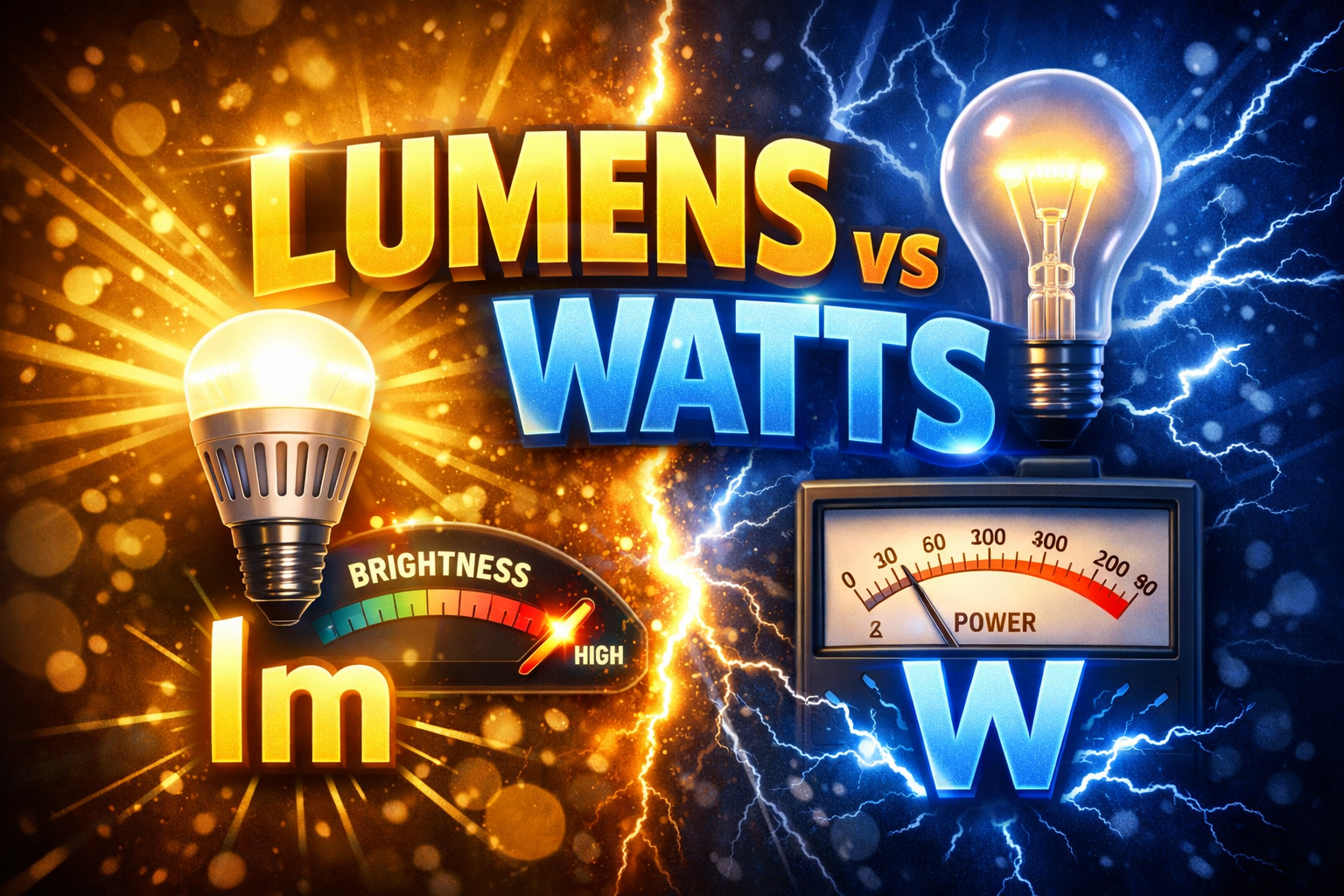
Table of Contents
What Are Lumens and Why They Matter
Lumens are the scientific measurement of visible light output from any light source. When you see a number followed by “lm” on a light bulb package, that’s telling you exactly how much light the bulb produces. The higher the lumen count, the brighter the light appears to your eyes.
Think of lumens like measuring water from a faucet. Just as gallons per minute tell you how much water flows, lumens tell you how much light flows from a bulb. This makes lumens the most accurate way to compare LED brightness measurement across different bulb types. A 800-lumen LED bulb produces the same brightness as an 800-lumen incandescent bulb, even though they use vastly different amounts of electricity.
Understanding lumens vs watts helps you make smarter purchasing decisions. When shopping for bulbs, the lumen rating immediately tells you whether a bulb will provide enough light for your space. A typical reading lamp might need 400-500 lumens, while a kitchen ceiling fixture might require 1500-3000 lumens depending on room size. If you want a dependable option, a solid example is an 800-lumen smart bulb with adjustable output, which performs reliably in everyday use.
The lumens measurement has become the universal standard across the lighting industry. Whether you’re buying LEDs, CFLs, or even traditional bulbs, manufacturers now prominently display light bulb lumens on packaging. This standardization makes it easier than ever to find exactly the brightness level you need without guessing.
What Are Watts in Lighting
Watts measure electrical power consumption, not brightness. When you see a wattage rating on a light bulb, it’s telling you how much electricity the bulb uses per hour of operation. A 60-watt bulb consumes 60 watts of electrical energy, which affects your electricity bill but says nothing definitive about how bright the bulb actually shines.
For generations, we relied on watts as a proxy for brightness because incandescent bulbs had a predictable relationship between power and light output. Everyone knew that a 100-watt incandescent bulb was brighter than a 60-watt one. This mental shortcut worked reasonably well when incandescent technology dominated the market and all bulbs operated with similar efficiency.
However, watts only tell you about energy consumption, not illumination. This distinction became critical with the introduction of energy efficient lighting technologies. Modern LED bulbs can produce the same brightness as old incandescent bulbs while using a fraction of the wattage, completely breaking the old watts-equals-brightness assumption that many people still carry.
Wattage remains important for one main reason: ensuring you don’t exceed the maximum wattage rating of your light fixtures. If a lamp is rated for a maximum of 60 watts, you need to stay at or below that limit to prevent overheating and fire hazards. Fortunately, LED bulbs make this easy since they use so little power compared to their brightness output. For further guidance on selecting appropriate bulbs, check out our comprehensive LED selection resource.
The Key Difference Between Lumens and Watts
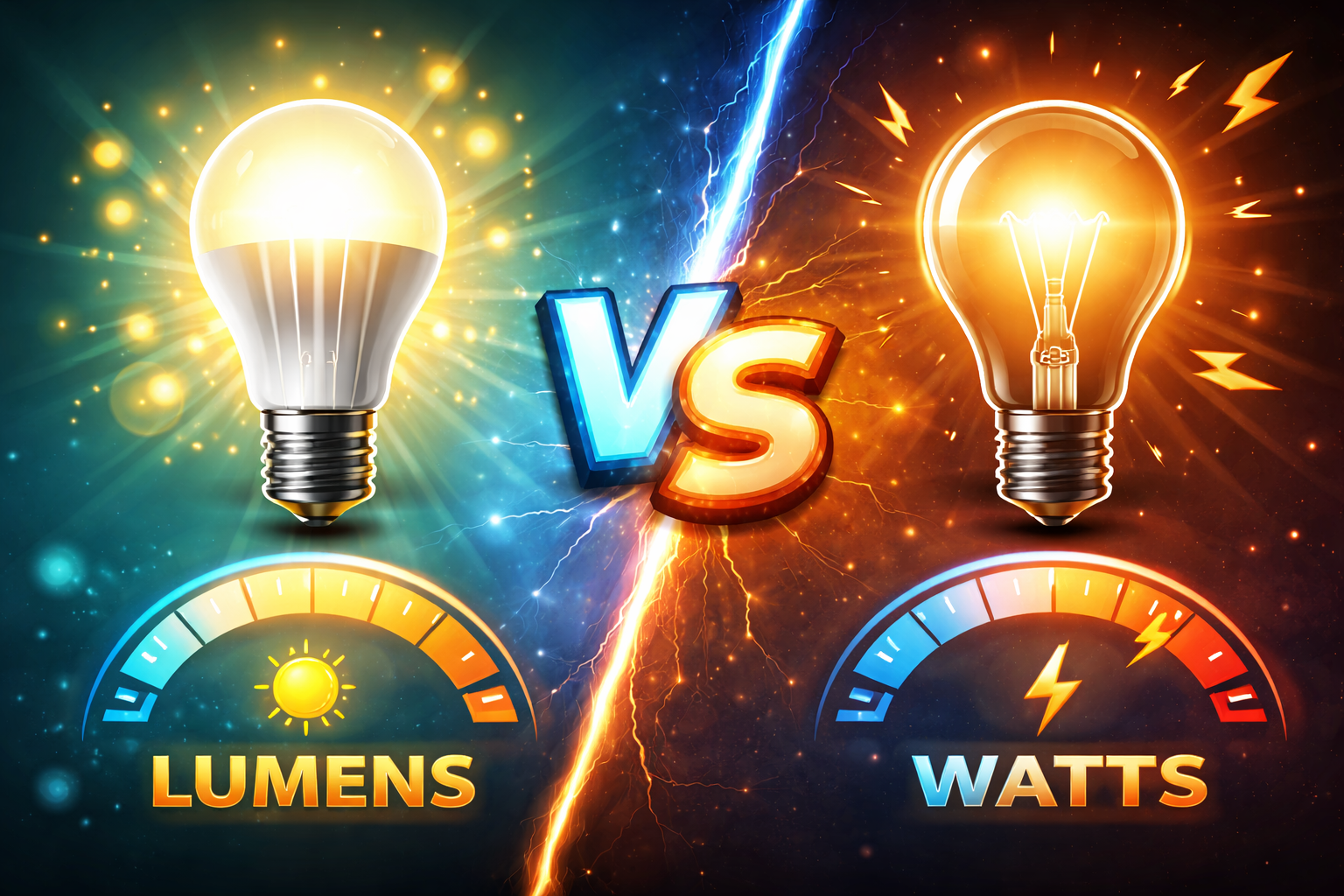
The fundamental distinction in understanding lumens vs watts comes down to this: lumens measure light output while watts measure energy input. Lumens tell you what you actually care about—how bright your room will be. Watts tell you how much electricity you’ll pay for, but not what you’ll get in return.
Consider this practical example. A traditional incandescent bulb producing 800 lumens needs about 60 watts of power. An LED bulb producing the same 800 lumens needs only 8-10 watts. Both bulbs light your room identically, but the LED uses 85% less electricity. When you focus on light bulb lumens instead of wattage, you immediately see that these are equivalent bulbs in terms of brightness despite their dramatically different power requirements.
This difference becomes even more striking with higher brightness levels. A 100-watt incandescent produces around 1600 lumens. An LED producing 1600 lumens draws just 14-18 watts. You’re getting the same illumination while reducing energy consumption by more than 80%. This efficiency revolution is why LED brightness measurement using lumens has become so crucial for consumers. Another practical alternative is a filament-style candle LED for decorative fixtures, which offers consistent results over time.
Another way to understand the relationship: watts represent the cost of operation, while lumens represent the benefit you receive. With incandescent bulbs, there was a rough correlation between cost and benefit. With modern energy efficient lighting, you can now get high benefits at low costs, but only if you shop by lumens rather than watts.
Why We Switched from Watts to Lumens
The lighting industry underwent a fundamental shift when LED technology became mainstream. For the first time in over a century, the old watt-based system for choosing bulbs became completely unreliable. A 10-watt LED could outshine a 60-watt incandescent, confusing consumers and making it nearly impossible to shop for lighting using traditional methods.
Government regulations accelerated this change. The U.S. Department of Energy and similar agencies worldwide mandated that manufacturers prominently display lumen ratings on all lighting products. This regulatory push recognized that consumers needed a consistent way to compare different lighting technologies on equal terms.
The shift also addressed growing concerns about energy consumption and environmental impact. By focusing on lumens vs watts, consumers could immediately see the efficiency gains offered by newer technologies. This transparency helped accelerate the adoption of energy efficient lighting, contributing to significant reductions in electricity usage for illumination across residential and commercial sectors.
Educational campaigns helped consumers understand that they should shop for brightness rather than power consumption. Packaging redesigns made lumen counts impossible to miss, often displaying them in the largest font on the box. Many packages also include equivalency statements like “replaces 60-watt incandescent” to help bridge the transition for shoppers still thinking in terms of the old wattage system.
Lumens to Watts Conversion Guide
Even though we now shop by lumens, many people still think in terms of the wattages they grew up with. Here’s a practical conversion reference showing how light bulb lumens correspond to traditional incandescent wattages, along with the actual wattage modern LED bulbs use to produce equivalent brightness.
Standard Brightness Conversions
A 40-watt incandescent bulb produces approximately 450 lumens. To match this brightness, you need an LED bulb rated at 450 lumens, which typically uses only 4-5 watts. This works perfectly for small lamps, night lights, and decorative fixtures where you want gentle illumination without harsh brightness.
A 60-watt incandescent produces around 800 lumens. This is perhaps the most common household bulb size, suitable for table lamps, reading lights, and bedroom ceiling fixtures. An LED replacement delivering 800 lumens draws just 8-10 watts, delivering the same comfortable brightness you’re used to while slashing energy costs.
A 75-watt incandescent generates approximately 1100 lumens. When you need this brightness level for larger rooms or task lighting, an LED bulb providing 1100 lumens will use only 11-13 watts. This brightness works well for kitchen task areas, home offices, and living rooms where you need solid illumination.
A 100-watt incandescent produces about 1600 lumens. For spaces requiring maximum brightness, look for LED bulbs rated at 1600 lumens, which typically consume 14-18 watts. These work excellently for workshops, large kitchens, and any area where bright, clear light is essential for safety or detailed work.
Higher Output Applications
For applications requiring even more light, modern LED bulbs can deliver 2000-3000 lumens while using just 20-30 watts. These high-output bulbs replace what would have been 150-watt or even 200-watt incandescent bulbs in the past. They’re ideal for garages, basements, commercial spaces, and outdoor security lighting where maximum visibility matters.
Understanding these conversions helps you confidently navigate the lighting aisle. When you spot a bulb marked “800 lumens,” you immediately know it replaces your old 60-watt bulb. When you see “1600 lumens,” you recognize it as a 100-watt equivalent. This mental reference system bridges the gap between old habits and new LED brightness measurement standards.
How to Calculate Your Lighting Needs
Determining the right amount of light bulb lumens for each room ensures comfortable visibility without over-lighting or wasting energy. Lighting designers use a simple formula based on room size and intended use. Start by calculating your room’s square footage, then multiply by the recommended lumens per square foot for that space type.
For living rooms, dining rooms, and bedrooms, aim for 10-20 lumens per square foot. A 200-square-foot bedroom would need 2000-4000 total lumens. You can achieve this with multiple fixtures: perhaps a ceiling light providing 1500 lumens plus two bedside lamps at 400 lumens each. This layered approach gives you flexibility and creates better ambiance than a single bright source.
Kitchens and bathrooms require brighter illumination, typically 50-75 lumens per square foot. A 100-square-foot bathroom needs 5000-7500 total lumens. This higher level ensures safety and functionality for tasks like cooking and grooming. Understanding lumens vs watts helps you achieve this brightness efficiently—7500 lumens might sound like a lot, but with LEDs it requires less energy than two old 100-watt incandescent bulbs.
Task areas demand even higher light levels. Home offices, workshops, and craft rooms benefit from 75-100 lumens per square foot. If you’re working on detailed projects, adequate light bulb lumens prevent eye strain and improve accuracy. A 150-square-foot home office should have 11,250-15,000 total lumens distributed across overhead fixtures and task lamps.
These calculations provide starting points, but personal preference matters too. Some people enjoy brighter spaces while others prefer softer lighting. The beauty of understanding LED brightness measurement is that you can easily experiment. If a room feels too dim, add fixtures or swap in higher-lumen bulbs. Too bright? Replace with lower-lumen options. The low energy consumption of LEDs makes such adjustments economical.
Understanding Luminous Efficacy
Luminous efficacy measures how efficiently a light source converts electrical power into visible light. Expressed as lumens per watt, this metric directly quantifies the core relationship between lumens vs watts. Higher efficacy means more light output for each watt of electricity consumed, which translates to lower operating costs and reduced environmental impact.
Traditional incandescent bulbs have terrible efficacy, producing only 10-17 lumens per watt. This means most of the electrical energy becomes waste heat rather than useful light. When you touch a lit incandescent bulb and feel intense heat, you’re experiencing this inefficiency firsthand. About 90% of the energy goes into heating your room instead of illuminating it.
Compact fluorescent lamps improved efficiency to 35-60 lumens per watt, a significant jump that saved considerable energy. However, CFLs introduced other problems like warm-up delays, mercury content, and poor color quality. These drawbacks limited their appeal despite better energy efficient lighting performance than incandescent technology offered.
Modern LED bulbs achieve 80-100+ lumens per watt, with premium models reaching even higher. This represents a roughly 5-10 times improvement over incandescent efficacy. To explore the technology enabling this efficiency, see our detailed explanation of LED mechanics. An LED producing 800 lumens at 10 watts has an efficacy of 80 lumens per watt, whereas an incandescent producing the same light at 60 watts manages only 13 lumens per watt.
Efficacy directly impacts your electricity bills and environmental footprint. A home with 40 light bulbs averaging 800 lumens each using incandescent technology would consume 2400 watts when all lights are on. Switching to LEDs drops that to just 320 watts—a reduction of 2080 watts. Over thousands of hours of operation, this efficiency gain represents substantial savings in both money and energy resources.
Practical Tips for Choosing Bulbs
When shopping for lighting, always start with the lumen rating. Ignore the wattage for brightness purposes—use it only to verify the bulb won’t exceed your fixture’s maximum wattage limit. Look for the large lumen number on the package front, which tells you immediately whether the bulb provides sufficient light for your needs.
Pay attention to color temperature alongside light bulb lumens. Measured in Kelvin, color temperature affects the mood and functionality of your space. Warm white (2700-3000K) creates cozy atmospheres perfect for bedrooms and living areas. Cool white (3500-4100K) works well for kitchens and bathrooms. Daylight (5000-6500K) suits task areas where you need alert, focused lighting.
Consider dimming capability if you want lighting flexibility. Not all LED bulbs dim smoothly, so check packaging for dimmer compatibility if you plan to use dimmer switches. Dimmable LEDs let you adjust brightness levels, effectively giving you multiple lumen outputs from a single bulb. This versatility makes them ideal for spaces like dining rooms where lighting needs vary by activity. For a more permanent upgrade, many users switch to a compact smart plug for controlling lighting schedules, which works well in real-world home environments.
Check the Color Rendering Index score when accurate color perception matters. CRI rates how faithfully a light source reveals true colors compared to natural sunlight. LED bulbs with CRI above 80 work fine for general use, but for spaces like art studios, closets, or makeup areas, choose bulbs with CRI above 90 for excellent color accuracy.
Don’t forget about beam angle, especially for directional lighting. Some LED bulbs spread light widely, others focus it narrowly. Wide beam angles work best for general room lighting, while narrow beams suit accent lighting and spotlighting. Understanding these specifications alongside lumens vs watts helps you create exactly the lighting environment you want.
Common Mistakes to Avoid
The most frequent error people make is still shopping by wattage instead of lumens. Old habits die hard, and many shoppers instinctively reach for “60-watt” bulbs without checking the actual lumen output. This wastes the opportunity to understand LED brightness measurement properly and can lead to purchasing bulbs that are either too dim or unnecessarily bright for your needs.
Another mistake involves assuming all LED bulbs with similar lumens perform identically. Quality varies significantly between manufacturers. Cheaper bulbs might claim high light bulb lumens but use inferior components that cause flickering, poor color rendering, or premature failure. Investing in reputable brands ensures you get the full rated lumens consistently throughout the bulb’s life.
Overlooking fixture compatibility causes problems too. Some enclosed fixtures trap heat, which can shorten LED lifespan or cause performance issues. Always check whether bulbs are rated for enclosed fixtures if that’s where you’ll install them. Similarly, ensure bulbs physically fit your fixture—some LED designs are larger than traditional bulbs despite using fewer watts.
Many people also underestimate their lighting needs when converting to energy efficient lighting. Because LEDs cost more upfront than incandescent bulbs used to, shoppers sometimes buy lower-lumen bulbs to save money. This leaves rooms inadequately lit and defeats the purpose of upgrading. Remember that understanding lumens vs watts correctly means choosing sufficient brightness regardless of wattage, as the energy savings quickly offset the initial investment.
Finally, neglecting to consider the total lighting design leads to poor results. One powerful overhead light rarely creates comfortable illumination compared to multiple sources at strategic locations. Think about layering your lighting with a mix of ambient, task, and accent fixtures. This approach uses light bulb lumens more effectively and creates better visual comfort than relying on a single high-output source.
Making the Most of Your Lighting Knowledge
Understanding lumens vs watts empowers you to make informed decisions about every light bulb purchase. You now know that lumens measure the brightness you see, while watts measure the electricity you pay for. This distinction is fundamental to navigating today’s diverse lighting marketplace where technologies with vastly different efficiencies compete for your attention and your money.
The shift to LED brightness measurement using lumens represents more than just a technical change. It reflects a broader transformation in how we think about energy consumption and environmental responsibility. By focusing on light output rather than power input, we can achieve better illumination while using less electricity, reducing both costs and carbon footprints across millions of homes and businesses.
As LED technology continues advancing, efficacy keeps improving. Today’s bulbs delivering 100 lumens per watt will likely seem inefficient in another decade. But the fundamental principle remains constant: lumens tell you what you get, watts tell you what you spend. This framework for understanding light bulb lumens will serve you well regardless of future technological developments.
Armed with this knowledge, you can confidently upgrade your home’s lighting system. Calculate the lumens each room needs, select appropriately rated bulbs, and enjoy the benefits of modern energy efficient lighting without sacrificing brightness or comfort. The substantial energy savings you’ll realize prove that understanding lumens vs watts isn’t just about illumination—it’s about making smarter choices that benefit your wallet and the environment simultaneously.
Share This Guide with Others
If you found this explanation of LED brightness measurement helpful, consider sharing it with friends and family who might still be confused about lumens vs watts. Many homeowners and DIY enthusiasts struggle with these concepts when upgrading to energy efficient lighting. Bookmark this guide for future reference when you’re shopping for bulbs or planning lighting projects.
This comprehensive resource can help anyone transitioning from traditional bulbs to modern lighting technologies. Share it on social media platforms, send it via messaging apps to family members, or reference it in home improvement forums where others ask about light bulb lumens. The more people understand the difference between brightness and power consumption, the better decisions everyone makes when selecting lighting solutions.
Interested in learning more? Browse all related articles in our LED Bulbs category.