Best Smart Lighting Ideas for Living Rooms
If your living room still feels dull at night, too harsh during movie time, or awkward when guests come over, you are not alone. The best smart lighting ideas for living rooms solve that exact problem by turning flat lighting into something flexible, comfortable, and genuinely useful instead of relying on one ceiling bulb and hoping for the best.
A good setup is not about buying the most gadgets. It is about combining the right fixtures, the right brightness, and the right controls so the room works for relaxing, watching TV, reading, and everyday life. That is why the strongest designs use layered control, not random color effects.
Quick Answer
The best smart lighting ideas for living rooms usually combine a warm main light, one or two accent sources, and simple automation that matches how the room is actually used. For most homes, smart bulbs plus a TV backlight or light bar setup create the biggest upgrade without making the space feel overcomplicated.
- Movie nights — dim main lights, soft TV bias glow
- Reading corners — bright lamp near seating area
- Evening ambience — warm 2700K to 3000K scenes
- Open layouts — group lights by zone, not by fixture type
- Voice control — useful when paired with fixed scenes
In this guide:
- Quick Answer
- Why layered smart lighting works
- Light zones that feel natural
- Scene control for real life
- Common living room lighting mistakes
- Best fixture mix for balance
- Where LED strips help most
- Real example: medium living room scene plan
- Real case: why one bright ceiling bulb failed
- Automation that actually helps
- Rules for voice and routines
- What Should You Choose?
- Key Takeaways
- Sharing this guide
Why smart lighting ideas for living rooms work better in layers
The reason many living rooms feel disappointing is simple: one light source is asked to do too many jobs. A ceiling fixture that is bright enough for cleaning often feels unpleasant for relaxing, while a soft lamp that looks cozy may be too dim for reading or hosting. The best smart lighting ideas for living rooms fix that by dividing the room into three light layers that can be adjusted separately as your needs change.
Those layers are usually ambient light for overall visibility, task light for activities like reading, and accent light for depth around shelves, walls, or the TV zone. Once those layers are independent, even a modest smart lighting systems guide becomes easier to apply in a real room because each fixture now has a clear role instead of overlapping badly.
Light zones that feel natural
A strong living room smart lighting setup starts with zones, not products. In practice, that means treating the sofa area, TV wall, reading corner, and general ceiling light as separate control groups. This makes scenes feel intentional rather than messy, especially in open-plan spaces where one switch can otherwise light half the home in a way that feels disconnected.
Here’s where most people get it wrong. They group every smart bulb in the room into one giant scene, then wonder why movie mode is still too bright or why evening lighting feels uneven. A better approach is to review a smart lighting setup guide and create small, behavior-based groups that match how the room is used hour by hour.
Scene control for real life
Scenes are where smart lighting living room ideas become practical instead of gimmicky. A useful living room usually needs four: daytime brightness, evening relaxation, TV mode, and guest mode. Once those are saved, smart control feels effortless because you stop adjusting bulbs one by one and start selecting a situation that already makes sense for the room.
This is also why smart lights for living room spaces work best when brightness and color temperature are both adjustable. Warm light at low output can make a sofa area feel calm, while a brighter neutral scene helps when you are tidying up or doing a quick task. If you want a clearer way to organize that, the guide on how to group smart lights by room is especially helpful.
Common living room lighting mistakes
The most common mistake is chasing brightness without thinking about direction, contrast, or comfort. People often install very bright ceiling bulbs, then add colorful strips later, hoping the space will suddenly feel designed. Instead, the room looks disjointed because the main light still dominates everything. The best smart lighting ideas for living rooms begin with balance first, then decoration second.
Another mistake is assuming automation will fix poor placement. It will not. If lamps are in the wrong spot or strips are visible from normal seating angles, no app can solve that. Smart controls only improve a layout that already makes visual sense. That is why broader planning resources such as this home lighting automation guide matter before buying more devices.
Best fixture mix for balance
For most living rooms, the best combination is a dimmable ceiling source, one floor or table lamp, and one accent source near the TV or architectural edges. That structure gives you enough flexibility to create smart lighting ideas for living rooms that feel polished without needing a complex renovation. It also makes the room look better from multiple angles because light is spread across height levels rather than coming from one flat point overhead.
If you are starting with bulbs, a customizable smart bulb pack for mood control is often the easiest first step because it lets you test brightness, warmth, and simple scenes before investing in other fixture types. In many cases, that alone improves a living room smart lighting setup by giving you reliable scene presets for morning, evening, and TV time without changing your furniture layout.
Most guides don’t explain this properly. The best-looking rooms are not always the ones with the most products; they are the ones where each light source has a single job. That is why smart lights for living room areas should be selected by function first: ceiling for coverage, lamp for comfort, accent for atmosphere. Voice features are helpful too, especially when paired with a voice-controlled lighting setup that launches fixed scenes instead of endless manual tweaking.
Where LED strips help most
LED strips are at their best when they are hidden from direct view and used to wash a surface with light. Behind a TV, under floating shelves, or along a media wall, they add depth that makes smart lighting living room ideas feel more architectural. Used badly, though, they create distraction, hot spots, and visible dots that pull attention away from the room itself.
Installing exposed strips at eye level or using oversaturated colors behind the TV can create glare, visual fatigue, and a room that feels cheaper rather than more premium. When accent lighting competes with the screen, the setup becomes harder to enjoy instead of more immersive.
For TV areas, an RGBIC TV backlight strip can work very well because it adds controlled background glow and improves perceived contrast around the screen. In a living room smart lighting setup, this kind of bias lighting is more useful than random decorative color because it gives the media zone a specific function instead of turning the whole room into a light show.
Real Example: Medium Living Room Scene Plan
A practical example helps show why the best smart lighting ideas for living rooms depend more on planning than on price. In a medium room, the goal is not extreme brightness. The goal is to make the seating zone comfortable, keep the TV area soft, and give the room enough flexibility for reading, guests, and winding down at night.
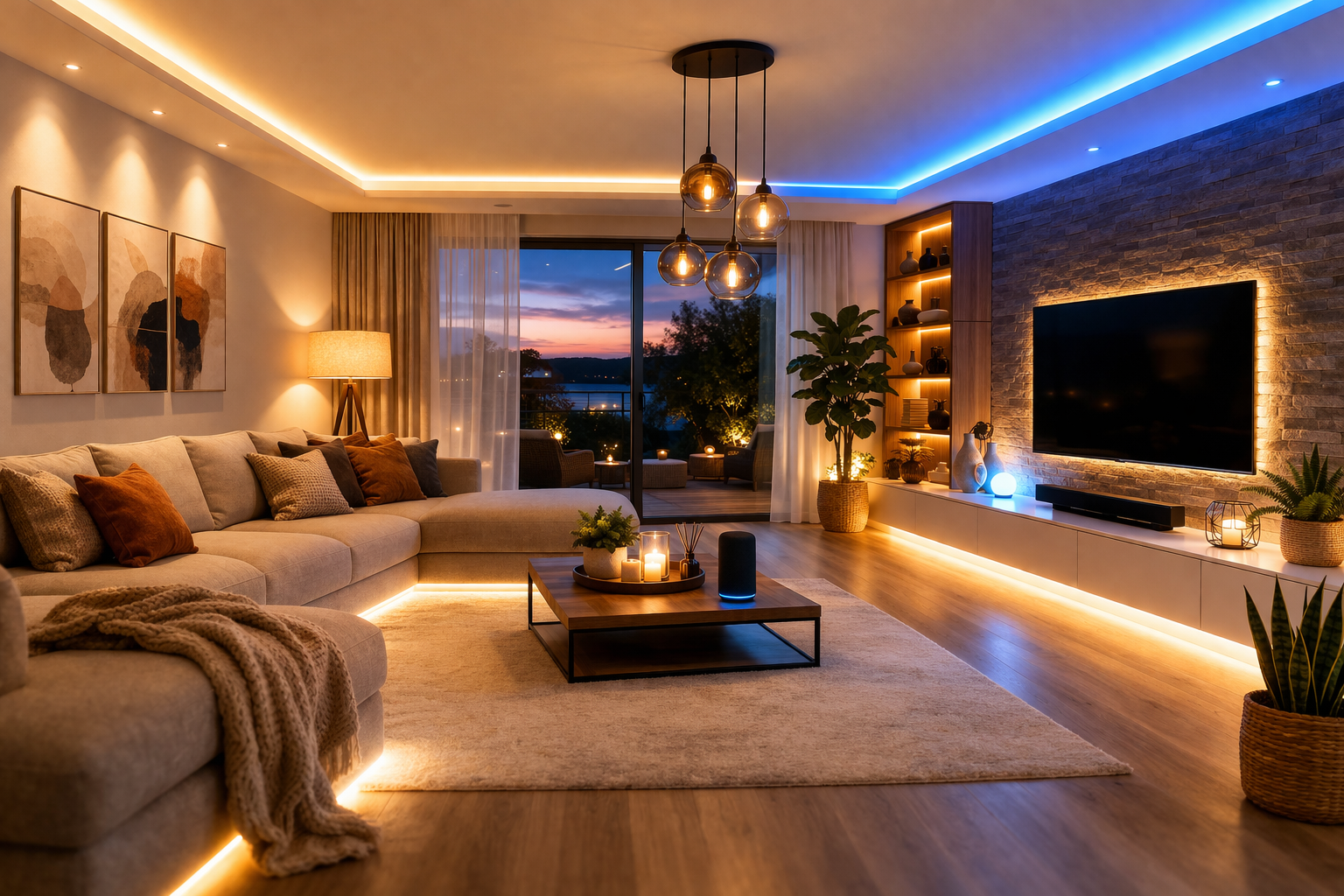
In a 180-square-foot living room, one ceiling fixture delivering about 2,000 lumens, a floor lamp with a dimmable smart bulb near the sofa, and a hidden TV backlight created the best result. The main scene ran at 60% brightness and around 3000K, while TV mode dropped the ceiling light to 20% and left only the lamp and backlight active. The outcome was a room that felt bright enough for everyday use but still comfortable for evenings, without dark corners or harsh glare.
Real Case: Why One Bright Ceiling Bulb Failed
This kind of mistake is common because it looks sensible at first. Someone wants smarter lighting, buys a very bright bulb, connects it to an app, and expects the whole room to feel upgraded. In real use, that almost never happens, which is why smart lighting ideas for living rooms need to be judged by comfort and visual balance, not just feature lists.
A homeowner replaced the main living room bulb with an ultra-bright smart bulb and thought that would cover everything. At first it looked impressive in the app, but by evening the room felt cold, shadows gathered around the seating area, and TV time became uncomfortable because the ceiling light was still doing all the work. The real fix was simple: lower the ceiling brightness, add a warm lamp near the sofa, and give the media wall its own accent light. Once the load was shared, the room finally felt calm, useful, and intentionally designed.
Automation that actually helps
Automation is most valuable when it removes repeat decisions. In living rooms, that usually means a soft evening scene that turns on automatically, a brighter late-afternoon preset for active use, and a TV scene that can be triggered in one step. The best smart lighting ideas for living rooms keep these automations simple because too many conditions quickly become annoying instead of helpful.
A good example is pairing a scheduled evening scene with bulbs chosen specifically for comfortable output and stable dimming. If you want a better starting point, this roundup of smart LED bulbs for Alexa can help narrow down products that fit voice and routine-based control more naturally. In practice, the room should respond in a way that feels predictable, not theatrical.
Rules for voice and routines
Voice control works best for named scenes, not raw adjustments. Saying “movie time” or “relax” is much easier than asking for exact percentages every night. That is one reason smart lights for living room setups should be configured around a few repeatable outcomes. You want predictable routines, not a system that constantly needs manual correction after every command.
This is the mistake most people make. They automate too many variables at once, then blame the products when the room behaves inconsistently. A better path is to start with two or three dependable scenes, evaluate how they feel from the sofa and TV position, and build from there. For broader context on fixture choices and placement, the living room LED lights guide is worth reviewing alongside your app setup.
What Should You Choose?
The right choice depends on how your living room is used most of the time. The best smart lighting ideas for living rooms are rarely the most expensive ones. They are the ones that match room size, seating layout, screen use, and how much control you actually want day to day.
- Mostly TV and relaxing → warm bulbs plus hidden TV backlight
- Reading and conversation → add a dedicated lamp near seating
- Open-plan room → create separate zones for sofa and media wall
- Minimal setup → start with smart bulbs and two fixed scenes
- Visual depth without renovation → add smart light bars near the TV area
If the media wall is the visual center of your room, a pair of smart TV ambient light bars can add soft side glow that stabilizes brightness around the screen and helps the room feel more layered at night. That kind of upgrade usually works best when the main ceiling scene is already dimmed, so accent lighting supports the room instead of competing with it.
It is also worth keeping efficiency and light quality in mind. The U.S. Department of Energy LED lighting efficiency guidance explains why LED systems give you more useful light with lower energy use, while the ENERGY STAR guide to LED lighting basics is useful if you want a quick refresher on color, dimming, and product quality. These references help ground smart lighting living room ideas in real performance rather than marketing language.
As you refine the room, keep a close eye on overlighting. More fixtures do not automatically create more comfort. In fact, many living rooms feel better when the brightest source is reduced and side lighting is allowed to shape the room more gently. That is why the best smart lighting ideas for living rooms often look subtle in photos but feel dramatically better in person.
For readers who want to go deeper into the technical side of product choice, placement, and scene building, the LED Knowledge Center is a useful next stop. It helps connect smart lights for living room planning with the broader decisions that affect brightness, efficiency, lifespan, and long-term satisfaction.
Key Takeaways
The strongest smart lighting living room ideas are built around roles, not gadgets. Your main light provides coverage, your lamp supports comfort, and your accent lighting adds depth. When those jobs are separated clearly, the room becomes easier to live with and easier to control.
Start simple, test scenes at the times you actually use the room, and adjust brightness before adding more hardware. That single habit avoids wasted money and helps you build a living room smart lighting setup that feels intentional. In most homes, practical comfort matters far more than novelty features.
The best smart lighting ideas for living rooms are the ones you stop noticing because they fit naturally into daily life. That is the real goal: better mood, better usability, and enough future flexibility to adapt the room as your habits change.
Sharing this guide
If you found this guide helpful, save it or share it with someone who’s still using old bulbs.
Interested in learning more? Browse all related articles in our category section.