Smart Bulbs vs Smart Switches: Best Choice for Each Room
Smart bulbs are usually the better choice for lamps, renters, bedrooms, and color-changing scenes. Smart switches are usually better for ceiling lights, multi-light rooms, shared spaces, and homes where people still expect the wall switch to work normally.
For most homes, the best answer is not choosing smart bulbs or smart switches everywhere. Use smart switches for main overhead lighting and use smart bulbs for lamps, accent lights, bedside fixtures, and rooms where color or individual control matters.
Quick Answer
Choose smart bulbs for lamps, rentals, bedrooms, color scenes, and individual light control. Choose smart switches for ceiling lights, rooms with several fixtures, family-friendly wall control, and a setup that feels natural every day.
- Smart bulbs are best for lamps, renters, bedrooms, accent lighting, and color effects.
- Smart switches are better for ceiling lights, multi-light rooms, hallways, kitchens, and shared spaces.
- Smart bulbs need constant power, so the wall switch should usually stay on.
- Smart switches may require a neutral wire, compatible wiring, and careful installation.
- A hybrid setup is often the best smart lighting option for an entire home.
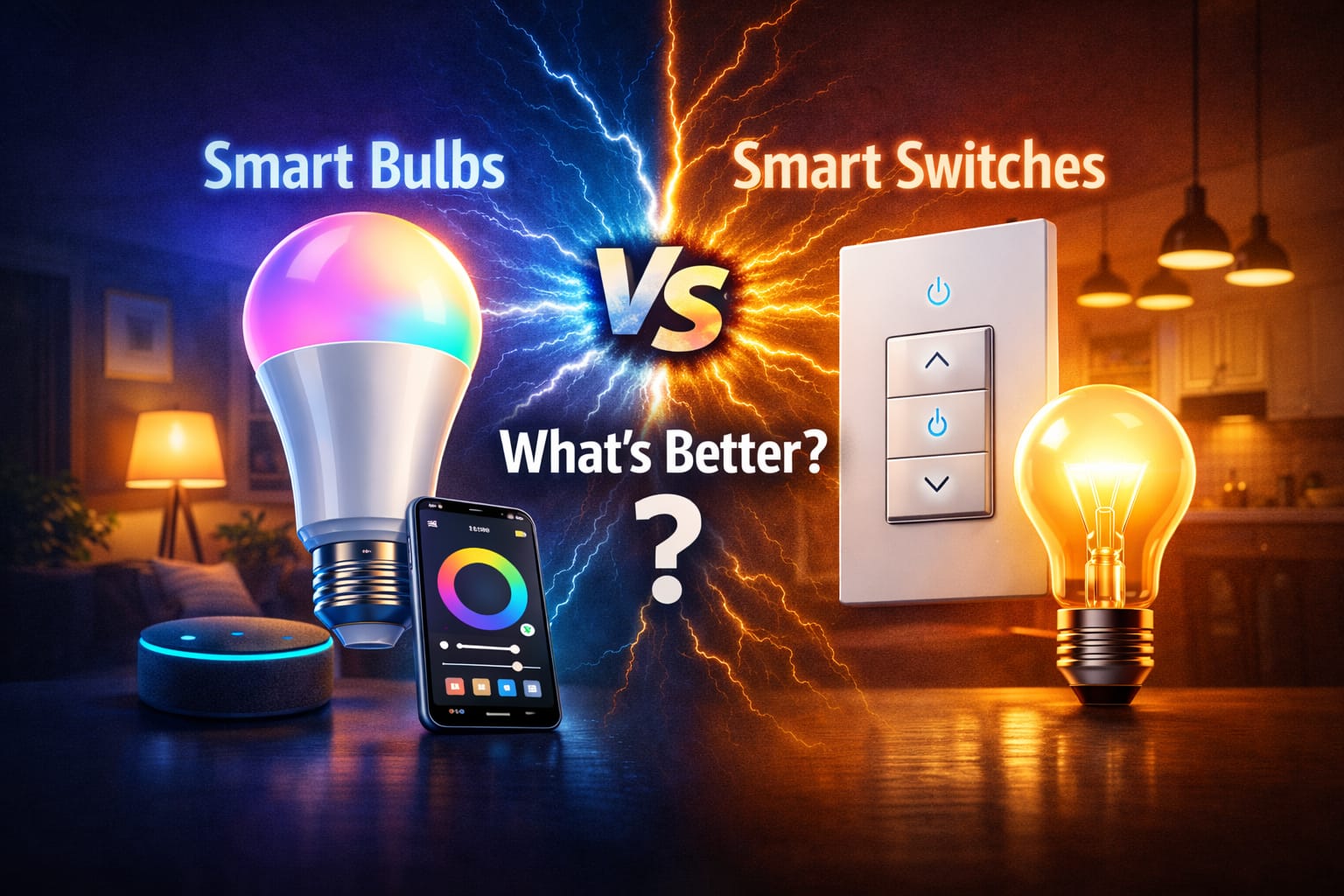
Table of Contents:
How Smart Bulbs and Smart Switches Work
The real difference between a smart bulb and a smart switch comes down to where the smart control lives. Smart bulbs place wireless controls inside each bulb, so each light can be adjusted individually. Smart switches place the control in the wall, so one switch manages power to the whole lighting circuit.
That design difference affects everyday use. Smart bulbs are flexible and feature-rich, especially if you want color control, tunable white light, or different settings for each lamp. Smart switches feel closer to traditional lighting because the wall switch remains the main control point, but app control, schedules, voice commands, and automation are added on top.
Both options can work well in a smart home, but they solve different problems. The best choice depends on how many lights are controlled by one switch, whether the room uses lamps or ceiling fixtures, how often people touch the wall switch, and whether you care more about color effects or simple whole-room control. If the connection type is part of your decision, this guide to Wi-Fi vs Bluetooth smart lighting can help you understand how different smart lights communicate.
Installation and Compatibility
Smart bulbs are the easiest starting point because they install like normal bulbs. You screw them into a compatible socket, connect them to an app, and keep the fixture powered. They are especially useful for table lamps, floor lamps, bedside lights, rental homes, and rooms where you do not want to open a switch box or change wiring.
The main weakness is power behavior. A smart bulb needs constant power to stay connected. If someone turns off the wall switch, the bulb can go offline and stop responding to app control, voice assistants, schedules, and automations until the switch is turned back on.
Smart switches require more work upfront, but they often create a cleaner long-term setup. Before buying a smart switch, check whether your switch box has a neutral wire, whether the circuit is single-pole or three-way, and whether the connected lights are dimmable and compatible. Older homes, crowded switch boxes, and multi-way circuits need extra care.
If the same light is controlled by two wall switches, such as in a hallway, stairway, or larger living room, you may need a 3-way compatible option rather than a basic single-pole switch. For that kind of setup, a Kasa 3-way smart dimmer kit for hallways and stairs is more relevant, but it still requires compatible wiring and a neutral wire.
Compatibility can decide the answer before price or features do. Smart light bulbs work well in standard sockets and portable fixtures. Smart switches are often better for recessed lights, integrated ceiling fixtures, chandeliers, track lighting, and rooms where one wall switch controls several lights. For newer ecosystems, it is also worth checking Matter smart lighting compatibility before you buy.
Do not pair smart bulbs with old dimmer switches unless the bulb manufacturer clearly supports it. Traditional dimmers can cause flickering, pairing problems, buzzing, or unreliable power. If this is already happening in your home, see our guide to LED bulbs not dimming properly.
Cost and Long-Term Value
Cost depends heavily on how many fixtures you are controlling. A single smart bulb is often affordable, but the total cost rises quickly when a room has four, six, or eight bulbs. This is why smart bulbs can feel cheap at first but become expensive in larger rooms with several sockets.
Before buying anything, count how many bulbs each wall switch controls. If one switch controls one lamp, a smart bulb may be enough. If one switch controls four or more ceiling lights, a smart switch often makes more sense.
Smart switches usually cost more per unit than a basic bulb, but one switch can control an entire circuit. In kitchens, dining rooms, hallways, living rooms, and rooms with recessed lighting, a switch-first approach can be more economical and easier to manage. Our guide to smart lighting systems explains how different control methods affect total setup cost.
Replacement costs also matter. When a standard bulb on a smart switch burns out, only the bulb needs to be replaced. When a smart bulb fails, the lighting element and the smart hardware are replaced together. Over time, switches can be the cheaper long-term option for busy rooms with main overhead lighting.
The biggest cost wildcard is installation. If you can safely install a smart switch yourself, the value can be strong. If you need an electrician for several switches, especially in an older home or complex wiring setup, the upfront cost can rise quickly. In that case, smart bulbs may still be the better first step.
Control, Scenes, and Everyday Use
The practical difference between smart light bulbs vs smart switches becomes obvious when people use the room. Smart bulbs are better when you want each light to behave differently. Smart switches are better when you want the whole room to respond in a simple, predictable way.
With smart bulbs, you can adjust brightness, color temperature, and sometimes RGB color for each fixture. That is useful in bedrooms, media rooms, desk areas, reading corners, and spaces with several lamps. The tradeoff is that setup, grouping, and scene management can become more complex as you add more devices.
With smart switches, control is usually simpler. One switch turns the room on and off, schedules can automate the whole circuit, and guests or family members can still use the wall switch normally. If voice control is important, our guide on setting up voice-controlled lighting explains how bulbs and switches can both fit into a hands-free system.
The better option depends on the room’s job. If the room needs mood lighting, color scenes, or separate lamp behavior, smart bulbs usually win. If the room needs reliable everyday lighting that everyone understands, smart switches usually win.
Where Smart Bulbs Win
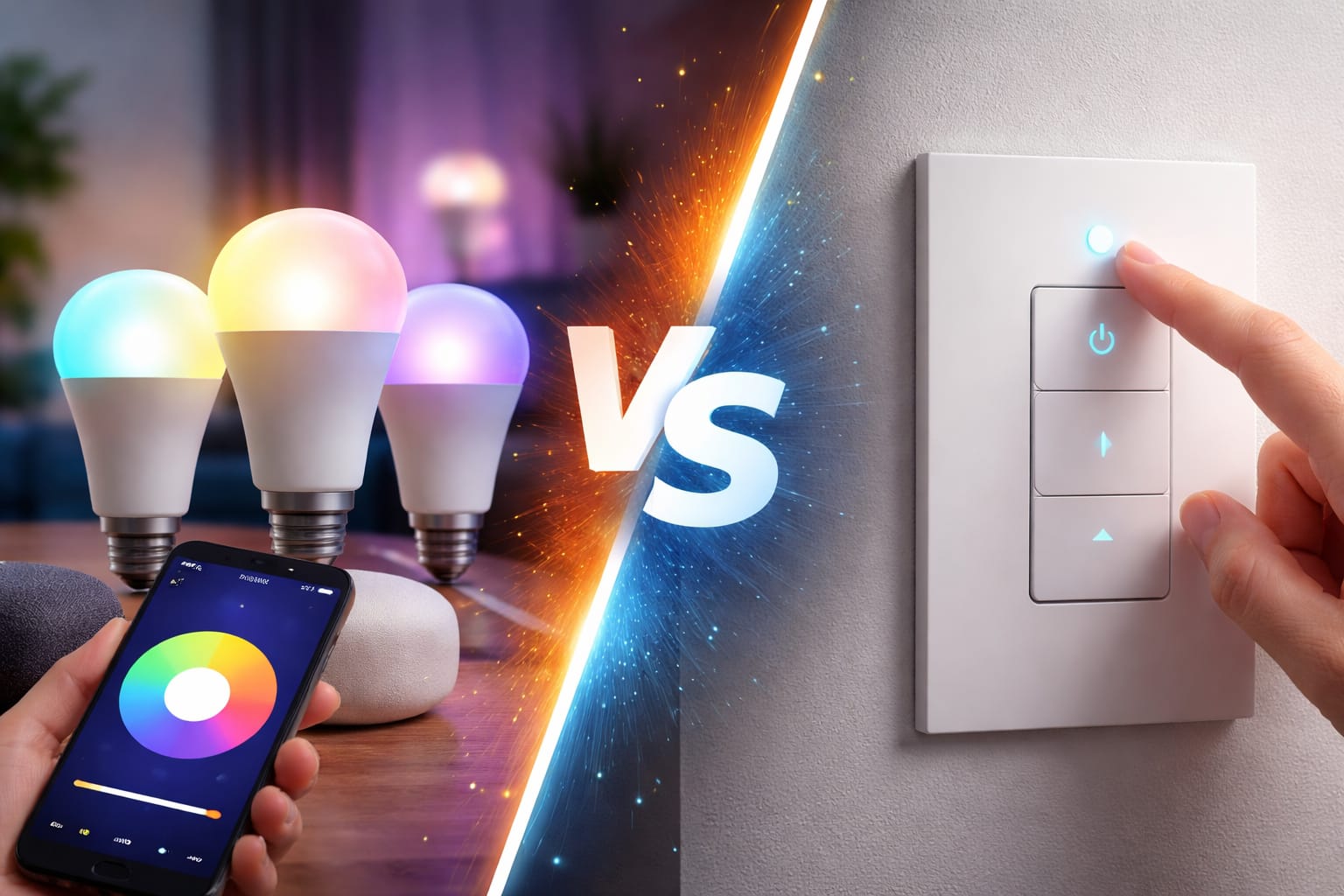
Smart bulbs win when flexibility matters more than wall-switch simplicity. Their biggest advantage is that every bulb can have its own brightness, color temperature, schedule, or scene. That makes them especially useful in rooms where lighting affects comfort, atmosphere, or focus.
Renters and apartments: smart bulbs are usually the easiest solution because they do not require permanent changes to the property. You can remove them in minutes when moving out, avoid wiring changes, and improve harsh lighting without asking for landlord approval.
Lamps and portable fixtures: table lamps, floor lamps, bedside lights, and decorative fixtures are natural matches for smart bulbs because they are controlled at the fixture level. In these cases, a smart switch can be unnecessary, while a bulb gives direct control over the actual light source.
Color and scene control: if you want warm evening light, cooler daytime light, RGB effects, or different scenes for reading, relaxing, gaming, or movie nights, smart bulbs are the clear winner. A switch can dim compatible bulbs, but it cannot turn a standard bulb into a full color-changing light source. For this kind of setup, Govee color-changing smart bulbs for lamps and bedrooms fit naturally because they are designed for app control, color scenes, and easy room-by-room upgrades.
The U.S. Department of Energy explains the energy-efficiency advantages of LED lighting, and smart LED bulbs build on that by adding app control, dimming, schedules, and customization.
Where Smart Switches Win
Smart switches win when reliable, low-friction control matters most. Their main strength is that they improve the room without changing how people expect lighting to work. The wall switch still feels like the natural control point, but you gain app control, schedules, automations, and voice compatibility.
Multi-light rooms: rooms with several hardwired fixtures often favor smart switches because one switch can control the entire circuit. This is especially useful in kitchens, dining rooms, large living rooms, hallways, chandeliers, track lighting, and recessed lighting setups.
Families and guests: a smart switch is easier for other people to use without explanation. Guests do not need an app, children do not need to remember that a wall switch must stay on, and family members can still control the lights normally. For compatible single-pole wiring with a neutral wire, Kasa single-pole smart light switches for wall control are a practical example of the switch-first approach.
Reliable power behavior: smart switches avoid one of the most common smart bulb problems: losing power at the wall. In high-traffic rooms where people naturally use the wall switch first, this can make a switch-based setup feel more dependable than a bulb-based setup.
Smart switches usually make the most sense for homeowners, long-term setups, main ceiling lights, and rooms where practicality matters more than color effects.
Best Setup by Room
The best smart lighting setup depends on the room, not just the product category. A smart switch vs smart bulb comparison is most useful when you think about how each space is actually used.
- Bedroom: use smart bulbs for bedside lamps, warm dimming, morning routines, and color temperature changes. Use a smart switch for the main ceiling light if wall control matters.
- Living room: use a smart switch for main overhead lighting and smart bulbs for table lamps, accent lights, or evening scenes. For bulb choices in this type of space, see our guide to the best LED bulbs for living rooms.
- Kitchen: smart switches usually work better because kitchens often have several ceiling lights, recessed fixtures, or under-cabinet zones controlled from the wall.
- Hallway: smart switches are usually the better option because the goal is simple, reliable control rather than individual scenes.
- Home office or desk area: smart bulbs work well for lamps where you want brighter neutral light during work and warmer light at night.
- Rental apartment: smart bulbs are usually safer and easier because they avoid permanent electrical changes.
- Dining room: a smart switch is often better for chandeliers or multi-bulb fixtures, especially if you want one clean control point.
This room-by-room approach also helps prevent overspending. Main ceiling lighting often benefits from smart switches, while lamps, bedside fixtures, and accent lights often benefit more from smart bulbs.
Hybrid Smart Lighting Setup
You do not have to choose only one technology. In many homes, the best setup is a hybrid system: smart switches for main overhead lighting and smart bulbs for lamps, accent lights, bedrooms, and color-focused areas.
A common setup is using a smart switch for the living room ceiling lights while keeping smart bulbs in table lamps to create softer evening scenes. In bedrooms, many people prefer a smart switch for the main fixture and smart bulbs for bedside lamps because routines, dimming, and color temperature matter more there.
This approach often gives the best balance of cost, convenience, and flexibility. Our guide to home lighting automation explains how to combine different smart lighting tools into a simple system that still feels easy to use.
Which Should You Choose?
When comparing smart bulbs vs smart switches, the best choice depends on the room, the wiring, the number of lights, and how people actually use the space. For most homes, the smartest answer is to use each product where it solves the right problem.
- Choose smart bulbs for lamps, rental homes, bedrooms, accent lighting, color scenes, and individual light control.
- Choose smart switches for ceiling lights, multi-light rooms, hallways, kitchens, dining rooms, and shared spaces.
- Choose smart switches when people still expect the wall switch to work normally.
- Choose smart bulbs when color temperature, RGB effects, or per-light scenes are important.
- Choose a hybrid setup if you want practical overhead lighting and flexible lamp or accent lighting.
FAQ
Are Smart Bulbs or Smart Switches Better?
Smart bulbs are better for lamps, renters, bedrooms, color scenes, and individual light control. Smart switches are better for ceiling lights, rooms with several fixtures, shared spaces, and reliable wall control. For a whole home, a hybrid setup is usually better than choosing one option everywhere.
Do Smart Bulbs Work With Normal Switches?
Yes, but the wall switch usually needs to stay on. If someone turns the switch off, the smart bulb loses power and may stop responding to app control, voice commands, schedules, and automations.
Are Smart Switches Cheaper Than Smart Bulbs?
Smart switches can be cheaper in rooms where one switch controls several lights. Smart bulbs can be cheaper for one lamp or one fixture, but the cost rises quickly when you need multiple smart bulbs in the same room.
Can You Use Smart Bulbs and Smart Switches Together?
Yes, but it works best when they are used for different jobs. Use smart switches for main overhead lighting and smart bulbs for lamps or accent lights. Avoid cutting power to smart bulbs if they need constant power to stay connected.
Key Takeaways
Smart bulbs and smart switches both improve convenience, automation, and remote control, but they are built for different lighting needs. Bulbs offer more flexibility, color features, and individual control. Switches provide better wall control, stronger everyday reliability, and better value in multi-light rooms.
The easiest way to decide is to look at each room separately. Count the fixtures, check whether people still use the wall switch, and decide whether color and per-light control are truly important or just nice to have.
For many homes, the best smart lighting system uses both: smart switches for main ceiling lights and smart bulbs for lamps, bedside fixtures, accent lighting, and scenes.
Sharing This Guide
Share this guide if you found it helpful. You can save it for later or share it with someone who is comparing smart bulbs and smart switches for their home.
Share using the links below.
Interested in learning more? Browse all related articles in our smart home lighting category.