LED Bulbs vs Halogen Bulbs: Cost, Lifespan & Heat Compared
For most home lighting, LED bulbs are better than halogen bulbs because they use far less electricity, last much longer, and produce much less heat. Halogen bulbs still have a few strengths, but for everyday fixtures, LEDs are usually the safer and more cost-effective choice.
This guide compares LED and halogen bulbs by energy use, lifespan, heat output, light quality, dimming, replacement compatibility, and total cost, so you can decide whether switching from halogen to LED makes sense for your home.
Quick Answer
LED bulbs are the better choice for most homes because they use around 80% less electricity than comparable halogen bulbs, last much longer, and run significantly cooler. Halogen bulbs can still offer excellent color quality and very smooth dimming, but they cost more to run and need more frequent replacement.
- Choose LED for lower electricity bills and longer lifespan
- Choose LED for recessed lights, daily-use fixtures, closets, and high-use rooms
- Choose halogen only for specific professional, temporary, or specialty lighting needs
- Check dimmer, voltage, fixture, and bulb base compatibility before replacing halogen with LED
- Use high-quality LEDs if color accuracy, dimming, or flicker-free performance matters
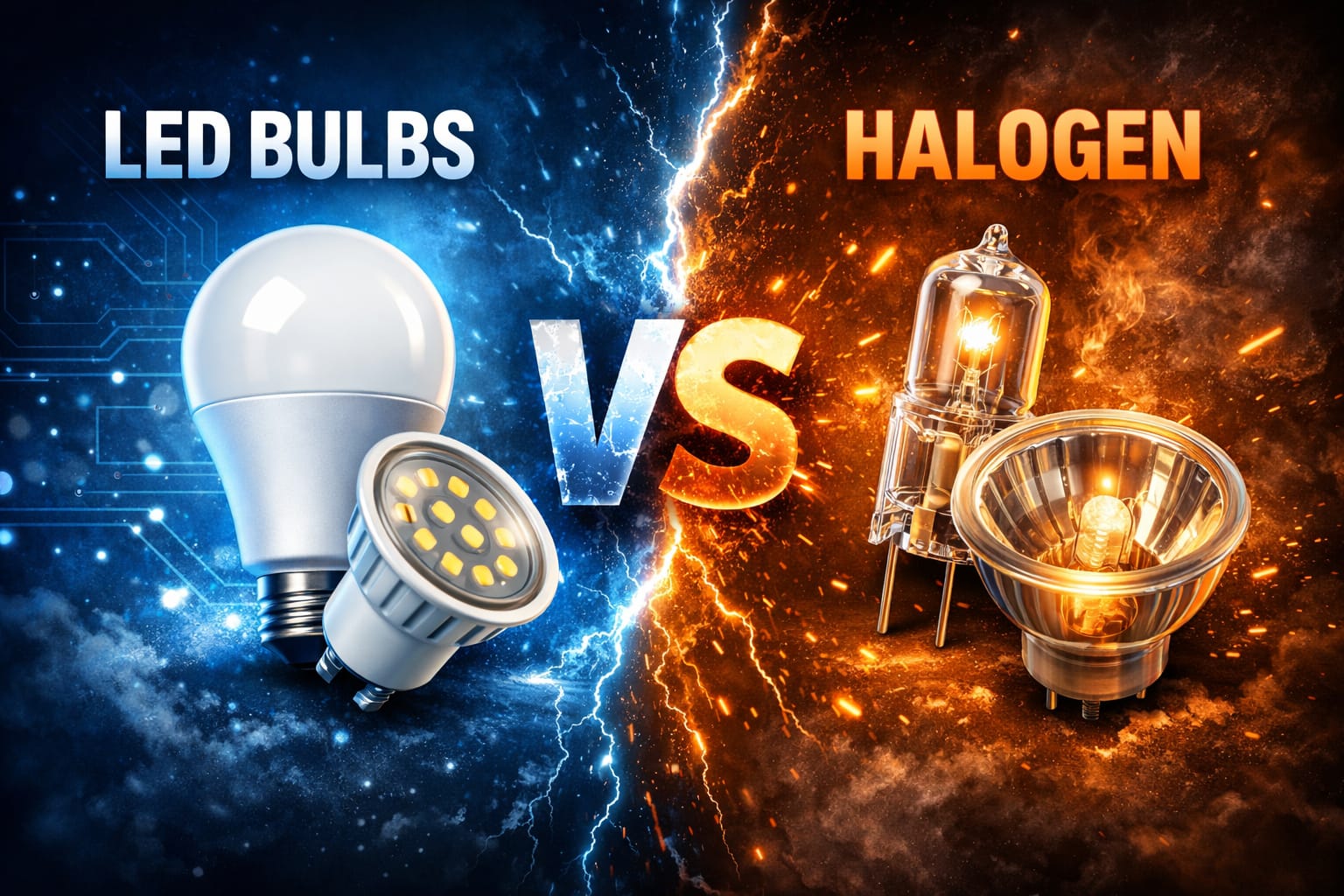
Table of Contents:
- Quick Answer
- LED vs Halogen Bulbs: Key Differences At A Glance
- How Each Technology Works
- LED vs Halogen Energy Use And Electricity Cost
- LED vs Halogen Lifespan And Replacement Frequency
- Light Output And Color Quality
- Heat Output, Fire Risk And Fixture Safety
- Purchase Price And Total Cost
- Can You Replace Halogen Bulbs With LED Bulbs?
- Environmental Impact And Disposal
- Do LED Bulbs Work With Halogen Dimmers?
- When Should You Use LED Or Halogen Bulbs?
- What Should You Choose?
- FAQ
- Key Takeaways
- Sharing This Guide
LED vs Halogen Bulbs: Key Differences at a Glance
The biggest difference between LED and halogen bulbs is how efficiently they turn electricity into visible light. Halogen bulbs create light by heating a filament, which wastes a large amount of energy as heat. LED bulbs use semiconductor technology, so more of the electricity becomes usable light instead of wasted heat.
Energy use: LED wins because it can produce similar brightness with much lower wattage.
Lifespan: LED wins because quality bulbs can last tens of thousands of hours.
Heat output: LED wins because halogen bulbs run extremely hot by design.
Color quality: Halogen is naturally excellent, but premium LEDs can now get very close.
Dimming: Halogen dims smoothly by default, while LEDs need compatible dimmers and dimmable bulbs.
For most households, the practical result is simple: LED is the better everyday choice, while halogen is mainly worth considering when a very specific lighting character, fixture type, or professional use case requires it.
How Each Technology Works
A halogen bulb is an improved version of the traditional incandescent bulb. It uses a tungsten filament inside a compact quartz envelope filled with halogen gas. When electricity heats the filament to a very high temperature, the filament glows and produces light. The halogen gas helps redeposit some evaporated tungsten back onto the filament, which gives halogen bulbs a longer lifespan than older incandescent bulbs.
The downside is heat. A filament has to become extremely hot before it produces visible light, so much of the energy used by a halogen bulb becomes thermal waste instead of useful brightness. This is the main reason halogen bulbs are less efficient than LEDs. If you want a simple explanation of the alternative technology, this guide to what LED bulbs are explains the basics clearly.
LED bulbs produce light through electroluminescence. An electrical current passes through a semiconductor material, causing electrons to release energy as photons. Because this process does not depend on heating a filament until it glows, LEDs can run cooler, last longer, and convert more electricity into visible light.
LED vs Halogen Energy Use and Electricity Cost
Energy use is where the LED vs halogen comparison becomes very practical. A typical 50-watt halogen bulb can often be replaced by a 7–10 watt LED bulb with similar usable brightness. That means the LED can deliver comparable light while using roughly 80% less electricity.
This matters most in fixtures that stay on for several hours a day. Kitchens, living rooms, bathrooms, hallways, offices, and recessed ceiling lights can all make a noticeable difference to energy use when upgraded from halogen to LED. For a deeper explanation of why wattage is not the same as brightness, see this lumens vs watts guide.
For example, ten 50-watt halogen bulbs running for five hours per day use about 2.5 kWh per day. Ten 8-watt LED replacements running for the same amount of time use about 0.4 kWh per day. Over a full year, that difference can become large enough to make the LED upgrade pay for itself, especially in high-use rooms or commercial spaces.
Start with the fixtures you use the most. Replacing rarely used halogen bulbs can wait, but upgrading daily-use rooms usually gives the fastest payback.
If your main goal is lower running cost, switching to efficient LED bulbs is usually one of the simplest lighting upgrades you can make.
LED vs Halogen Lifespan and Replacement Frequency
Halogen bulbs usually last around 2,000 to 4,000 hours, depending on quality, voltage stability, fixture temperature, and how often they are switched on and off. In a room used for several hours each day, that can mean replacing bulbs every couple of years or even sooner.
Quality LED bulbs commonly last much longer, often reaching 15,000 to 25,000 hours or more depending on the product and operating conditions. Premium models may be rated even higher. Instead of failing suddenly like a filament bulb, LEDs usually lose brightness gradually over time.
This difference is especially useful in high ceilings, recessed fixtures, outdoor lights, stairwells, garages, and other places where changing a bulb is inconvenient. In the LED vs halogen lifespan comparison, LED has the clear advantage for most everyday installations.
Light Output and Color Quality
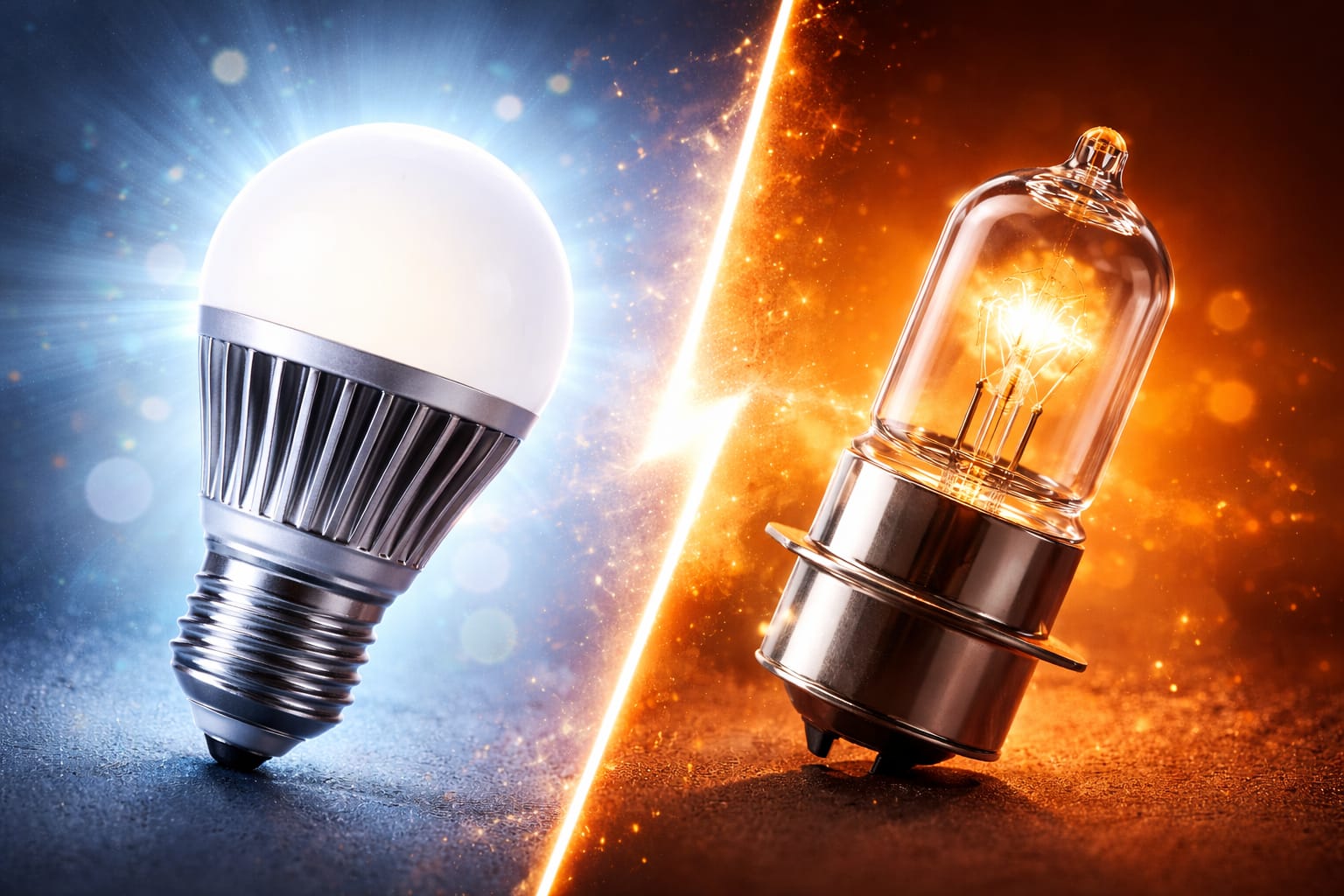
Halogen bulbs produce a warm, continuous spectrum with excellent color rendering. This is why halogen lighting has often been used in retail displays, galleries, photography, and other settings where colors need to look rich and natural.
Modern LED bulbs have improved a lot. Basic LEDs may still look flat or slightly harsh, but good-quality LEDs can offer strong color rendering, stable brightness, and a wide range of color temperatures. If you are replacing halogen in a room where color quality matters, look for LEDs with a high CRI rating, ideally 90+ for demanding spaces.
Color temperature is another important difference. Halogen bulbs usually sit close to warm white, while LED bulbs are available in warm white, neutral white, cool white, and daylight options. This gives LEDs more flexibility for bedrooms, kitchens, bathrooms, garages, offices, and task lighting. For help choosing the right tone, this guide to color temperature for home lighting explains the main options.
Choosing the Right Color Temperature
Warm white around 2700K works well in bedrooms and living rooms because it feels softer and more relaxing. Neutral white around 3000K to 4000K is useful in kitchens, bathrooms, and utility rooms where you need clearer visibility. Cooler daylight tones around 5000K to 6500K can work in garages, workshops, and task-focused spaces, but they may feel too harsh for relaxing rooms.
Smart LED bulbs add even more flexibility because they can change brightness and color temperature from one fixture. That makes them useful for home offices, multipurpose rooms, and spaces where lighting needs change throughout the day. These recommended bulbs for home office lighting include options designed for longer work sessions.
Heat Output, Fire Risk and Fixture Safety
Heat is one of the most important practical differences between halogen and LED bulbs. Halogen bulbs run extremely hot because heat is part of how they create light. The glass surface can become hot enough to burn skin, damage nearby materials, or create risk in unsuitable enclosed spaces.
LED bulbs also produce heat, but the heat is managed through the base, body, or heat sink rather than by heating a glowing filament. In normal home use, LEDs are much cooler at the light-emitting surface than halogen bulbs. However, they still need proper ventilation, and not every LED bulb is safe for every enclosed fixture.
Do not install halogen bulbs in enclosed or tight fixtures unless the fixture is clearly rated for them. Also check that any LED replacement is rated for enclosed fixtures if the bulb will be used in a sealed shade, recessed can, or compact housing.
This is especially important in closets, storage spaces, recessed ceiling lights, and older fixtures where heat can build up. Replacing halogen with LED can reduce heat stress, but the replacement bulb still has to match the fixture rating. A poor-quality LED trapped in the wrong fixture can overheat, flicker, or fail early.
If you switch to LED and notice flicker, buzzing, or unstable brightness, the issue is often related to the dimmer, transformer, minimum load, or bulb quality. In many cases, using LED-compatible dimmer switches solves the problem.
Purchase Price and Total Cost
Halogen bulbs usually cost less upfront than LED bulbs. That low purchase price can be appealing when you only need to replace one bulb quickly. But “cheap to buy” and “cheap to run” are not the same thing.
LED bulbs usually cost more at the point of purchase, especially if you choose dimmable, high-CRI, smart, or specialty models. However, they use much less electricity and usually last much longer, which makes them cheaper over time in fixtures that are used regularly.
The payback period depends on local electricity rates, daily operating hours, the price of the LED bulb, and how many halogen bulbs you replace. In high-use rooms, LEDs can often recover the extra upfront cost quickly. For a broader cost breakdown, see this LED energy savings guide.
Can You Replace Halogen Bulbs with LED Bulbs?
In many cases, yes, you can replace halogen bulbs with LED bulbs. The important part is choosing the right LED replacement, not just picking a bulb that looks similar. Before switching, check the bulb base, voltage, fixture rating, beam angle, brightness, color temperature, and dimmer compatibility.
Match the base: GU10, MR16, G9, E26, E27, and other bases are not interchangeable.
Match the voltage: Some halogen systems are mains voltage, while others use low-voltage transformers.
Check the beam angle: A narrow LED beam can feel like a spotlight, while a wider beam gives softer room coverage.
Use lumens, not watts: Choose brightness by lumen output rather than copying the old halogen wattage.
Check fixture and dimmer compatibility: Enclosed fixtures, old dimmers, and older transformers can cause problems with some LEDs.
MR16 halogen replacements deserve extra attention because many MR16 systems use transformers. Some older transformers require a minimum electrical load and may not work properly with low-wattage LEDs. If the bulb flickers, buzzes, fails to turn on, or dims poorly, the transformer or dimmer may need to be replaced with an LED-compatible version.
For GU10 halogen bulbs, replacement is often simpler because many GU10 bulbs run on mains voltage. Even then, you should still check the bulb size, beam angle, dimmability, and fixture rating before buying. If you are upgrading recessed lights, this guide to LED bulbs for recessed lighting can help you choose a better match.
Environmental Impact and Disposal
LED bulbs usually have the environmental advantage because they use much less electricity over their lifetime and need to be replaced less often. That means lower operating energy use and fewer replacement bulbs over time.
The U.S. Department of Energy explains that LED lighting is one of the most energy-efficient lighting technologies available for homes. The ENERGY STAR guide to LED lighting also emphasizes choosing quality LED products for reliable long-term performance.
Halogen bulbs do not contain mercury, but they have a short lifespan and are usually discarded more often. LED bulbs should be recycled where local programs are available, especially because they contain electronic components. For either type, check local disposal guidance instead of assuming every bulb belongs in the same bin.
Do LED Bulbs Work with Halogen Dimmers?
Halogen bulbs usually dim very smoothly on traditional dimmer switches. As they dim, the light also becomes warmer, which creates a soft effect that many people like in bedrooms, dining rooms, and living spaces.
LED bulbs can also dim well, but only when the bulb and dimmer are compatible. A dimmable LED on an old halogen dimmer may flicker, buzz, shut off early, or have a limited dimming range. This does not always mean the LED bulb is defective. It often means the dimmer was designed for a higher electrical load than the LED now uses.
If dimming quality matters, choose bulbs labeled as dimmable and pair them with an LED-compatible dimmer. Warm-dimming LEDs can also mimic the warmer color shift of halogen bulbs. These dimmable LED bulbs built for smooth low-end control are a better option than basic LEDs if you want stable performance.
If your new LED bulbs flicker, this guide to LED lights flickering can help you identify the cause. If the issue is noise instead of flicker, this guide to LED bulb buzzing explains the most common reasons.
When Should You Use LED or Halogen Bulbs?
For normal home lighting, LED is the better choice in most rooms. It is more efficient, produces less heat, lasts longer, and gives you more control over brightness and color temperature. This makes it the practical option for kitchens, living rooms, bathrooms, hallways, bedrooms, offices, garages, outdoor-rated fixtures, and most recessed lighting layouts.
Where Halogen Still Makes Sense
Halogen can still make sense in certain professional or specialty situations. Photography, film, theater, display lighting, and some technical applications may value halogen’s continuous spectrum, familiar dimming behavior, or specific beam characteristics.
For regular household use, halogen is usually only worth keeping if the fixture is difficult to upgrade, the bulb is rarely used, or the budget does not allow a full replacement yet. That is a practical limitation, not a strong technical reason to prefer halogen.
Where LED Is the Better Choice
LEDs are usually better for recessed fixtures, track lighting, under-cabinet lighting, outdoor-rated fixtures, motion-sensor lights, stairways, closets, garages, and any light that runs for several hours per day. They also perform well in colder environments and do not suffer the same filament damage risk as halogen bulbs.
Outdoor and landscape lighting can also benefit from LED replacements because lower energy use and longer lifespan reduce maintenance. Just make sure the bulb and fixture are rated for outdoor or damp/wet locations where needed.
If you want a broader comparison across different bulb types, this light bulb comparison guide can help you compare brightness, cost, lifespan, and color across multiple options.
What Should You Choose?
Choose LED bulbs for almost all everyday home lighting. They are more efficient, safer around heat-sensitive areas, longer-lasting, and cheaper to operate over time. Choose halogen only when you specifically need its color character, dimming behavior, or compatibility with an existing specialty fixture.
- If the light is used every day, switch to LED first
- If the fixture is enclosed, check the LED rating before buying
- If you have old dimmers, choose dimmable LEDs and an LED-compatible dimmer
- If you are replacing MR16 halogen bulbs, check transformer compatibility
- If color quality matters, choose high-CRI LEDs instead of the cheapest option
FAQ
Are LED Bulbs Better Than Halogen Bulbs?
Yes, LED bulbs are better than halogen bulbs for most home lighting because they use less electricity, last longer, and produce less heat. Halogen bulbs still have some niche advantages in color quality and traditional dimming, but they are less practical for everyday use.
Can I Replace Halogen Bulbs with LED Bulbs?
Yes, in many fixtures you can replace halogen bulbs with LED bulbs, but you need to match the base, voltage, brightness, beam angle, and fixture rating. MR16 systems may also need an LED-compatible transformer.
Do LED Bulbs Get as Hot as Halogen Bulbs?
No, LED bulbs usually run much cooler than halogen bulbs at the light-emitting surface. However, LEDs still produce heat in the base or heat sink, so they need proper airflow and must be suitable for the fixture where they are installed.
Do LED Bulbs Work with Halogen Dimmers?
Some LED bulbs work with older dimmers, but many perform better with LED-compatible dimmer switches. If an LED flickers, buzzes, or does not dim smoothly, the dimmer may be incompatible.
Which Lasts Longer, LED or Halogen?
LED bulbs last much longer than halogen bulbs in most normal conditions. Halogen bulbs often last a few thousand hours, while quality LED bulbs can last tens of thousands of hours depending on the product, fixture, and operating temperature.
Key Takeaways
In the LED bulbs vs halogen comparison, LED is the better choice for most homes because it uses less electricity, lasts longer, and produces less heat. Halogen still has value in certain specialty situations, but it is rarely the most practical everyday option.
The most important thing when switching from halogen to LED is compatibility. Match the bulb base, voltage, brightness, beam angle, fixture rating, and dimmer setup before buying replacements.
The smartest upgrade strategy is to start with high-use fixtures first. Over time, replacing halogen bulbs with quality LEDs can reduce energy use, lower maintenance, improve comfort, and make your lighting safer and more flexible.
Sharing This Guide
If you found this guide helpful, save it or share it with someone who still uses halogen bulbs.
Interested in learning more? Browse all related articles in our category section.
Comments are closed.