Basement Lighting Ideas: Best Lights for Dark & Low Ceilings
Most basements feel dark for three reasons: low ceilings, weak center fixtures, and corners that never get enough light. The best basement lighting ideas fix those problems with low-profile ceiling lights, wider beam spread, and layered lighting instead of relying on one brighter bulb.
For finished basements, start with 3000K to 4000K lighting for a bright but comfortable feel. For storage, laundry, gyms, or utility areas, 4000K to 5000K can give cleaner visibility. This guide shows how to brighten a dark basement, what works for low ceilings, and which basement lighting options make the most sense before you buy.

Quick Answer
For most dark basements, use several low-profile ceiling lights instead of one central bulb. Recessed or slim flush lights work best for low ceilings, 3000K to 4000K works well for finished rooms, and 4000K to 5000K works better for storage, laundry, gyms, or utility areas. Add lamps, strips, or wall lighting near corners if the room still feels flat.
Table of Contents:
- Why Dark Basements Need a Different Lighting Plan
- Best Basement Lighting Setup for Dark and Low-Ceiling Spaces
- Choose Brightness and Color Temperature Before Fixtures
- Best Overhead Lights for Basements: Flush, Recessed, or Linear
- Build Lighting Zones Instead of Glare
- Common Mistakes That Keep a Basement Gloomy
- Which Basement Light Should You Choose?
- Quick Buying Checklist
- FAQs
- Sharing This Guide
Why Dark Basements Need a Different Lighting Plan
Many lower-level rooms are not truly underlit. They have poor light distribution. A single fixture may make the center of the room bright while the walls, corners, shelves, and seating areas stay dull. That contrast makes the ceiling feel heavy and the basement feel smaller than it really is.
This is why dark basement lighting ideas need to focus on spread, bounce, and layers, not only raw brightness. If your room has few windows, deep paint colors, dark floors, exposed joists, or a charcoal sofa, it may need more total illumination than an upstairs room of the same size. The same problem appears in other low-daylight spaces, so our guide to lighting for windowless rooms is useful if your basement gets almost no natural light.
Finishes matter too. Dark floors, navy walls, matte black shelves, and exposed ceilings absorb light before it can bounce around the room. If your basement has deep colors or heavy materials, our article on lighting rooms with dark walls can help you understand why the same bulb can look bright in one room and weak in another.
Before replacing every fixture, shine a bright lamp toward the wall and corners. If the room still looks muddy, the problem is probably poor coverage and low reflectance, not only a weak bulb.
Best Basement Lighting Setup for Dark and Low-Ceiling Spaces
The best basement lighting setup usually combines three layers: broad overhead light for general visibility, softer edge lighting to make the room feel wider, and task lighting where people read, work, sort laundry, exercise, or use tools. This is the same basic principle behind ambient vs task vs accent lighting, but it matters even more in a basement because the room often starts with less daylight and more shadow.
For low ceilings, avoid anything that hangs too far into the room unless it is over a table or a clear walking-free zone. A low basement feels taller when the light reaches the walls and ceiling edges instead of dropping straight down to the floor. Shallow flush mounts, wafer lights, recessed lights, linear LEDs, wall washing, shelf lighting, and concealed strips usually work better than bulky pendants or a single decorative fixture.
If your main problem is headroom, the most useful searches for basement lighting ideas for low ceilings usually lead to the same rule: keep the fixture shallow and the beam wide. Our guide to lighting for low ceilings explains why shallow mounts and indirect light often make a room feel more open than one powerful fixture in the middle can.
For a finished basement with limited headroom, a low-profile flush ceiling light for low basement ceilings can make sense when you need bright overhead output without adding visual bulk. Use it as part of the main layer, then add lamps, strips, or wall lighting near the edges if the corners still look flat.
Best setup: For most dark basements, use one main ceiling layer, one softer edge layer, and one task layer. That combination usually makes the room feel brighter and more comfortable than replacing one central fixture with a stronger one.
Choose Brightness and Color Temperature Before Fixtures
A lot of bad basement lighting purchases happen because the fixture looks good online but does not deliver enough useful light for the room. Start with the basement size, ceiling height, wall color, and use of the space. A storage-heavy basement may need around 50 lumens per square foot, while a workshop, laundry, gym, or hobby area can need 80 to 100 lumens per square foot. For closer planning, our how many lumens per room guide can help you turn room size into a practical target.
A finished rec room, office, or playroom often needs more light than expected because basements have limited daylight and darker finishes. A large lower level may need 20,000 lumens or more overall, but that total should be divided across several sources instead of forced through one harsh ceiling unit. Splitting light into layers helps the basement feel brighter without making the room uncomfortable.
Color temperature should match how the basement is used. For movie rooms, guest spaces, family rooms, and relaxed seating zones, 2700K to 3000K feels warmer and more comfortable. For offices, laundry rooms, storage, gyms, and utility areas, 4000K to 5000K gives sharper visibility. For mixed-use basements, 3000K to 4000K is usually the safest middle ground.
LEDs are usually the best choice for basement lighting because they deliver strong output with lower energy use and long service life. The U.S. Department of Energy LED lighting guidance and the ENERGY STAR guide to LED lighting basics both reinforce the efficiency advantage of LED lighting, which matters when a basement needs multiple fixtures running at the same time.
✅ Total lumen output
Plan for the whole room, not one fixture. Large lower levels often need several sources working together to feel even.
✅ Fixture depth
Low ceilings benefit from slim flush mounts, wafer lights, recessed lights, or linear fixtures that do not hang into the room.
✅ Color temperature
Use warmer light for comfort zones and cooler light where visibility matters. Avoid mixing random temperatures in the same open area.
✅ Beam spread and coverage
Wide beams over 100 degrees help fill a broad room, while narrow beams work better as accents and are rarely enough on their own.
Best Overhead Lights for Basements: Flush, Recessed, or Linear
Overhead lighting is still the backbone of most basement lighting ideas, but the best choice depends on the ceiling and the purpose of the room. Flush mounts work well in finished basements with drywall ceilings. Recessed and wafer lights keep the ceiling clean when you want a more built-in look. Linear LED fixtures are practical for storage rooms, laundry areas, home gyms, utility spaces, and unfinished basements.
Recessed lighting is worth considering when you want clean sightlines, flexible spacing, and broad coverage without visual clutter. It works especially well when the room is finished and you want the ceiling to disappear instead of becoming the focus. A smart recessed layout places lights by zone, not only in a perfect grid, so walkways, seating, shelves, and work areas each get the coverage they need.
For open storage, laundry, workshop, or multipurpose zones, a bright linear ceiling fixture can be one of the best lights for basement areas because it throws a wide beam and gives immediate visibility across shelves, bins, equipment, and work surfaces. If you are upgrading a dark unfinished or utility-heavy space, a broad-beam 5000K ceiling light for utility basements fits that problem better than a decorative fixture that looks good but leaves the edges dim.
If you are still shaping the layout, our beginner guide to lighting design can help you think through spacing, layers, and fixture placement before you commit to a ceiling plan.
Build Lighting Zones Instead of Glare
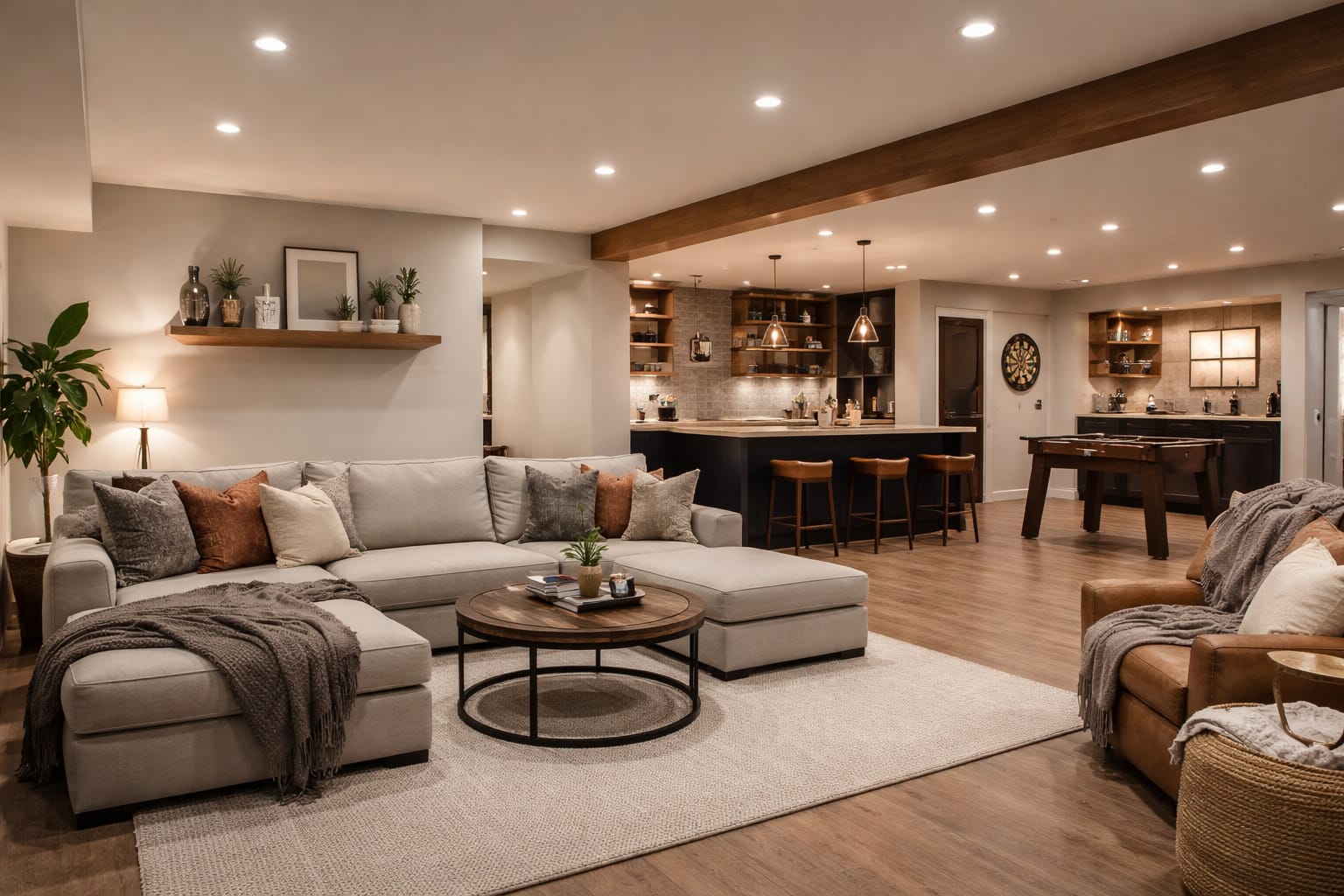
The most livable basement lighting ideas divide the room by use. A finished basement may need circulation lighting for walking through the room, warmer ambient lighting for relaxing, brighter task lighting for a desk or laundry area, and accent lighting near shelves, media walls, or corners. That zone-based approach makes the room more useful than one setting that tries to do everything.
A TV area needs controlled, low-glare light behind or beside the screen. A small office needs directed light from above or from the side. A storage wall needs wide, practical coverage. A gym or laundry area often needs brighter, cooler light than a couch zone. If part of your lower level works like a utility or workshop space, you can borrow ideas from our guide to best LED lights for garages, where coverage and visibility matter more than decoration.
This is also where edge lighting helps. Shelf strips, wall washers, floor lamps, and cove lighting can make the perimeter feel brighter without blasting the whole room from above. That matters because a basement often feels gloomy when the walls disappear into shadow, even if the center of the room has enough light.
Do not mix random bulb colors in the same open basement. One 2700K lamp next to 5000K ceiling fixtures can make skin tones, paint colors, and furniture look inconsistent, which often reads as dimness even when the room is technically bright.
Common Mistakes That Keep a Basement Gloomy
The biggest mistake is single-source lighting. One central fixture often creates a bright spot in the middle and leaves the edges underlit. That makes the room feel smaller and less finished. A better plan spreads moderate light across several points so your eyes do not keep adjusting between a bright center and dark surroundings.
The second mistake is choosing a decorative fixture before checking lumen output, beam angle, and depth. A fixture can look perfect in a product photo and still perform badly in a basement if it throws light too narrowly or hangs too low. The third mistake is using cool white everywhere because it looks brighter on the box. Cool light can work well in storage or laundry zones, but it may feel sterile in a family room or media space.
Another mistake is ignoring the room finishes. Dark shelves, exposed beams, black furniture, and deep flooring absorb light. In those spaces, a better fixture helps, but adding light to the walls and corners often changes the perceived brightness faster than simply buying a stronger central ceiling light. For broader planning ideas across the home, browse our LED Knowledge Center.
Which Basement Light Should You Choose?
The right basement light depends on the ceiling height, finish level, and how the room is used. Use the guide below as a practical shortcut before buying fixtures.
- ✓ Finished basement with low ceiling: Choose slim flush mounts, wafer lights, or recessed LEDs. Keep fixtures shallow and spread them across the room instead of relying on one central light.
- ✓ Unfinished basement, storage, laundry, or utility zone: Choose linear LED fixtures or bright overhead lights with wide beam spread. Prioritize visibility, durability, and simple placement over decorative style.
- ✓ Family room, guest room, or media area: Use moderate overhead light, warmer lamps, and soft edge lighting. Avoid blasting the sofa or TV wall with harsh cool light.
- ✓ Basement office or homework corner: Use task lighting near the desk plus enough ceiling light to avoid strong contrast between the work surface and the rest of the room.
If your room still feels cave-like after upgrading the main fixtures, add light to the edges first. Corners, shelves, and wall surfaces often change the perceived size of a basement faster than another bright bulb in the middle.
Quick Buying Checklist
Before you buy basement lights, match the fixture to the room instead of the product photo. Good basement lighting ideas are easier to execute when you know the ceiling type, room use, and where darkness actually shows up.
- ✓ Measure square footage first so you can estimate a realistic lumen target instead of guessing.
- ✓ Check ceiling height before choosing pendants, semi-flush fixtures, or anything that hangs down.
- ✓ Use flush, recessed, wafer, or linear fixtures when the room has limited headroom.
- ✓ Pick color temperature by zone: warmer for comfort, cooler for chores, storage, gyms, and work areas.
- ✓ Add edge lighting if corners still look dull after the overhead layer is installed.
- ✓ Check dimming compatibility if the basement changes from chores to movie nights or guests.
FAQs
These quick answers cover the decisions that usually delay a basement lighting project: fixture type, color temperature, ceiling coverage, and whether recessed lights are enough on their own.
What lights work best for a low basement ceiling?
Slim flush mounts, wafer lights, recessed LEDs, and shallow linear fixtures usually work best for low basement ceilings. They keep the room visually open and spread light without hanging into the walking area.
What color temperature works best in a basement?
For most finished basements, 3000K to 4000K works best because it feels bright without looking harsh. Use 2700K to 3000K in movie or lounge zones, and 4000K to 5000K over desks, laundry areas, gyms, storage, or workshops.
Are recessed lights enough for a finished basement?
Recessed lights can be the main ceiling layer, but they rarely solve everything on their own. A finished basement usually feels better with recessed lights plus wall washing, lamps, under-shelf lighting, or other accent layers near the edges.
How many ceiling lights does a typical 400-square-foot basement need?
A 400-square-foot basement often needs about 20,000 to 32,000 lumens overall, depending on how it is used. That usually means several ceiling fixtures plus extra task or edge lighting near seating, storage, laundry, or work areas.
Key Takeaways
The best basement lighting ideas do not depend on a single bright fixture. They work because they combine enough overall lumens, smart overhead placement, low-profile fixtures, and secondary lighting around the edges of the room.
For dark, low-ceiling basements, start with shallow overhead lights, then add wall, shelf, lamp, or strip lighting where corners still disappear. Use 3000K to 4000K for finished spaces and 4000K to 5000K for storage, laundry, gyms, or utility areas.
The most important decision is not one perfect product. It is building a lighting system that matches the ceiling height, room use, brightness target, and real shadow problems in the basement.
Sharing This Guide
If you found this guide helpful, save it or share it with someone who’s still trying to brighten a dark basement.
Interested in learning more? Browse all related articles in our category section.