MacAdam Ellipses & SDCM: What 1-Step, 3-Step and 5-Step Mean
MacAdam ellipses, also called SDCM or MacAdam steps in LED specifications, show how much LED color variation people can actually notice. The lower the step number, the tighter the color match.
For most visible LED installations, 3-step MacAdam is the safest practical target. 1-step is a premium choice for visually critical spaces, while 5-step can show mismatch when fixtures, modules, lamps, or LED strips are installed side by side.
This guide explains what MacAdam ellipses mean, how 1-step, 3-step and 5-step compare, why color temperature alone is not enough, and how to avoid visible LED color mismatch before you buy or specify products.
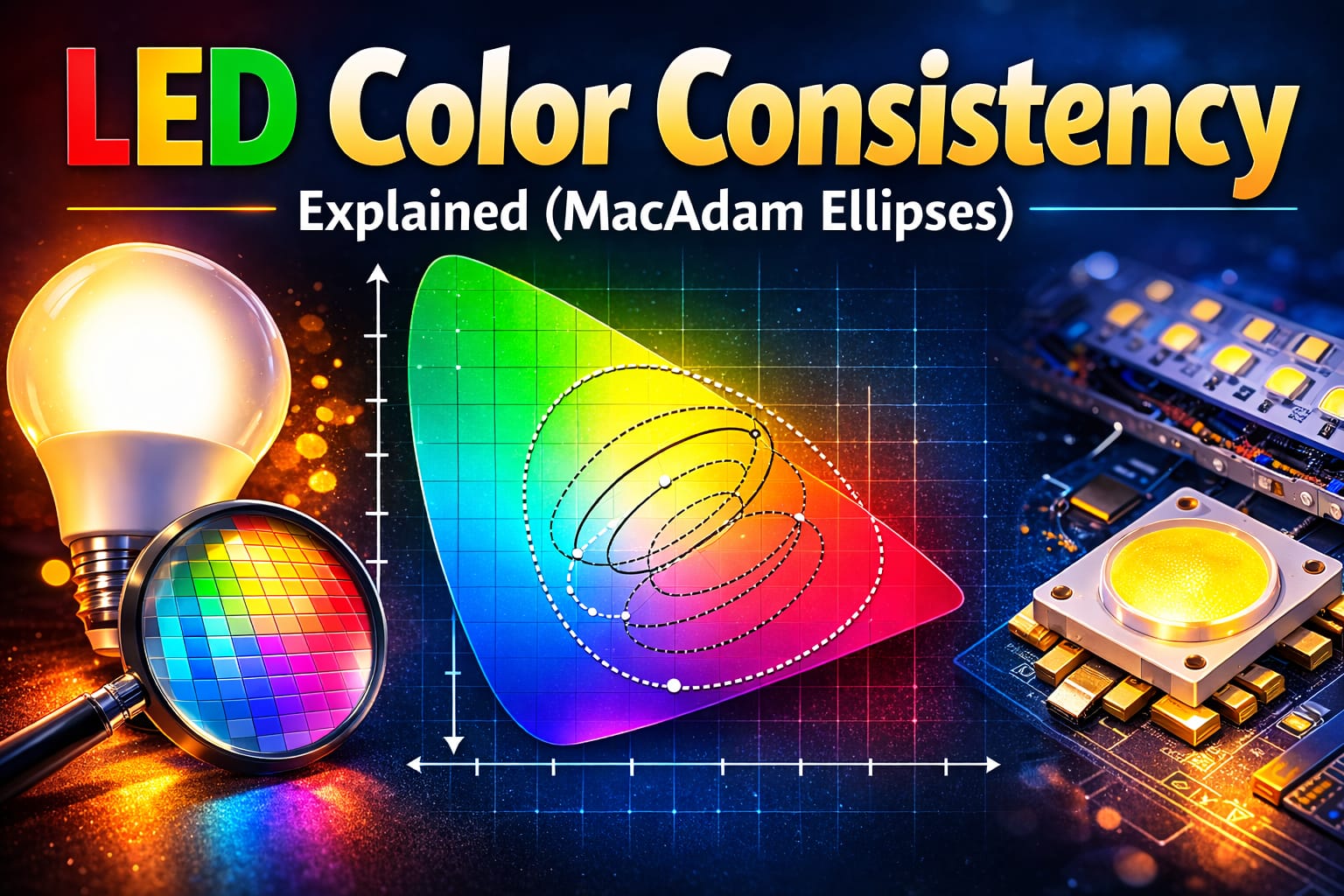
Table of Contents:
- Quick Answer
- What MacAdam Ellipses and SDCM Mean
- 1-Step vs 3-Step vs 5-Step MacAdam: Which Should You Choose?
- Why LED Color Consistency Matters in Real Projects
- How Binning, SDCM and ANSI Specs Connect
- Why LED Fixtures Still Look Mismatched
- How to Choose and Specify the Right MacAdam Step
- FAQ
- Sharing This Guide
Quick answer: MacAdam ellipses, also called SDCM or MacAdam steps, measure LED color consistency. Lower step numbers mean tighter color matching: 1-step is premium, 3-step is a safe quality target for most visible installations, and 5-step or higher is more likely to show visible mismatch.
What MacAdam Ellipses and SDCM Mean
MacAdam ellipses are visual tolerance zones plotted on a chromaticity diagram. They show the area around a target color where a shift is small enough that the average person may not notice it under controlled conditions. In LED lighting, that makes them a practical way to judge whether multiple light sources will look uniform or visibly different.
In product specifications, you may see the same idea written as SDCM, which stands for standard deviation of color matching. A lower SDCM number means the LED product is held closer to its target color point. A higher SDCM number means more variation is allowed.
This matters because two LEDs can both be labeled 3000K and still look different. One may appear slightly greener, rosier, cooler, or warmer because color temperature only describes part of the color appearance. MacAdam ellipses help explain that hidden variation instead of leaving it to guesswork.
If you want the broader technical context behind Kelvin values and warm vs cool light, our color temperature guide is a helpful foundation alongside this topic.
Key point: Color temperature tells you the general warmth of the light. MacAdam steps tell you how closely multiple products are likely to match each other.
They are called ellipses rather than circles because human color perception is not uniform across the chromaticity chart. In some regions, the eye notices very small shifts. In other regions, a larger shift is needed before the difference becomes obvious. That is why chromaticity tolerance zones change in size and direction depending on the target color point.
For LED buyers, installers, designers and specifiers, the practical takeaway is simple: if several light sources will be seen together, you need more than a matching Kelvin label. You need a reasonable MacAdam or SDCM tolerance.
1-Step vs 3-Step vs 5-Step MacAdam: Which Should You Choose?
Manufacturers often do not show the full MacAdam ellipse diagram on a product page. Instead, they use step sizes such as 1-step, 3-step or 5-step. A step is a multiple of the original just-noticeable-difference ellipse. The smaller the number, the tighter the color control.
1-step MacAdam
Very tight color control with barely noticeable variation. Best for premium architectural lighting, galleries, hospitality, display lighting and high-end residential spaces.
3-step MacAdam
The best practical target for most quality LED installations. Strong enough for visible fixture groups without the cost of the tightest premium tolerances.
5-step MacAdam and above
More likely to show visible mismatch, especially when downlights, strips, panels or lamps are close together in the same field of view.
For most readers, the safest rule is this: choose 3-step MacAdam or tighter when fixtures need to look closely matched. Choose 1-step or 2-step when the space is visually critical. Use 5-step only where small color differences are unlikely to be noticed or where budget matters more than perfect uniformity.
This is where LED color consistency becomes a real-world issue rather than just a technical term. Side-by-side products reveal differences much more clearly than isolated fixtures viewed from a distance.

What Should You Choose?
- Choose 1-step or 2-step for galleries, retail displays, hospitality, luxury interiors and spaces where color mismatch would be obvious.
- Choose 3-step for most quality residential, office, commercial and visible ceiling layouts.
- Be cautious with 5-step when several products are installed together, especially in rows, coves, shelves or one ceiling view.
- Do not rely on Kelvin alone when replacing lamps, expanding an installation or mixing products from different batches.
When fixtures will be seen in the same ceiling view, treat MacAdam step size as a visual quality decision, not just a technical detail on a datasheet.
Why LED Color Consistency Matters in Real Projects
MacAdam ellipses matter because people notice mismatch more quickly than many product pages suggest. If one downlight looks slightly pink and the next one looks slightly green, the installation can feel cheap or poorly planned even when both products technically work.
The risk is highest when fixtures are aligned in rows, placed close together, used across one ceiling view, installed in coves, or aimed at surfaces where small color shifts become obvious. White walls, artwork, merchandise, countertops and glossy finishes can make LED color variation easier to see.
This is why color consistency standards matter in hospitality, retail, museums, offices and residential spaces with visible fixture groupings. The tighter the tolerance, the more coherent the installation usually looks.
There is also a long-term dimension. LED products can shift slightly as they age, and a fixture that starts near the edge of an acceptable bin may drift into more visible mismatch later. Our LED degradation guide explains how light quality can change over time, not just brightness.
How Binning, SDCM and ANSI Specs Connect
No LED manufacturing process produces perfectly identical chips every time. Small differences in materials, wafer position, phosphor application and process control all influence final chromaticity. That is why manufacturers measure LEDs and sort them into bins.
This sorting process is known as LED binning. Each bin groups products within a target chromaticity range. Tighter bins usually mean lower yield and higher cost, which is why highly consistent LED products often cost more.
That cost difference is not just branding. It reflects real manufacturing effort to reduce LED color variation. If a project depends on fixtures matching closely, tighter binning usually matters as much as wattage, lumen output or color temperature.
Buying note: For visible LED strip runs, shelf lighting or cove lighting, try to buy from the same product line and production batch when possible. If the product page does not mention MacAdam steps or SDCM, ask the supplier before mixing batches.
In practical specifications, MacAdam ellipses often appear alongside ANSI chromaticity ranges rather than replacing them. ANSI C78.377 defines recommended chromaticity ranges for white solid-state lighting products, while MacAdam or SDCM language is used to describe how tightly the product is controlled around a target color point.
The CIE also discusses chromaticity difference using MacAdam ellipse step sizes, including how five-step MacAdam ellipses have been used in lighting tolerance specifications. You can read more in this CIE technical note on chromaticity difference.
You may also see broader quality terms such as CRI or TM-30, but those describe color rendering performance rather than simple chromaticity consistency. They are related to light quality, but they are not the same as MacAdam steps.
The same logic connects to LED chip differences, because the underlying source technology can affect how stable and consistent the finished product is.
Why LED Fixtures Still Look Mismatched
Even when a specification looks acceptable on paper, visible mismatch can still appear in real installations. The most common causes are mixing fixtures from different batches, replacing only part of an older installation, using products with loose tolerances in side-by-side layouts, or combining products from different manufacturers.
Replacement is one of the biggest traps. A new lamp may match the original Kelvin label but still come from a different bin, different production run or updated product revision. That is why large or visually important installations often benefit from spare stock set aside from the original batch.
Thermal conditions can also affect color appearance. A fixture running hotter than another may not behave exactly the same over time. Driver quality and dimming behavior can add another layer of variation, especially when products are mixed or controlled poorly.
If dimming is part of your setup, our PWM vs analog dimming guide explains why control method, driver behavior and light stability can interact.
Common mismatch scenarios
- Replacing only one or two lamps in a group of older fixtures.
- Mixing 2700K or 3000K products from different brands.
- Installing loose-tolerance LEDs in rows, coves or ceiling grids.
- Buying LED strips in separate orders and expecting a perfect match.
- Combining dimmable products with drivers or controls that affect color stability.
How to Choose and Specify the Right MacAdam Step
If color matching matters, do not specify only color temperature and wattage. Define the acceptable MacAdam step, SDCM value or equivalent chromaticity tolerance. That gives manufacturers and suppliers a clearer target and reduces the risk of an installation that looks inconsistent after it is already installed.
A practical rule of thumb is simple: 1-step to 2-step is best for premium visual spaces, 3-step is a strong general-purpose quality target, and 4-step to 5-step is acceptable only where visible mismatch is less critical.
You should also ask for consistent batch supply when possible, especially on larger jobs. A tight specification is much more useful when the delivered products actually come from the same production lot.
Specification checklist
- ✓Specify the target color temperature, such as 2700K, 3000K or 4000K.
- ✓Ask for the MacAdam step or SDCM tolerance, not just the Kelvin value.
- ✓Use 3-step or tighter when products are seen together.
- ✓Use 1-step or 2-step for premium, design-sensitive or color-critical spaces.
- ✓Ask whether the order can be supplied from one batch or one production lot.
- ✓Keep spare lamps, modules or fixtures from the same batch for future replacement.
For more advanced LED performance topics beyond this one, the LED Knowledge Center is the best place to continue.
FAQ
Is 3-Step MacAdam Good Enough?
Yes, 3-step MacAdam is usually good enough for quality LED installations where fixtures are visible together. It is often the best balance between color consistency, availability and cost. For galleries, luxury retail, hospitality or highly visible architectural lighting, 1-step or 2-step may be a better target.
Is 5-Step MacAdam Bad?
Not always. A 5-step tolerance may be acceptable in utility areas, garages, back-of-house spaces or installations where fixtures are far apart. It becomes riskier when products are installed side by side, used on visible surfaces or expected to create a clean premium look.
Can Two 3000K LEDs Still Look Different?
Yes. Two LEDs can share the same 3000K label and still look different because color temperature does not describe the full chromaticity tolerance. One product may sit slightly above or below the blackbody curve, which can make it appear greener, rosier, warmer or cooler.
Should I Mix LED Products From Different Batches?
Avoid mixing batches when color matching matters. Different production runs can have slightly different chromaticity, even when the product name and Kelvin rating are the same. For visible fixture groups, it is safer to buy the full quantity at once and keep spare stock from the same batch.
Sharing This Guide
If you found this guide helpful, save it for later or share it with someone comparing LED color consistency, SDCM values or fixture matching requirements.
Share using the links below
Interested in learning more? Browse all related articles in our category section.