Narrow Hallway Lighting Ideas: Best Fixtures to Feel Wider
The best narrow hallway lighting ideas usually start with low-profile, low-glare fixtures: recessed lights or slim flush mounts for even ceiling light, plus shallow wall sconces or soft wall washing if you want the corridor to feel wider. Avoid bulky fixtures, harsh cool-white bulbs, and wide sconces that steal visual space.
This guide shows which lights work best in tight corridors, how far apart to place them, how bright they should be, and when to use recessed lights, wall sconces, motion sensors, or warm LEDs for a brighter, calmer hallway.
Quick Answer
The best lighting for a narrow hallway is usually a low-profile, low-glare setup: recessed lights or slim flush mounts for even ceiling light, plus shallow wall sconces or wall washing if you want the hallway to feel wider. Smooth light distribution matters more than raw brightness because tight corridors quickly show glare, shadows, and bright spots.
- Choose slim fixtures that do not crowd the ceiling or walls
- Use even spacing so the hallway does not feel patchy or tunnel-like
- Pick warm white or soft-neutral white for most homes
- Use wall washing or shallow sconces to make the hallway feel wider
- Control glare before adding more brightness
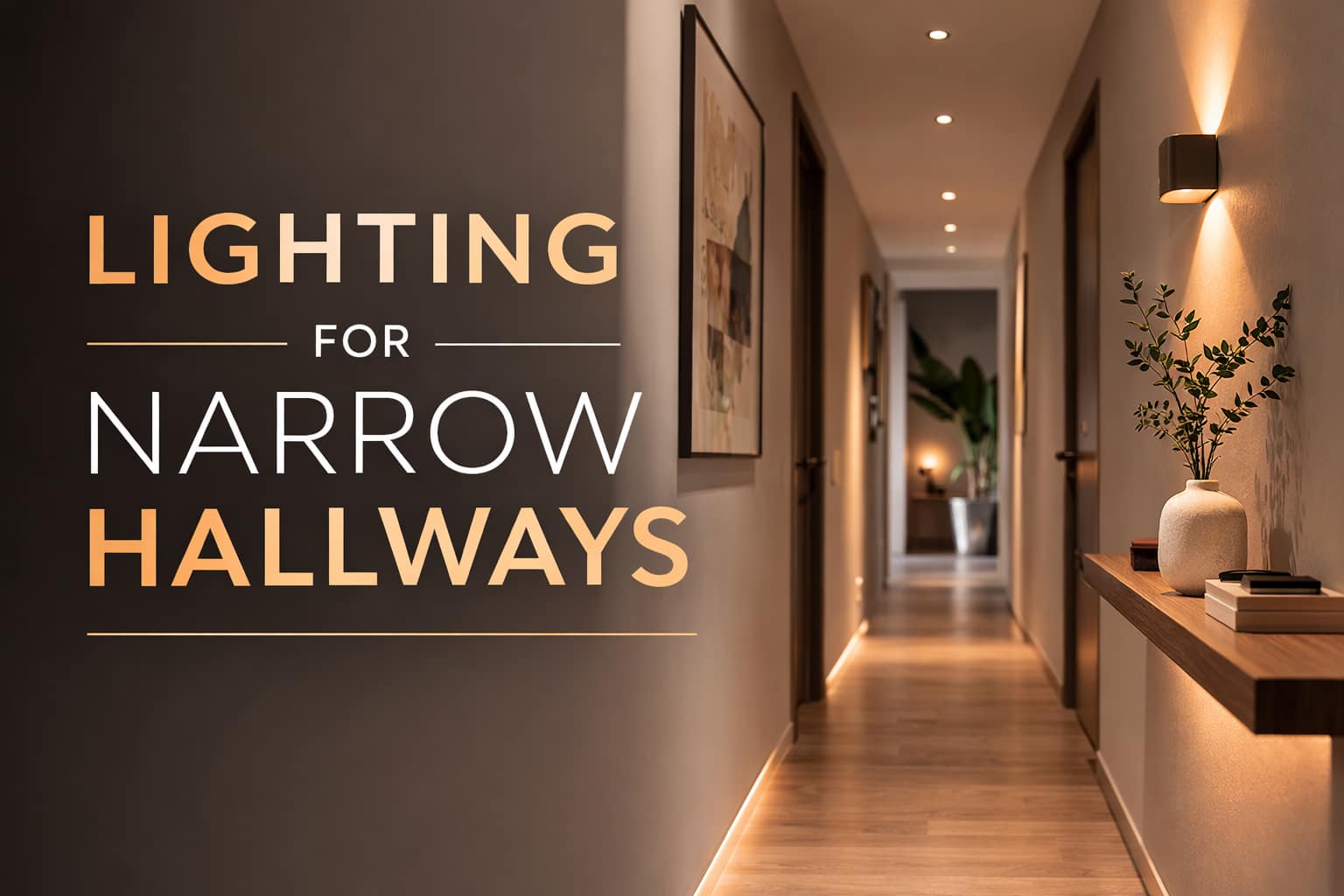
Looking at hallway lighting more broadly before narrowing the design? Our guide to best LED lights for hallways covers the main fixture types, controls, and layout ideas for standard corridors too.
Table of Contents:
Best Light Fixtures for Narrow Hallways
Choosing the right fixture is the first big decision in narrow hallway lighting. In a tight corridor, bulky lights can make the space feel more confined, while poor beam control can create glare, dark patches, or a harsh tunnel effect. The safest starting point is usually a fixture that stays visually quiet and spreads light smoothly.
If you are planning a ceiling-based setup, slim recessed LED downlights for narrow hallways can be a practical option because they keep the ceiling clean, spread light evenly, and avoid the visual bulk of larger fixtures. Use the warmer 2700K or 3000K settings for a softer residential hallway, and avoid over-spacing them if the corridor is long.
Depth matters. Wall lights that stick out too far can reduce comfort and make the hallway feel smaller than it already is. If you want decorative wall lighting without stealing usable space, choose a shallow, low-profile sconce that fits close to the wall instead of a bulky statement fixture.
Ceiling height also changes the best answer. Standard 8-foot ceilings usually work well with recessed lights or shallow flush mounts. Lower ceilings need simpler, tighter fixtures so the corridor does not feel compressed. If your hallway is both narrow and low, the advice in our lighting for low ceilings guide is especially relevant.
Simple rule: in a narrow hallway, choose fixtures that reduce visual clutter first, then adjust brightness. A brighter bulky light can still make the hallway feel worse if it adds glare or makes the corridor feel smaller.
Spacing and Brightness
Spacing is one of the biggest factors in whether a narrow hallway feels smooth or awkward. Even a good fixture can perform badly if the gaps between lights are too large. Wide gaps create alternating bright and dim zones, which can make the hallway feel longer, darker, and less comfortable.
As a general starting point, recessed lighting spacing often lands close to the ceiling height, then gets adjusted for beam spread, wall color, and layout. In many 8-foot residential hallways, that means starting around 6 to 8 feet apart and then adjusting for the real corridor rather than following a rigid formula.
Do not leave the ends of the hallway too dark. Doorways, turns, and intersections are often where poor lighting becomes most obvious. A light placed too far from the end can make the corridor feel unfinished and dim right where people enter, turn, or move toward stairs.
Brightness should feel clear and even, not aggressive. A useful residential starting point is roughly 10 to 20 lumens per square foot, which can then be adjusted based on ceiling height, wall color, floor finish, and whether the hallway also works as an entrance, stair transition, or nighttime route. Darker walls and floors usually need more light than pale, reflective finishes.
The bigger issue is comfort. If the hallway feels bright but full of hotspots or glare, it still will not feel good to use. Narrow spaces magnify glare because the eye is closer to the fixture and there is less room for light to soften. For a deeper look at this problem, see our lighting glare reduction guide.
If you are planning fixture locations before installing anything, our lighting layout planning guide can help you map spacing, end positions, and fixture placement more carefully.
In narrow hallways, slightly better spacing usually matters more than slightly stronger bulbs. Smooth overlap tends to improve comfort more than raw output does.
Where to Place Wall Sconces in a Narrow Hallway
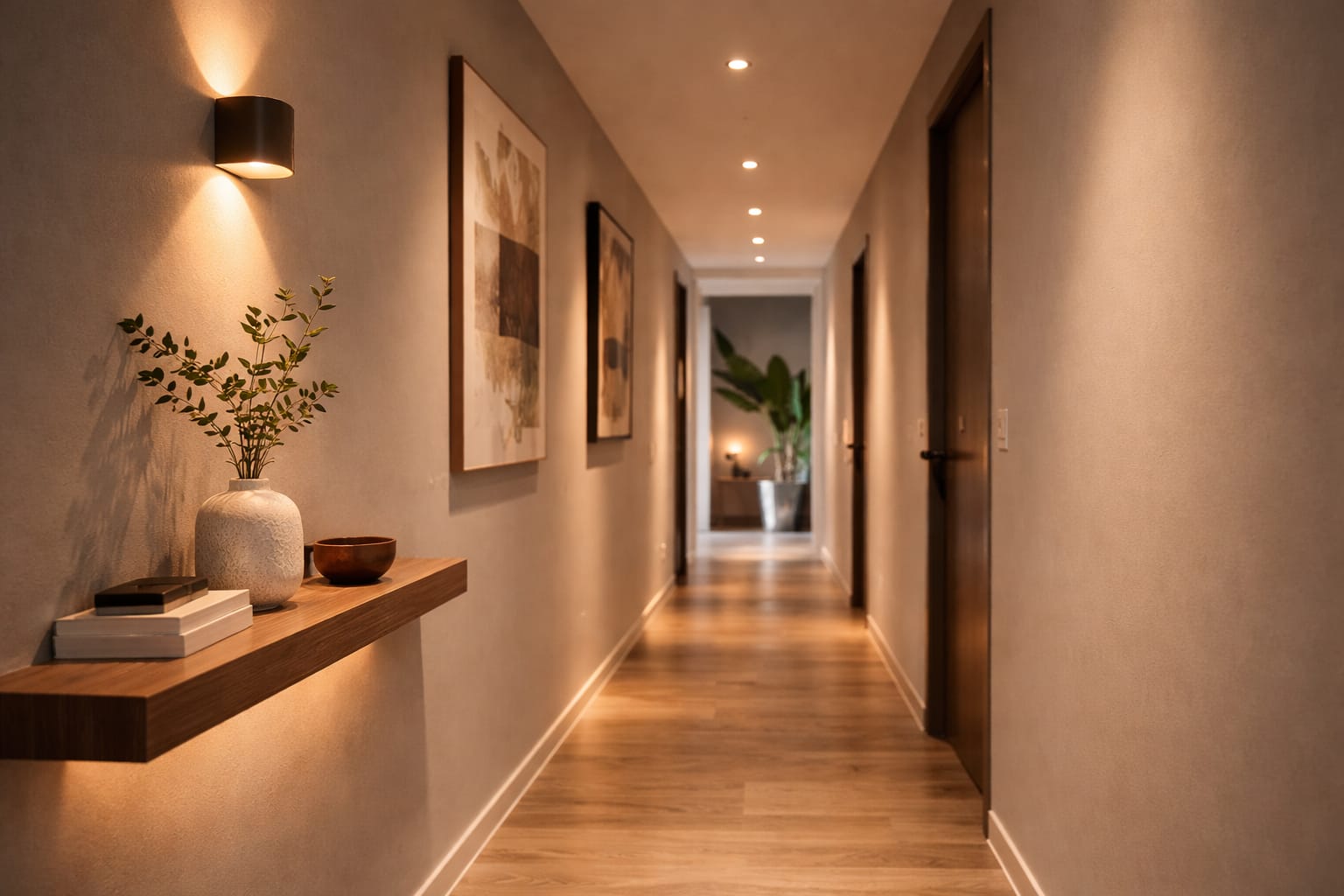
Wall sconce placement can work extremely well in narrow hallways when the fixtures are shallow, softly diffused, and positioned with care. Sconces bring light closer to eye level, add rhythm to a plain corridor, and can make the space feel more designed instead of like a leftover passage.
In tight corridors, sconces usually work best when they wash light up the wall or toward the ceiling rather than throwing a strong beam straight across the hallway. Softer vertical light draws attention outward and upward, which helps the hallway feel wider than a single row of bright downlights in the center.
Keep the fixture depth in mind before you choose the style. A sconce may look attractive in a product photo but feel intrusive in a narrow passage if it projects too far from the wall. For this reason, shallow, low-profile designs are usually safer than deep decorative fixtures in high-traffic corridors.
If you want wall lighting without making the corridor feel tighter, a shallow LED wall sconce for narrow hallways fits this use case better than a bulky fixture that sticks out into the walking path.
Hardwired sconces usually give the cleanest result during a renovation. In finished homes, plug-in or battery-powered options can still help, but they usually work better as secondary lighting than as the only source. For the strongest result, think of sconces as part of a layered plan, not just decoration.
How to Make a Narrow Hallway Feel Wider
This is where lighting for narrow hallways differs from general hallway lighting. The goal is not just visibility. It is perception. You want the corridor to feel less pinched, less dark, and less like a tunnel.
Wall washing is one of the best techniques because it brightens the vertical surfaces that define the narrowness of the space. Lighter walls, reflective finishes, mirrors, and evenly distributed light all help the eye read the corridor as more open. A single bright downlight in the center rarely has the same widening effect.
Flooring also changes the result. Dark or highly absorptive floors can make a hallway feel heavier and may require more output to feel balanced. Lighter finishes reflect more light back into the space and usually support a softer, more open look. Glossy surfaces can help with reflectivity, but too much shine can create distracting reflections if the fixtures are poorly placed.
How wide a space feels is not only about measurements. It is also about contrast, brightness balance, and where the eye is being pulled. Our lighting psychology guide explains why certain lighting setups feel calmer, wider, or more comfortable than others.
Best widening effect: light the walls softly, reduce harsh contrast, keep the ceiling fixtures slim, and avoid leaving the far end of the hallway in shadow.
Color Temperature, Controls, and Night Use
For most homes, warm white or slightly neutral white works best in narrow hallways. A range around 2700K to 3000K usually feels inviting and residential, while 3500K can work if you want a cleaner, brighter look. Very cool white often makes narrow corridors feel harder, flatter, and less comfortable.
Consistency matters too. A hallway connects rooms, so mismatched color temperatures can feel jarring fast. If the surrounding rooms are warm, keeping the hallway warm usually creates better visual flow. If you are deciding between warmer and more neutral tones, our color temperature explained guide is a useful next step.
Controls are just as important as fixture choice. In most homes, narrow hallways should have switching at both ends if possible. That makes the space easier to use and avoids walking into darkness or backtracking to turn lights off.
Motion sensor switches can work very well in hallways used briefly but frequently, especially at night, near bedrooms, or in family homes where people often pass through with full hands. If you are comparing automation options, our guide to energy savings using motion sensors fits naturally with this kind of hallway setup.
For night use, avoid making the hallway too bright. A dimmed fixture, a motion sensor night light, or soft low-level guidance usually feels better than full brightness late at night. The goal is safe movement without shocking the eyes.
Safety and Energy Efficiency
Narrow hallways need clear, stable light because there is less room for error. Floor transitions, threshold strips, and nearby stairs become more noticeable when the corridor is tight. Good lighting should make these areas easy to read without making the space harsh.
If the hallway connects directly to steps or landings, treat those zones as safety areas rather than just the end of the corridor. A single step at the end of a hallway deserves stronger visual definition, but that does not mean blasting the area with light. It means making sure the change in level is easy to see from both directions.
LEDs make sense in hallways because these are spaces where older lighting often wastes energy without adding much value. Good LED fixtures give steady output, lower running costs, and much less maintenance over time. Motion sensors and dimming can improve that even further in corridors that are used briefly but often.
The U.S. Department of Energy also highlights the value of LED lighting and controls for residential efficiency. For a broader reference point, see the U.S. Department of Energy LED lighting guidance.
A narrow hallway can feel much worse when fixtures create direct glare at eye level. In tight corridors, harsh light is usually more noticeable and more annoying than it would be in a larger room.
Common Mistakes
The most common mistake is treating a narrow corridor like any other hallway. A tight space usually needs more finesse: slimmer fixtures, better glare control, more attention to walls, and more consistent spacing.
- Using bulky fixtures: deep sconces and heavy ceiling lights can make the hallway feel smaller.
- Overlighting the corridor: too much brightness can create harsh contrast and make the space feel narrower.
- Ignoring glare: tight spaces magnify direct glare because the fixture is closer to the eye.
- Leaving dark ends: poor end positioning can make doorways, turns, and stair transitions feel unfinished or unsafe.
- Mixing color temperatures: warm rooms connected by a cool hallway can feel visually disconnected.
- Forgetting controls: bad switch placement can make an otherwise good lighting setup frustrating to use.
Also make sure dimmers, bulbs, and fixtures are compatible before installation. Flicker and unstable dimming can quickly ruin the comfort of a narrow hallway, even if the layout looks good on paper.
What Lighting Should You Choose for a Narrow Hallway?
For most homes, the smartest choice is a low-profile, low-glare setup that makes the corridor feel smoother rather than brighter for the sake of it.
- If the ceiling is low, choose shallow flush-mount or recessed lighting
- If you want the hallway to feel wider, use soft wall washing or shallow sconces
- If the corridor is long, prioritize even spacing and avoid dark end zones
- If the hallway is used at night, add dimming or motion-sensor guidance
- If glare is already a problem, prioritize diffusion before adding brightness
- If you want the safest all-round result, aim for smooth, even light with warm or soft-neutral color
Want to improve more awkward spaces around the home? The LED Knowledge Center brings together practical guides on room layouts, fixture choice, brightness, glare, and design strategy so you can make better lighting decisions with more confidence.
FAQ
What Is the Best Light for a Narrow Hallway?
The best light for a narrow hallway is usually a slim, low-glare fixture that spreads light evenly. Recessed lights, shallow flush mounts, and slim wall sconces are usually better than bulky decorative fixtures.
Are Wall Sconces Good for Narrow Hallways?
Wall sconces can be very good for narrow hallways if they are shallow and softly diffused. They work especially well when they wash light up the wall or ceiling instead of throwing a harsh beam across the corridor.
How Far Apart Should Hallway Lights Be?
A common starting point is to space recessed hallway lights roughly the same distance apart as the ceiling height. In many 8-foot hallways, that often means about 6 to 8 feet apart, then adjusted for beam spread, wall color, and corridor length. In many 8-foot hallways, that often means about 6 to 8 feet apart, then adjusted for beam spread, wall color, and corridor length.
What Color Temperature Is Best for a Narrow Hallway?
Warm white or soft-neutral white is usually best. Around 2700K to 3000K feels comfortable in most homes, while 3500K can work if you want a cleaner and slightly brighter look.
How Do You Make a Narrow Hallway Look Wider with Lighting?
Use even ceiling light, brighten the walls softly, avoid harsh glare, and keep the far end of the hallway from looking dark. Wall washing and shallow sconces can help the eye read the corridor as wider.
Sharing This Guide
If you found this guide helpful, you can save it for later or share it with a friend. It is especially useful for homeowners trying to improve tight hallways, darker corridors, or awkward transition spaces.
Share using the links below
Interested in learning more? Browse all related articles in our category section.