LED Lighting Terms Explained: What They Mean and Why They Matter
Understanding these terms makes it much easier to compare bulbs, fixtures, and product labels. Modern lighting packaging is full of technical terms—from lumens and watts to Kelvin, CRI, and efficiency claims—but once you understand those terms, choosing the right product becomes much easier.
This guide breaks down the most important specifications in plain English, helping you match brightness, color quality, efficiency, and compatibility to your room, fixture, and budget.
Quick Answer
The most important LED lighting terms tell you how bright a bulb is, how much power it uses, what color the light is, how accurately it shows colors, and whether it will work with your fixture or dimmer.
- Lumens tell you brightness.
- Watts tell you power use.
- Kelvin tells you whether the light looks warm or cool.
- CRI tells you how natural colors appear under the light.
- Dimmability, base type, voltage, and certifications help prevent compatibility issues and safety problems.
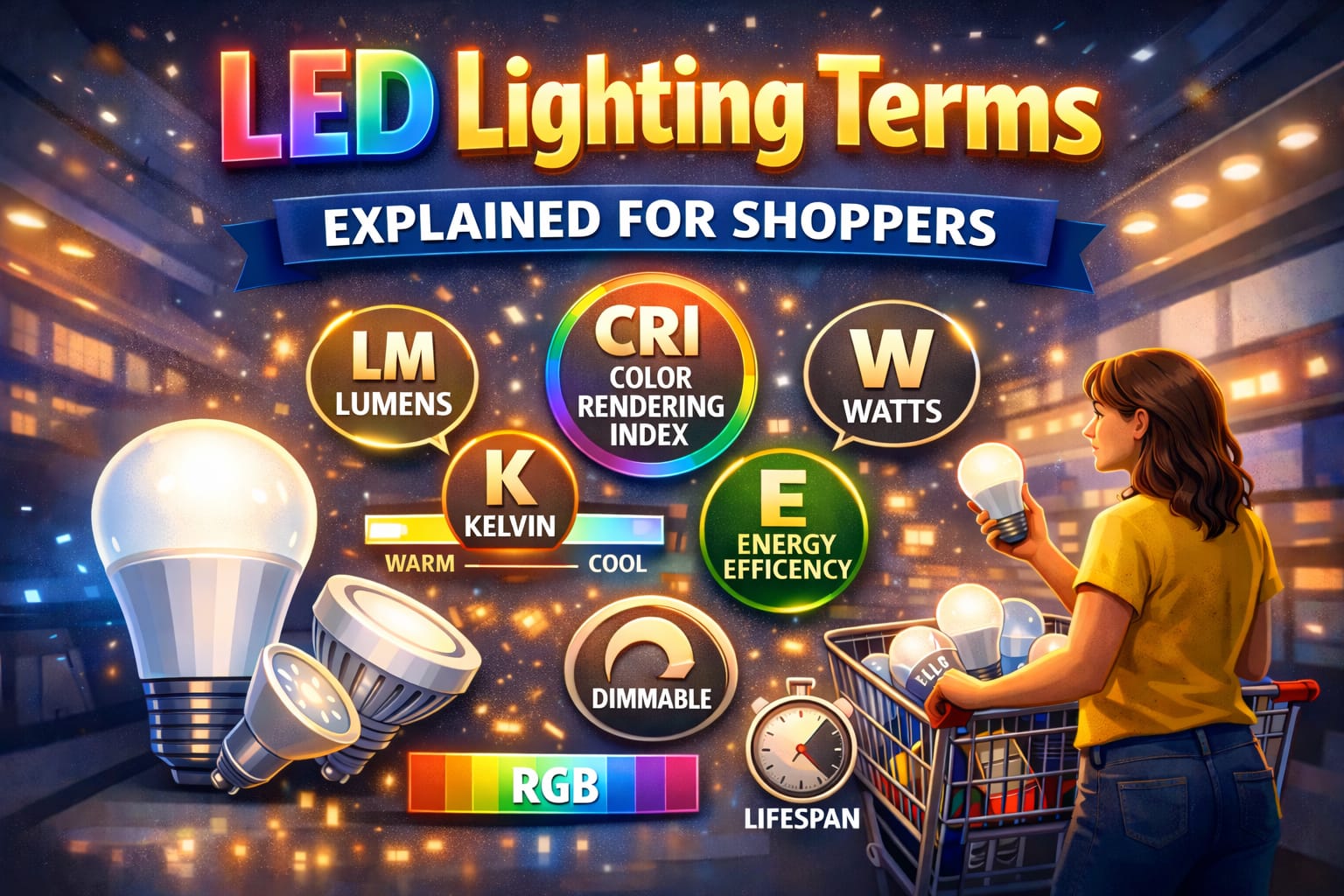
Table of Contents:
- Quick Answer
- Lumens and brightness
- Wattage and energy use
- Color Temperature and Kelvin
- CRI and color quality
- Efficiency and energy savings
- Lifespan and durability
- Beam angle and light spread
- Dimming compatibility
- Base types and sockets
- Voltage and safety
- Certification marks and standards
- Key Takeaways
- Share this guide
Lumens and brightness
Lumens measure the total amount of visible light a source produces, making them the most useful metric for comparing brightness. Many people still associate brightness with wattage, but that only made sense with older incandescent bulbs. Modern bulbs can use far less electricity while delivering the same amount of light.
For instance, a traditional 60-watt incandescent bulb produces about 800 lumens. A modern LED bulb can reach the same brightness while using only 8 to 10 watts. This is why lumens are more important than the old watt-based shortcuts that many shoppers grew up with.
When comparing bulbs, check the lumens first. Then, use the Kelvin, CRI, and beam angle to determine if the brightness will be appropriate for the room.
As a rough guide, around 450 lumens is sufficient for a small accent light, 800 lumens is sufficient for many table lamps, and 1,100 to 1,600 lumens is sufficient for brighter general lighting. Larger rooms, garages, and commercial spaces often require a much higher output. If you want a broader framework for choosing the right balance of specifications, our LED lighting buying guide ties these measurements together in a more practical way.
Manufacturers measure lumen output under controlled conditions, making the specification useful for side-by-side comparisons. However, real-world brightness also depends on fixture design, beam angle, shade materials, and how the light is positioned in the room. For those who want adjustable color temperature alongside brightness control, this smart, dimmable LED bulb lets you adjust both the light level and tone throughout the day.
Wattage and energy use
Wattage tells you how much electrical power a bulb uses, not how bright it is. This is one of the most important terms in LED lighting for people switching from older bulbs because lower wattage no longer means weaker light. In many cases, it simply means better efficiency.
An LED bulb that produces 800 lumens may use only 9 or 10 watts, whereas a similar brightness incandescent bulb could use around 60 watts. Over time, this difference can significantly reduce electricity costs, particularly in areas where lights are left on for extended periods, such as kitchens, living rooms, and offices.
Package labels often show the actual wattage and an incandescent equivalent, such as “10W (60W equivalent).” This makes shopping easier if you are used to thinking in terms of old bulb sizes. It is also useful for checking fixture limits. Fixtures rated for 60 watts usually refer to heat and power draw, so using a lower-wattage LED bulb in the same fixture is generally fine as long as the bulb fits and is suitable for the housing.
Color temperature and the Kelvin scale
Color temperature describes the appearance of white light. It does not tell you how hot the bulb gets. Instead, it indicates whether the light appears warm and yellowish, neutral, or cool and bluish. This measurement is shown in Kelvin and has a significant effect on how a room feels.
Kelvin scale basics
Correlated color temperature, usually shortened to CCT, uses the Kelvin scale to describe the tone of white light. Lower values, such as 2700K, look warm and soft, similar to traditional incandescent bulbs. Mid-range options, such as those between 3,000 and 4,000 K, feel cleaner and more neutral. Those at 5,000 K and above look cooler and closer to daylight.
The word “correlated” is important because LEDs do not produce white light in the same way that incandescent filaments do. Nevertheless, the Kelvin scale is still the standard for comparing how warm or cool a bulb will appear. Understanding this can help you avoid buying bulbs that appear too clinical, yellow, or out of place in a room.
Choosing the right color temperature for a room is important
Warm light, with a color temperature below 3000K, is usually preferred in bedrooms, dining rooms, and living areas, where comfort is the priority. Neutral and cooler options often work better in kitchens, home offices, workshops, and bathrooms, where visual clarity and alertness are more important. However, that does not mean every home needs a different temperature in every room.
One simple strategy is to use a warm setting in relaxing spaces and a neutral setting in work-focused areas. This approach maintains a consistent feel throughout the home while still matching the light to the task. If you need help understanding the specifications on LED packaging, our guide explains where to find each one and how to interpret it quickly. This measurement is shown in Kelvin and has a significant effect on how a room feels.
CRI and color quality
For many homes, a CRI of 80 or higher is sufficient. However, if you are concerned about makeup application, food presentation, artwork, photography, or other color-sensitive work, a CRI of 90 or above is preferable. Lower-quality light can make skin tones, fabrics, and surfaces appear dull or inaccurate, even when the room seems bright enough.
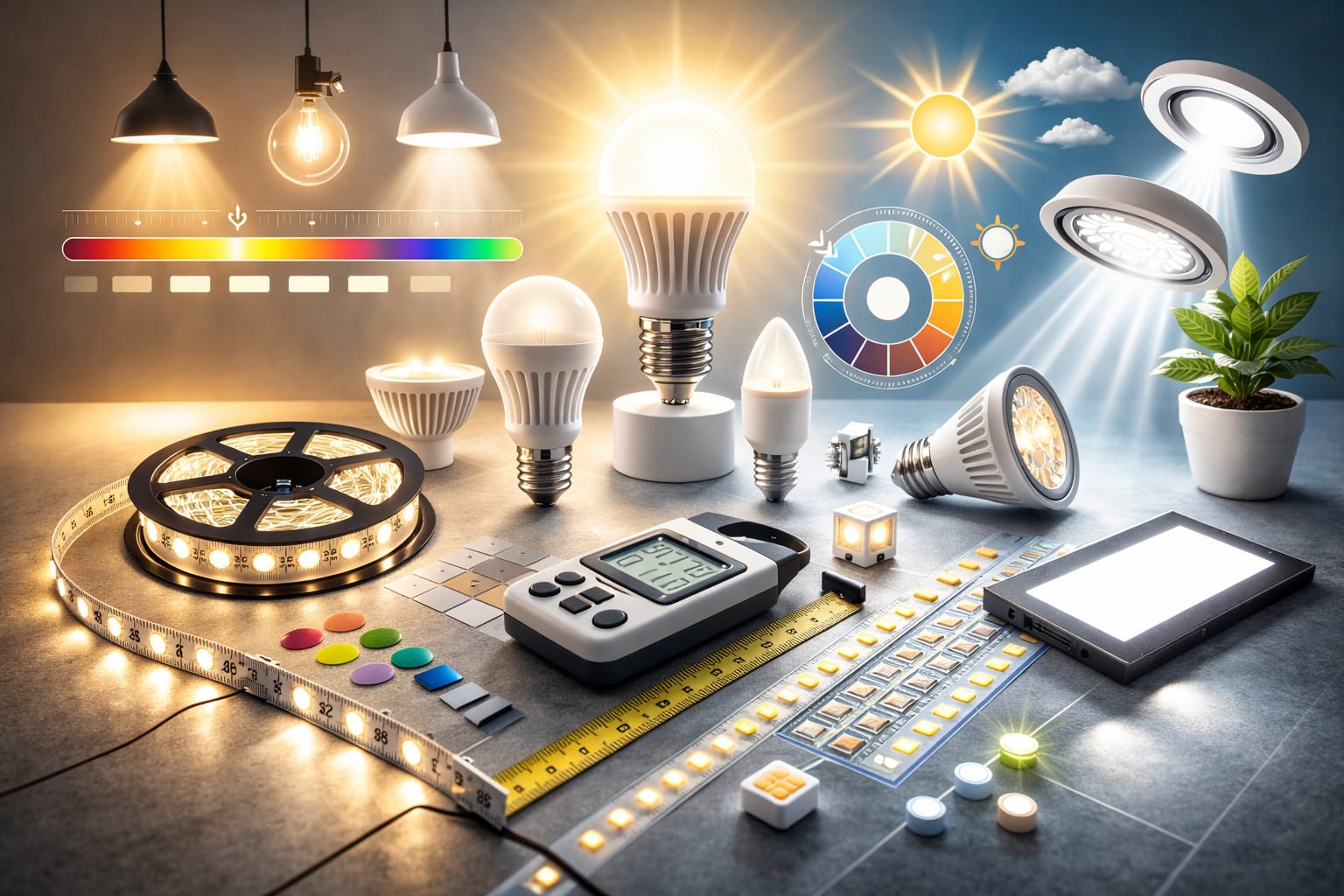
When two bulbs have similar brightness and color temperature, CRI is often the detail that distinguishes an adequate bulb from one that enhances daily life. Our light bulb comparison guide shows how CRI fits into the bigger picture when comparing different types of bulbs. To measure actual light levels in your space, use a digital lux meter to verify real-world performance instead of relying only on the package.
Efficiency ratings and energy savings
Efficiency is often expressed as lumens per watt, indicating how much light a product produces for each watt of electricity it uses. This makes it one of the most useful specifications for comparing energy performance across technologies and brands.
What do lumens per watt actually mean?
Incandescent bulbs are relatively inefficient, while modern LEDs can deliver much more light with far less wasted energy. A higher lumen-to-watt ratio usually means the bulb is converting electricity into useful light more effectively, rather than losing more of it as heat.
The highest number does not always win, since brightness, color quality, dimming behavior, and price still matter. However, when two products seem similar, a higher efficacy rating often indicates stronger long-term value due to lower operating costs.
This is why Energy Star can still be useful
Energy Star certification indicates that a product meets specific performance and efficiency standards instead of relying solely on marketing claims. These standards may include criteria related to efficacy, color consistency, startup behavior, and lifespan testing, depending on the product category.
For shoppers comparing unfamiliar brands, third-party certification provides a useful added layer of confidence. While it does not replace reading the entire label, it can help narrow the field when you want a product that has been tested beyond the manufacturer’s packaging claims.
Lifespan and durability
Rated lifespan estimates tell you how long a product is expected to perform before its light output drops to a lower level, often described as L70. In simple terms, this means that the bulb still works but has dimmed to about 70% of its original brightness. Many residential products are rated for 15,000 to 25,000 hours, while heavier-duty models may claim much more.
The real-world lifespan of a bulb depends on factors such as heat, airflow, switching frequency, driver quality, and power stability. For example, a bulb in a cool, open fixture may last much longer than one inside a poorly ventilated enclosure. For this reason, lifespan claims should be treated as estimates, not guarantees under all conditions.
Warranty coverage can also be informative. Brands that offer multi-year warranties typically have more confidence in their products’ quality. If a light fails prematurely, our guide to LED driver failure can help you determine if the issue lies with the bulb, the driver, or the installation itself.
Beam angle and light spread
Beam angle describes how widely a light spreads from the source. Narrow beams concentrate light into a smaller area, which is useful for accent lighting, highlighting artwork, or directing light toward a specific task. Wider beams spread light more broadly and usually work better for general room lighting.
This is most important with directional bulbs, recessed lights, spotlights, and track lighting. A beam that is too narrow can create harsh, bright spots and dark edges. Conversely, a beam that is too wide can waste light or reduce focus. Matching the beam angle to the ceiling height, fixture placement, and room layout significantly impacts how usable the light is.
Do not assume that a brighter bulb will fix poor coverage. Often, the real issue is the wrong beam angle rather than a lack of lumens.
If you are replacing an existing directional bulb and liked its coverage, try to match its beam angle as closely as possible. If the old setup created glare or left shadows, changing the beam spread may be more helpful than simply buying a brighter bulb.
Dimming compatibility
Dimming is one of the most misunderstood aspects of LED shopping because it depends on the compatibility of both the bulb and the control system. Seeing “dimmable” on the box is a good start, but it doesn’t guarantee smooth performance with every dimmer.
Dimmable versus non-dimmable bulbs
Non-dimmable bulbs have simpler electronics and are not designed to respond to dimming signals. Using one with a dimmer can lead to flickering, buzzing, an unstable light output, or premature bulb failure. Dimmable bulbs have extra circuitry that allows for a smoother adjustment of the light level.
Even among dimmable products, performance varies. Some dim cleanly to very low levels, while others drop suddenly, flicker near the bottom of the range, or never get very dim. Reading product reviews and consulting manufacturer compatibility notes can save you a lot of frustration.
Matching the bulb to the dimmer
Older dimmers built for incandescent bulbs often malfunction with modern, low-wattage LEDs. The issue is not always the bulb itself. Sometimes, the dimmer requires a higher electrical load than the circuit provides now, or it uses a dimming method that the bulb does not handle well.
In those cases, replacing the dimmer is often the best solution. Many manufacturers publish lists of compatible dimmers, which are worth checking before buying a large set of bulbs. If you want app control and dynamic scenes instead of a basic wall dimmer, consider these RGBIC LED strip lights, which offer more flexible control and voice assistant support.
Base types and socket standards
Base types describe how the bulb connects to the fixture. In North America, the most common household screw base is E26, while E12 is common in smaller decorative fixtures. Other products use GU10, GU5.3, G4, and other base types, depending on the fixture design and voltage requirements.
While matching the base is essential, it is not the only factor to consider. Bulb shape, diameter, and overall length also matter, especially in recessed housings, enclosed fixtures, and decorative fittings with limited space. Even if a bulb has the correct base, it may not fit properly once installed.
If you are unsure which base a fixture uses, remove the old bulb and read the label before shopping. This simple step can prevent a lot of unnecessary returns and confusion.
Voltage and safety
Voltage indicates what type of electrical supply the product is designed to use. Many standard household bulbs are built for line voltage and can connect directly to normal residential circuits. Others are designed for low-voltage systems, such as 12V or 24V setups, which rely on a transformer or driver.
This is important because using the wrong voltage can result in flickering, poor performance, failure to start, or permanent damage. Since low-voltage lighting is common in landscape systems, under-cabinet installations, vehicles, and strip-light applications, it is especially important not to assume that every product works the same way.
When in doubt, check the fixture and product labels before installation. For a broader technical background on safety, compatibility, and LED system basics, visit our LED Knowledge Center, where these topics are covered in more depth.
Certification marks and standards
Certification marks indicate whether a product has been tested for safety, compliance, or performance. Many buyers overlook these markings, but they are one of the fastest ways to distinguish a trustworthy product from a questionable one.
UL listing is commonly associated with electrical safety testing. FCC compliance is important for products that include electronics that could cause interference. In commercial lighting, DLC qualification matters for performance expectations and rebate eligibility. While these labels do not make a bulb perfect, they add a layer of credibility when comparing unfamiliar brands or marketplace listings.
A lack of clear safety or compliance information, or minimal technical detail provided by the seller, is usually a reason to be cautious. Good packaging makes these terms easy to find, rather than burying them in vague marketing language.
Key Takeaways
The most useful LED lighting terms affect real buying decisions. These terms include lumens for brightness, watts for energy use, Kelvin for light appearance, CRI for color quality, and compatibility details such as dimming, voltage, and base type.
When comparing products, start with the basics. Ensure that the bulb fits the fixture, matches the correct voltage, and delivers the desired brightness and color tone before being distracted by marketing claims or flashy packaging.
Once these terms become familiar, product labels will no longer look technical, but rather useful. This will make future lighting purchases faster, smarter, and much less frustrating.
Share this guide!
If it helped you understand LED lighting terms more clearly, save it for later or send it to someone who is comparing bulbs, fixtures, or smart lighting products for the first time.
Use the links below to share it:
Interested in learning more? Browse related articles in our LED Buying Guides category.