Waterproof LED Strip Lights for Bathroom, Kitchen & Outdoors
Waterproof LED strip lights are useful in bathrooms, kitchens, patios, laundry areas, basements, and other damp spaces, but only when the protection level matches the real conditions. IP65 is usually enough for splashes, steam, and covered areas, while IP67 or IP68 is safer for harsher outdoor exposure or continuous water contact.
This guide focuses on where waterproof LED strip lights make sense, where they are unnecessary, and what parts of the installation need protection beyond the strip itself. If you’re new to strip lighting altogether, our complete beginner’s guide to LED strip lights is the best place to start before choosing a waterproof option.
Quick Answer
For most homes, IP65 waterproof LED strip lights are enough for bathrooms, kitchens, laundry areas, and covered outdoor spaces. Choose IP67 for more exposed exterior installations, and choose IP68 only when the product is specifically designed for continuous water exposure.
- Use IP20 only in dry indoor areas with no moisture risk.
- Choose IP65 for splashes, steam, humidity, and covered outdoor areas.
- Choose IP67 for stronger exterior protection and temporary wet exposure.
- Choose IP68 only for strips designed for continuous water exposure.
- Protect the connectors, cut ends, controller, wiring, and power supply too.
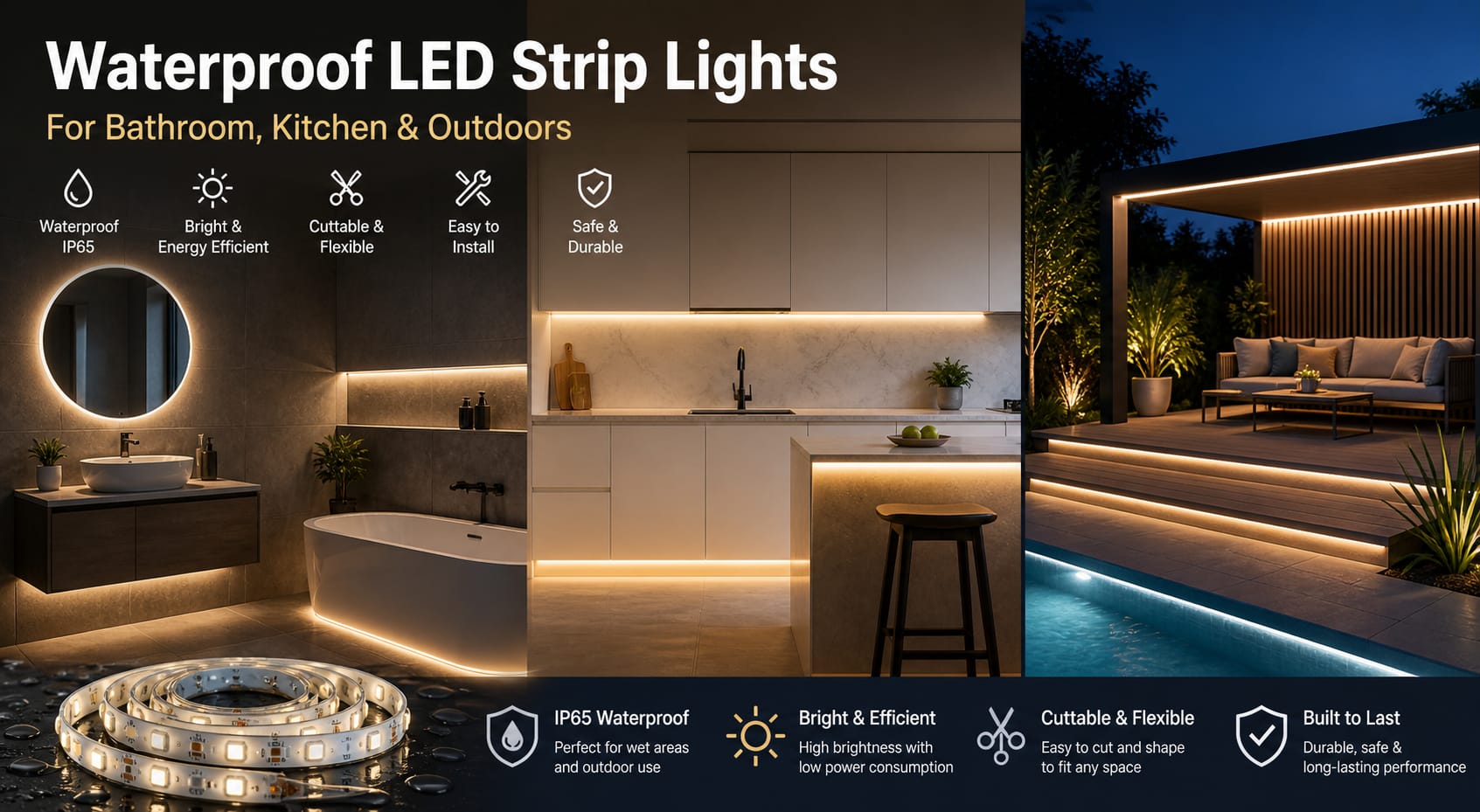
Table of Contents:
- Quick Answer
- Understanding Protection Levels
- IP Rating Summary
- Types of Protective Coatings
- Where to Use Waterproof LED Strip Lights Indoors
- Waterproof LED Strip Lights for Bathrooms
- Waterproof LED Strip Lights for Kitchens
- Outdoor Waterproof LED Strip Lights
- Moisture-Prone Areas
- When Waterproof LED Strip Lights Are Not Worth It
- Are Waterproof LED Strip Lights Worth the Extra Cost?
- Installation Differences
- The Strip Is Not the Only Waterproof Part
- Maintenance Considerations
- Do Waterproof LED Strip Lights Lose Brightness?
- Common Mistakes to Avoid
- Testing Waterproof Quality
- What Should You Choose?
- Key Takeaways
- Sharing This Guide
Understanding Protection Levels
When comparing waterproof LED strip lights, it is better to think in terms of real moisture exposure instead of simply choosing the highest rating available. A strip used under a kitchen cabinet does not face the same conditions as one mounted on a patio, near a shower, or around an outdoor water feature.
Bare indoor strips have little or no sealing, so they should only be used in dry spaces. Their exposed circuit boards leave LEDs, solder points, and copper traces vulnerable to humidity, dust, splashes, and accidental contact. Waterproof versions add a coating, sleeve, or sealed housing to reduce that risk.
The smartest choice is not always the most heavily sealed strip. Kitchens usually need splash protection, bathrooms need reliable humidity resistance, and outdoor installations need stronger sealing around both the strip and its accessories. Matching the product to the location keeps the project more practical, durable, and cost-effective.
IP Rating Summary
The IP rating for LED strips is the simplest way to compare protection across different models. The first digit describes resistance to solids such as dust, while the second digit describes resistance to water. For waterproof LED strip lights, the second digit is usually the most important one to check.
For everyday home use, the main ratings to understand are IP20, IP65, IP67, and IP68. IP20 belongs in dry indoor spaces. IP65 is usually enough for kitchens, bathrooms, and covered outdoor areas. IP67 is better for more exposed outdoor use, while IP68 should be reserved for products designed for continuous water exposure.
This page focuses on where waterproof strips make sense and how to avoid installation failures. For a deeper technical breakdown of rating numbers, use our dedicated IP rating guide as the main supporting article, so this page stays focused on bathrooms, kitchens, outdoors, connectors, and wet-area use.
Types of Protective Coatings
Silicone-coated LED strips are one of the most common choices for residential and light commercial projects. The silicone layer creates a flexible barrier over the LEDs and circuitry, helping block moisture while still allowing the strip to bend around mild corners and curves.
Epoxy-coated strips are another option, but they are usually less forgiving during cutting, bending, or installation. Some waterproof LED strip lights are enclosed in hollow silicone sleeves instead of being coated directly. This can improve protection, especially outdoors, but it can also make the strip bulkier and harder to mount neatly.
For most home projects, IP65 is the practical sweet spot. It provides useful protection against splashes, steam, and humidity without the extra bulk, price, and stiffness that often come with heavily sealed strips.
Thicker coatings can slightly scatter light and reduce adhesive performance. That does not make waterproof strips bad, but it does mean you should avoid buying more protection than the location actually needs. A dry bedroom cove and an exposed patio should not be treated the same way.
Where to Use Waterproof LED Strip Lights Indoors
Waterproof LED strip lights are most useful indoors when moisture, steam, splashes, or cleaning exposure are part of the environment. Bathrooms, kitchens, laundry rooms, utility rooms, basements, and some indoor plant areas are the strongest candidates.
Dry rooms are different. Living rooms, bedrooms, offices, gaming setups, shelves, and entertainment areas usually work better with standard indoor strips unless there is a specific moisture risk. Non-waterproof strips are often slimmer, brighter, cheaper, easier to cool, and easier to install cleanly.
If you are comparing strip types for different rooms, our guide on how to choose LED strip lights can help you decide whether waterproofing, brightness, color quality, voltage, or smart control should matter most for each setup.
Waterproof LED Strip Lights for Bathrooms
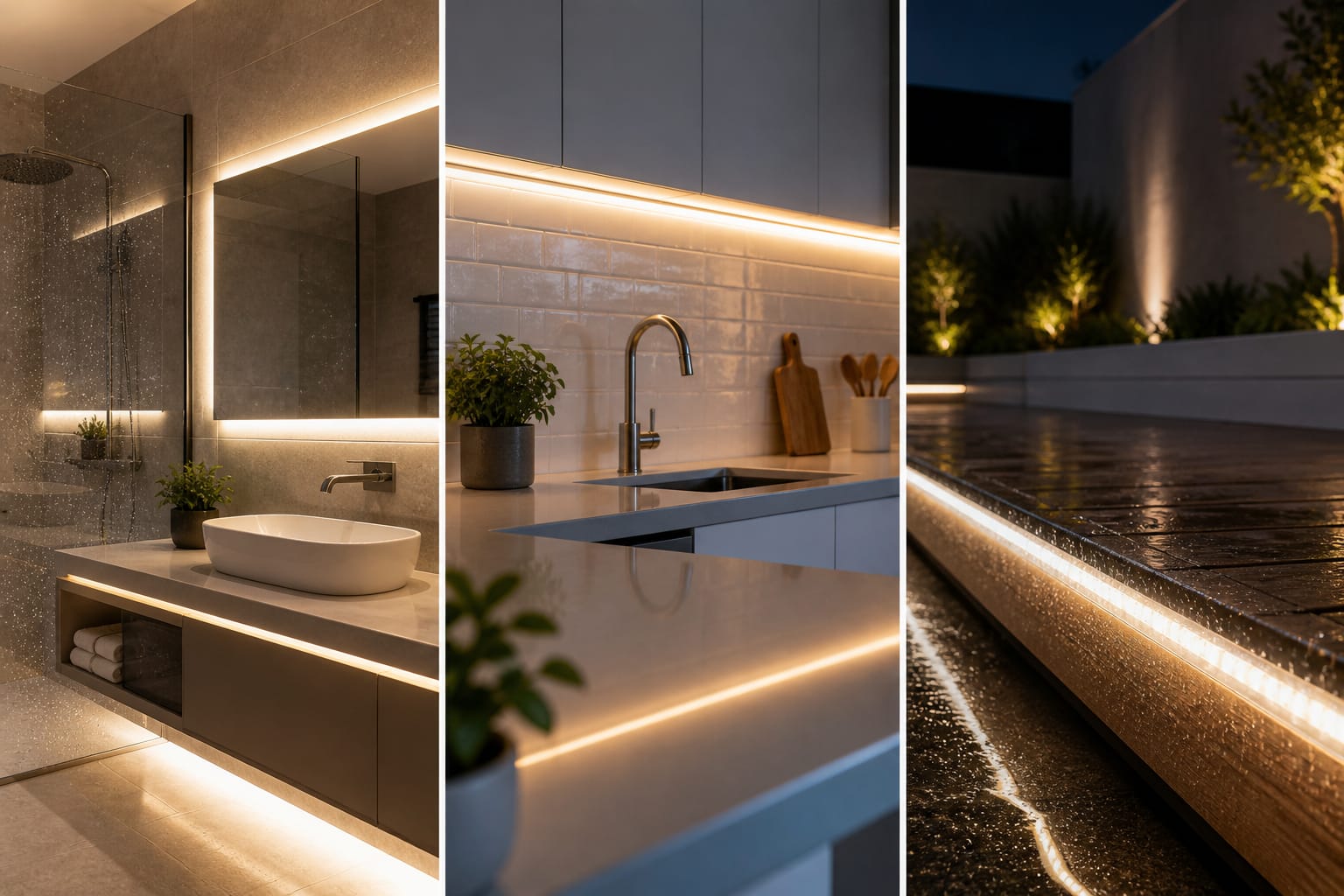
Bathrooms are one of the clearest places where waterproof LED strip lights make sense. Steam, splashing, condensation, and regular humidity can damage exposed electronics over time, even when the strip is not mounted directly inside the shower.
For general bathroom use, IP65 is usually a sensible minimum. It works well around vanities, mirror backlighting, toe-kick lighting, shelves, and areas that may see steam or occasional splashes. Strips closer to tubs, showers, or wet zones may need stronger protection depending on placement and local electrical safety rules.
Harsh reflections from mirrors and glossy tiles can make bathroom lighting uncomfortable. Installing soft-diffused LED strips can help create a smoother spread of light for grooming, shaving, makeup, and low-glare accent lighting.
Do not judge bathroom protection only by whether the strip gets directly wet. Ambient moisture matters too. A strip mounted above a mirror, under a vanity, or near a sink may still need protection if the room regularly fills with steam.
Waterproof LED Strip Lights for Kitchens
Kitchens are another strong use case because under-cabinet LED strips can be exposed to steam, grease, cleaning sprays, and occasional splashes. Even when the strip is not directly above the sink, the combination of cooking moisture and regular cleaning can shorten the life of exposed indoor strips.
IP65 waterproof LED strip lights are usually enough for kitchen under-cabinet lighting, toe-kick lighting, shelves near prep zones, and areas close to steam or light splashes. They offer useful protection without making the strip unnecessarily bulky or difficult to install.
Not every kitchen strip needs waterproofing. A strip installed inside a dry cabinet or on a decorative ceiling cove may work perfectly well with a standard indoor rating. For broader task-lighting ideas in cooking and prep zones, our guide to the best LED lights for kitchens can also help you compare fixtures beyond strip lighting alone.
Outdoor Waterproof LED Strip Lights
Outdoor waterproof LED strip lights need more than a basic splash-resistant coating. Rain, UV exposure, wind-driven moisture, temperature swings, condensation, and freeze-thaw cycles can all weaken cheap strips over time. For exposed outdoor installations, IP65 should be treated as a starting point rather than a universal answer.
Covered patios, soffits, pergolas, balconies, and sheltered decks can often use IP65 strips if they are protected from direct rain. Fully exposed edges, stair lighting, garden borders, railing accents, and low-mounted exterior runs usually deserve stronger sealing, more secure mounting, and better protection around cable entries.
Pools, fountains, and water features are a separate category. They require products specifically designed for continuous wet use, low-voltage systems, and proper electrical protection. Never assume that a standard outdoor strip is suitable for underwater lighting just because it is advertised as waterproof.
A waterproof strip does not automatically make the whole outdoor system weatherproof. The power supply, controller, connectors, cable entries, cut ends, and mounting method all need appropriate protection too.
In outdoor setups, using a sealed outdoor LED driver can help protect the power side of the system and support more reliable voltage in humid or exposed conditions.
Moisture-Prone Areas
Basements, laundry rooms, crawl spaces, garages, and utility areas often sit between dry indoor use and true outdoor exposure. They may not receive direct rain, but damp air, condensation, cleaning water, and seasonal humidity can still damage exposed strip lighting.
In these areas, IP54 or IP65 protection is often safer than a bare indoor strip. IP65 is especially useful near washers, utility sinks, damp storage areas, exposed concrete walls, or spots where condensation appears during seasonal changes.
Greenhouses and indoor gardening setups are another example. Regular watering, damp air, and maintenance splashes can damage exposed electronics. Marine environments are even tougher because salt exposure accelerates corrosion, so boats and dock areas need products designed specifically for marine conditions.
When Waterproof LED Strip Lights Are Not Worth It
Waterproof LED strip lights are not always the better choice. In dry bedrooms, living rooms, offices, shelves, gaming setups, and ceiling coves, a standard indoor strip can be brighter, cheaper, slimmer, easier to bend, and easier to cool.
Overbuying protection can make the installation harder without improving the result. A thick silicone sleeve may reduce adhesive grip, make corners awkward, and slightly soften the visible output. If the strip will never face moisture, that extra sealing may add cost without adding real value.
Use waterproof strips where moisture is realistic. Use standard indoor strips where the space is dry and the main priorities are brightness, clean installation, flexible routing, and better heat dissipation.
Are Waterproof LED Strip Lights Worth the Extra Cost?
Waterproof LED strip lights usually cost more because they require extra coating materials, stronger sealing, tighter manufacturing, and more careful testing. That higher price is worth it when the strip will be exposed to steam, splashes, rain, condensation, cleaning moisture, or outdoor conditions.
The extra cost is not always justified in dry rooms. If the strip will be installed in a protected indoor cove or on a decorative shelf, spending more on better color quality, higher output, smoother dimming, or a nicer channel system may deliver a better result than paying for waterproofing.
Installation costs can rise too. Waterproof strips are often heavier, less flexible, and more difficult to modify. Outdoor LED strip installation can also require clips, channels, sealant, heat-shrink tubing, weatherproof boxes, and extra time for properly sealing every weak point.
Installation Differences
Non-waterproof strips are usually easier to mount, cut, bend, and route through tight spaces. Their standard adhesive backing works well on clean, dry surfaces, and their slimmer profile makes them easier to hide inside narrow channels or shallow coves.
Waterproof LED strip lights require more careful installation because every cut, splice, connector, and cable entry can become a moisture path. If you cut a waterproof strip, the original protection no longer applies at that exposed point unless it is properly resealed.
If you are planning longer runs or more demanding layouts, our LED strip voltage guide explains why stable power matters, and a mid-run power injector can help keep output consistent where power delivery becomes uneven.
Thicker coatings can reduce the effectiveness of adhesive backing over time, especially outdoors. In many wet or exterior installations, clips, channels, brackets, or other secure mounting hardware are better than relying only on adhesive tape.
The Strip Is Not the Only Waterproof Part
One of the biggest mistakes with waterproof LED strip lights is protecting the strip but ignoring the rest of the system. The connectors, controller, power supply, cable entries, end caps, solder joints, and cut points all matter. A high-rated strip can still fail if water reaches an exposed connection.
Clear silicone sealant, adhesive-lined heat-shrink tubing, proper end caps, weather-resistant housings, and suitable cable routing are often necessary after cutting or extending a waterproof strip. This is especially important outdoors, near sinks, near showers, or in damp utility spaces.
Many DIY installations fail because buyers assume the factory coating protects every later modification. It does not. Once the strip is cut, connected, extended, or routed through a wet area, the new weak points need the same level of attention as the strip itself.
Maintenance Considerations
Bare indoor strips are simple to inspect because the components are visible. Dusting them occasionally and checking for loose sections is usually enough in dry spaces. Waterproof LED strip lights require more attention to the coating, seals, connectors, and mounting points.
Small cracks, peeling, loose end caps, cloudy silicone, or damaged sleeves can allow moisture in before the strip fails completely. Regular inspection is especially important outdoors, in bathrooms, in laundry rooms, and anywhere the strip sees frequent humidity changes.
Cleaning should also match the product type. Exposed indoor strips are best cleaned dry. Protected strips can usually handle a slightly damp cloth, but harsh chemicals, abrasive tools, and high-pressure cleaning can damage the coating or weaken the seals.
Always disconnect power before performing maintenance. Even a well-protected strip benefits from careful handling if you want the sealing and electrical components to stay reliable over time.
Do Waterproof LED Strip Lights Lose Brightness?
Waterproof LED strip lights can look slightly softer than bare strips with the same LEDs because silicone, epoxy, or tubing may absorb or scatter a small amount of light. In most home projects, the difference is modest, but it is worth remembering when comparing strips only by brightness claims.
Heat handling can also affect long-term performance. Bare strips release heat more easily because airflow reaches the components directly. Coated strips can trap more warmth, especially in dense LED layouts, enclosed channels, hot outdoor areas, or spaces with poor ventilation.
Color consistency is usually good with quality products, though some silicone-coated LED strips may shift white tones slightly depending on the material and coating thickness. If the strip will be visible in a design-sensitive area, testing a sample before full installation is a smart move.
Common Mistakes to Avoid
One common mistake is using non-waterproof strips in bathrooms or kitchens because the area does not seem that wet. Steam, splashes, grease, cleaning moisture, and repeated humidity exposure can add up over time. The short-term savings often disappear once the strip fails and the project must be redone.
Another mistake is overbuying protection. Not every room needs IP67 or IP68. Installing heavily sealed strips in a dry bedroom cove often means paying more for a bulkier, dimmer, less flexible product with no real benefit.
A third mistake is forgetting the power supply. Outdoor projects require weather-resistant power supplies and suitable housings, not just sealed strips. Even when connected to high-rated waterproof LED strip lights, an indoor-rated transformer mounted outside can fail quickly.
Testing Waterproof Quality
Reputable manufacturers test waterproof LED strip lights under controlled conditions to verify the protection level they advertise. Even so, product quality varies. Weak coatings, poor seal quality, bubbles, thin spots, and sloppy end caps may not be obvious in product photos.
Before a full installation, inspect a short section closely. Look for gaps in the coating, loose sleeves, damaged end caps, cloudy material, uneven sealing, and weak adhesive. If the strip arrives with obvious defects, return it before spending time mounting it in a difficult location.
For demanding projects, testing a sample section in the intended environment can be more useful than relying on the packaging alone. This lets you confirm brightness, flexibility, adhesive grip, coating quality, and installation difficulty before committing to the entire run.
What Should You Choose?
For most people, the best choice is a waterproof LED strip light that matches the environment without adding unnecessary bulk, cost, or installation difficulty. Buy enough protection for the real moisture risk, then make sure the connectors, cut ends, mounting method, and power supply are protected too.
- Choose IP20 for dry indoor shelves, coves, bedrooms, offices, and accent lighting.
- Choose IP65 for bathrooms, kitchens, laundry areas, and covered outdoor spaces.
- Choose IP67 for more exposed exterior projects or harsher wet conditions.
- Choose IP68 only for products designed for continuous water exposure.
- Set aside budget for sealing, connectors, clips, channels, and the power supply.
Key Takeaways
Waterproof LED strip lights are most useful in bathrooms, kitchens, outdoor areas, laundry rooms, basements, and other spaces where steam, splashes, rain, condensation, or cleaning moisture can reach the strip.
IP65 is the practical choice for many home projects, including kitchens, bathrooms, and covered outdoor areas. IP67 is safer for more exposed exterior use, while IP68 should be reserved for products designed for continuous water exposure.
The strip itself is only part of the system. Connectors, cut ends, end caps, mounting clips, cable entries, controllers, and power supplies all affect whether the installation stays reliable or becomes a moisture problem later.
Sharing This Guide
If you found this guide helpful, save it for later or share it with a friend. It’s especially useful for homeowners, beginners, and DIY users planning bathroom, kitchen, or outdoor LED strip lighting.
Share using the links below:
Interested in learning more? Browse all related articles in our category section.