Bedroom Lighting Design: Essential Expert Guide
Effective bedroom lighting design balances functionality with atmosphere, creating spaces that support both restful sleep and practical activities. This comprehensive guide reveals professional strategies for transforming your bedroom into a sanctuary that adapts to every need throughout the day.
Understanding the three essential lighting layers—ambient, task, and accent—enables you to craft environments that enhance wellbeing while reflecting your personal style.

Table of Contents
- Understanding the layers
- Creating ambient foundation
- Implementing task solutions
- Adding accent elements
- Selecting color temperature
- Installing dimming controls
- Optimizing fixture placement
- Developing bedside strategies
- Designing closet solutions
- Integrating smart features
- Maximizing energy efficiency
- Avoiding common mistakes
- Sharing this guide
Understanding the Layers
Professional designers build successful bedroom lighting design around three fundamental layers that work together harmoniously. Each layer serves distinct purposes while contributing to the overall atmosphere, ensuring the room functions effectively for sleeping, reading, dressing, and relaxing.
Ambient lighting provides general illumination that fills the entire space with comfortable, even light. This foundational layer typically comes from ceiling-mounted fixtures, recessed lights, or architectural elements that distribute light broadly without creating harsh shadows or bright spots.
Task lighting addresses specific activities requiring concentrated illumination, such as reading in bed, applying makeup, or selecting clothing. These focused light sources supplement the ambient layer exactly where additional brightness proves necessary.
Accent lighting adds visual interest and depth by highlighting architectural features, artwork, or decorative elements. This optional layer enhances aesthetic appeal while contributing subtle illumination that enriches the room’s character and dimensionality.
Layer Interaction
The magic emerges when these layers combine flexibly through independent controls. Dimming the ambient layer while maintaining task lighting creates intimate atmospheres perfect for winding down, whereas full brightness across all layers supports morning routines and cleaning activities.
Understanding how light affects human biology and mood informs decisions about when to activate each layer. Evening hours benefit from warmer, dimmer settings that encourage melatonin production, while morning light should energize and promote alertness.
Creating Ambient Foundation
Ceiling fixtures form the traditional backbone of ambient lighting in bedrooms. Flush-mount or semi-flush designs work well in rooms with standard ceiling heights, while pendant fixtures or chandeliers suit spaces with higher ceilings where dramatic statements enhance the design.
Recessed lighting offers clean, contemporary alternatives that preserve ceiling space and provide even distribution. Installing these fixtures on dimmer switches proves essential, as full brightness rarely feels appropriate for bedroom environments outside morning preparation periods.
If you want a dependable option, a solid example is Smart LED Strips, which performs reliably in everyday use. Cove lighting hidden behind crown molding creates sophisticated indirect illumination that washes ceilings with soft light, eliminating harsh shadows while maintaining visual comfort.
Illuminance Levels
Bedrooms typically require 10-20 lumens per square foot for general ambient lighting, significantly lower than kitchens or workspaces. A 12×12 foot bedroom needs approximately 1,440-2,880 lumens total from ambient sources, achievable through various fixture combinations.
Calculating precise requirements prevents over-illumination that feels uncomfortable and institutional. Dimmer controls compensate for slight over-specification, allowing flexibility to adjust brightness based on time of day, season, and personal preference.
Implementing Task Solutions
Reading requires concentrated illumination delivering 300-500 lumens directly onto book or tablet surfaces. Bedside lamps positioned on nightstands provide traditional solutions, while wall-mounted swing-arm fixtures save surface space and offer adjustable positioning.
Task lighting near vanities or dressing areas demands careful consideration to avoid unflattering shadows. Fixtures mounted on both sides of mirrors at eye level create even illumination across faces, supporting grooming activities and makeup application without distortion.
Desk areas within bedrooms benefit from dedicated task fixtures that provide focused brightness without disturbing sleeping partners. Adjustable desk lamps with multiple brightness settings accommodate different activities from computer work to handwritten correspondence.
Reading Light Positioning
Optimal reading light placement positions the bulb 15-20 inches from the reading surface at approximately shoulder height when sitting upright. This arrangement minimizes glare while directing sufficient light onto pages without requiring awkward neck positions.
Adjustable fixtures accommodate different reading positions from fully upright to partially reclined. Individuals exploring tunable color options discover how cooler temperatures enhance alertness for reading while warmer tones support relaxation.
Adding Accent Elements
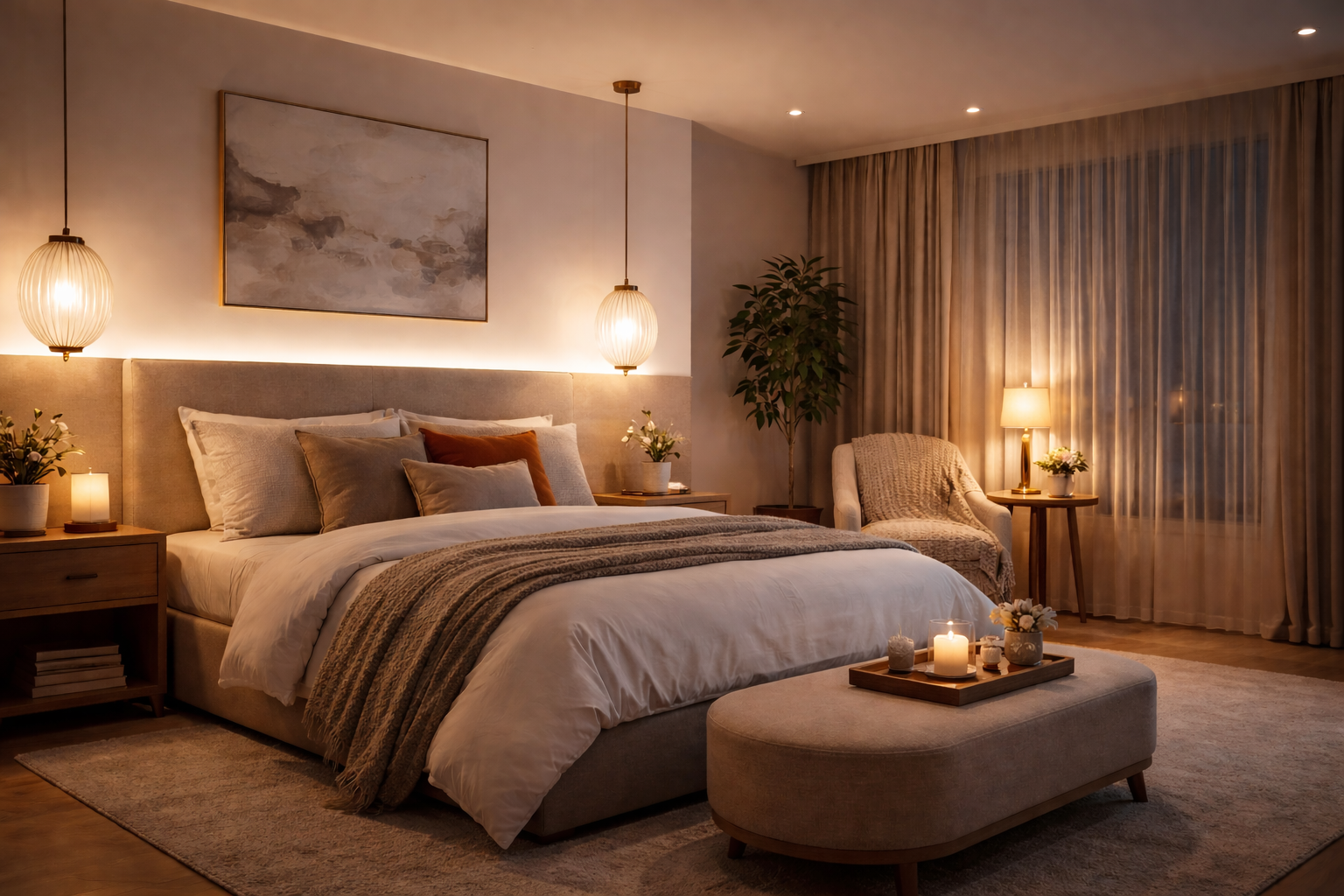
Accent illumination transforms ordinary bedrooms into sophisticated spaces with visual depth and personality. Picture lights mounted above artwork draw attention to favorite pieces while contributing ambient glow during evening hours when overhead fixtures remain off.
LED strip lighting installed under bed frames creates floating effects that add modern flair while providing subtle nighttime navigation. This low-level illumination prevents the harsh brightness shock of activating overhead lights during nighttime bathroom trips.
Uplighting directed toward textured walls or architectural features emphasizes interesting surfaces and adds dimensionality. These strategic highlights prevent flat, one-dimensional lighting that fails to showcase the room’s full potential and character.
Decorative Fixtures
Statement chandeliers or sculptural pendants serve dual purposes as both functional light sources and artistic focal points. Selecting fixtures that complement the bedroom’s design style reinforces the overall aesthetic while fulfilling practical illumination needs.
Decorative bedside lamps with interesting shapes, colors, or materials contribute personality during both day and night. These visible elements should coordinate with other room furnishings while providing sufficient light output for their intended tasks.
Selecting Color Temperature
Color temperature profoundly impacts bedroom atmospheres and sleep quality. Measured in Kelvin, this characteristic determines whether light appears warm and amber or cool and blue-white, with each range producing distinct psychological effects.
Bedrooms typically benefit from warm white bulbs in the 2700-3000K range, mimicking traditional incandescent bulbs that promote relaxation. These warmer tones support melatonin production essential for healthy sleep cycles, making them ideal for evening use.
Cooler temperatures around 4000-5000K prove useful for task lighting near vanities or work areas where accurate color rendering matters. However, reserving these cooler tones for daytime use prevents circadian disruption that interferes with sleep onset.
Tunable Options
Modern tunable white technology allows automatic color temperature adjustments throughout the day, supporting natural circadian rhythms. Morning periods utilize cooler tones promoting alertness, while evening hours gradually shift toward warmer wavelengths encouraging rest.
These adaptive systems reduce the need for multiple bulb types while ensuring optimal conditions for different activities. Programming schedules aligned with sunrise and sunset times creates seamless transitions that support biological timing without conscious intervention.
Installing Dimming Controls
Dimmer switches represent essential components in effective bedroom lighting design, enabling precise brightness adjustments that accommodate varying needs throughout the day. Installing dimmers on all major light sources provides maximum flexibility and control.
Modern LED-compatible dimmers prevent flickering and buzzing that plagued older dimmer technologies. Verifying compatibility between dimmers and bulbs before installation avoids frustration and ensures smooth, silent operation across the entire brightness range.
Smart dimmers connected to home automation systems enable remote control via smartphones or voice commands. These advanced options remember favorite settings for different scenarios, activating appropriate lighting with single commands like “bedtime” or “reading.”
Scene Programming
Pre-programmed scenes coordinate multiple fixtures simultaneously, creating instant atmosphere transformations. A “morning” scene might activate full brightness across all layers, while “evening” dims ambient sources and emphasizes task lighting near seating areas.
Customizing scenes for specific activities eliminates repetitive adjustments while ensuring consistent, optimal conditions. Guests appreciate simple interfaces that avoid confusion about operating multiple independent controls in unfamiliar environments.
Optimizing Fixture Placement
Strategic positioning prevents common problems like inadequate coverage, harsh shadows, and uncomfortable glare. Central ceiling fixtures work well in symmetrical rooms, while off-center arrangements accommodate sloped ceilings or architectural features.
Avoiding placement directly above the bed prevents light shining into eyes when lying down. Positioning fixtures slightly forward illuminates the room effectively without creating discomfort for occupants in bed looking upward.
Wall sconces flanking the bed save nightstand space while providing symmetrical illumination. Mounting these fixtures 60-70 inches from the floor positions them appropriately for reading while sitting upright against pillows or headboards. Solutions for various room types appear in resources covering specialized applications throughout the home.
Recessed Spacing
Recessed fixtures achieve even distribution when spaced according to their beam angles and ceiling height. The general rule divides ceiling height by two to determine spacing in feet—for 8-foot ceilings, place fixtures 4 feet apart in a grid pattern.
Edge fixtures should sit 2-3 feet from walls to prevent scalloping effects that create uneven light pools. This mathematical approach ensures consistent ambient lighting without obvious bright or dim zones throughout the bedroom.
Developing Bedside Strategies
Bedside illumination requires careful consideration of both partners’ needs in shared bedrooms. Independent controls allow one person to read while the other sleeps, preventing the resentment that arises when lighting choices conflict.
Table lamps remain popular for their versatility and ease of positioning. Selecting styles with opaque shades directs light downward and outward rather than into sleeping partners’ eyes. Three-way bulbs or dimmable options provide brightness flexibility without requiring fixture changes.
Clip-on reading lights attach directly to books or headboards, providing highly focused illumination with minimal light spill. These portable solutions work particularly well for avid readers who frequently change positions or move between different seating areas.
Touch Controls
Touch-sensitive bedside lamps eliminate fumbling for small switches in darkness. Simply tapping the base cycles through brightness levels, providing intuitive operation that proves especially valuable during groggy nighttime awakenings.
These user-friendly interfaces reduce frustration while maintaining the classic lamp aesthetic that appeals to traditional design sensibilities. The U.S. Department of Energy LED lighting efficiency guidance explains how modern technology enhances both convenience and energy performance.
Designing Closet Solutions
Walk-in closets demand dedicated illumination systems that support clothing selection and organization. Overhead fixtures provide general visibility, while LED strips under shelves illuminate lower areas where overhead light fails to reach effectively.
Color rendering index (CRI) matters significantly in closet lighting, as poor color accuracy leads to mismatched outfits and frustration. Selecting bulbs with CRI ratings above 90 ensures colors appear true, preventing the disappointment of discovering mismatches in different lighting conditions.
Motion sensors automate closet lighting, activating illumination upon entry and turning off after absence is detected. These energy-saving features prevent the common problem of leaving closet lights burning unnecessarily throughout the day or night.
Reach-In Closets
Smaller reach-in closets benefit from LED strips mounted along the front edge of shelves. This positioning eliminates shadows cast by hanging clothes while providing even illumination across the entire closet depth without requiring ceiling penetrations.
Battery-powered puck lights offer installation simplicity for renters or those avoiding electrical work. Modern rechargeable options with long battery life rival hardwired solutions while maintaining installation flexibility that accommodates changing storage configurations.
Integrating Smart Features
Smart bulbs and fixtures revolutionize bedroom lighting design by enabling unprecedented control and automation. Voice commands eliminate the need to reach for switches or phones, allowing comfortable adjustments from bed without moving.
Scheduling features automatically adjust lighting based on time of day, sunrise/sunset times, or custom routines. Gradual wake-up sequences that slowly brighten lights over 15-30 minutes provide gentler morning experiences than jarring alarm clocks.
Integration with broader smart home ecosystems coordinates bedroom lighting with thermostats, window shades, and security systems. Arriving home triggers welcome sequences that illuminate pathways and create inviting environments before entry.
Presence Detection
Advanced motion sensors distinguish between major movement and minor shifts, preventing lights from turning off while occupants remain relatively still reading or watching television. Adjustable sensitivity settings accommodate different activity levels and room sizes.
Geofencing capabilities detect when residents approach home, pre-warming environments and activating lighting before arrival. These anticipatory features enhance convenience while demonstrating the sophisticated possibilities of modern bedroom lighting design integrated with smart technology.
Maximizing Energy Efficiency
LED technology delivers dramatic energy savings compared to incandescent or halogen alternatives while providing superior longevity and performance. Replacing traditional bulbs with LED equivalents reduces bedroom lighting costs by 75-80% without compromising light quality or ambiance.
Selecting appropriately sized bulbs prevents wasteful over-illumination. Matching lumen output to actual needs rather than defaulting to maximum wattage reduces energy consumption while maintaining comfortable, adequate lighting levels throughout the space.
Timer switches and occupancy sensors ensure lights activate only when needed, eliminating the waste from accidentally leaving fixtures running. The ENERGY STAR guide to LED lighting basics provides detailed information about certified products meeting strict efficiency standards.
Payback Calculations
Despite higher upfront costs, quality LED bulbs typically pay for themselves within 1-2 years through reduced electricity consumption. Extended lifespans of 15,000-50,000 hours eliminate frequent replacement expenses and inconvenience that plague traditional bulb technologies.
Calculating total cost of ownership rather than focusing solely on purchase price reveals the true value proposition. When accounting for energy savings and replacement costs over a decade, LED investments deliver substantial financial returns alongside environmental benefits.
Avoiding Common Mistakes
Over-reliance on overhead fixtures represents the most frequent bedroom lighting design error. Single central fixtures create harsh shadows and fail to provide the flexibility necessary for different activities and moods throughout the day.
Neglecting dimmer installations limits versatility and forces occupants to choose between too bright and completely off. This binary approach fails to support the graduated lighting transitions that promote healthy sleep patterns and comfortable evening relaxation.
Ignoring color temperature impacts leads to uncomfortable environments that feel either sterile and institutional or excessively dim and dreary. Matching temperature selection to intended use and time of day prevents these atmospheric failures that undermine bedroom comfort. Comprehensive guidance appears in our extensive knowledge repository covering lighting fundamentals and advanced applications.
Fixture Scale
Selecting fixtures too large or small for bedroom proportions creates visual imbalance that disrupts design harmony. Measuring ceiling height and floor area before purchasing ensures appropriate fixture sizing that complements rather than overwhelms or disappears within the space.
Chandeliers and pendants require sufficient clearance above beds and walkways to prevent head collisions. Maintaining minimum 7-foot clearances protects safety while ensuring fixtures remain visible and effective rather than creating navigation hazards in familiar spaces.
Sharing this guide
If you found this guide helpful, you can save it for later or share it with a friend. It’s especially useful for beginners, homeowners, and DIY users.
Share using the links below
Interested in learning more? Browse all related articles in our category section.