LED Bulbs Burning Out Fast: Critical Fixes Now
LED bulbs burning out prematurely frustrates homeowners who expect decades of reliable service from their lighting investments. While manufacturers advertise lifespans of twenty-five thousand hours or more, many users experience failures within months or a few years. This comprehensive guide examines the critical factors causing early failure, provides proven solutions to extend bulb longevity, and offers prevention strategies that protect your investment while ensuring optimal lighting performance throughout your home.
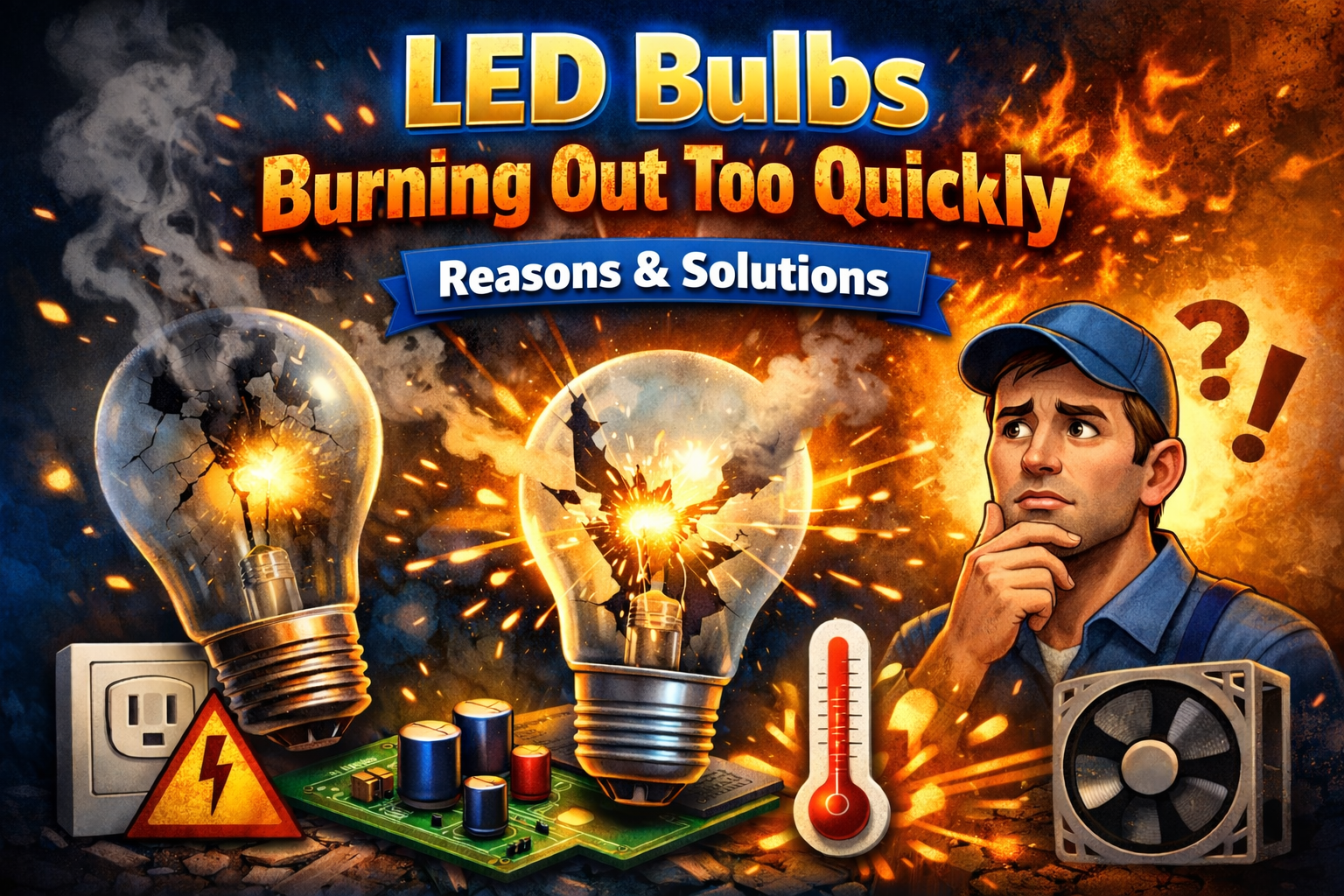
Table of Contents
- Understanding expected lifespan claims
- Heat-related failure mechanisms
- Electrical supply issues
- Quality and manufacturing defects
- Installation and fixture problems
- Environmental stress factors
- Diagnosing the root cause
- Immediate corrective actions
- Long-term preventive measures
- Smart replacement strategies
- Warranty and return options
- Sharing this guide
Understanding expected lifespan claims
LED manufacturers base their lifespan estimates on controlled laboratory testing that rarely mirrors real-world operating conditions. When companies claim twenty-five thousand to fifty thousand hours of service, they test bulbs in carefully regulated environments with stable power supplies, optimal temperatures, and continuous operation cycles. These ideal conditions don’t account for the voltage fluctuations, temperature extremes, and frequent switching that bulbs experience in typical homes, which significantly accelerates the aging process.
The rated lifespan refers to when the bulb reaches seventy percent of its original brightness, not complete failure. This means LED bulbs burning out before reaching their advertised hours doesn’t necessarily indicate defects if they’ve been gradually dimming. However, catastrophic failures within the first few years almost always result from environmental stress, electrical problems, or manufacturing defects rather than normal aging. Understanding this distinction helps you identify whether your situation requires immediate corrective action.
Operating hours accumulate faster than most people realize, especially in frequently used rooms like kitchens and living areas. A bulb operating five hours daily reaches its twenty-five thousand hour rating in just under fourteen years. If you’re experiencing failures sooner than this calculation suggests, external factors are likely compromising your bulbs’ longevity. Documenting actual usage patterns provides valuable context when evaluating whether your failure rate exceeds reasonable expectations. If you want a dependable option, a solid example is an LED-rated dimmer switch with smooth low-end control, which is widely trusted for indoor setups.
Heat-related failure mechanisms
Excessive heat buildup represents the single most common cause of LED bulbs burning out prematurely. Unlike incandescent bulbs that tolerate high temperatures, LED driver circuits contain sensitive electronic components that degrade rapidly when exposed to sustained heat. Capacitors, in particular, lose their electrical characteristics at elevated temperatures, causing driver failure that renders the entire bulb inoperative even when the LED chips themselves remain functional.
Enclosed fixtures trap heat around bulbs, creating thermal conditions that exceed design specifications. Many LED bulbs carry warnings against enclosed fixture use, yet consumers frequently ignore these restrictions or remain unaware of them. When a bulb designed for open-air operation runs inside a covered ceiling fixture or recessed can, temperatures can climb fifty to seventy degrees above ambient levels. This thermal stress cuts expected lifespan by seventy-five percent or more, explaining why some bulbs fail within months rather than years.
Inadequate heat dissipation also occurs when bulbs lack proper thermal management features. Budget models often skimp on heat sink material or use plastic instead of aluminum for cost savings. These design compromises prevent efficient heat transfer from the driver circuit to the surrounding air, causing internal temperatures to rise beyond safe thresholds. Premium bulbs invest in larger heat sinks, better thermal interface materials, and improved airflow designs that maintain lower operating temperatures and deliver their promised lifespan.
Electrical supply issues
Voltage fluctuation damage accelerates LED failure through mechanisms that remain invisible to most users. LED drivers regulate incoming voltage to provide stable current to the LED chips, but this regulation requires additional electrical components that generate heat and experience stress during voltage swings. When your home’s voltage varies significantly above or below the standard one hundred twenty volts, drivers work harder to compensate, generating excessive heat buildup that shortens component life.
Power surges from lightning strikes, utility switching, or large appliance cycling subject LED drivers to brief but destructive voltage spikes. While these events last only milliseconds, they can permanently damage driver components or weaken them enough that subsequent normal operation leads to premature failure. LED bulbs burning out in clusters after storms or when running simultaneously with high-power devices often indicates surge-related damage that could be prevented with proper electrical protection. Another practical alternative is a voltage-regulating outlet protector for sensitive electronics, which performs reliably in everyday use.
Harmonic distortion on your electrical supply creates another form of voltage fluctuation damage that manifests gradually rather than immediately. Non-linear loads like computer power supplies, variable-frequency drives, and certain appliances inject harmonics into the electrical system that cause voltage waveforms to deviate from the ideal sine wave. LED drivers interpret these distorted waveforms as unstable power, forcing them to work harder and generate more heat during regulation. Over time, this continuous stress accumulates until components fail. Similar electrical issues may also manifest as unusual buzzing or humming sounds from your lighting fixtures.
Quality and manufacturing defects
Poor quality drivers represent a primary reason LED bulbs burning out occurs far sooner than advertised. Manufacturers face intense price competition that incentivizes cost-cutting in invisible components like driver circuits. Budget bulbs often use the minimum number of capacitors rated at the lowest acceptable voltage, leaving no safety margin for real-world electrical conditions. These marginal designs work adequately under ideal circumstances but fail quickly when subjected to typical home electrical environments.
Manufacturing defects include cold solder joints, inadequate thermal compound application, and component placement errors that escape quality control inspection. A single poorly soldered connection creates resistance that generates heat and eventually fails, taking the entire bulb with it. These defects appear randomly across production runs, explaining why some bulbs from the same package may last years while others fail within weeks. Reputable manufacturers maintain stricter quality control standards that catch more defects before products reach consumers.
Counterfeit or substandard components infiltrate supply chains, particularly for ultra-cheap LED products. Capacitors rated for eighty-five degrees Celsius get substituted with versions rated for only seventy degrees, driver chips get replaced with inferior clones, and thermal interface materials get omitted entirely. These substitutions save pennies per bulb during manufacturing but guarantee premature failure in service. Purchasing from established brands with verifiable supply chains reduces but doesn’t eliminate exposure to these quality issues.
Installation and fixture problems
Improper fixture selection creates thermal environments that guarantee LED bulbs burning out prematurely regardless of bulb quality. Recessed can fixtures designed for incandescent bulbs often lack the insulation clearance and ventilation that LEDs require for adequate cooling. When installed in these fixtures, even premium LED bulbs experience excessive heat buildup that degrades driver components within a fraction of their expected lifespan. The problem intensifies in insulated ceilings where surrounding material blocks heat dissipation paths.
Dimmer compatibility issues cause additional stress on LED bulbs beyond the obvious flickering problems. Incompatible dimmers force LED drivers to operate outside their design parameters, generating extra heat and electrical stress during the dimming process. This stress accumulates over time, weakening driver components until they fail completely. Even when bulbs appear to dim smoothly, poor quality drivers experiencing this stress will fail months or years before they would operating at full brightness on a standard switch.
Loose socket connections create intermittent contact that subjects LED drivers to repeated power cycling and voltage instability. Each time the connection breaks and re-establishes, the driver experiences an inrush current surge that stresses components. Over hundreds or thousands of these micro-cycles, the cumulative damage leads to premature failure. Corrosion on socket contacts exacerbates this problem by increasing contact resistance and generating heat at the connection point. Regular inspection and cleaning of sockets extends bulb life significantly. You might also encounter related problems such as persistent flickering issues that indicate similar connection problems.
Environmental stress factors
Ambient temperature extremes challenge LED bulbs in ways that laboratory testing rarely captures. Outdoor fixtures expose bulbs to temperature swings from below freezing to over one hundred degrees Fahrenheit, forcing driver components to expand and contract repeatedly. This thermal cycling stresses solder joints and component leads, creating mechanical fatigue that eventually causes electrical failures. LED bulbs burning out in outdoor locations typically fail from this mechanical stress rather than pure electrical or thermal causes.
Humidity and moisture infiltration accelerate corrosion of internal components even in bulbs marketed for damp locations. Condensation forms when bulbs cool after being turned off, allowing moisture to penetrate through microscopic gaps in the bulb housing. This moisture attacks solder joints, corrodes circuit board traces, and degrades insulation properties. Over time, these effects compound until they cause short circuits or open connections that render bulbs inoperative. Proper fixture sealing and bulb selection for the environment prevents most moisture-related failures.
Vibration from ceiling fans, garage door openers, or nearby traffic subjects bulbs to mechanical stress that loosens connections and cracks solder joints. Each vibration cycle fatigues the materials slightly, and after thousands or millions of cycles, cumulative damage leads to electrical failures. This explains why LED bulbs burning out occurs more frequently in certain locations than others within the same home. Selecting bulbs with robust mechanical construction and vibration-resistant driver mounting reduces failures in high-vibration environments.
Diagnosing the root cause
Begin diagnosis by documenting failure patterns across your home’s lighting installations. If LED bulbs burning out concentrates in specific fixtures or rooms, focus investigation on environmental or electrical factors affecting those locations. Widespread failures across multiple unrelated fixtures suggest whole-house electrical issues or consistently poor bulb selection. Creating a simple spreadsheet tracking installation dates, failure dates, bulb brands, and fixture types reveals patterns that guide corrective action.
Measure voltage at affected fixtures using a multimeter during various times of day and under different load conditions. Voltage should remain within ten percent of the nominal one hundred twenty volts for North American installations. Readings consistently above one hundred twenty-six volts or below one hundred fourteen volts indicate voltage fluctuation damage as a likely contributor to premature failures. Also check for voltage drops when the bulb is operating, which might indicate poor quality drivers struggling with inadequate power delivery.
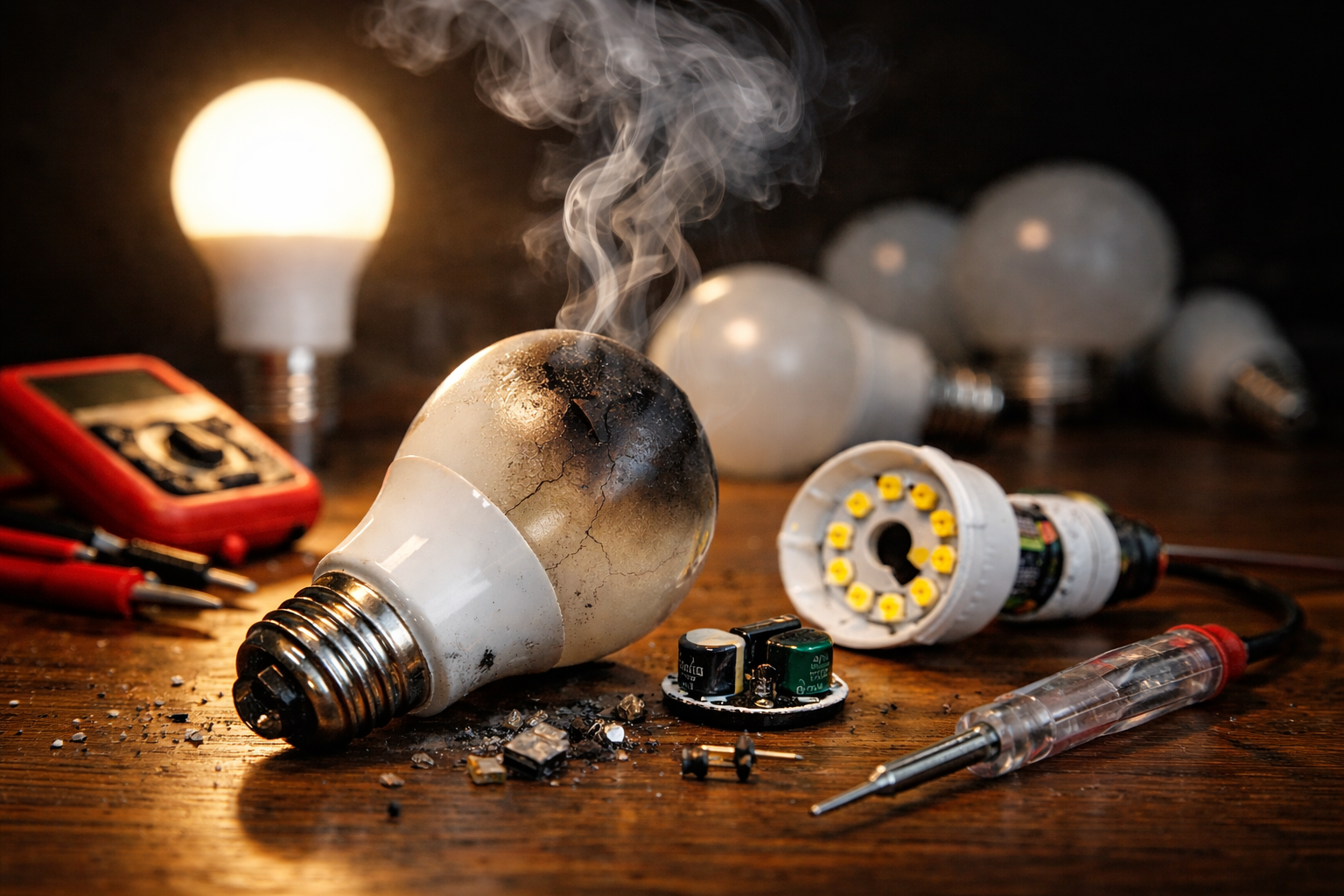
Inspect failed bulbs for physical evidence of the failure mode. Discoloration around the driver circuit area indicates excessive heat buildup from inadequate cooling or electrical stress. Bulging or leaked capacitors confirm heat-related driver failure. Burned or corroded socket contacts point to connection problems as the primary cause. This visual inspection often provides immediate insight into whether environmental, electrical, or quality factors drove the failure. For comprehensive troubleshooting when bulbs won’t illuminate at all, consult guides about complete lighting system failures for additional diagnostic steps.
Immediate corrective actions
Replace failed bulbs with models specifically rated for your fixture type and operating environment. If failures occurred in enclosed fixtures, select bulbs explicitly certified for enclosed use. For outdoor locations, choose bulbs with appropriate wet or damp location ratings and wide operating temperature ranges. For high-vibration environments, opt for bulbs with solid-state driver construction rather than those using relays or mechanical components. Matching bulb specifications to actual conditions prevents repeat failures from the same root causes.
Install whole-house surge protection at your electrical panel to guard against voltage fluctuation damage from external sources. Quality surge protectors clamp voltage spikes before they reach your LED bulbs, preventing the cumulative damage that leads to premature driver failures. For homes experiencing frequent power quality issues, consider adding point-of-use surge protection at critical lighting circuits. This layered approach provides comprehensive protection that extends the life of all electronic devices, not just LED bulbs.
Upgrade incompatible dimmers to models engineered specifically for LED loads. Modern LED dimmers provide cleaner power output that reduces electrical stress on bulb drivers, directly extending operational life. When selecting replacement dimmers, choose models from manufacturers that publish compatibility lists including your preferred bulb brands. This proactive approach prevents both immediate operational issues and the long-term degradation that causes LED bulbs burning out prematurely in dimmed applications.
Long-term preventive measures
Invest in premium LED bulbs from manufacturers with established reputations for reliability and quality. While these products cost more initially, their superior driver circuits, better thermal management, and genuine component specifications deliver the advertised lifespan under real-world conditions. Calculate total cost of ownership including replacement labor and disposal rather than focusing solely on purchase price. Premium bulbs that last five times longer than budget alternatives provide better value despite higher upfront costs.
Improve fixture ventilation where possible to reduce excessive heat buildup around bulbs. For recessed cans, verify that insulation maintains proper clearance and consider upgrading to IC-rated fixtures designed for insulated ceiling contact. In enclosed fixtures, switch to semi-enclosed or open designs when aesthetics permit. Even small improvements in airflow can reduce operating temperatures by ten to twenty degrees, significantly extending driver component life and preventing LED bulbs burning out from thermal stress. For a more permanent upgrade, many users switch to an adjustable socket extender for improved bulb ventilation clearance, which offers consistent results over time.
Schedule periodic electrical system maintenance with a qualified electrician to identify and correct developing problems before they cause widespread bulb failures. Professional inspection can detect voltage irregularities, loose connections, inadequate grounding, and other issues that gradually degrade LED performance. According to the U.S. Department of Energy, proper electrical infrastructure maintenance improves efficiency and longevity for all lighting technologies. This preventive approach protects your lighting investment while improving overall electrical safety throughout your home.
Smart replacement strategies
Develop a strategic replacement plan that addresses root causes rather than simply swapping failed bulbs with identical models. If poor quality drivers caused initial failures, upgrading to better brands prevents recurrence. When excessive heat buildup drove failures, either change to bulbs rated for enclosed fixtures or modify fixtures to improve ventilation. This analytical approach to replacement stops the cycle of LED bulbs burning out repeatedly in the same locations.
Consider replacing all bulbs in a multi-bulb fixture simultaneously even when only one fails. This strategy prevents the aesthetic mismatch that occurs when new bulbs differ in color temperature or brightness from aging originals. It also resets the replacement clock for the entire fixture, reducing future maintenance frequency. For fixtures in difficult-to-reach locations, this approach minimizes the number of times you need ladders or specialized access equipment.
Maintain a small inventory of spare bulbs from proven manufacturers to enable quick replacement when failures occur. Purchasing bulbs in multi-packs reduces per-unit cost and ensures you have matching replacements available. Document which bulb models perform well in specific applications so you can repurchase the same products when restocking. This systematic approach to inventory management prevents the frustration of discovering your preferred bulb discontinued when you need replacements. For additional guidance on LED technology and best practices, explore resources available at the comprehensive knowledge center covering all aspects of modern lighting.
Warranty and return options
Many premium LED bulbs include warranties ranging from three to ten years that cover defects and premature failures. When LED bulbs burning out occurs well before expected lifespan, retain packaging and purchase receipts to support warranty claims. Manufacturers typically require proof of purchase and may request the failed bulb for analysis before issuing replacements. Establishing this paper trail at purchase time simplifies the claims process when failures occur years later.
Contact the manufacturer directly rather than the retailer for the most efficient warranty service. Most major lighting companies operate customer service departments equipped to process warranty claims quickly. They can often identify patterns suggesting environmental or electrical issues contributing to failures, providing valuable diagnostic insight beyond simple replacement. Document your conversation and retain any claim numbers or reference codes for future follow-up if necessary.
Some retailers offer satisfaction guarantees that exceed manufacturer warranties, particularly for premium or professional-grade products. These policies may allow returns or exchanges without requiring proof of defect, simplifying the replacement process. When purchasing bulbs for critical applications or challenging environments, factor return policy quality into your vendor selection. The additional peace of mind and simplified replacement process justifies shopping at retailers with customer-friendly policies even if prices run slightly higher than discount alternatives.
Sharing this guide
If you found this guide helpful, you can save it for later or share it with a friend. It’s especially useful for beginners, homeowners, and DIY users.
Share using the links below
Interested in learning more? Browse all related articles in our category section.
Pingback: Why LED Lights Glow When Off: Shocking Truth Revealed
Pingback: LED Lights Blinking Randomly: Ultimate Fix Guide 2026
Pingback: LED Lights Overheating: Critical Safety Risks Exposed