LED Lights Flickering? Ultimate Fix Guide Revealed
When LED lights flickering disrupts your home or workspace, it creates visual discomfort and raises questions about electrical safety. This comprehensive guide explores the root causes behind unstable lighting, provides proven solutions to eliminate the problem, and reveals prevention strategies that ensure long-term performance. Whether you’re dealing with occasional flashes or constant strobing, understanding the ultimate fix techniques will restore stable, comfortable illumination throughout your space.
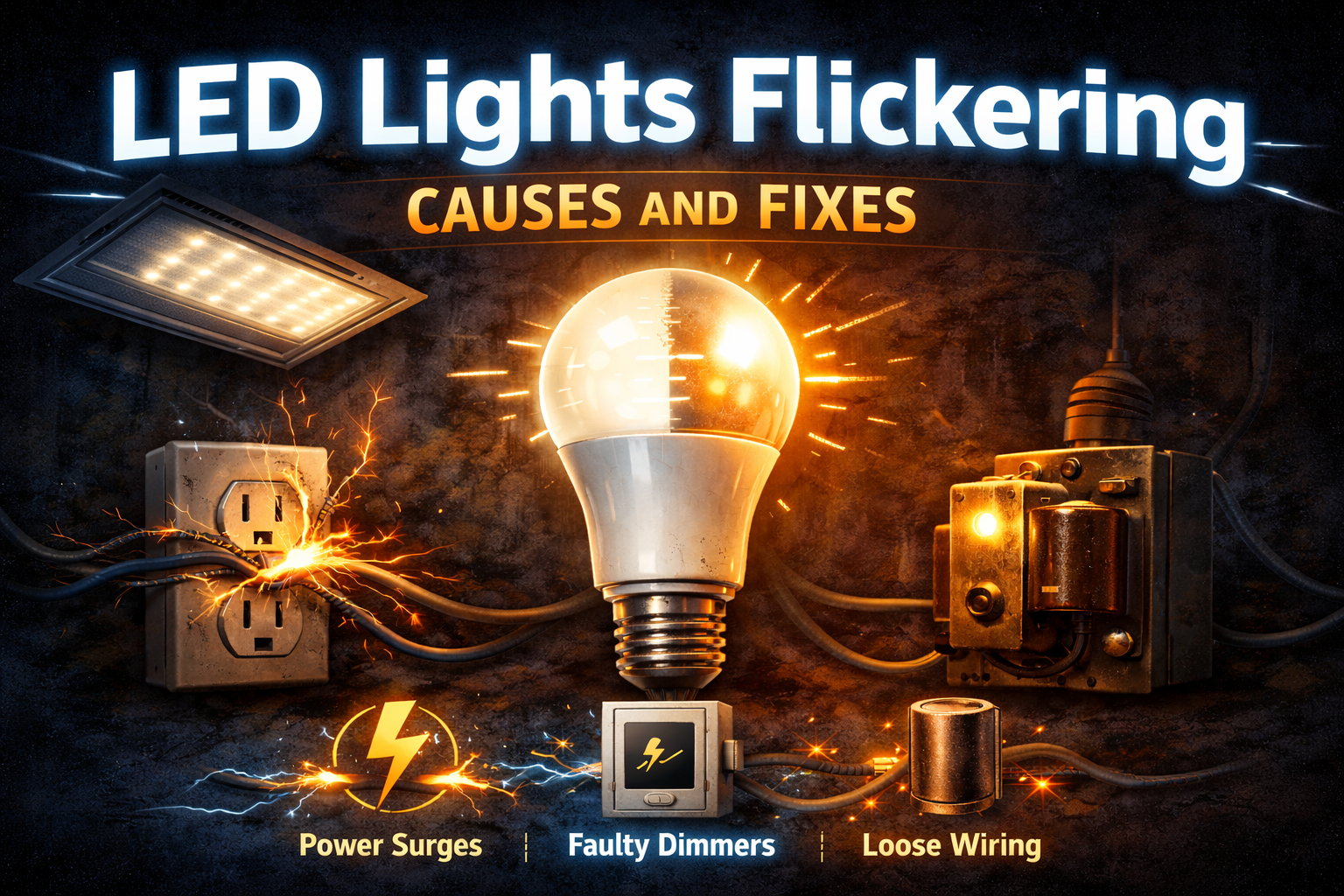
Table of Contents
Incompatible Dimmer Switches
The most common cause of LED lights flickering involves incompatible dimmer technology. Traditional incandescent dimmers use phase-cut dimming that rapidly switches power on and off at rates incompatible with LED driver circuits. When these older dimmers control modern LEDs, the mismatch creates visible strobing effects that range from subtle pulsing to severe flashing.
LED-rated dimmers specifically designed for solid-state lighting solve most dimmer switch compatibility problems. These advanced controllers use electronic dimming protocols that communicate properly with LED drivers, providing smooth transitions from full brightness to minimum levels without flicker. Upgrading to quality LED dimmers eliminates the majority of dimming-related instability issues.
Minimum load requirements present another dimension of dimmer switch compatibility challenges. Most dimmers need circuits to draw 25-60 watts to function correctly, but LED bulbs consume far less power than their incandescent predecessors. A circuit with multiple low-wattage LEDs may not reach the dimmer’s minimum threshold, causing a flickering light bulb throughout the entire circuit. If you want a dependable option, a solid example is a non-contact voltage tester for safely checking live wires, which performs reliably in everyday use.
Trailing Edge vs Leading Edge
Leading-edge dimmers cut power at the beginning of each AC waveform cycle, while trailing-edge models cut at the end. Trailing-edge technology generally provides better performance with LED loads, reducing electromagnetic interference and improving overall stability. When replacing dimmers, selecting trailing-edge models optimized for LED technology delivers superior results.
Some bulbs marketed as “dimmable” work only with specific dimmer brands or technologies. Manufacturers publish compatibility lists identifying which bulb models pair successfully with various dimmer switches. Consulting these resources before purchase prevents frustration and ensures reliable operation throughout the dimming range.
If complete power loss accompanies instability, the problem may extend beyond dimming equipment. Resources addressing total lighting system failures provide additional diagnostic guidance for complex electrical issues.
Electrical Voltage Problems
Utility Power Fluctuations
Utility companies deliver electricity within specified voltage ranges, but fluctuations occur due to grid load changes, equipment switching, and transmission line conditions. When incoming voltage varies outside LED driver specifications, LED lights flickering becomes visible as the driver struggles to maintain stable output. These voltage fluctuation issues affect entire neighborhoods simultaneously during peak demand periods.
Voltage monitoring equipment records power quality over extended periods, revealing patterns that correlate with unstable lighting. Professional electricians use these diagnostic tools to determine whether problems originate from utility delivery or internal wiring faults. Persistent voltage variations outside acceptable ranges require utility company involvement to correct transmission or distribution equipment problems.
Internal Circuit Voltage Drop
Long wire runs between electrical panels and fixtures create resistance that reduces available voltage at endpoints. This voltage drop intensifies when multiple high-draw appliances share circuits with lighting loads. As voltage sags below driver minimum thresholds, a flickering light bulb signals inadequate power delivery that worsens during peak usage times.
Undersized wire gauges exacerbate voltage drop problems, particularly in older homes wired to outdated electrical codes. Upgrading branch circuits with heavier gauge conductors reduces resistance and maintains stable voltage throughout the distribution system. This infrastructure improvement benefits all connected devices while eliminating voltage fluctuation issues affecting sensitive LED drivers.
Loose Wiring Connections
Intermittent electrical contact at wire connections creates resistance that varies with temperature, vibration, and mechanical stress. These unstable connections generate heat while disrupting current flow, producing visible instability as contact quality fluctuates. LED lights flickering from loose connections typically worsens gradually as oxidation and heat cycling degrade contact surfaces further.
Wire nuts securing fixture connections must be tightened properly during installation and periodically inspected for degradation. Vibration from nearby equipment, thermal expansion cycles, and initial settling can loosen connections over time. Removing and remaking suspect connections with fresh wire nuts often eliminates chronic instability problems.
Push-in wire connectors offer installation convenience but may not provide long-term reliability compared to traditional wire nuts. The spring mechanisms in these connectors can weaken over time, allowing wires to develop poor contact that manifests as a flickering light bulb. Converting push-in connections to screw-type wire nuts improves connection security and reduces maintenance requirements.
Panel and Breaker Connections
Electrical panel connections require periodic inspection and maintenance to ensure tight, corrosion-free contact. Breakers themselves can develop internal contact problems that affect entire circuits. When LED lights flickering occurs across multiple fixtures on the same circuit, examining panel connections and testing breaker integrity should be priority troubleshooting steps.
Aluminum wiring in older homes presents unique connection challenges due to the metal’s tendency to oxidize and creep under pressure. Special connectors rated for aluminum-to-copper transitions prevent the galvanic corrosion that creates high-resistance connections. Professional evaluation of aluminum wiring systems helps identify and correct connection problems before they escalate to safety hazards.
Understanding proper wiring techniques prevents many connection issues. Guides explaining correct installation methods detail best practices that ensure reliable long-term performance across various lighting applications.
Driver Component Failures
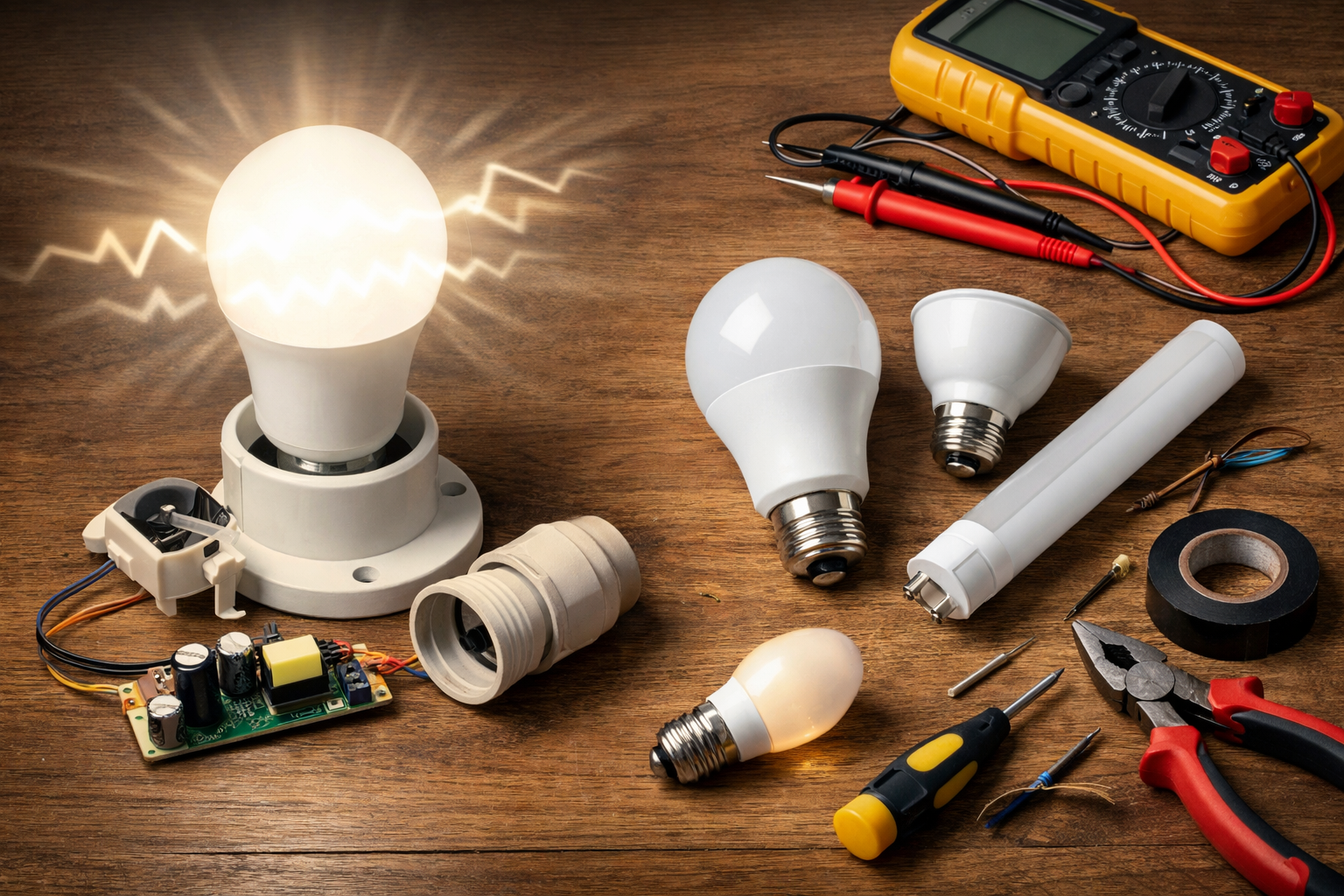
LED drivers contain electronic components that regulate power delivery to LED arrays. As these components age or experience thermal stress, their performance degrades, causing output instability visible as LED lights flickering. Electrolytic capacitors represent the most failure-prone driver components, with reduced capacitance creating visible ripple in LED current as they deteriorate.
Heat accelerates capacitor aging exponentially, with every 10-degree Celsius temperature increase roughly halving component lifespan. Drivers installed in enclosed fixtures or poorly ventilated spaces experience elevated operating temperatures that drastically shorten their functional life. Adequate cooling extends driver longevity and maintains stable output characteristics throughout the rated service life.
Driver replacement often proves more economical than entire fixture replacement when LED elements remain functional. Many fixtures use standard driver form factors that accept compatible replacement units from multiple manufacturers. Matching voltage and current specifications while ensuring physical compatibility allows driver swaps that restore stable operation at fraction of complete fixture costs. Another practical alternative is an LED-specific dimmer switch with trailing-edge control, which is known for stable long-term performance.
Identifying Failing Drivers
Drivers nearing end-of-life often produce audible buzzing or humming in addition to visible instability. These sounds result from magnetic components vibrating at AC line frequency as internal regulation deteriorates. A flickering light bulb accompanied by unusual noise strongly suggests driver component failure requiring replacement.
Thermal imaging cameras reveal excessive heat generation in failing drivers, identifying problematic units before complete failure occurs. Drivers operating significantly hotter than similar units warrant preemptive replacement to prevent sudden lighting loss. This predictive maintenance approach minimizes unexpected failures while maximizing fixture availability.
Power Supply Overload
Connecting too many fixtures to a single transformer or driver exceeds its current capacity, forcing it to operate beyond design specifications. This overload condition generates excessive heat while degrading output regulation, creating visible instability across all connected fixtures. LED lights flickering affecting multiple fixtures simultaneously often indicates power supply saturation requiring load redistribution.
Low-voltage LED systems running on 12V or 24V transformers are particularly susceptible to overload issues. Calculating total connected wattage and comparing it against transformer ratings identifies whether excessive loading causes performance problems. Dividing loads across multiple appropriately sized transformers eliminates overload while improving overall system reliability.
Voltage drop in low-voltage distribution wiring compounds overload problems, with fixtures farthest from power supplies experiencing the most severe instability. Proper wire sizing based on total current and distribution distance maintains adequate voltage throughout the system. Resources covering flexible lighting modifications explain wire gauge selection for various installation scenarios.
Transformer Efficiency Losses
Transformers convert input voltage to the lower voltages LED systems require, losing some energy as heat during conversion. As transformers age or operate near maximum capacity, efficiency decreases while heat generation increases. This thermal stress accelerates component degradation, creating a cycle that eventually produces dimmer switch compatibility problems and visible output instability.
Quality transformers incorporate thermal protection that reduces output or shuts down completely when internal temperatures exceed safe limits. While this protection prevents fire hazards, it can cause a flickering light bulb as the transformer cycles between normal operation and thermal limiting. Upgrading to higher-capacity transformers with better heat dissipation characteristics solves chronic overheating issues.
Temperature Related Issues
Extreme temperatures affect LED performance and driver operation in ways that produce visible instability. Very cold conditions can prevent drivers from starting properly or cause temporary performance degradation until components warm to operating temperature. LED lights flickering during winter cold snaps in outdoor or unheated installations often resolves as ambient temperatures moderate.
Excessive heat poses greater long-term risks than cold, accelerating component aging while potentially triggering thermal protection circuits that reduce output or shut fixtures down entirely. Enclosed fixtures without adequate ventilation trap heat around bulbs and drivers, creating hostile thermal environments that shorten lifespan dramatically while causing chronic instability.
According to the U.S. Department of Energy, maintaining LED junction temperatures below 85 degrees Celsius significantly extends operational life and maintains stable performance characteristics. Proper fixture selection, adequate ventilation, and appropriate ambient temperature control all contribute to thermal management that prevents temperature-induced voltage fluctuation issues.
Thermal Cycling Effects
Repeated heating and cooling cycles stress electronic components through differential thermal expansion. Solder joints, connector contacts, and component leads all experience mechanical fatigue from this cycling, eventually developing intermittent connections that produce a flickering light bulb. Fixtures experiencing extreme temperature swings fail faster than those operating in stable thermal environments.
Outdoor fixtures face the most severe thermal cycling, experiencing daily temperature ranges exceeding 50 degrees Celsius in some climates. Selecting fixtures specifically rated for outdoor use ensures components can withstand these demanding conditions. Quality outdoor-rated products incorporate robust construction and component selection that tolerates environmental extremes without performance degradation.
Electromagnetic Interference
Radio frequency interference from nearby electronic devices can disrupt LED driver operation, creating instability visible as LED lights flickering. Wireless routers, baby monitors, cordless phones, and other RF transmitters generate electromagnetic fields that couple into LED wiring, injecting noise that confuses driver control circuits. This external interference typically affects fixtures closest to RF sources most severely.
Power line noise from motors, appliances, and switching power supplies propagates through building wiring, potentially disrupting LED drivers sharing circuits with these noise sources. Refrigerators, HVAC systems, and garage door openers generate particularly strong interference during startup and shutdown transitions. Installing line filters isolates sensitive LED circuits from these disruptive signals.
Proper wiring practices minimize susceptibility to electromagnetic interference by reducing loop areas that act as receiving antennas. Twisting supply and return conductors together, maintaining separation from RF sources, and using shielded cables in electrically noisy environments all improve immunity to dimmer switch compatibility and interference problems.
Ground Loop Interference
Multiple ground paths in electrical systems create current loops that generate magnetic fields affecting nearby lighting. These ground loops particularly plague low-voltage LED installations where multiple transformers or drivers share common grounds. Breaking ground loops by isolating power supplies or implementing single-point grounding schemes eliminates this interference source.
A flickering light bulb sometimes indicates ground fault issues requiring immediate attention for safety reasons. Professional electricians equipped with specialized test equipment can identify and correct grounding problems that both create instability and pose shock hazards. Never ignore chronic instability issues, as they may signal serious electrical faults requiring expert diagnosis.
Comprehensive electrical knowledge helps prevent interference issues during installation. The educational resources available explain proper grounding, shielding, and routing techniques that minimize electromagnetic susceptibility across various applications.
Bulb Quality Factors
Budget bulbs from unknown manufacturers often use inferior drivers and components that produce unstable output from initial installation. While these products cost significantly less than premium alternatives, the savings disappear through early failures and chronic performance problems. LED lights flickering from poor-quality bulbs may occur immediately or develop within weeks of installation.
Reputable manufacturers invest heavily in driver design, component selection, and quality testing to ensure stable performance across rated operating conditions. Their products command premium prices but deliver reliable operation throughout expected lifespans. Warranties from established brands provide recourse when defects occur, unlike budget alternatives offering minimal support.
Counterfeit products bearing fake brand names proliferate in online marketplaces, copying packaging while using substandard internals. These imitations frequently produce voltage fluctuation issues and fail prematurely despite appearing identical to genuine articles. Purchasing from authorized dealers or manufacturer direct channels avoids counterfeits while ensuring genuine products with valid warranties.
Driver Design Quality
Premium bulbs incorporate drivers with active power factor correction, low harmonic distortion, and wide input voltage ranges that tolerate utility fluctuations gracefully. These sophisticated designs maintain stable output despite challenging input conditions. Budget drivers lack these refinements, making them sensitive to voltage variations that cause a flickering light bulb across the entire circuit.
Component quality within drivers varies enormously between price points. Quality drivers use industrial-grade capacitors, precision voltage references, and robust output stages that maintain tight regulation under varying loads and temperatures. Budget alternatives substitute consumer-grade components that drift out of specification quickly, producing unstable output visible as chronic instability.
Diagnostic Testing Procedures
Systematic diagnosis isolates root causes efficiently, preventing wasteful replacement of functional components. Start by documenting when LED lights flickering occurs—continuously, during specific times, or when certain appliances operate. These patterns reveal whether problems stem from utility delivery, internal wiring, or component failures within fixtures themselves.
Substitution testing with known-good components quickly identifies defective parts. Swapping suspect bulbs with functioning units from other fixtures determines whether bulbs or fixtures cause problems. Similarly, testing bulbs in different circuits reveals whether instability follows bulbs or remains with specific circuits.
Voltage measurements at fixtures during instability episodes provide critical diagnostic information. Voltage dropping below driver minimum thresholds during operation indicates wiring problems or overloaded circuits. Stable voltage combined with unstable light output points to driver or dimmer switch compatibility failures rather than power delivery issues.
Oscilloscope Analysis
Advanced diagnostics using oscilloscopes reveal voltage waveform distortions invisible to standard meters. Clean sinusoidal waveforms indicate healthy power delivery, while distorted waveforms suggest interference or power quality issues. Professional electricians employ these sophisticated diagnostic tools when standard troubleshooting fails to identify voltage fluctuation issues.
Thermal imaging identifies overheating components before complete failure, allowing preventive replacement that avoids unexpected outages. Hot spots in drivers, transformers, or connections indicate excessive resistance or component degradation requiring attention. This predictive approach minimizes downtime while preventing secondary damage from failed components.
Permanent Solutions
Replacing incompatible dimmers with LED-rated models eliminates the most common source of LED lights flickering. Invest in quality dimmers from established manufacturers, consulting compatibility databases to ensure proper pairing with installed bulbs. This upgrade typically costs under $50 per switch while solving chronic instability affecting entire circuits.
Upgrading to premium bulbs from reputable manufacturers eliminates quality-related instability while providing better light quality and longer service life. Though initial costs exceed budget alternatives, superior reliability and performance justify the investment through reduced maintenance and replacement frequency. Standardizing on proven bulb models simplifies inventory management and ensures consistent results.
Installing dedicated circuits for sensitive lighting loads isolates them from interference generated by motors, appliances, and other noise sources. This infrastructure investment pays dividends through improved reliability across all connected fixtures. Separate circuits also allow proper wire sizing for lighting loads without compromise from shared high-current devices. For a more permanent upgrade, many users switch to an LED anti-flicker resistor that stabilizes low-load dimmer circuits, which reduces the risk of installation failure.
Whole House Power Conditioning
Whole-house surge protectors and power conditioners installed at service panels protect all connected devices from utility disturbances while filtering interference. These systems provide comprehensive protection against voltage fluctuation issues affecting sensitive electronics throughout homes. Quality units cost several hundred dollars but protect thousands of dollars worth of equipment.
Uninterruptible power supplies (UPS) for critical lighting provide backup power during outages while conditioning incoming electricity. These devices eliminate virtually all power quality issues, delivering clean, regulated voltage regardless of utility conditions. While UPS systems represent significant investments, they ensure absolutely stable operation for essential lighting applications.
Prevention Strategies
Purchasing quality components from the outset prevents most instability problems from ever occurring. Research products thoroughly, reading independent reviews and checking manufacturer reputations before buying. The modest premium for quality products returns enormous dividends through reliable performance and reduced maintenance over product lifetimes.
Proper installation following manufacturer specifications and electrical codes ensures optimal performance from the start. Hire qualified electricians for complex installations, as their expertise prevents mistakes that cause LED lights flickering and other chronic problems. Professional installation may cost more initially but saves money by avoiding troubleshooting and correcting amateur errors.
Regular maintenance prevents gradual degradation from developing into serious problems. Periodically inspect connections, clean fixtures, and verify proper ventilation around heat-generating components. These simple preventive measures extend component life while maintaining stable performance characteristics throughout rated service periods.
Document installations thoroughly, recording bulb models, dimmer types, driver specifications, and circuit details. This information proves invaluable when troubleshooting problems or planning upgrades. Knowing exactly which components succeeded or failed guides future purchasing decisions while simplifying maintenance planning.
Environmental considerations during fixture selection prevent temperature and moisture problems before installation. Match fixture ratings to installation locations, selecting weatherproof models for outdoor use and high-temperature designs for enclosed applications. Proper specification eliminates environmental factors that contribute to a flickering light bulb across various installations.
Sharing this guide
If you found this guide helpful, you can save it for later or share it with a friend. It’s especially useful for beginners, homeowners, and DIY users.
Share using the links below
Interested in learning more? Browse all related articles in our category section.
Pingback: Why LED Lights Glow When Off: Shocking Truth Revealed
Pingback: LED Bulbs Burning Out Fast: Critical Fixes Now - NeoLEDHub
Pingback: Lighting for High Ceilings: Complete Expert Guide