LED Bulbs vs. Incandescent Bulbs: Which Should You Choose?
The debate between LED and incandescent lighting has changed the way we think about home lighting. While incandescent bulbs dominated for over a century, LED technology now offers much better performance for everyday use. Understanding these differences helps you make informed decisions that impact your energy bills, maintenance schedules, and overall lighting quality.
This guide covers key factors to consider when choosing between these bulbs, including upfront cost, long-term value, environmental impact, and everyday performance.
Quick Answer
LED bulbs use far less electricity and last much longer than incandescent bulbs. Incandescent bulbs cost less upfront, but they waste most of their energy as heat.
- Lower power bills
- Fewer replacements
- Cooler operation
- Better long-term value
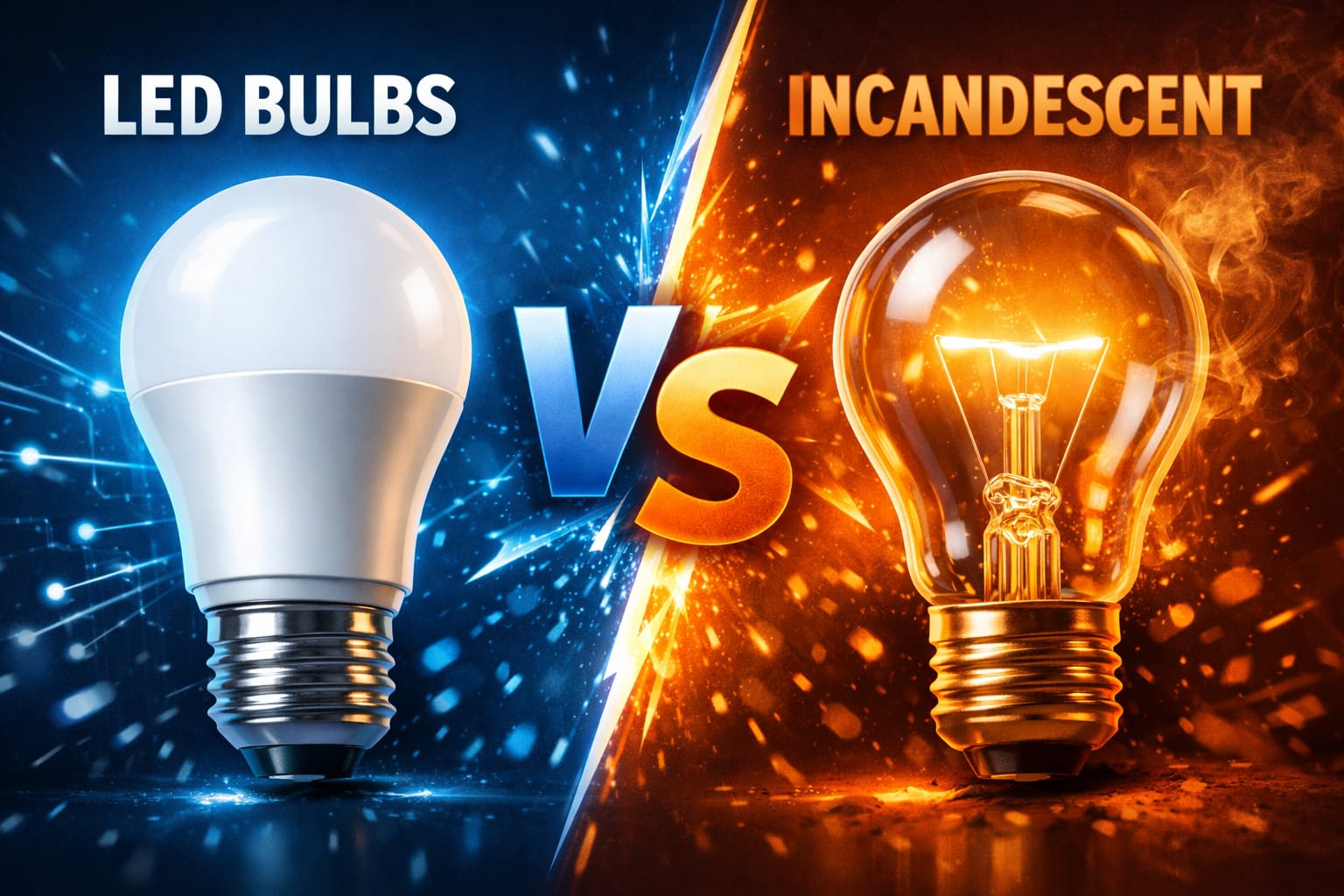
Table of Contents
- Quick Answer
- Technology Fundamentals
- Energy Consumption Analysis
- Lifespan and Durability
- Cost Comparison
- Light Quality Characteristics
- Heat Generation
- Environmental Impact
- Installation and Compatibility
- Common Applications
- Dimming Capabilities
- Safety Considerations
- Making the Transition
- What Should You Choose?
- Key Takeaways
- Sharing this Guide
Technology Fundamentals
Traditional incandescent bulbs generate illumination by heating a tungsten filament until it glows. This simple mechanism has remained largely unchanged since Thomas Edison’s original design, using electrical resistance to produce light and a substantial amount of heat.
Light-emitting diode (LED) technology operates through a different principle called electroluminescence. When an electrical current passes through a semiconductor material, photons are released directly as light without the need for extreme heat. This fundamental difference is what helps explain why LED options outperform older technologies in several important ways.
How Incandescent Technology Works
Traditional incandescent bulbs operate by heating a coiled tungsten wire to approximately 2,500 degrees Celsius. At this temperature, the filament emits visible light along with significant infrared radiation. The glass envelope contains inert gas that prevents the filament from oxidizing; however, it still gradually deteriorates through sublimation.
Only about five percent of the consumed electricity is converted into visible light by this heating process. The remaining 95 percent becomes waste heat, making traditional incandescent bulbs highly inefficient compared to modern alternatives that maximize light output while minimizing energy waste. If dim lighting is an issue in everyday spaces, switching to high-efficiency LED bulbs can increase brightness without using more power.
How Light Emitting Diode Technology Works
LED technology uses semiconductor chips that emit photons when electrons move through the material’s junction. Different semiconductor materials produce different wavelengths, enabling manufacturers to create specific color temperatures. Modern white LEDs typically use blue chips combined with phosphor coatings to produce a broader light spectrum.
The efficiency advantage stems from the direct conversion of electrical energy into light photons. With conversion rates exceeding 50 percent in modern designs, these advanced bulbs waste far less energy as heat. This results in cooler operation and dramatically reduced power consumption at equivalent brightness levels. If you are new to this technology, our guide on what LED bulbs are would be a good place to start.
Energy Consumption Analysis
When comparing LED and incandescent bulbs, the difference in energy consumption is dramatic. A traditional incandescent bulb that produces 800 lumens typically consumes 60 watts. In contrast, an LED bulb that produces the same brightness requires only 8-10 watts, which is an 85% reduction in electricity usage.
These efficiency gains directly translate into lower utility bills. Households that replace ten 60-watt incandescent bulbs with 10-watt LED bulbs can reduce their power usage by about 500 watts while the lights are on. Over the course of a year and under average usage patterns, this reduction can significantly decrease lighting expenses, as detailed in our LED vs. incandescent electricity cost guide.
Real-World Consumption Patterns
Actual energy savings depend on usage patterns and installation locations. For example, kitchen lighting that operates six hours daily will see greater savings than closet fixtures that are used for just a few minutes each day. To calculate your specific savings, multiply the wattage difference by the number of hours the lights are on and your local electricity rate per kilowatt-hour.
Energy-efficient lighting choices compound savings across multiple fixtures. For example, a home with thirty bulbs running four hours daily at twelve cents per kilowatt-hour can save approximately three hundred dollars annually by switching from 60-watt traditional bulbs to 10-watt modern alternatives. Payback periods are often under six months. For a broader look at how these savings add up, see our overview of LED energy savings.
Prioritize the bulbs that are used for the longest hours first because those fixtures usually provide the fastest return on investment.
Lifespan and Durability
Traditional incandescent bulbs typically last between 750 and 1,000 hours before the filament fails. Their short lifespan means they need to be replaced more frequently in high-use areas, resulting in ongoing maintenance and repeated purchase costs over time.
Modern alternatives using light-emitting diode (LED) technology offer rated lifespans between 15,000 and 50,000 hours. Even the more conservative 15,000-hour rating is fifteen times longer than that of traditional options. This dramatically reduces the frequency of replacements and associated labor costs, which is particularly valuable for hard-to-reach fixtures, such as those in vaulted ceilings. In spaces where flicker is noticeable and affects comfort, choosing a reliable option like a flicker-free LED bulb can improve stability and maintain consistent performance.
Factors Affecting Lifespan
Several environmental factors influence actual bulb longevity. For example, voltage fluctuations accelerate filament degradation in traditional incandescent bulbs, and frequent on-off cycling reduces their operational life. Vibration from ceiling fans or slamming doors can also damage the delicate tungsten filaments in traditional bulbs, causing them to fail prematurely in mechanically unstable locations.
Modern solid-state designs resist these environmental stresses better. Light-emitting diode technology contains no fragile filaments that are susceptible to shock or vibration. However, heat management affects longevity. Proper ventilation in enclosed fixtures helps maximize the rated lifespan by preventing the buildup of excessive temperatures that can degrade electronic components over time.
Cost Comparison
A proper cost comparison between LED and incandescent bulbs must consider more than just the purchase price. While traditional incandescent bulbs cost one to two dollars each, modern alternatives typically cost three to ten dollars, depending on their features and quality. Although the higher upfront cost may seem like a barrier, the long-term savings are usually much greater.
Total cost of ownership calculations reveal the true financial picture. Over a 15,000-hour period, one modern bulb replaces fifteen traditional incandescent bulbs. Combining the cost of replacements with energy savings from reduced wattage results in payback periods measured in months rather than years, making energy-efficient lighting a financially sound investment.
Calculating total ownership costs
A comprehensive cost analysis includes purchase price, energy consumption, and replacement frequency. For a fixture operating four hours daily at twelve cents per kilowatt-hour, a 60-watt traditional bulb costs approximately ten dollars in electricity annually, while a 10-watt equivalent costs under two dollars, saving eight dollars per bulb per year in operating expenses alone.
Adding replacement costs amplifies savings. Fifteen traditional incandescent bulbs, priced at two dollars each, cost thirty dollars over 15,000 hours, compared to a single modern alternative priced at ten dollars. Combined with energy savings of nearly one hundred twenty dollars over the same period, the total cost of ownership favors advanced technology by substantial margins in virtually all residential applications.
Light Quality Characteristics
Light quality encompasses color temperature, color rendering, and spectral distribution. Traditional incandescent bulbs produce a warm light of around 2,700 Kelvin, with a color rendering index near 100 that accurately shows colors as they appear under natural sunlight. Many users prefer this warm, familiar glow for living spaces.
Modern options using light-emitting diode (LED) technology now offer an extensive range of color temperatures, from warm 2,700 Kelvin to cool 5,000 Kelvin and beyond. Quality products achieve CRI values above 80, with premium versions reaching 90 or higher. These products provide accurate color rendering that rivals that of traditional sources across most applications requiring true color perception.
Color Rendering Considerations
The color rendering index (CRI) measures how accurately a light source shows colors compared to natural daylight. Traditional incandescent bulbs excel at color rendering due to their continuous spectral output. However, early alternatives struggled with narrow spectral distributions that distorted certain colors, particularly reds and skin tones.
High-CRI options are useful in spaces that demand accurate color representation, including art studios, retail displays, and makeup areas. Selecting products with CRI ratings above 90 ensures professional-grade color accuracy for demanding visual tasks.
Heat Generation
One of the most important differences between LED and incandescent bulbs is heat production. Traditional incandescent bulbs convert approximately 95% of consumed energy into heat. Surface temperatures reach 150 to 250 degrees Celsius during normal operation, creating burn risks and contributing unwanted thermal loads to air-conditioned spaces.
Advanced alternatives generate significantly less waste heat due to superior electrical efficiency. While they produce some thermal output, requiring heat sink designs, their surface temperatures typically remain below 80°C. This reduced heat generation improves comfort in enclosed spaces and decreases cooling costs in climates that require air conditioning during lighting hours.
Traditional incandescent bulbs can become hot enough to burn skin or damage nearby materials in tight fixtures.
Thermal Management Impact
Excessive heat can damage surrounding materials and electronic components. For example, traditional incandescent bulbs can damage plastic fixtures, discolor lampshades, and create fire hazards when insulation touches hot surfaces in recessed installations. Building codes often require special clearances around these high-temperature sources to prevent the ignition of combustible materials.
The lower operating temperatures of energy-efficient lighting expand installation possibilities. Modern designs are safer in enclosed fixtures, near fabrics, and in tight spaces where traditional options would overheat. This thermal advantage enables new lighting applications and reduces fire risks in residential settings. This is particularly valuable in children’s rooms, closets, and storage areas with combustible contents.
Environmental Impact
Environmental considerations extend beyond energy consumption to manufacturing, materials, and disposal. Though traditional incandescent bulbs contain simple materials, including glass, metal, and tungsten, that recycle easily, their high energy consumption creates substantial carbon emissions from power generation, particularly in regions dependent on fossil fuel electricity sources.
Light-emitting diode (LED) technology reduces environmental impact through dramatic energy savings that decrease power plant emissions. According to the U.S. Department of Energy, widespread adoption of LED technology could save approximately 348 terawatt-hours of electricity annually. This is equivalent to the output of forty-four large power plants, and it would prevent substantial greenhouse gas emissions.
Lifecycle Environmental Costs
The manufacturing impacts of different technologies vary. Traditional incandescent bulbs require simpler production processes with lower embodied energy. In contrast, advanced alternatives involve semiconductor fabrication and electronic component assembly, which demand more complex manufacturing processes. However, their extended lifespan means fewer units are produced per service hour, which could offset manufacturing impacts.
Disposal considerations differ as well. Traditional options contain no hazardous materials requiring special handling, but modern designs include electronic components with trace amounts of materials that need proper recycling. Fortunately, many retailers and municipalities now offer recycling programs for electronic lighting, enabling responsible end-of-life management that recovers valuable materials and prevents landfill accumulation.
Installation and compatibility
Standard screw bases enable direct replacement in most fixtures. Traditional incandescent bulbs fit E26 (medium) and E12 (candelabra) sockets, which are common in North American residential installations. Modern alternatives with identical base configurations can be installed without modifying the fixture, providing straightforward retrofit solutions for existing lighting infrastructure.
However, there are still a few compatibility issues to consider. These include enclosed fixture ratings, dimmer compatibility, and three-way switch operation. While traditional incandescent bulbs work universally across all fixtures and controls, light-emitting diode (LED) technology may require specific dimmer types or have restrictions on enclosed fixture installations, depending on the thermal design and manufacturer specifications.
Fixture Compatibility Checks
Verify fixture requirements before purchasing replacements. Recessed cans may have IC (insulation contact) or non-IC ratings, which affect heat dissipation. Fully enclosed decorative fixtures require bulbs that are rated for enclosed operation. Outdoor fixtures require the appropriate weather resistance ratings to ensure reliable performance in extreme temperatures and moisture.
Directional applications, such as track lighting, recessed downlights, and accent fixtures, benefit from considerations regarding the beam angle. Traditional incandescent bulbs emit omnidirectional light, so they require reflectors for directional control. In contrast, modern alternatives offer integrated beam forming, ranging from narrow spot to wide flood patterns. This eliminates efficiency losses from reflector absorption in directional applications.
Common Applications
Different lighting needs favor different technologies based on specific requirements. The choice between LED and incandescent bulbs often depends on the application, including color quality, dimming needs, and how long the lights are used.
General illumination throughout homes benefits from energy-efficient lighting that provides a long service life with minimal maintenance. Living rooms, bedrooms, and hallways see substantial savings from reduced energy consumption during extended daily operation. Kitchen task lighting, bathroom vanities, and home offices benefit particularly from cool operation and instant brightness without warm-up delays.
Specialty applications
Certain applications exploit specific technological advantages. Accent lighting that highlights artwork benefits from light-emitting diode (LED) technology, which lacks the ultraviolet emissions that fade pigments over time. Closet lighting benefits from instant-on capability, cool operation, and the ability to avoid warm-up periods near clothing and flammable materials.
Modern alternatives are favored for outdoor applications due to their durability in temperature extremes and resistance to vibration. Holiday decorations, landscape lighting, and security fixtures reliably operate in harsh conditions. Garage and workshop lighting benefits from robust construction and long service intervals, which reduce maintenance needs for difficult-to-access installations that require ladder work for bulb changes.
Dimming capabilities
Dimming performance varies significantly between technologies. Traditional incandescent bulbs dim smoothly across their entire range with standard phase-cut dimmers and maintain a warm color temperature, even at low output levels. This natural dimming behavior provides intuitive control without requiring specialized equipment or compatibility verification.
Modern alternatives require dimmer compatibility verification. While dimmable versions exist, they may have minimum brightness thresholds, limited dimming ranges, or flicker with incompatible controls. Quality dimmable products that are labeled for use with standard dimmers tend to perform well. However, verifying compatibility between specific bulb models and installed dimmer types can prevent performance issues and user frustration. If inconsistent dimming affects visual comfort, switching to a smart, dimmable LED bulb can provide more stable control and a better everyday experience.
Dimmer Upgrade Considerations
Optimal dimming often requires upgrading older dimmer switches designed for resistive loads. Modern dimmers that are specifically engineered for electronic loads provide smoother dimming curves, eliminate buzzing or flickering, and support lower minimum brightness levels, which enhances ambiance control throughout the dimming range.
Investing in compatible dimmers improves the user experience. Although quality controls cost between twenty-five and sixty dollars, they unlock the full dimming potential. Many manufacturers provide compatibility lists that identify tested dimmer models, which removes the guesswork from the selection process. Proper pairing ensures reliable performance across the dimming range, preventing flickering, buzzing, and premature failure due to incompatible electrical interactions.
Safety Considerations
Electrical safety fundamentals apply to all lighting technologies. Proper installation within rated voltage ranges, avoiding overloading circuits, and using fixtures rated for bulb wattages can prevent electrical hazards. Traditional incandescent bulbs pose an additional burn risk due to their extremely high surface temperatures, which can cause immediate skin burns upon contact.
Modern alternatives have lower operating temperatures, making them safer around children, pets, and flammable materials. Although they still generate heat that requires ventilation in enclosed fixtures, their surface temperatures remain below levels that cause immediate burns. This thermal safety advantage is particularly beneficial for table lamps, floor lamps, and fixtures in locations accessible to children, where accidental contact might occur during normal household activities. For more information on safe operating temperatures and practical lighting basics, please refer to our knowledge center.
Making the Transition
Transitioning from traditional incandescent bulbs to modern alternatives requires strategic planning to achieve optimal results. Rather than replacing all bulbs simultaneously, prioritize high-use areas where energy savings will accumulate quickly. Living room, kitchen, and bathroom fixtures that are on for several hours a day usually provide the fastest payback and the most noticeable reduction in energy bills.
Selecting the appropriate color temperature can prevent dissatisfaction. Warm white options around 2,700 Kelvin replicate the appearance of traditional bulbs in living spaces, bedrooms, and dining areas. Neutral white temperatures between 3,000 and 4,000 Kelvin provide brighter, more energizing illumination for task areas like kitchens and home offices.
Transition Planning Tips
Document existing bulb specifications before purchasing replacements. Note the base types, wattages, and special features, such as three-way switching or dimming capabilities. Having this inventory on hand ensures that compatible replacements will arrive before you remove old bulbs, preventing fixtures from being left in the dark while you wait for proper substitutes.
Consider purchasing sample bulbs for critical applications. Testing color temperature, brightness levels, and dimming performance in actual fixtures before making bulk purchases prevents costly mistakes. Most retailers accept returns of incompatible products, so you can experiment with different bulbs to find your preferred specifications. Successful transitions result in lasting satisfaction and maximum value from modern lighting investments throughout the home.
What should you choose?
Choose LED bulbs for lower bills, a longer lifespan, and cooler operation in most rooms. Pick incandescent bulbs only if you want a very low upfront cost or a familiar dimming feel.
- If lights run daily → choose LED
- If heat matters → choose LED
- If replacements are hard → choose LED
- If initial cost is the priority → choose incandescent
Key Takeaways
LED bulbs save far more electricity than incandescent bulbs, last longer, run cooler, and reduce the need for frequent replacement in everyday home lighting.
For most households, the smartest approach is to replace high-use bulbs first and match the lumens and color temperature so that the upgrade feels practical rather than disruptive.
Over time, as energy costs and maintenance needs add up, efficient lighting becomes the stronger long-term choice for comfort, safety, and value.
Share this guide!
If you found this guide helpful, save it or share it with someone who still uses incandescent bulbs.
Interested in learning more? Browse all related articles in our category section.