The Best LED Interior Lights for Cars: Top Picks and Easy Setup Tips
When the interior lighting is weak, a car cabin can feel dull, uneven, or older than it really is. The right upgrade can transform the look of your dashboard, footwells, doors, and console at night without making the cabin look overdone.
The best options balance style, visibility, installation ease, and daily comfort, ranging from subtle warm accents to colorful ambient setups. When done well, interior LEDs can make the cabin feel cleaner, sharper, and much more enjoyable after dark.
Quick Answer
The best LED interior lights for cars depend on what you want to improve. Bulb swaps are better for practical visibility, while strip or fiber kits are better for ambient style. The cleanest setups use moderate brightness, consistent color, and careful placement.
- Choose bulb replacements for dome, map, vanity, and trunk lighting.
- Use strips or fiber kits for footwells, dash trim, and doors.
- Prioritize diffused light and restrained brightness over raw output claims.
- Match the color temperature throughout the cabin for a more polished look.
- Plan the placement of wiring and controllers before installing anything.
Table of Contents:
- Quick Answer
- Why factory cabin lighting often feels disappointing
- How to choose the right interior upgrade
- How to get brightness without harshness
- The placement zones that matter most
- Smart features worth paying for
- Mistakes that Ruin the Final Look
- Installation Basics Before You Start
- Final thoughts before you buy
- What should you choose?
- Key Takeaways
- Share this guide!
Why factory cabin lighting often feels disappointing
Harsh hotspots, dim footwells, and yellowish stock bulbs can make nighttime driving feel more exhausting than necessary. Many drivers only start looking for better options after dealing with shadowy door pockets, a dim dome light, or a dated-looking interior every time the sun goes down. That is why the best LED interior lights for cars are more than just cosmetic upgrades. They solve a real comfort problem inside the cabin.
Most factory setups are designed to meet cost targets rather than create a refined atmosphere. Light output can be uneven, colors can look muddy, and some interiors feel darker than they really are because the lighting is poorly placed. A good upgrade improves visual clarity while maintaining a pleasant interior instead of a flashy one.
Before buying, it helps to understand the basic types of upgrades and where they work best. Our beginner-friendly overview of car LED lighting is useful for getting a broader look at how interior and exterior applications differ. This knowledge makes it easier to judge what will actually improve your own cabin.
Common night visibility issues inside the cabin
Interior lighting is often treated as a minor detail, but poor placement can make the cabin feel unusable. Weak map lights make finding small items annoying, dim rear zones leave passengers in the dark, and low-quality upgrades create a patchy look that is more distracting than helpful. A good setup improves the entire cabin experience, not just a bright spot near the console.
Another common issue is mismatch. For example, a cool white dome bulb paired with warm halogen vanity lights makes the interior look unfinished. Consistency matters because the eye quickly notices mixed tones, especially on glossy trim, leather, and piano-black surfaces. Good interior LEDs create a cohesive look from the front to the rear seating area.
Why does light color change the mood?
The color choice shapes the personality of the cabin more than many buyers expect. Warm white feels premium and relaxing. Neutral white looks crisp and practical. RGB systems allow for mood and customization. The best LED interior lights give off a tone that matches the purpose of the space instead of overwhelming it.
To achieve a cleaner result, consider whether you want subtle task lighting, full ambient lighting, or a mix of both. A restrained setup usually ages better than extreme saturation everywhere. When the glow complements the trim, upholstery, and dashboard materials, the interior feels intentionally designed rather than randomly upgraded.
How do you choose the right interior upgrade?
The smartest way to shop is to decide if you want simple bulbs, flexible strips, or a premium accent system. The best LED interior lights for cars aren’t always the brightest. They are the ones that fit your cabin layout, your tolerance for wiring, and your desired style. For example, a small commuter car usually benefits from a lighter touch than a large SUV with more trim lines and darker interior panels.
Drivers who want color variety often start with car interior LED light kits because they can quickly change the mood. If your main concern is a tired factory look, replacing the stock dome, map, vanity, and trunk bulbs may provide a cleaner upgrade with less effort. Either option can work well when the products are high-quality and the lighting is used with restraint.
One frustration with cheap strip setups is flicker, especially when low-end controllers struggle with dimming transitions. This is important because unstable light makes the cabin feel cheap, even when the colors look good. If you want customizable colors without committing to a full custom build, a multi-zone interior accent strip kit is a sensible place to start.
It also helps to compare upgrade categories before making a purchase. This breakdown of different types of car lighting upgrades can help you decide whether to prioritize footwell strips, direct bulb swaps, or decorative accent channels. Having this extra information can save you money on kits that look impressive in photos but do not suit your actual cabin.
Strip kits versus bulb replacements?
Strip-based systems create a mood and perimeter glow. Bulb swaps improve the light you use directly for reading, finding items, or entering the vehicle. Many of the strongest setups combine both types of lighting: strips for atmosphere and replacement bulbs for function. This combination often feels more premium than focusing on color alone.
Strip kits are ideal for lighting under seats, beneath the dashboard, and along lower trim lines. Conversely, dome and vanity replacements are better suited for stronger everyday usability. Carefully combining the two creates a cabin that feels upgraded in a practical way, not just decorative.
How can you achieve brightness without harshness?
A brighter cabin is not necessarily a better one. Too much direct output can reflect off glossy trim, screens, and chrome accents in ways that are unpleasant during nighttime driving. The best LED interior lights for cars provide controlled illumination, making the cabin feel well-lit and modern without being distracting. This balance is especially important in vehicles with dark dashboards and large touchscreens.
To make the cabin look more premium, choose diffused lighting and dim it slightly lower than you think you need. A soft, even glow usually looks better than a brighter, harsher setup.
Look for diffused light wherever possible, especially in accent kits. A soft glow along trim edges usually looks more expensive than exposed points of light. When replacing stock bulbs, a neutral white color often provides a sharp result without drifting into a bluish tone that can feel sterile. The goal is usable brightness, not the lighting equivalent of a flashlight in your face.
This is also why product descriptions can be misleading. Some kits boast high output, but what matters more are beam spread, hotspot control, and color consistency. The best choices make objects easier to see while maintaining a refined space. Stronger numbers on paper do not always lead to a better result in real use.
The most important placement zones
Where you put the lights often matters more than which lights you buy. Good ambient lighting for cars usually begins in the footwells, along the lower edges of the dashboard, the center console, and the door trims. These locations build atmosphere without shining directly into the eyes. The best LED interior lights for cars create depth by outlining the cabin rather than shining light directly at occupants.
Think in layers. You need functional light for reading and locating items, as well as decorative light to support the overall style. Placing LEDs too high can create reflections on windows and screens. Keeping them lower tends to produce a calmer effect and allows the trim surfaces to catch the glow more naturally.
Dashboard and footwell ideas
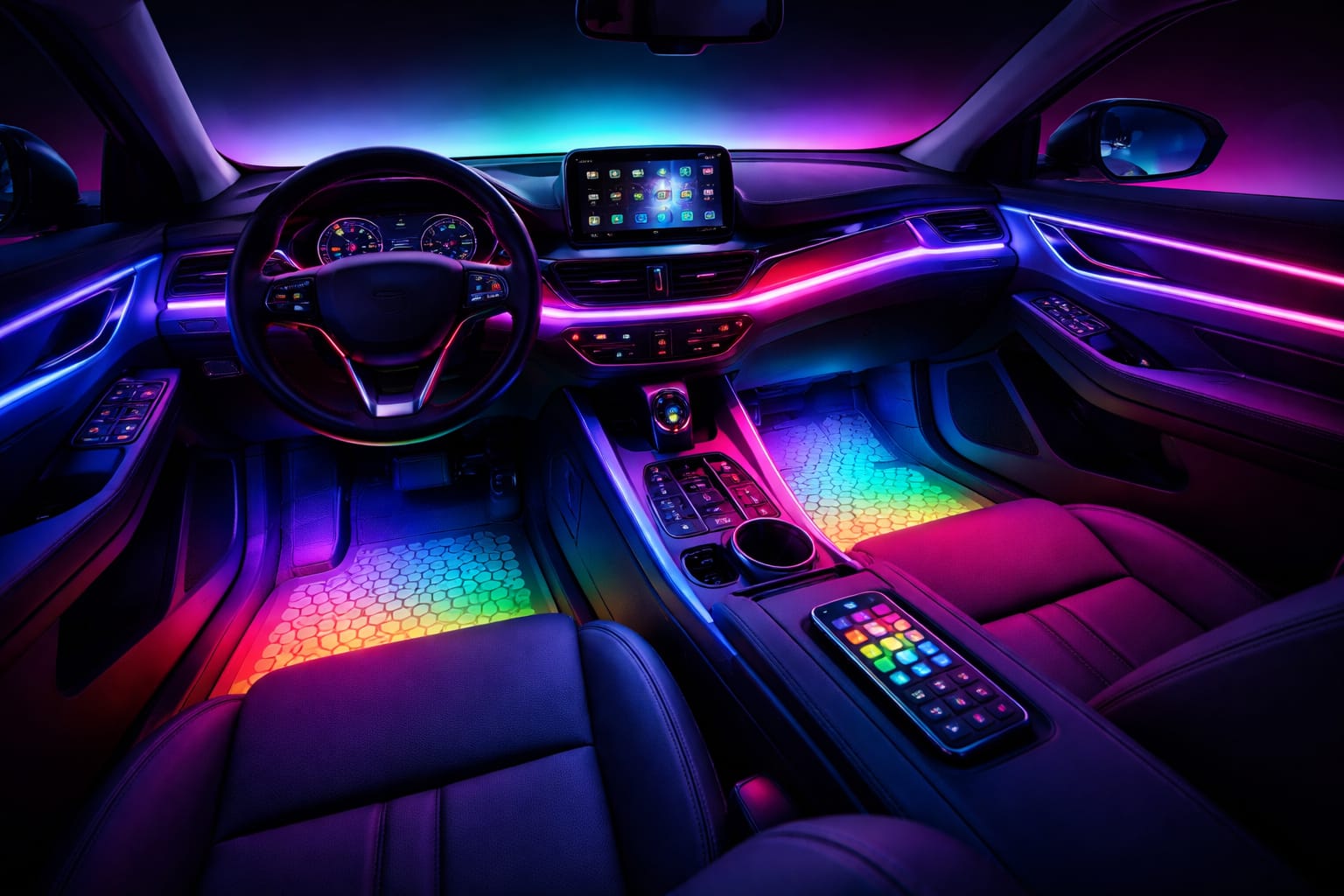
Footwells are often the easiest place to start because they make an immediate difference without looking excessive. A hidden strip of lights under the dashboard can give passengers a soft glow, making the interior feel more expensive. Meanwhile, a slim accent line around the dashboard can highlight its shape and width when installed properly.
At this point, many drivers also compare ambient accents with simple bulb replacements. If your goal is cleaner dome and map light output, this guide on switching from factory bulbs to LED versions provides useful context. It will help you decide if your cabin needs better functionality, stronger style, or both.
Some smart features are worth paying for
Some features sound impressive but add very little to the real-life experience. Others genuinely improve the ownership experience. Many buyers consider the best LED interior lights for cars to be those with dimming memory, stable app control, grouped zones, and presets that allow you to switch from a subtle commuter mood to a weekend color setup in seconds. These features make the lighting feel integrated instead of gimmicky.
Music sync can be fun, but most drivers will use fixed scenes far more often. More important are reliable reconnectivity and consistent colors across zones. Quality ambient lighting should make your car look intentional every time you enter it, not just when you spend several minutes adjusting the settings.
Some buyers want an upscale cabin effect that standard strip products cannot provide. In those cases, poor diffusion can create distracting glare along shiny trim, making a premium-style build look unfinished. A side-channel accent fiber lighting kit can create a more continuous line of light across the dashboard and door seams, often resulting in a cleaner look.
App control and music sync explained
App control matters most when it is simple. A confusing interface turns a cool feature into something you stop using after a week. Good car interior LED light kits allow you to save a few strong presets, adjust the brightness quickly, and turn off zones independently. This is far more useful than dozens of flashy effects that are impractical for everyday driving.
Understanding the trade-off between regular RGB and more segmented lighting behavior helps if you are deciding between the two. Our comparison of RGB and RGBIC strip behavior is especially relevant if you want moving effects or advanced color transitions inside the cabin. While not always necessary, it can influence your decision.
Mistakes that ruin the final look
One of the biggest mistakes is setting the maximum brightness everywhere. The best LED interior lights for cars accentuate the cabin’s shape, rather than flattening it with nonstop brightness. When every gap glows at full power, the interior stops feeling premium and starts looking busy. Lower brightness with better placement usually wins.
Another common mistake is ignoring cable management. Visible wiring ruins the appearance of a factory-style installation. Planning cable routes under trim, testing controller placement, and checking clearances before attaching anything permanently can make a huge difference. A clean installation is often what separates tasteful ambient lighting from something that feels temporary.
Buyers also overlook color discipline. Just because a kit can display every color does not mean that every color belongs in everyday use. Two or three refined presets usually make more sense than cycling through loud effects. Interior lighting should complement the cabin materials, not compete with them.
Here are some installation basics to keep in mind before you start
Preparation matters almost as much as the product itself. Properly clean surfaces, test every zone before sticking anything down, and decide where the controller will go before routing wires. The best LED interior lights for cars look factory-clean only when the installation process is planned in advance.
Do not route wires near pedals, seat tracks, airbag areas, or moving trim pieces. A setup that looks neat but interferes with normal vehicle operation is never worth it.
You should also consider how the cabin will be used in real life. Passengers will kick the under-dash area, the doors will open and close constantly, and the trim pieces will heat up in the summer. This means that the attachment method, wire slack, and connector quality are more important than they initially seem. Strip-based interior lighting can work extremely well, but only if it is installed with daily wear in mind.
To learn more about efficiency, lifespan, and why quality LEDs outperform older lighting technology, check out the U.S. Department of Energy’s LED lighting efficiency guidance and the ENERGY STAR guide to LED lighting basics. Although these resources focus on broader applications, the core principles still help when comparing cheap versus well-made products.
Power sources and cable routing
Powering a kit through a USB port, a 12V outlet, or a hidden hardwired connection affects both convenience and the final appearance. USB is simple but may leave you with visible cabling. A cleaner route through trim panels often looks far better, especially if your goal is a premium finish.
Where possible, routing should always follow existing lines. Tucking cables near seams, under lower trim edges, and away from pedal movement will keep your setup safe and discreet. Reading broader installation articles in our LED Knowledge Center can help you avoid basic wiring mistakes before taking panels apart.
Final thoughts before you buy
Choosing the best LED interior lights for cars comes down to restraint, consistency, and fit. A great setup does not need to overpower the cabin. It should make the interior feel cleaner, easier to use, and more modern every time you drive at night. When the output is smooth, the placement is smart, and the color coordinates with the trim, even a modest upgrade can feel like a major improvement.
For some drivers, the right answer is a subtle ambient lighting kit. Others prefer a full replacement of stock bulbs plus a few accent zones. Either way, the best choice is the one that solves your specific problems instead of going for the loudest effect. Consider whether you need style, stronger visibility, or a better mix of both, and then purchase accordingly.
Another issue to watch for late in the process is inconsistent brightness between factory bulbs and replacement bulbs. This mismatch stands out immediately and can make the cabin look unfinished. If you want a simple, functional upgrade for map lights, dome lights, vanity areas, and the trunk, consider a full cabin replacement bulb set.
What should you choose?
Choose based on what bothers you most about the cabin right now. If poor visibility is the issue, start with bulb replacements. If the issue is the atmosphere, start with a subtle ambient lighting kit.
- Choose bulb swaps for better map, dome, vanity, and trunk lighting.
- Choose strip kits for a footwell and lower-dash ambient glow.
- If you want a smoother, more premium accent line, choose fiber-style kits.
- Select neutral or warm white bulbs for a cleaner daily driving look.
- Only choose multi-zone control if you will actually use presets and dimming.
Key Takeaways
The best LED interior lights for cars improve the cabin without making it feel cluttered, harsh, or gimmicky. Good results come from balanced brightness, consistent color, and lighting that supports the interior’s shape.
For better everyday usability, start with the dome, map, vanity, and trunk bulbs. For more atmosphere, add diffused footwell or trim lighting, keeping the brightness lower than maximum for a cleaner, factory-style effect.
Take the time to plan the layout, match the color tone, and properly hide the wiring. Even a modest interior LED upgrade can make the cabin feel newer, more comfortable, and much more refined at night.
Share this guide!
If you found it helpful, save it or share it with someone who is dealing with weak factory cabin lighting.
Interested in learning more? Browse all related articles in our category section.