LED Lens vs Reflector: Beam Control & Best Uses
Choosing between an LED lens and a reflector mainly comes down to beam control. A lens is usually better for tighter, more precise beams and compact fixture designs, while a reflector is often better when you want a simpler, lower-cost optic with a softer or wider light distribution.
Both are LED optical systems, but they control light in different ways. A reflector redirects light from a shaped reflective surface. A lens bends light through a clear material such as polycarbonate, acrylic, silicone, or glass.
This guide compares LED lenses and reflectors by beam angle, glare control, fixture size, efficiency, cost, durability, and best uses so you can choose the optic that actually fits the lighting job.
Quick Answer
Use a lens when you need a tighter, more precise beam or a compact fixture. Use a reflector when cost, simplicity, durability, or a wider and softer light distribution matter more. Both can work well, but the right choice depends on beam angle, glare control, fixture size, and application.
- Choose a lens for compact fixtures, narrow beams, sharper cutoff, or more controlled light distribution.
- Choose a reflector for lower-cost designs, larger optical chambers, broad beams, or simpler fixture construction.
- For beam angle control, lenses usually offer more precision, especially with TIR, collimating, or asymmetric optics.
- For general lighting, reflectors can still be efficient, durable, and visually comfortable when designed well.
- Neither option is always better. The best optic is the one that matches the LED package, fixture body, target surface, and viewing comfort.
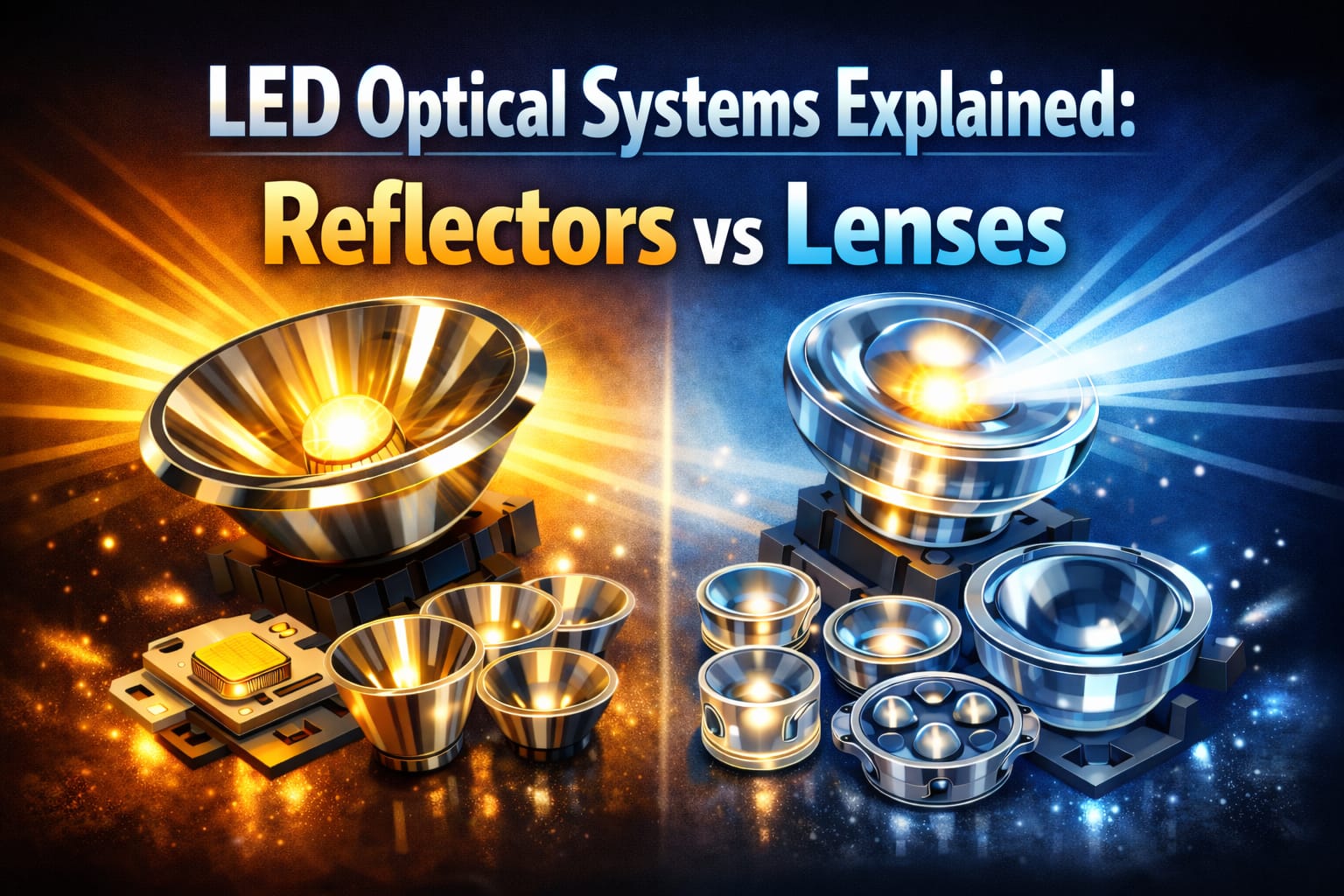
Table of Contents:
LED Lens vs Reflector: The Core Difference
LED chips naturally emit light over a wide range of angles. Without optical control, that light can spill into unwanted areas, create weak intensity on the target surface, or produce uneven illumination. That is why lenses and reflectors matter in almost every directional LED fixture. For the source behavior behind this, it helps to understand how LED lighting works.
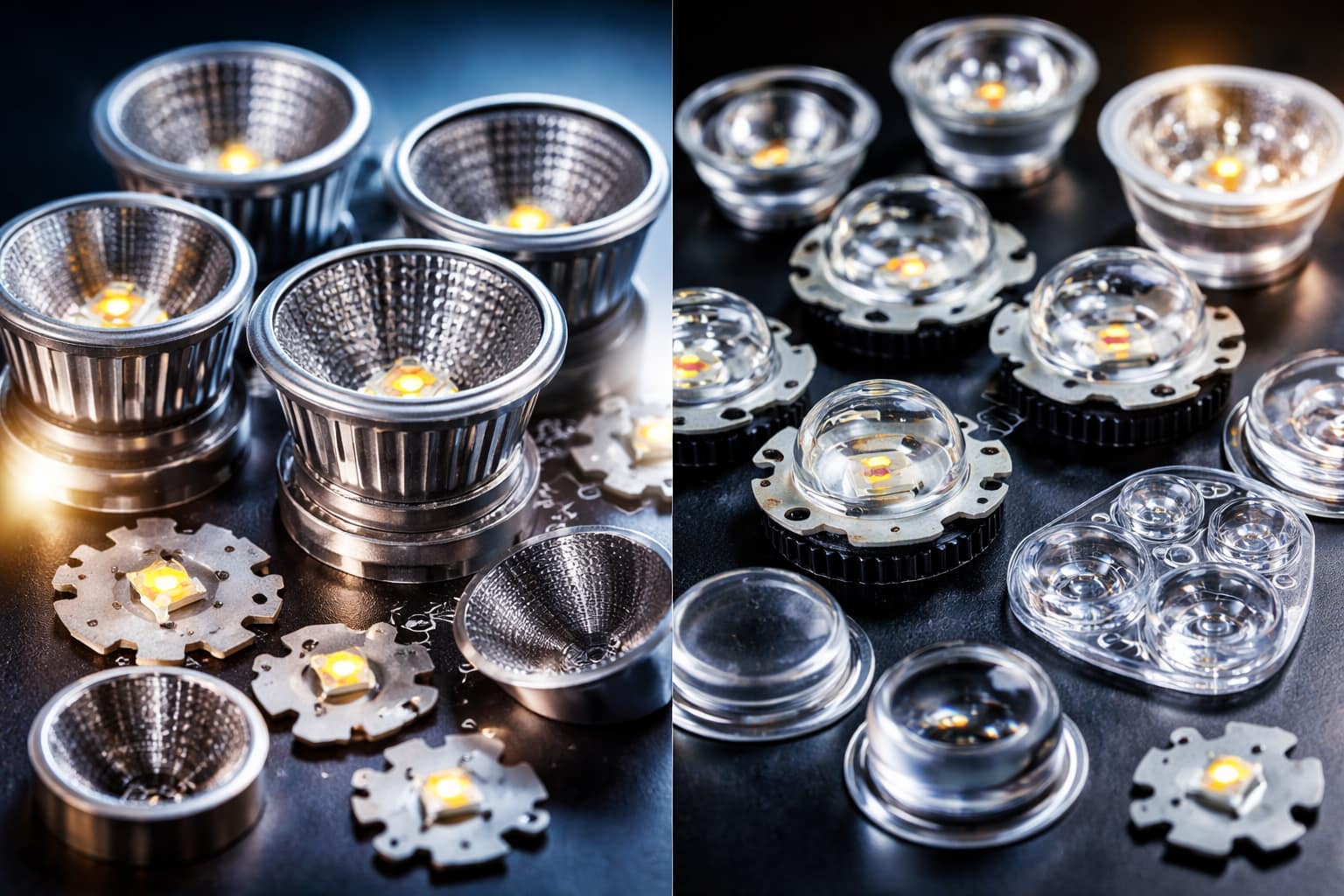
A reflector controls light by reflection. Light leaves the LED, hits a shaped reflective surface, and is redirected forward, sideways, or across a wider area depending on the reflector geometry. A lens controls light by refraction. Light passes through a clear material and bends according to the lens shape, material, and surface design.
In practical terms, reflectors are often strong when the fixture has enough space for a larger optical chamber. Lenses are often stronger when the fixture needs compact optics, sharper control, or a more specific beam pattern. The LED package also matters, so it is useful to compare LED package types before assuming one optic will work best with every source.
The important point is that a lens is not automatically more advanced, and a reflector is not automatically more basic. A well-designed reflector can outperform a poor lens, while a good TIR lens can create a cleaner beam than a basic reflector in a compact fixture.
How LED Reflectors Work
LED reflectors rely on specular reflection. The LED emits light into the optical chamber, the light strikes the shaped surface, and the reflector redirects it according to the angle of incidence. By changing the depth, aperture, curvature, and surface finish, designers can create anything from a tighter spot to a broad flood beam.
Common reflector shapes include parabolic, elliptical, compound, and faceted designs. Deep reflectors usually capture more off-axis light and push it forward into a tighter beam. Shallower reflectors tend to produce wider patterns that are useful for area lighting or general illumination. Hybrid reflectors can shape the center beam and spill area separately, which helps when a fixture needs a controlled hotspot with softer surrounding light.
Surface finish is just as important as shape. Smooth, mirror-like reflectors can deliver high reflectivity and stronger punch, while textured or diffuse finishes soften the beam and reduce harsh edges. Aluminum remains common because it combines reflectivity with useful thermal behavior, especially when the optical chamber is paired with proper LED thermal management.
The main trade-off is size. A reflector often needs more physical depth to collect and redirect light effectively. That can be fine in downlights, high-bay fixtures, outdoor housings, and larger luminaires, but it can be limiting in very slim or compact products.
How LED Lenses Work
LED lenses guide light through refraction. As light passes from air into a transparent material and back out again, its path bends. The lens shape determines whether the beam becomes narrower, wider, softer, sharper, symmetric, or asymmetric.
One of the most common LED lens designs is the TIR optic, which stands for total internal reflection. A TIR lens combines refraction on the front surface with internal reflection on the sides, allowing the optic to collect light that a simple front lens would miss. This makes TIR lenses especially useful in compact fixtures where strong beam control must come from a small optical part.
Other lens types solve different problems. Fresnel lenses reduce thickness and weight by using stepped rings instead of one thick curved body. Collimating lenses narrow diverging LED output into a more directional beam. Asymmetric lenses spread light more in one direction than another, which is useful for wall washing, roadway lighting, and area lighting where the target is not directly below the fixture.
Lenses are also sensitive to source quality. If multiple LEDs in an array vary in color or brightness, the optic may make those differences more visible. For applications where uniformity matters, LED binning consistency can be just as important as the lens itself.
Beam Angle Control and Light Distribution
Beam angle describes how concentrated or spread out the light appears. Narrow beams under roughly 20 degrees are common for spotlighting. Mid-range beams often work well for accent lighting. Wide beams are better for general illumination, area coverage, and softer light distribution.
Reflectors and lenses can both create narrow or wide beams, but they do it differently. Reflector depth, aperture size, curve shape, and surface finish control how much light is collected and where it goes. With lenses, curvature, refractive index, TIR geometry, surface texture, and the distance from the LED source have more influence on the final beam pattern.
For small DIY tests, prototypes, or simple beam-focusing experiments, a convex LED lens for tighter beam control can help show how a lens narrows and redirects light compared with a bare LED or a simple reflector setup.
Do not compare optics by beam angle alone. Two fixtures can both be labeled 30 degrees and still look very different because center intensity, edge softness, cutoff, glare, and beam uniformity are not the same.
Field angle is another useful measurement because it shows where intensity drops farther away from the center beam. Looking at both beam angle and field angle gives a better sense of how the fixture will actually cover a surface. This becomes even more important when you are also comparing lighting efficiency metrics.
Beam quality also includes cutoff, uniformity, center beam candlepower, spill control, and visual comfort. In architectural or retail lighting, a cleaner cutoff can reduce visual clutter and keep attention on the target. In general lighting, a softer transition may feel more natural. The U.S. Department of Energy LED lighting guidance explains why useful light output matters more than simply increasing raw lumens.
Some fixtures also use field-adjustable optics. Interchangeable lenses or reflectors can change the beam after installation without replacing the whole luminaire. This is useful in retail, hospitality, display, museum, and architectural spaces where layouts change over time. Higher-end products may use zoom-style systems that mechanically reposition optical elements relative to the LED source, although these are less common in standard residential fixtures.
Efficiency, Materials, Cost, and Durability
Optical efficiency describes how much of the LED’s output leaves the fixture in a useful direction. Both lenses and reflectors can be highly efficient, but losses always exist. Some light is absorbed by materials, scattered by imperfect surfaces, trapped inside the fixture, or redirected in ways that do not help the target application.
Well-made reflectors can perform very strongly in directional applications, especially when the source and reflector geometry are well matched. Lenses can reach similar practical performance, but complex optics may introduce extra losses at additional surfaces or internal features. Still, the most efficient-looking optic on paper is not always the best choice if it creates glare, spill, uneven coverage, or poor cutoff.
Reflectors are often attractive when you want strong performance at lower component cost, good output from a larger optical cavity, and a design that is relatively straightforward to manufacture.
Lenses are often the better fit when compact size, tighter beam control, or specialized distributions matter more than keeping the optic as simple as possible.
In short: efficiency ranges can overlap quite a bit, so beam quality, fixture size, glare control, and application requirements usually matter more than chasing a small optical percentage difference by itself.
Material choice affects clarity, durability, heat resistance, and long-term appearance. Polycarbonate is common for LED lenses because it combines good clarity with strong impact resistance. Acrylic can offer high optical transmission, but it is usually less impact-resistant and less tolerant of heat. Silicone is useful in high-temperature environments because it keeps its optical properties better than many rigid plastics. Glass remains a premium option when long-term clarity, temperature resistance, and optical stability justify the extra weight and cost.
For reflectors, aluminum is common because it is lightweight, reflective, and thermally useful. Some systems use coated polymers or specialty reflective films when lower weight, lower cost, or easier manufacturing matters more than using solid metal.
Manufacturing quality also matters. Plastic lenses are often injection molded, and mold quality has a major effect on beam consistency. Reflectors may be stamped, spun, hydroformed, or coated through processes such as vacuum metallizing. Photometric testing checks beam angle, center intensity, and distribution shape, while surface inspection helps catch scratches, contamination, coating flaws, and molding defects that can scatter light.
Cost is not just the price of the optic. A lens may cost more as a component but allow a smaller fixture, fewer LEDs, or a more controlled beam. A reflector may reduce part cost but require a larger housing. Thermal management, LED aging, driver losses, maintenance, and beam quality all affect real value over time. For a broader view of system performance, see our guide to LED efficiency optimization.
Abrasive cloths, harsh solvents, and aggressive scrubbing can permanently damage reflector coatings or haze plastic lenses. Once the optical surface is compromised, beam quality usually does not fully recover.
Maintenance should match the optical material. Dust lowers reflector performance by reducing reflectivity, while dirt on a lens can scatter light and create haze or glare. In dirty, damp, or outdoor environments, sealed optical chambers help preserve performance. In accessible indoor fixtures, easier serviceability and replacement support may matter more than a fully sealed design.
Best Uses for LED Lenses vs Reflectors
The best optic depends on the space, the target surface, and the type of beam you need. In retail displays, galleries, and museums, narrow controlled beams help highlight products or artwork without wasting light. Both deep reflectors and precision lenses can work, but lenses are often preferred when fixture size must stay compact or the beam needs sharper control.
Outdoor area lighting often uses reflector-based designs because they are durable, effective for broad distribution, and easy to integrate into larger housings. However, many roadway, parking, and perimeter fixtures now use advanced lens arrays to create specific light distributions over lanes, sidewalks, and boundary zones.
Office and commercial lighting usually needs even coverage and visual comfort rather than a dramatic spotlight effect. Diffuse or controlled lens systems are common here, especially when the goal is reducing glare in lighting without losing useful brightness.
Industrial and high-bay fixtures need the beam to match mounting height, aisle layout, task area, and environmental conditions. A reflector may be enough for broad output from a larger fixture. A lens may be better when the light must be aimed more precisely from a high mounting point. The ENERGY STAR overview of LED lighting is a useful starting point for broader LED application context.
Best fit by situation:
- Small or slim fixture: lens, because compact optics are easier to package.
- Lower-cost general fixture: reflector, because the optical design can be simpler.
- Sharp accent beam: lens or deep reflector, depending on fixture depth and cutoff needs.
- Broad area lighting: reflector or wide lens, depending on distribution and glare requirements.
- Roadway, wall washing, or asymmetric output: advanced lens optics are often stronger.
- Harsh or dirty environment: choose the optic and enclosure together, not separately.
Which Option Should You Choose?
Choose based on the beam you need, the fixture size you can accept, and how much optical precision the application really requires. The best LED optical system is the one that delivers useful light where you need it without creating unnecessary glare, spill, cost, or maintenance problems.
- Choose a reflector when you want a simpler, often lower-cost solution in a fixture with enough depth.
- Choose a lens when compact size, sharper beam shaping, or more exact control matters. For basic testing, a simple convex lens for testing tighter LED beams can be useful.
- Use advanced lens optics for asymmetric distributions, wall washing, roadway patterns, or compact directional fixtures.
- Use reflector-based designs when durability, broad distribution, larger housings, and cost efficiency are strong priorities.
- Compare the complete system instead of focusing on one spec: beam angle, glare, cutoff, maintenance, heat, housing size, and target surface all matter.
For more LED basics, optical design concepts, and lighting performance guides, visit the LED knowledge center.
FAQ
Is a Lens Better Than a Reflector for LED Lighting?
A lens is better when the fixture needs tighter beam control, compact size, sharper cutoff, or a specialized distribution. A reflector can be better when the design needs lower cost, simpler construction, broader output, or more room inside the fixture.
Which Gives Better Beam Angle Control, a Lens or a Reflector?
Lenses usually give more precise beam angle control, especially TIR, collimating, and asymmetric lenses. Reflectors can still produce strong narrow or wide beams, but they often need more physical depth and careful surface design to achieve the same level of control.
Are LED Lenses More Efficient Than Reflectors?
Not always. Both can be efficient when well designed. A lens may control the beam more precisely, while a reflector may have strong optical performance in a larger fixture. Real efficiency depends on the optic, LED package, surface quality, thermal design, and how much light reaches the target area.
Do LED Lenses Reduce Glare?
They can, but only if the lens is designed for glare control. A lens can improve cutoff and distribution, but a poor lens can also create visible artifacts or harsh brightness. Reflectors can also reduce glare when they use the right depth, finish, shielding, and beam shape.
Key Takeaways
LED lenses and reflectors both control light, but they do it through different optical principles. Reflectors redirect light from a shaped surface, while lenses bend and shape light through transparent material.
For tighter beam control, compact fixtures, and specialized distributions, a lens is often the stronger choice. For simpler, lower-cost, durable fixtures with enough optical depth, a reflector can be the better value.
The right choice depends on beam angle, glare, cutoff, fixture size, material, maintenance, and the real target surface. Compare the complete LED optical system, not just the component name.
Sharing This Guide
If you found this guide helpful, you can save it for later or share it with someone comparing LED optics, beam control, or fixture design choices.
Use the links below
Interested in learning more? Browse all related articles in our category section.