High Ceiling Lighting Ideas: Best Fixtures, Heights & Tips
The best high ceiling lighting usually combines a large chandelier or pendant to bring the light down, recessed lighting for even ambient coverage, and lower lamps or sconces to make the room feel warm instead of empty.
Use chandeliers for foyers, dining rooms, and statement living spaces; pendant lights for islands, stairwells, and defined seating zones; and recessed lights when you need clean, practical brightness across a tall room. Below, you’ll see what to choose, how low to hang it, and which mistakes to avoid before buying.
Quick Answer
The best high ceiling lighting is usually a layered setup: a large chandelier or pendant to lower the visual focus, recessed lights for broad ambient brightness, and lower lamps or sconces to make the room feel warmer and more usable.
- Choose a chandelier for foyers, dining rooms, and statement living spaces.
- Choose pendant lights over islands, stairwells, and defined seating zones.
- Use recessed lighting when you need clean, even coverage across a tall room.
- Add dimmers and lower lamps to avoid a cold, empty feeling at night.

Table of Contents:
- Quick Answer
- Why High Ceilings Are Harder to Light
- Best Lighting Fixtures for High Ceilings
- How to Hang a Chandelier from a High Ceiling
- How to Use Pendant Lights for High Ceilings
- How Recessed Lighting Works in High-Ceiling Rooms
- Why Layered Lighting Works Better
- Getting Fixture Scale Right
- Installation and Safety Basics
- How Much Brightness Do You Need?
- Plan for Cleaning and Maintenance
- Energy Efficiency in Tall Rooms
- Smart Controls for Hard-to-Reach Fixtures
- What Is the Best Lighting for Your High Ceiling Room?
- High Ceiling Lighting FAQ
- Key Takeaways
- Sharing This Guide
Why High Ceilings Are Harder to Light
High ceilings are harder to light well because the ceiling plane sits much farther from the surfaces, seating areas, tables, and walkways that actually need illumination. When the fixture is too high, the room can look dramatic during the day but dim, cold, or disconnected at night.
Visual proportion is another challenge. Small fixtures disappear in tall rooms and fail to anchor the space. Oversized fixtures can solve that problem, but they still need the right hanging height, beam spread, and surrounding light layers to feel intentional rather than heavy or awkward.
Maintenance is also a practical concern. Cleaning, changing bulbs, or adjusting fixtures becomes much more difficult when the ceiling is 12 feet or higher. That makes long-life LED sources, reliable hardware, and service-friendly designs especially important in tall rooms.
If you want the lighting to feel balanced rather than flat, the same logic behind ambient, task, and accent lighting becomes even more important in tall spaces.
Best Lighting Fixtures for High Ceilings
The best lighting fixtures for high ceilings solve two problems at once: they have enough physical presence to suit the room’s scale, and they deliver enough useful light down into the part of the room people actually use.
Chandeliers work well in entryways, great rooms, stairwells, and dining areas where a central focal point makes sense. Pendant lights are often a better fit when you want a cleaner, more contemporary look or when the light needs to hang lower over an island, table, or seating zone. Recessed lighting helps fill in ambient coverage without adding visual clutter.
Best Fixture by Room Type
- Two-story foyer: a large chandelier or multi-light pendant cluster.
- High-ceiling living room: chandelier or pendant plus recessed lights and lamps.
- Kitchen with tall ceilings: pendants over the island with recessed lights around the room.
- Stairwell: vertical pendant cluster or chandelier with enough clearance.
- Open-plan space: several layers of lighting to separate zones visually.
If the room is large or open, combining fixture types usually works better than depending on one oversized piece. That is especially true in layouts where light has to serve multiple zones, such as double-height living areas that connect to kitchens or loft spaces. Our guide to lighting design for open floor plans applies the same idea of visual zoning through layered placement.
Choosing Materials and Finishes
Material choice affects both appearance and performance. Open metal frames feel lighter and more architectural, while glass and crystal help scatter light and add sparkle in tall rooms. Heavier finishes can also work beautifully, but they usually need enough surrounding scale in the furniture and architecture to feel balanced.
Weight matters in a practical sense as well. Large fixtures suspended high above the floor need proper support and correct mounting hardware. This becomes even more important with multi-tier chandeliers or pieces that combine metal, glass, and solid decorative elements.
How to Hang a Chandelier from a High Ceiling
A chandelier should feel connected to the occupied part of the room, not stranded near the ceiling. In open circulation areas, the lowest point of the fixture usually needs at least 7 feet of clearance above the floor. In double-height spaces, the right hanging height depends on what the chandelier is visually anchoring below it.
Over a dining table, the usual rule still applies even in tall rooms. Most chandeliers look and perform best around 30 to 36 inches above the tabletop. Ceiling height changes the suspension length, not the ideal relationship between the light and the table.
Entryways and stair halls usually benefit from centered placement that reads well from several viewing angles. If the room has a clear architectural axis, the fixture should usually reinforce it. A 25-inch matte black chandelier for dining rooms, islands, entryways, or foyers can work well when you want a visible statement fixture without making the room feel overly heavy.
One of the most common mistakes with high-ceiling lighting is choosing a fixture that is too small and hanging it too high. Even a beautiful chandelier can look weak if it never drops visually into the room.
Getting the Suspension Length Right
Adjustable chains, rods, and cables make a big difference because tall rooms rarely behave like standard-height rooms. Before buying, measure from the ceiling down to the ideal fixture bottom, then subtract the fixture height. That gives you a realistic suspension requirement instead of guessing from product photos.
Longer suspension also helps bring decorative fixtures into the visual field. That is often more important than simply buying a larger diameter. A well-scaled chandelier at the right height will usually feel better than a larger one left too close to the ceiling.
How to Use Pendant Lights for High Ceilings
Pendant lights are especially effective when a tall room needs definition without the formality of a chandelier. They work well above kitchen islands, breakfast tables, stair voids, and lofted sitting areas because they can bring light closer to the activity zone while still acknowledging the height of the room.
Multiple pendants can also create rhythm in large spaces. Instead of one central fixture trying to do everything, a row or grouped arrangement can spread both light and visual interest more evenly. This is often the better choice when the room has a long footprint or several connected functions.
If you need more direct output over an island, stairwell, or seating zone, a high-output adjustable LED pendant for tall ceilings can be more practical than a small decorative pendant. It helps maintain a clean look while putting more usable light where it is actually needed.
Single Pendants vs Grouped Pendants
Grouping pendants at slightly different heights can make a tall room feel more dynamic and less flat. Small changes in suspension length are often enough. You do not need a dramatic waterfall effect unless the architecture truly calls for it.
Over an island, evenly spaced pendants usually look best. In stairwells or entry voids, staggered groupings often feel more sculptural. The best choice depends on whether the light is meant to read as a clean line or as a more decorative vertical composition.
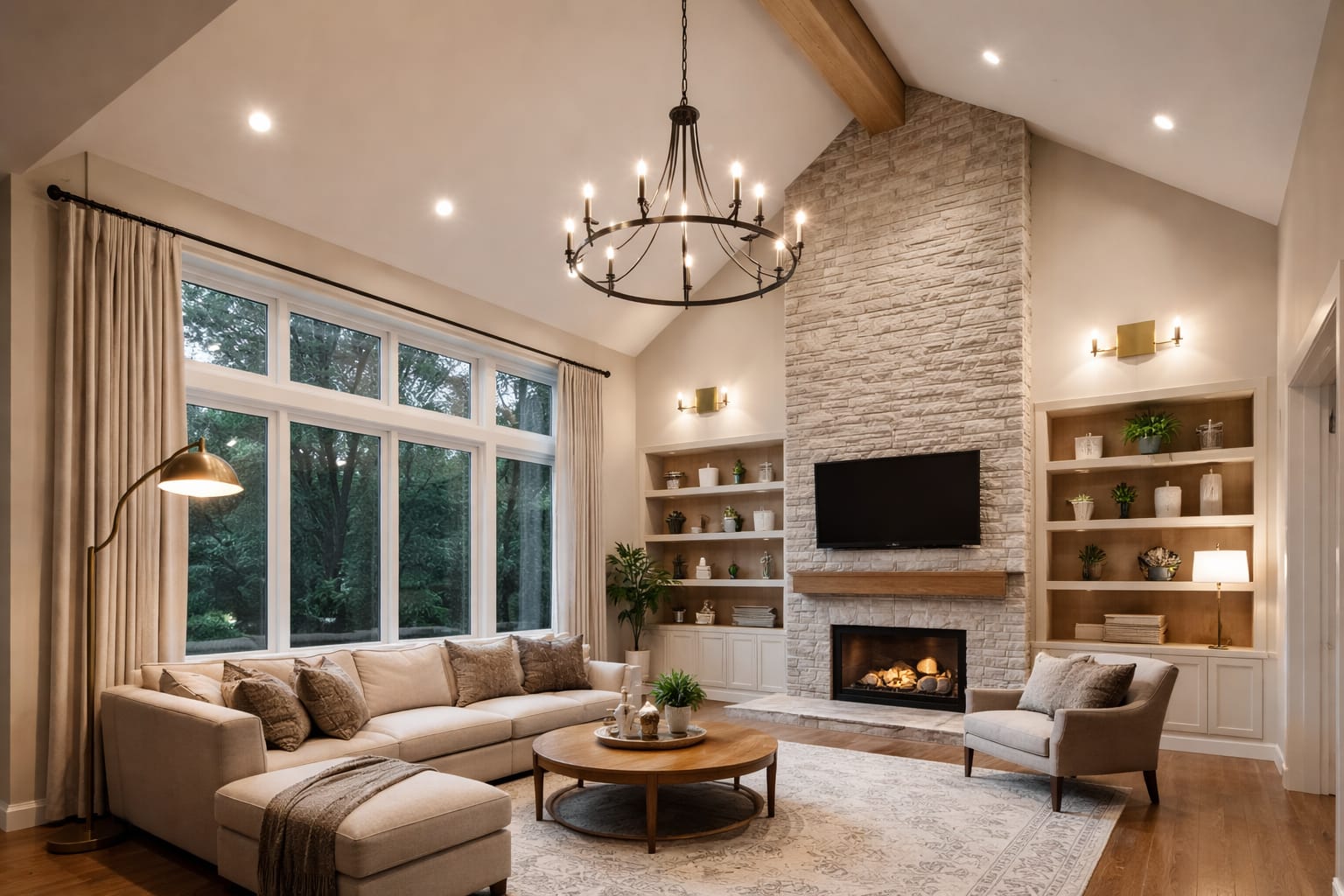
How Recessed Lighting Works in High-Ceiling Rooms
Recessed lighting is often the quiet workhorse in high-ceiling rooms. It gives you ambient coverage without adding visual weight, which makes it especially useful when a chandelier or pendant already carries the decorative role. In modern interiors, recessed lights often provide the lighting backbone that keeps the room practical.
Because the fixtures are farther from the floor, high ceilings often need higher-lumen recessed lights than standard rooms. Spacing may also need to be a bit tighter to avoid dark patches. The goal is not just to brighten the ceiling plane, but to create usable brightness where people sit, walk, and work.
Beam angle matters too. Narrower beams are often more effective in tall rooms because they concentrate more light downward. Wide flood beams can work, but they may waste output by spreading light too broadly across upper walls and ceiling areas.
If you are using recessed lights in a very tall room, check both lumen output and beam angle before you buy. A stronger bulb alone will not help much if the beam is too wide to deliver useful light at floor level.
When Adjustable Recessed Lights Make Sense
Adjustable or gimbal-style recessed lights add flexibility because they can aim at walls, art, shelving, or architectural details. In tall spaces, that is useful for making the room feel layered rather than simply top-lit. Wall washing can also reduce the empty feeling that some double-height rooms develop at night.
If the room already has plenty of brightness but still feels harsh, our guide on reducing lighting glare can help you fine-tune beam direction, fixture style, and placement choices.
Why Layered Lighting Works Better
The strongest high-ceiling rooms rarely rely on one type of light. A layered plan usually includes ambient light for overall brightness, task lighting for useful work zones, and accent lighting to add depth. That combination makes the room feel more finished and more comfortable at night.
In practice, that might mean recessed lighting for general coverage, a statement chandelier or pendant for visual focus, and floor lamps or table lamps closer to seating. Lower-level light sources matter because they pull the atmosphere down from the ceiling and make the room feel less cavernous.
Layering also makes it easier to adapt the room to different moods and uses. A bright daytime setting might depend more on ambient light, while evening use may feel better with dimmed overhead lighting and warmer pools of light closer to the furniture.
Why Separate Controls Matter
Different layers should ideally be controlled separately. That gives you the flexibility to brighten the whole room when needed or create a softer atmosphere without losing functionality. If you are deciding between bulb-level control and wall-level control, this guide to smart bulbs vs smart switches explains when each option makes more sense.
For compatible three-way circuits, a Kasa smart 3-way dimmer switch kit for layered lighting control can help manage chandeliers, pendants, and recessed lights more easily. It should only be considered if your setup matches the product requirements, including a neutral wire and 2.4GHz Wi-Fi compatibility.
The U.S. Department of Energy’s LED lighting guidance also highlights how efficient sources and better controls can improve both comfort and energy performance.
Getting Fixture Scale Right
Scale is one of the biggest reasons high-ceiling lighting succeeds or fails. A fixture can be stylish and well made, but still feel wrong if it is undersized for the room. Tall ceilings generally tolerate, and often require, larger diameters and greater fixture height than standard rooms do.
Basic room-size formulas are a useful starting point, but they are often too conservative once the ceiling height climbs well above 8 feet. In tall spaces, the fixture’s vertical presence matters almost as much as its width. Multi-tier chandeliers and substantial pendants often feel more natural than shallow, compact pieces.
The surrounding furniture matters too. A bold fixture looks more comfortable above large seating groups, long tables, or visually strong architectural features. In a lightly furnished room, the same fixture may feel heavier than intended.
Understanding Visual Weight
Visual weight is not only about inches and pounds. Open-frame designs, clear glass, and crystal can read lighter even when the fixture is large. Dark finishes, dense shades, and solid forms can make a fixture feel heavier and more dominant. That is not necessarily a problem, but it needs to suit the room.
If you want the room to feel warm rather than stark, fixture style should also work with the bulb choice. In many chandelier and pendant designs, choosing the right lamp shape and tone matters almost as much as choosing the fixture itself. Our guide to color temperature is useful here because warm and cool whites can change how a tall room feels at night.
How Acoustics and Architecture Affect the Feel of the Room
Large vertical rooms often feel more echo-prone and less cozy than standard-height interiors. Lighting will not fix acoustics on its own, but fixture scale and placement still influence how comfortable the room feels visually. In very open spaces, the lighting should work with beams, windows, and furnishings so the ceiling does not feel empty or disconnected from the rest of the room.
Installation and Safety Basics
Installation safety matters more in tall rooms because the fixtures are larger, heavier, and harder to access. A licensed electrician is usually the right choice for anything substantial, especially when the fixture needs extra bracing or long suspension hardware. Correct support is not optional with large suspended lights.
The ceiling box and mounting method need to match the actual weight of the fixture, not just the visual size. Heavy chandeliers may require dedicated support between joists or specialized hardware. This is one of the main reasons large decorative fixtures should not be treated like simple swap-in replacements.
Working at height is also a real risk. Tall ladders are often not enough for safe installation or service. In many cases, scaffolding or lift access is the safer option, especially for heavy fixtures or double-height entry spaces.
Regional Safety Requirements
Some regions require additional support or restraint for suspended fixtures, especially in areas with stricter structural or seismic codes. Even where it is not mandatory, added safety hardware can make sense for large fixtures installed high above the floor. Local code always takes priority over generic sizing advice.
How Much Brightness Do You Need?
Tall ceilings often need more lumens than standard rooms because the fixtures sit farther from the task plane and floor. A room that feels properly lit at 8 feet may feel noticeably dim at 14 feet if the same fixture output is used. That does not mean you should flood the room with harsh light, but it usually does mean planning more carefully for useful brightness.
As a rough guide, many living rooms need around 10 to 20 lumens per square foot under normal conditions. High ceilings can push the requirement higher, especially if the room has dark finishes or limited lower-level light sources. For a deeper breakdown of brightness terminology, the lumens vs watts guide can help you compare fixture output more accurately before buying.
Photometric data from manufacturers is helpful when you want a more accurate picture of how a fixture performs at greater mounting heights. It is one of the best ways to avoid buying a beautiful fixture that still leaves the room feeling underlit.
Do Not Overlook Color Rendering
Brightness is not the only thing that affects comfort. The Color Rendering Index matters too, especially in kitchens, dressing spaces, and rooms where finishes, artwork, or décor should look accurate. High-CRI lighting usually makes a room feel richer and less flat, even at similar brightness levels.
The ENERGY STAR guide to LED lighting basics also explains how color temperature and color rendering affect the way a room feels. In tall spaces, those choices can strongly influence whether the room reads as warm and inviting or cold and distant.
Plan for Cleaning and Maintenance
Maintenance should be part of the decision from the start, not an afterthought. Even long-life LED lighting still needs cleaning, occasional servicing, or replacement at some point. A fixture that looks perfect but is frustrating to maintain can become a long-term nuisance in a tall room.
Fixtures with accessible shades, modular components, or service-friendly bulb layouts usually make life easier. Integrated LED fixtures reduce bulb changes, but they should still come from reliable brands and make sense for the level of access the room requires.
If the room is extremely tall or the chandelier is complex, professional maintenance may be the most realistic approach. That is especially true in entry voids, stairwells, and rooms where safe ladder placement is difficult.
When Lowering Systems Are Worth Considering
Some homes use motorized or manual lowering systems that bring a chandelier down for cleaning and service. These are not necessary in every project, but they can be worth considering when the ceiling height is extreme or the fixture is too complex to access safely by hand.
Energy Efficiency in Tall Rooms
High-ceiling rooms often need more total light, but that does not mean they need to be inefficient. LED fixtures are the obvious starting point because they provide strong output with much lower energy use than older incandescent options. They also reduce maintenance frequency, which matters when access is difficult.
Dimming is especially valuable here because tall rooms do not always need their full designed brightness. A layered setup with dimmable circuits allows the room to feel bright and functional when needed, then softer and more efficient later in the day. That is often a better solution than trying to choose one fixed brightness level for everything.
Occupancy sensors can also help in large homes where tall entry spaces, lofts, or secondary living areas are easy to leave lit by mistake. The bigger the room and the higher the output, the more those control improvements can matter over time.
Using Daylight to Reduce Waste
Many high-ceiling rooms include large windows, clerestories, or skylights. That means daylight can do a lot of the work during bright hours if the lighting plan responds properly. Photocells, smart dimming, or manual scene control can keep the room balanced without wasting energy.
Window treatments matter too. Good shade control can reduce glare while still letting the room benefit from natural light. That often creates a better result than simply overpowering the space with more artificial light.
Smart Controls for Hard-to-Reach Fixtures
Smart controls are especially useful in rooms where fixtures are difficult to reach or where several light layers need to work together. App control, voice control, and programmable scenes make it much easier to manage a tall room without walking between several switches every time the mood or activity changes.
Scenes are particularly effective because they let you coordinate chandeliers, pendants, recessed lighting, and lower lamps in a single command. That makes a large room easier to live with and helps the lighting behave more like a complete system instead of a collection of separate fixtures.
Smart systems can also help you spot failures or outages more quickly, which is useful when checking the fixture directly takes extra effort. For broader technical reading, the LED Knowledge Center covers related setup and optimization topics across the site.
Useful Automation Features
Advanced automation can turn lights on before arrival, switch off unused zones, or adjust scenes by time of day. Those features are not essential for every room, but they can make high-ceiling spaces more convenient, more energy-efficient, and more consistent in everyday use.
What Is the Best Lighting for Your High Ceiling Room?
Most high-ceiling rooms work best with a layered mix rather than a single fixture. The right choice depends on whether you need a focal point, stronger ambient coverage, or better lighting over a specific zone.
- Chandeliers: best for entryways, dining rooms, and statement living spaces.
- Pendant lights: ideal over islands, stairwells, and defined seating or dining zones.
- Recessed lighting: best for clean ambient coverage and support lighting.
- Layered combinations: usually the strongest option when the room is large, tall, or open-plan.
High Ceiling Lighting FAQ
What Is the Best Lighting for High Ceilings?
The best lighting for high ceilings is usually a combination of a large chandelier or pendant, recessed lights for ambient coverage, and lower lamps or sconces for warmth. One fixture alone rarely gives enough comfort, scale, and usable brightness.
Are Recessed Lights Good for High Ceilings?
Yes, recessed lights can work well in high-ceiling rooms, but they need enough lumen output and the right beam angle. Narrower or better-controlled beams often perform better from high mounting points than very wide flood beams.
Should I Choose a Chandelier or Pendant Lights?
Choose a chandelier when you want a central statement piece in a foyer, dining room, or great room. Choose pendant lights when you need more focused lighting over an island, stairwell, table, or seating zone.
How Do You Make a High Ceiling Room Feel Cozy?
Bring some of the light closer to eye level with table lamps, floor lamps, sconces, or lower-hanging pendants. Warm color temperature, dimmers, and separate lighting zones also help a tall room feel less empty at night.
Key Takeaways
High-ceiling lighting works best when you treat the room as a full vertical composition instead of relying on one overhead fixture. Size, hanging height, lumen output, beam control, and layering all matter more once the ceiling is noticeably taller than normal.
In most rooms, the strongest result comes from combining a chandelier or pendant with recessed lighting and lower-level lamps. That approach improves usable brightness, makes the room feel less empty at night, and gives you more flexibility through dimmers and separate controls.
Before you buy, think beyond looks. Consider safe installation, long-term maintenance, and how the space will actually be used every day. A tall room can feel striking and comfortable at the same time when the lighting plan is built around real function as well as style.
Sharing This Guide
If you found this guide helpful, save it for later or share it with someone planning a room with tall ceilings. It is especially useful for homeowners, renovators, and anyone trying to make a double-height space feel brighter and more balanced.
Use the links below to share it.
Interested in learning more? Browse all related articles in our category section.